Searching an address and accepting the owner name on the assessor's website isn't ownership verification. A reliable U.S. property records search identifies the parcel, retrieves the recorded deed, and reconciles the people, entities, and documents attached to that property. The hard part isn't finding a result. It's proving that the result belongs to the right parcel and answers the question you're asking.
- For parcel and tax information: Start with the county assessor.
- For ownership and recorded claims: Inspect documents held by the recorder or clerk.
- For portfolio screening: Use standardized data, then investigate exceptions against official records.
Choose your source by the decision you need to make, not by whichever portal returns a name fastest.
Which Source Should You Search First?
There's no single federal database containing every U.S. property record, so identify the county holding the parcel and choose the office responsible for your question. The U.S. Census Bureau's administrative-record study found property-record systems across all 50 states and the District of Columbia, but local jurisdictions maintain different structures, definitions, and access rules.
Public sources and third-party datasets compared
| Source | What it holds | Search keys | Best for |
|---|---|---|---|
| County assessor portal | Parcel, assessed owner, legal description, tax status | Street address, APN, map location | Identifying the parcel and its tax data |
| County recorder or clerk index | Deeds, mortgages, releases, liens, judgments | Grantor or grantee name, recording date, document number | Tracing ownership and encumbrances |
| County GIS parcel viewer | Parcel boundaries drawn on a map | Map location, parcel number | Checking mapped boundaries and spotting splits or merges |
| Third-party dataset | Standardized fields across many counties, plus owner contacts and valuations | Address, APN, owner name, bulk lists | Screening many properties across several counties |
A dataset saves time when your input is a spreadsheet of addresses rather than a single disputed deed. Standardized fields let an analyst compare properties without translating every county's column names. They don't replace recorder images for chain-of-title work or establish that a search is legally complete.
A study comparing commercial property data with Cook County deeds found that, among sampled disagreements, the deed matched one commercial source 89.2% of the time and another 97.2%, while estimated county-record accuracy overall was 99.8%–99.9%. Those are different measures: disagreement samples aren't the same as all records. Timing and field definitions can produce an apparent conflict without demonstrating that either system contains a false transaction.
Keep valuation separate from ownership. If you also need a land estimate, Unitism®’s Compare land value estimators by address resource helps evaluate that separate task; an estimated value doesn't validate title.
Source-selection rule: Use each office for the question it administers. A convenient summary isn't a substitute for the underlying instrument.
- Identify the county: Confirm the property's jurisdiction.
- Search the assessor: Establish parcel identity.
- Search the recorder: Reconstruct recorded ownership.
- Verify before relying: Resolve conflicts and missing documents.
The deciding question is simple: Do you need the name on the tax roll, or the party holding legal title?
How Do You Search and Verify a Property Record Step by Step?
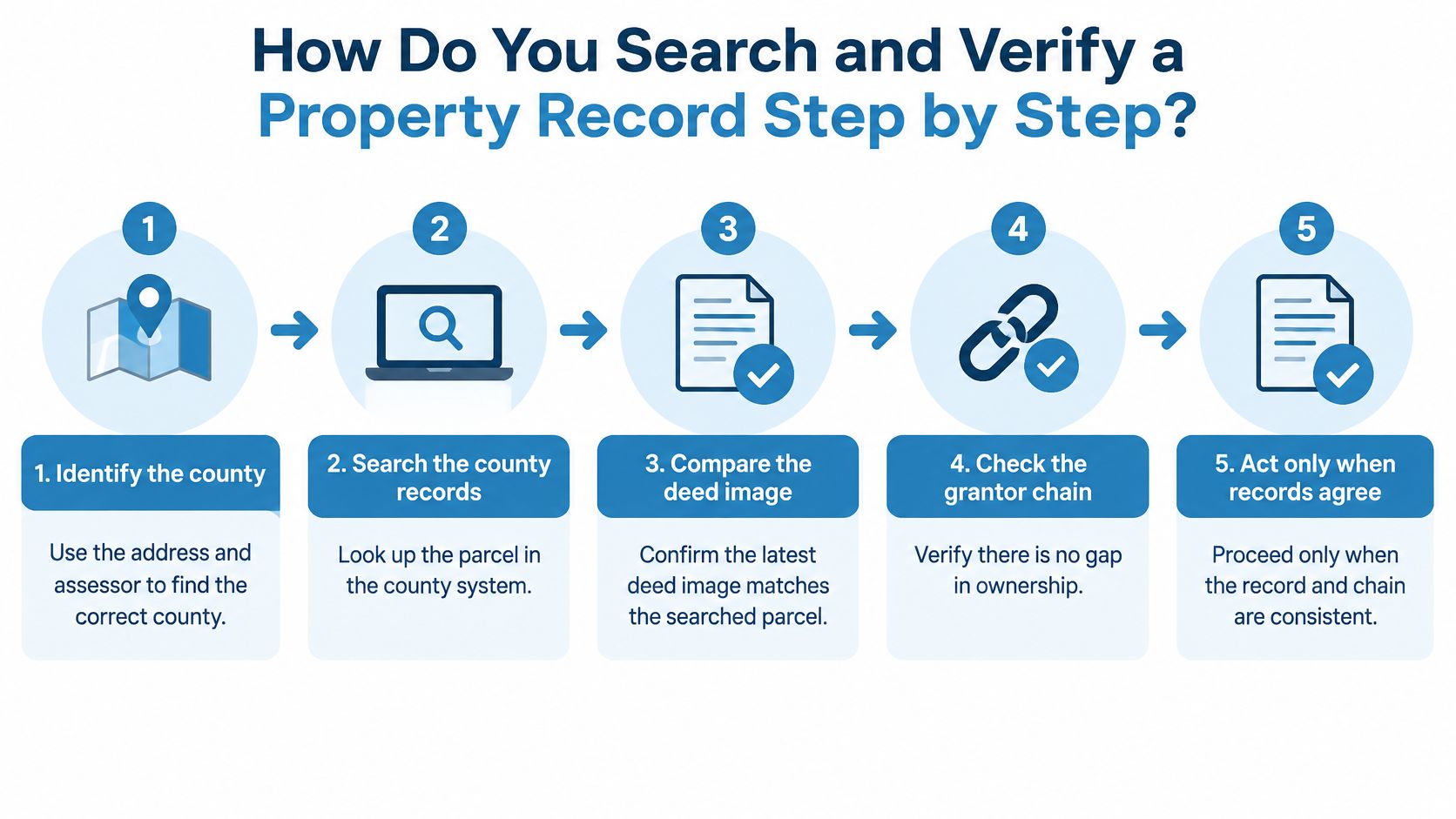
Treat ownership as provisionally verified only when the latest deed image matches the searched parcel and the grantor chain contains no unexplained gap. That's a working research standard, not a substitute for a professional title examination when a transaction depends on the result.
Ada County's property-record guidance supports starting with assessor information while recognizing that recorded transfers and assessor ownership updates aren't interchangeable. Use the assessor to locate the property, then use the recorder to investigate the instruments.
The verification sequence should remain visible while you work.
Search and retrieve
Start with jurisdiction and parcel identity before searching people's names.
Identify the county. Use the property address and an official assessor or parcel map to establish jurisdiction. Don't assume the postal city identifies the recording office. Confirm that the mapped parcel corresponds to the building or tract you intend to investigate.
Search the assessor by address, then APN. Capture the assessor's parcel number, assessed owner, legal description, tax status, and recorded-document reference. Remove directional abbreviations or unit formatting only as needed to accommodate the portal, while preserving the original address in your notes.
Search the recorder by party name. Search the identified owner as both grantor and grantee across an appropriate date range. Add document-type filters only after establishing how the index works. An APN-only query can miss instruments indexed under names or associated with an earlier parcel identifier.
Open the deed images. Work backward from the latest transfer. Compare each grantor with the preceding grantee, and inspect the legal description, vesting language, signatures, recording information, and transfer date. An index entry gives you a retrieval path; it doesn't expose every qualification written into the deed.
LendingXpress's guide to check county records for property owners provides a complementary ownership-checking reference. Keep your own search log rather than relying on a browser session that may expire.
Reconcile and document
Finish the search by resolving claims, discrepancies, and evidence gaps.
Search the encumbrance documents separately. Look for mortgages, assignments, releases, liens, and judgments against the relevant parties and property. Connect a release to the obligation it identifies. Don't classify a mortgage as satisfied merely because it's old, or as unpaid simply because a summary database still displays it.
Resolve ownership conflicts. When assessor ownership differs from the latest matching deed, use the recorded instrument as the working ownership answer and document the discrepancy. Check whether the grantee is a person, company, trust, or LLC before deciding that different names represent different owners.
Save a reproducible record. Preserve the search date, county, source office, document numbers, images, name variants, and unresolved issues. Mark each encumbrance open, released, or unresolved. If a document can't be retrieved, record that limitation rather than treating it as absent.
Our BatchData property records include the last sale, prior sale, full chain of title, and owner type, whether person, company, trust, or LLC. We also connect the owner's mailing address, phone, and email with the property's liens and pre-foreclosure stage. Use those consolidated details to organize research, then reconcile consequential ownership findings against recorder images.
A useful deliverable is a dated ownership chain with document references and an encumbrance list, not a screenshot containing an owner's name.
Escalate trusts, entity changes, common-name matches, quitclaim or estate transfers, and recent recordings when they leave material uncertainty. A title professional can determine the examination scope and investigate exceptions that a public portal doesn't resolve.
What Do the Fields in a Property Record Mean?
The assessor's owner field identifies a tax-roll entry, not a completed legal-title finding. Sonoma County's ownership guidance explicitly warns that the assessed owner isn't necessarily the legal owner and that updates can lag recorded transfers.
Read each field according to its purpose. A highly reliable document locator can still point to an instrument that doesn't establish the ownership interest you're investigating.
Property record fields and how far to trust them
| Field | Where it appears | What it tells you | Trust level |
|---|---|---|---|
| APN (assessor's parcel number) | Assessor record | Parcel key, which can change or be entered wrongly | Medium, pair with a second key |
| Assessed owner | Assessor record | Who the tax roll lists, potentially behind recorded transfers | Low for legal ownership |
| Legal description | Deed and assessor record | Lot, tract, or metes-and-bounds description | High when the correct parcel matches the deed |
| Recording date | Recorder index | When the instrument entered the public record | High for recording chronology |
| Document number | Recorder index | Pointer to the deed or lien image | High once the image is opened |
| Sale price | Deed or transfer record | Consideration as the county defines it | Medium, compare only within one county |
| Tax status | Assessor record | Whether taxes are current or delinquent | Medium, valid as of the update date |
| Owner mailing address | Assessor record or dataset | Where tax bills go, often not the property | Low as proof of ownership |
Identity fields and evidence fields
Identity fields help you locate the right property; evidence fields help you inspect what happened to it. For parcel-number formatting and interpretation, use the APN real estate guide, but preserve the county's original identifier alongside any normalized version.
The legal description is the strongest textual check that the instrument concerns your tract. It isn't permission to treat a GIS outline as a surveyed boundary. Conflicting descriptions require investigation rather than choosing whichever polygon looks plausible.
A recording date can differ from a signing date, so keep those events separate. Likewise, a document number proves nothing about the document's contents until you open the corresponding image.
Match provenance
A defensible match includes enough provenance for another researcher to reproduce it.
- Jurisdiction and office: Identify who maintains the record.
- Document number and indexing method: Explain exactly how you found it.
- Retrieval timestamp: Establish when you checked the source.
- Confidence status: Distinguish confirmed matches from provisional or unresolved ones.
- Original spelling: Retain recorded names alongside normalized search names.
Match confidence means confidence that the retrieved record belongs to the intended property or party. It doesn't mean the title is clear, marketable, or insurable.
Which Edge Cases Break a Property Records Search?
A clean search result doesn't prove that the online archive contains every relevant instrument. Recorded documents carry more weight for ownership than summary databases, but incomplete indexing can prevent you from finding those documents in the first place.
Check the document itself when an online summary leaves an identity question unresolved.
Identity exceptions
Search names as recorded, not merely as you expect them to appear.
| Failure point | Why the match breaks | Practical fix |
|---|---|---|
| Trust or LLC ownership | Title appears under a trustee or entity rather than an individual | Search the complete trust, trustee, and entity names alongside known individuals |
| Prior or maiden names | The index preserves the name used at recording | Search historical names across the relevant ownership period |
| Common names | Unrelated parties appear in the same results | Narrow by jurisdiction, middle initials, dates, and legal description |
| Estate or quitclaim transfer | Ownership changes without an ordinary sale entry | Read the grantor, grantee, and conveyed interest |
| Parcel split or merger | A historical document uses a retired APN | Follow legal descriptions, predecessor parcels, and split or merger documents |
| Multifamily or condominium units | A building address doesn't uniquely identify the interest | Check unit identifiers and the legal description |
Don't assume a missing sale price means a missing transfer. Disclosure rules create a separate interpretation problem, explained in the guide to non-disclosure states.
Archive and legal exceptions
Historical coverage must be established before a negative search means anything. Ohio's legislative materials reported that, as of May 2023, only 41 counties had digitized required recorder documents back to 1980. Ask the recording office which periods are searchable online, which images are available, and where earlier volumes or microfilm must be inspected.
Negative-result test: If you haven't established the archive's coverage and indexing rules, you've established only that your query returned nothing.
For an additional explanation of the topic, use the accompanying video.
A genuine title dispute requires more than increasingly elaborate searches. For a jurisdiction-specific legal reference, Olson & Sons' title dispute guidance for Kona landowners addresses quiet-title issues; it isn't a nationwide procedural template.
Stop treating the task as routine data matching when competing claims, conflicting descriptions, or missing conveyances remain. Preserve the evidence and obtain jurisdiction-appropriate legal or title assistance.
How Do APIs and Bulk Files Compare to Manual Lookups?
Choose an access method by how many properties you need and how often their records must refresh. Manual portals suit focused verification; APIs and bulk delivery suit repeatable processing, provided you preserve the underlying source and retrieval history.
Access methods for property records at different volumes
| Method | Best for | Refresh | Trade-off |
|---|---|---|---|
| County portal, manual search | A small parcel set and checking the official source | County's published update schedule | Slow, one county at a time |
| Assessor bulk download | Full county extracts for local analysis | County's extract schedule; verify separately from portal updates | Formats and fields differ by county |
| Third-party API, on demand | Per-address lookups inside an application | Unknown until the product's source-refresh policy is confirmed | Requires API authentication and rate-limit handling |
| Bulk flat files or cloud delivery, including S3 and Snowflake | Portfolio-wide analysis and model training | Unknown until the delivery schedule is confirmed | Requires a pipeline to load, normalize, and match |
Cuyahoga County's parcel portal says its parcel-transfer data are updated daily. That doesn't establish the refresh schedule of every field, bulk extract, or downstream vendor using county information.
Build an auditable pipeline
A scalable pipeline must preserve identity and provenance, not just return a successful response.
- Normalize addresses before matching: Standardize street components and retain unit identifiers rather than collapsing distinct units.
- Use county plus APN: An APN alone isn't a national identifier. Preserve leading zeros and punctuation in a source-value field.
- Store source and pull time: Keep retrieval timestamps separate from recording dates and source-update dates.
- Handle pagination and retries: Track page tokens, detect duplicate results, and log failed requests.
- Protect API credentials: Keep keys out of client-side code and use the provider's documented authentication method.
- Align refreshes with source changes: Pulling unchanged source data more often doesn't make it fresher.
The API versus bulk real estate delivery guide helps distinguish application lookups from warehouse-scale ingestion. The decision isn't which method downloads faster. It's which method fits your matching logic, change tracking, and exception queue.
For underwriting or portfolio monitoring, keep unresolved matches out of automatic decisions. Route changed APNs, conflicting owner identities, and missing source references to review rather than allowing a successful ingestion job to imply verified property identity.
What Does a Record Copy Cost and What Stays Private?
An online index may be free, but obtaining a document can cost money. Budget separately for index access, reference copies, and certified copies. Recorder fees are set by each office and are often charged per page. Confirm the current fee schedule, page count, and delivery options with the recorder before ordering.
Record copy costs by action
| Action | Example fee | Evidentiary value |
|---|---|---|
| View index entry online | Often free, though the copy may not be | Locator only, not a document copy |
| Unofficial copy download, San Diego County | San Diego's property-record page lists $2 for the first page and $0.05 for each additional page, with the displayed fee temporarily waived | Reference copy |
| Plain copy from a recorder | Set by the recorder, often charged per page | Copy of the recorded document |
| Certified copy from a recorder | Set by the recorder, often charged per page | Officially certified copy for transactions and filings |
| Name-index search | Set by the recorder | Index result only |
A long ownership history may require searching multiple names and periods, then ordering several documents. The latest deed alone may not show the full chain of title, so check the index and confirm the cost of each document before placing an order.
Public access and protected details
Public access does not mean every personal detail appears in a portal. The Bureau of Justice Assistance's discussion of public records describes public access to ownership and transaction information alongside protections for personally identifiable information.
A portal may show parcel characteristics and transfers while withholding or redacting personal details. A redaction does not, by itself, indicate a defective record or an undisclosed ownership interest.
Before relying on a figure or document:
- Check the disclaimer: Informational access may come without an accuracy guarantee.
- Check the update date: A current webpage can display an older underlying record.
- Check the required format: A downloaded image and a certified copy are not interchangeable.
- Check completeness: Certification authenticates the copy, not the completeness of your title investigation.
For a transaction or legal filing, order the certified copy required by the receiving institution or court. Certification does not replace confirming that you have identified the correct instrument.
BatchData brings property records, ownership history, liens, and owner contact details into a consolidated workflow for screening and research. Visit BatchData to explore property search and lookup options for an address list, then use county recorder documents to resolve ownership questions that matter to your decision.