






































SEO Title: LLC Property Ownership Guide for Real Estate Buyers
Meta Description: Learn how LLC property ownership affects title, taxes, liability, financing, records, and real estate due diligence.
Meta Keywords: LLC property ownership, LLC real estate, property title, LLC asset protection, real estate ownership records, LLC transfer
LLC property ownership is not the same as personal ownership with a different name on the paperwork. A U.S. federal housing review found that limited liability companies, limited liability partnerships, and limited partnerships owned 15.4% of rental properties but 40.4% of rental units nationwide, showing that entity ownership is concentrated in larger buildings rather than distributed evenly across small rentals. The Congressional Research Service report also found that these entities owned 67.8% of units in properties with 100 or more units.
The practical question is simple: when an LLC appears on the deed, who owns the building, who receives the economic benefit, and what can a lender, insurer, tenant, or analyst see? The answer requires separating four layers, legal title, membership interests, tax treatment, and property-record data.
- Title: The LLC is usually the record owner named on the deed.
- Economic ownership: Members own interests in the LLC under its operating agreement.
- Liability: Claims generally target the LLC, subject to guarantees, misconduct, and veil-piercing risks.
- Data: Public records may show an entity name without clearly identifying the people behind it.
The sections below connect those legal mechanics to financing, compliance, underwriting, and ownership research.
What LLC Property Ownership Means in 2026
LLC property ownership means that a limited liability company holds record title to real estate, while its members own interests in the company itself. The county recorder may list “Oak Street Rentals LLC” as the grantee, but that entry doesn't automatically identify every person who benefits from or controls the property.
That distinction matters because the deed answers one question, who owns the parcel as a legal matter, while the operating agreement and membership records answer another, who owns or controls the entity. The LLC can sign leases, enter contracts, borrow money, and receive rent in its own name. An individual member doesn't usually own the building directly merely because that person owns all or part of the LLC.
The structure can be small or highly complex. A single-family rental owned by an individual may show that person's name in county records. The same property transferred to a Wyoming LLC may show only the entity name in the ownership field, while the member's economic interest appears in private company records, lender files, tax documents, or beneficial-ownership reporting.
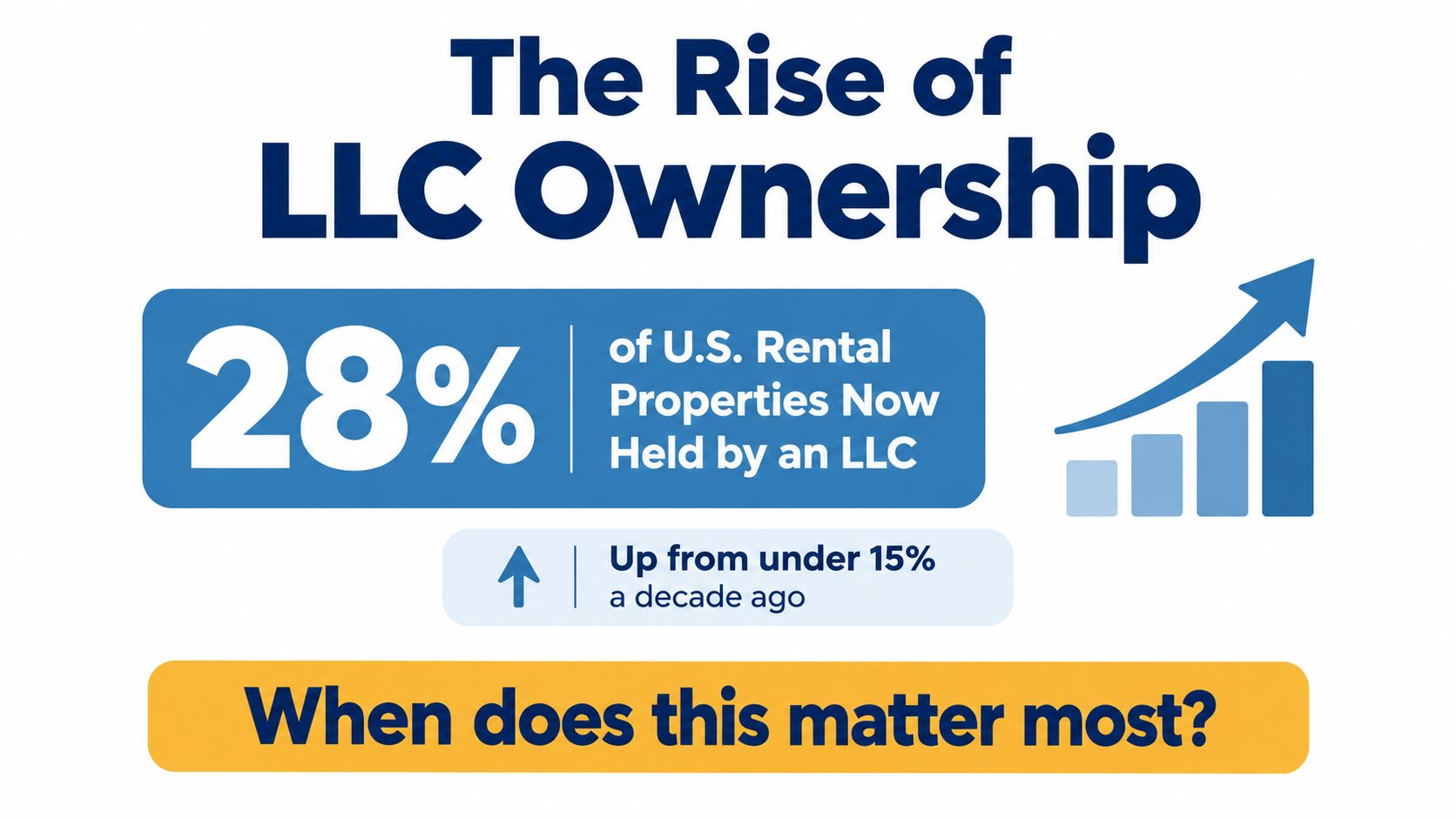
The 28% figure shown in the supplied graphic isn't supported by the verified data for this article, so it shouldn't be treated as a current national statistic. The verified national figures show a different and more useful pattern: entities held a larger share of rental units than rental properties, and their share was especially high in buildings with at least 100 units. That tells an analyst that entity ownership can signal scale and concentration, not merely a personal privacy preference.
Why the entity matters beyond the deed
Chicago illustrates how quickly this structure can become part of the rental market. The share of multifamily rental properties owned by LLCs rose from 3% in 2006 to 16% in 2022, while LLC ownership among apartment buildings with seven or more units rose from 9% to 34%. WBEZ's analysis of Chicago rental ownership provides the local context.
For a lender, the entity may change underwriting documents and guarantee requirements. For a tenant, it may change where notices and claims are directed. For a data team, the LLC name creates an entity-resolution problem, because one legal string may connect to multiple parcels and related companies.
Owners researching those connections can use a property owner history lookup to compare ownership names and property records, but the result still needs legal and jurisdictional verification.
How an LLC Holds Title vs How Owners Are Taxed
Title ownership and tax ownership are related, but they aren't the same layer. The deed records the LLC as the owner of the property, while the members hold ownership interests in the LLC and generally receive the economic results through the entity's tax structure.
A state creates the LLC under its business-entity law. The county recorder then records a deed naming that LLC as grantee. The operating agreement governs membership, voting rights, distributions, management authority, and transfer restrictions. In a default federal tax classification, a single-member domestic LLC is generally disregarded for federal income tax purposes, while a multi-member LLC is generally treated as a pass-through entity. The IRS Internal Revenue Manual explains these ownership and classification mechanics.
Consider an LLC that owns three duplexes and has two members. If one member owns 60% of the membership interests, that member generally has a 60% economic stake in the LLC's overall results, subject to the operating agreement. The member doesn't automatically own 60% of each duplex as a separate deeded interest, and can't necessarily sell or refinance one property alone.
| Layer | Who Holds It | Where It Appears | Default Federal Tax Treatment |
|---|---|---|---|
| Record title | The LLC | Recorded deed and county land records | The entity is the titled owner |
| Membership interest | The LLC members | Operating agreement and membership records | Economic rights follow the entity structure |
| Federal tax classification | The LLC or its members, depending on classification | Federal returns and schedules | Single-member LLCs are generally disregarded, while multi-member LLCs are generally pass-through entities |
| Control rights | The manager or members | Operating agreement and lender documents | Voting and authority depend on the governing agreement |
A tax classification election can change the default treatment, but it doesn't rewrite the deed by itself. The legal owner remains the entity named in the recorded instrument. Anyone considering a structure should compare the legal and tax layers with a guide to LLC versus trust tax structures in real estate, then obtain advice specific to the property, state, and ownership arrangement.
Asset Protection Benefits and Real Limits
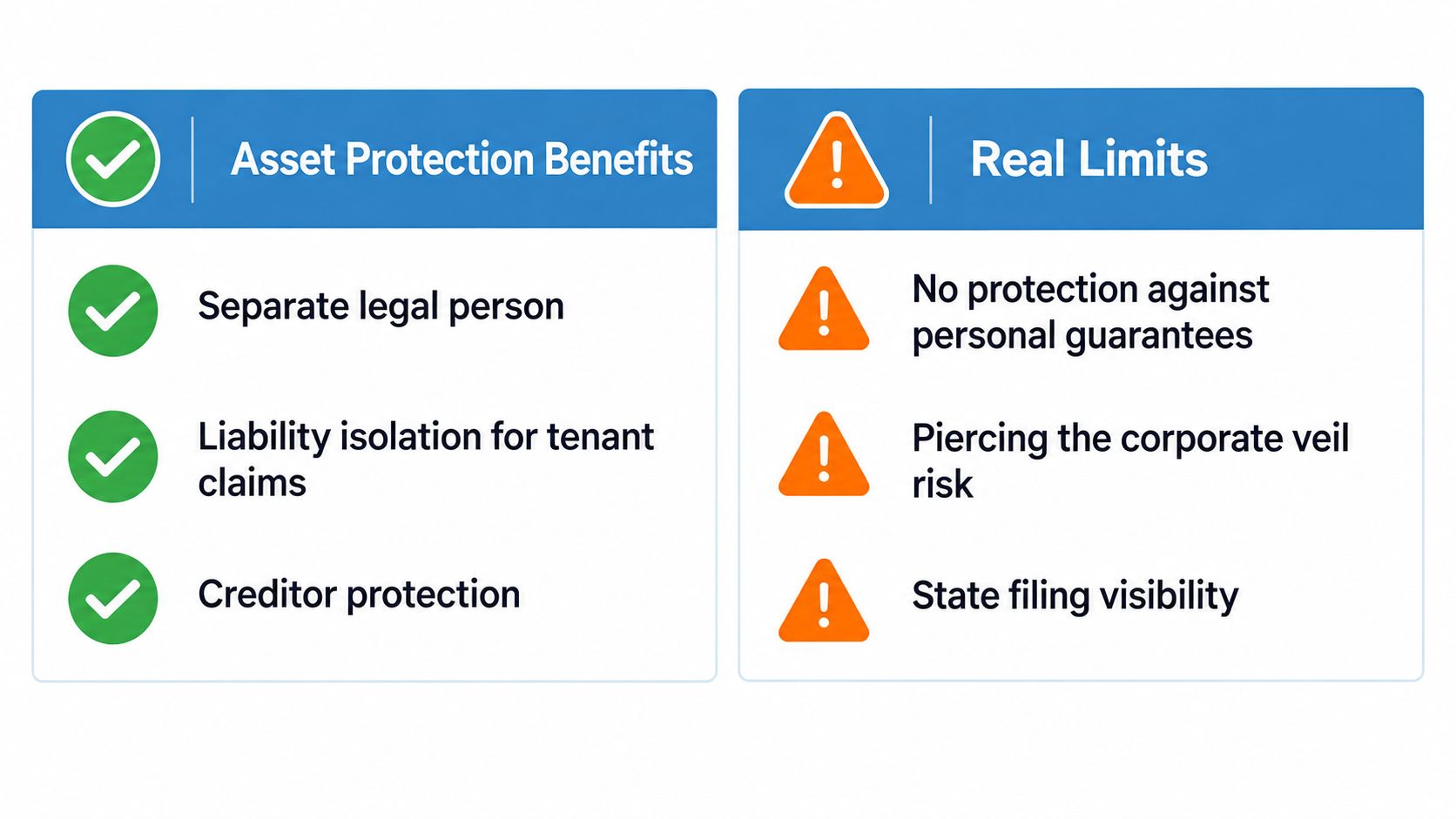
An LLC can separate property-level liabilities from the personal assets of its members, but it doesn't create an absolute shield. The LLC owns real estate and enters contracts, so a claim connected to that property will generally be brought against the company rather than directly against a member.
That separation can matter when a tenant alleges an injury, a contractor alleges nonpayment, or a vendor pursues a contract dispute. The claim may reach the LLC's property, cash, and insurance proceeds, while a properly maintained structure can make it harder to reach unrelated personal assets or assets held by another LLC.
What weakens the separation
The protection depends on conduct, documents, and the facts of the dispute. A member who personally guarantees a mortgage may remain personally liable for that debt even though the LLC owns the building. Mixing personal and company funds, using the LLC as a personal account, failing to maintain required records, or making fraudulent transfers can also support an argument that the entity is being misused.
A creditor's remedy against a member's LLC interest can also differ from a direct claim against the property. In many jurisdictions, charging-order rules restrict how a judgment creditor reaches distributions from the member's interest, but the exact remedy depends on state law and the governing facts.
Practical rule: Treat the LLC as an operating business, not as a label placed on a deed after a lawsuit begins.
The legal analysis of partition actions against LLCs illustrates why entity ownership, membership interests, and creditor rights must be analyzed separately. An LLC also won't protect against every category of exposure, including a member's own fraud, professional malpractice, tax claims, or obligations covered by a personal guarantee.
Federal protections for transfers to certain living trusts shouldn't be treated as a general permission to transfer mortgaged rental property into an LLC. A mortgage may allow the lender to accelerate the debt after an unauthorized transfer, and the protection analysis can differ for rental property, second homes, and larger multifamily buildings. Get written lender consent before recording a transfer.
Financing, Insurance, and Tax Consequences
Putting real estate in an LLC changes the documents that lenders, insurers, and tax professionals review. The deed, loan agreement, insurance policy, and tax return must describe the ownership structure consistently.
A mortgage lender may require the LLC to be the borrower, require a member to guarantee repayment, or approve an ownership transfer without replacing the existing borrower. A due-on-sale clause can allow the lender to demand repayment when title changes without consent. This risk is especially important when an owner deeds an already mortgaged property to an LLC.
Insurance also needs deliberate coordination. The property policy should identify the LLC correctly, and the liability limits should reflect the rental activity, building use, and any umbrella coverage. A policy that lists only an individual can create a mismatch when the recorded owner is an entity.
Federal tax treatment follows the LLC's classification rather than the appearance of the deed. A single-member domestic LLC is generally reported through the owner's return in the default case, while a multi-member LLC generally uses pass-through reporting. Rental income, expenses, depreciation, financing, and distributions require records that match the operating agreement and ownership percentages.
| Factor | Personal Ownership | LLC Ownership |
|---|---|---|
| Deed | Individual appears as record owner | LLC appears as record owner |
| Loan approval | Borrower is typically the individual | Lender may require entity underwriting and a personal guarantee |
| Insurance | Policy names the individual owner | Policy should identify the LLC and rental activity |
| Liability analysis | Personal assets are more directly connected to ownership | Entity separation may isolate property-level claims, subject to exceptions |
| Tax reporting | Individual reports rental activity directly | Treatment depends on single-member, multi-member, or elected classification |
| Transfer process | No entity conveyance is needed | Deed, lender consent, title, insurance, and tax records may need updating |
State and local taxes can also apply when property is transferred. The exact result depends on the jurisdiction, the property's use, the consideration, the debt, and the ownership change. For a focused discussion of how tax recourse interacts with LLC structures, review the INTELLI guide on tax recourse LLC. A title insurance policy guide can also help first-time buyers understand why the insured owner must match the ownership shown in the title documents.
Setting Up and Transferring Property into an LLC
Transferring property into an LLC usually requires a new deed, lender review, insurance updates, and careful recording. The transfer isn't complete merely because the owner signs an operating agreement or opens a business bank account.
Form the entity. Create the LLC and confirm that it can hold property in the state where the real estate sits. The formation state and the recording jurisdiction may create different filing and qualification requirements.
Obtain an EIN. Banks, insurers, and other counterparties may request the LLC's federal employer identification number, including when the entity has one member.
Prepare the deed. Use the legally correct deed for the jurisdiction, such as a quitclaim or warranty deed, and copy the legal description from the current recorded deed. The mailing address alone isn't enough to identify the parcel.
Record the conveyance. Sign and notarize the deed as required, submit it to the county recorder, and address any required recording documents or transfer taxes. The LLC becomes the record owner after the conveyance is properly recorded.
Update the operating records. Notify the lender, update hazard and liability coverage, amend leases and management agreements, and keep income and expenses separate from personal funds.
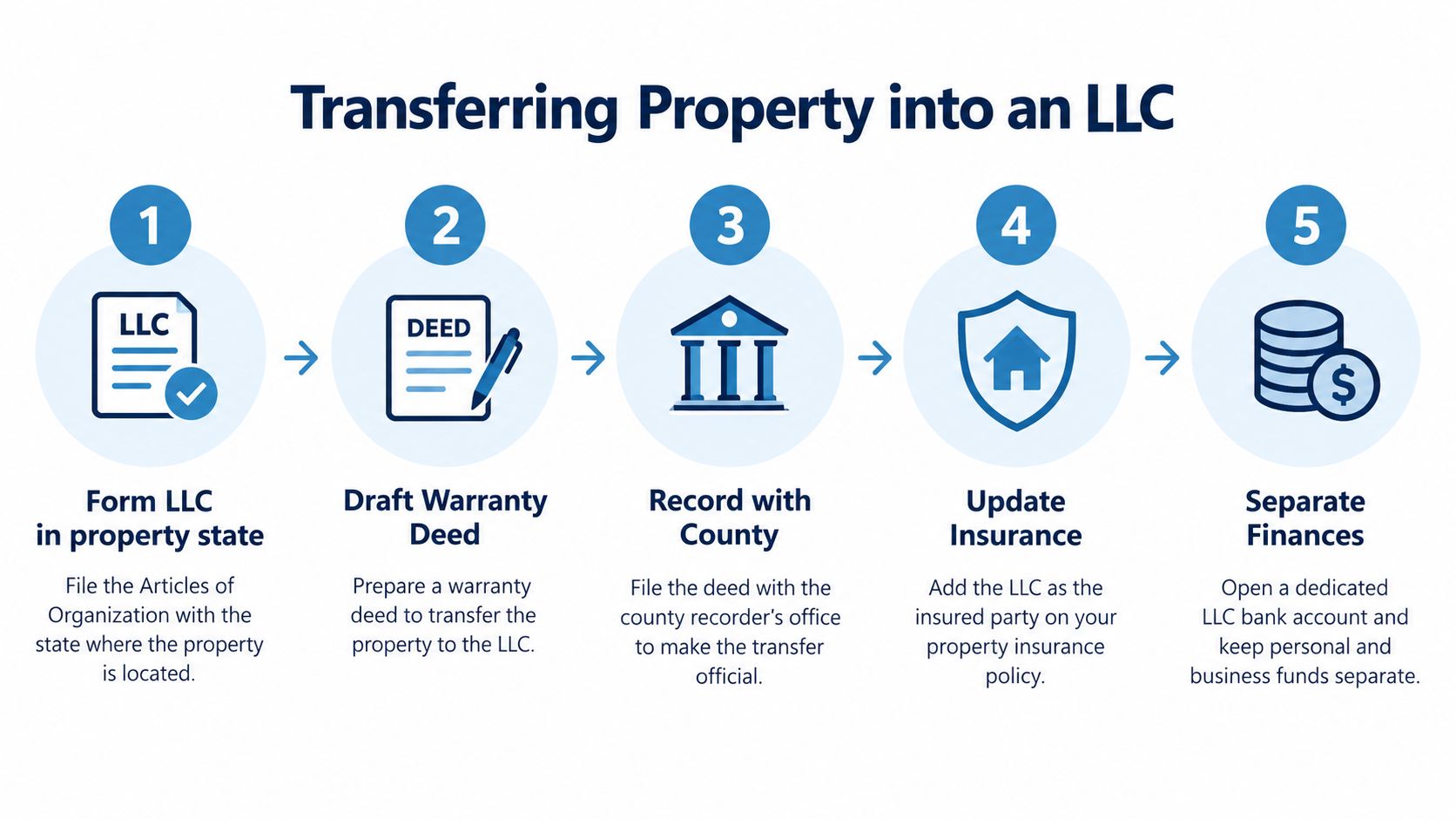
The legal guide to transferring property to an LLC explains that a recorded deed generally makes the LLC the owner and that a routine conveyance isn't automatically the same as a taxable sale for federal capital-gains purposes. State rules, debt, consideration, and the owner's facts can change that analysis.
Transfer checklist
- Operating agreement: Confirm that the agreement authorizes ownership and management of the property.
- Recorded deed: Obtain the recorder's confirmation and verify the legal description.
- Lender consent: Keep written approval or a documented waiver before transferring mortgaged property.
- Insurance: Reissue or endorse coverage so the LLC is properly identified.
- Title policy: Ask the title company how coverage should be updated after the conveyance.
- Financial controls: Use an LLC account for rent, repairs, taxes, insurance, and debt service.
A video walkthrough can provide a visual overview of the transfer sequence:
How LLC Ownership Shows Up in Property Data
County property records usually show the LLC as the owner of record, not the human member behind it. The parcel's assessor record can still contain the APN, situs address, assessed value, taxes, and building characteristics, but the ownership field may contain only a string such as “1234 Main Street Holdings LLC.”
That creates a data task called entity resolution. An analyst must determine whether several differently named LLCs connect to one person, management company, registered agent, or portfolio. A single LLC may own one rental, while related entities may divide a larger portfolio across multiple deeds.
The ownership pattern has practical consequences:
| Data Layer | What It Shows | What It Hides |
|---|---|---|
| Assessor record | Parcel ID, situs address, assessed value, and owner name | The full membership and control structure |
| Recorder document | Deed parties, legal description, and transfer history | Private agreements and the complete economic relationship |
| Business registry | Entity status, formation details, and registered agent | The full property portfolio and informal control |
| Loan and insurance file | Borrower, guarantor, insured party, and coverage terms | Ownership interests not supplied to the counterparty |
| Resolved portfolio dataset | Connections among entities, parcels, and people | Relationships that cannot be verified from available records |
This matters to three teams. Marketing teams can waste outreach on a tenant or an outdated owner if they treat every entity string as a complete contact record. Underwriters can miss portfolio concentration if they evaluate each LLC as an unrelated one-off owner. Appraisers and analysts need to inspect entity transfers carefully because the recorded buyer or seller may not reveal the complete transaction context.
The scale makes this more than a niche workflow. Entity types owned 40.4% of U.S. rental units, and they owned 67.8% of units in properties with 100 or more units, according to the federal housing review cited earlier. The correct response isn't to assume every LLC is institutional. It's to resolve the entity, compare related parcels, and document the confidence level of the ownership connection.
Common Misconceptions and Best Practices
An LLC can improve ownership separation without making the owner invisible or automatically protected. County records may still display the LLC name, the deed remains a public ownership document in the recording system, and lenders, insurers, tax authorities, and counterparties may hold additional information.
The privacy assumption is particularly weak when several properties use related entity names, addresses, managers, or registered agents. Rutgers' Hidden Hands research found that LLC use surged after the 2008 housing crisis, that 27% to 39% of LLCs owned more than one property in some neighborhoods, and that one identified individual controlled 512 properties in one city. The Rutgers report shows why counting LLCs can understate the concentration of control.
Myth and practice
| Misconception | More accurate rule |
|---|---|
| An LLC guarantees total privacy | The entity name can appear in county records, and ownership may be mapped through other filings and documents |
| One LLC should hold every property | Separate structures may reduce cross-property exposure, but the right design depends on cost, financing, management, and state law |
| A deed transfer is only paperwork | A transfer can affect lender rights, title coverage, insurance, taxes, leases, and public records |
| Beneficial ownership reporting is irrelevant to real estate | Ownership and control information may require careful mapping, especially through layered entities |
| A trust transfer rule automatically covers an LLC transfer | Federal protections and lender clauses must be analyzed for the specific property and loan |
FinCEN's framework treats beneficial owners as natural persons who exercise substantial control or own or control at least 25% of ownership interests. The OpenCorporates discussion of corporate property ownership describes the continuing tension between disclosure requirements and the use of LLCs or privacy trusts in real estate. The compliance environment can shift, so owners should verify current filing requirements rather than rely on an old checklist.
Use these habits to preserve the structure's value:
- Separate accounts: Pay property expenses and receive rent through the LLC's account.
- Document authority: Keep the operating agreement, resolutions, deeds, leases, and guarantees together.
- Request consent: Ask the lender before transferring any mortgaged property.
- Review coverage: Confirm that the LLC, property manager, and relevant activities are properly insured.
- Track ownership: Reconcile deeds, entity records, membership interests, and beneficial-ownership obligations.
- Monitor the portfolio: Review related entities and parcels when underwriting, refinancing, or assessing concentration risk.
Your next action is to compare the deed, loan, insurance policy, operating agreement, and ownership records before changing title.
BatchData provides property records, ownership history, entity unmasking, skip tracing, valuations, mortgage and lien details, and portfolio monitoring data that can help teams connect LLC-held parcels with verified owner contacts. Visit BatchData to evaluate the ownership and property-data workflows that fit your acquisition, underwriting, or monitoring process.