






































A complete property owner history lookup rarely comes from one database. Reliable results require a pipeline that combines recorder deeds, assessor rolls, tax records, liens, parcel geometry, and identity-resolution signals.
A deed establishes the recorded transfer. An assessor roll may still show the previous owner. An LLC can conceal the people exercising effective control. A national property dataset can accelerate discovery, but it can't replace the local record that legally documents a transfer.
The practical takeaways are:
- Use the recorder or land registry first for legal ownership changes.
- Cross-check assessor and tax records to expose update lags and mailing-status differences.
- Resolve APNs, names, LLCs, and trusts across sources instead of matching addresses alone.
- Choose real-time APIs or bulk delivery based on query latency, portfolio size, and freshness requirements.
- Monitor ownership continuously because title, liens, court filings, and tax records can change independently.
The popular advice to “just search the county records” is directionally correct for a one-off investigation, but it breaks down when a proptech platform must resolve thousands of properties consistently. The engineering problem is record reconciliation, not simple retrieval.
Why Single-Source Property Owner History Lookup Fails
A single public file doesn't contain a complete ownership history. A price-paid dataset may describe a transaction without naming the current title holder. A tax roll may identify the owner used for assessment or mailing purposes while lagging behind a recently recorded deed. A corporate registry may confirm a current company proprietor without showing the property's historical transfers.
That distinction matters because legal title and effective control aren't always the same thing. The deed identifies the recorded grantor and grantee, but the grantee may be an LLC, trust, estate, nominee, or entity connected to other properties. A name on an assessor file may be operationally useful, but it isn't automatically proof of the latest legal transfer.
HM Land Registry illustrates why the source choice matters. It has maintained the definitive legal ownership record in England and Wales for more than 160 years, and its register contains more than 27 million land and property titles covering over 90% of the land area. The government also says records exist for most property or land sold since 1993, with historical searches available by date for registered properties. Those figures come from HM Land Registry's annual report.
The false completeness problem
Developers usually encounter four failure modes:
- Recent-transfer gaps: The recorder has a new deed, but the assessor still displays the prior owner.
- Historical truncation: A digital search begins at the point where a vendor digitized records, not when the property was first transferred.
- Entity masking: The legal grantee is an LLC or trust, so an address search returns no individual decision-maker.
- Dataset mismatch: A transaction file contains sale information but omits title identifiers or individual owners.
HM Land Registry's public-data documentation warns that some datasets include property and transaction information without the individuals who own the title or the title ID. OpenOwnership's UK register is updated monthly, but it provides current corporate proprietors and doesn't include historical ownership. The ODI analysis of UK land registers therefore supports a two-layer design, current-title confirmation plus historical title or deed review.
Engineering rule: Treat every ownership record as a claim with a source, effective date, recording date, and confidence level. Never treat a convenient row as the entire chain of title.
An API pipeline stores source provenance rather than flattening every result into one owner field. It should preserve the original grantor, grantee, instrument type, recording date, parcel identifier, document reference, and source jurisdiction. That structure lets underwriting, servicing, and marketing teams distinguish a recorded transfer from a stale tax representation.
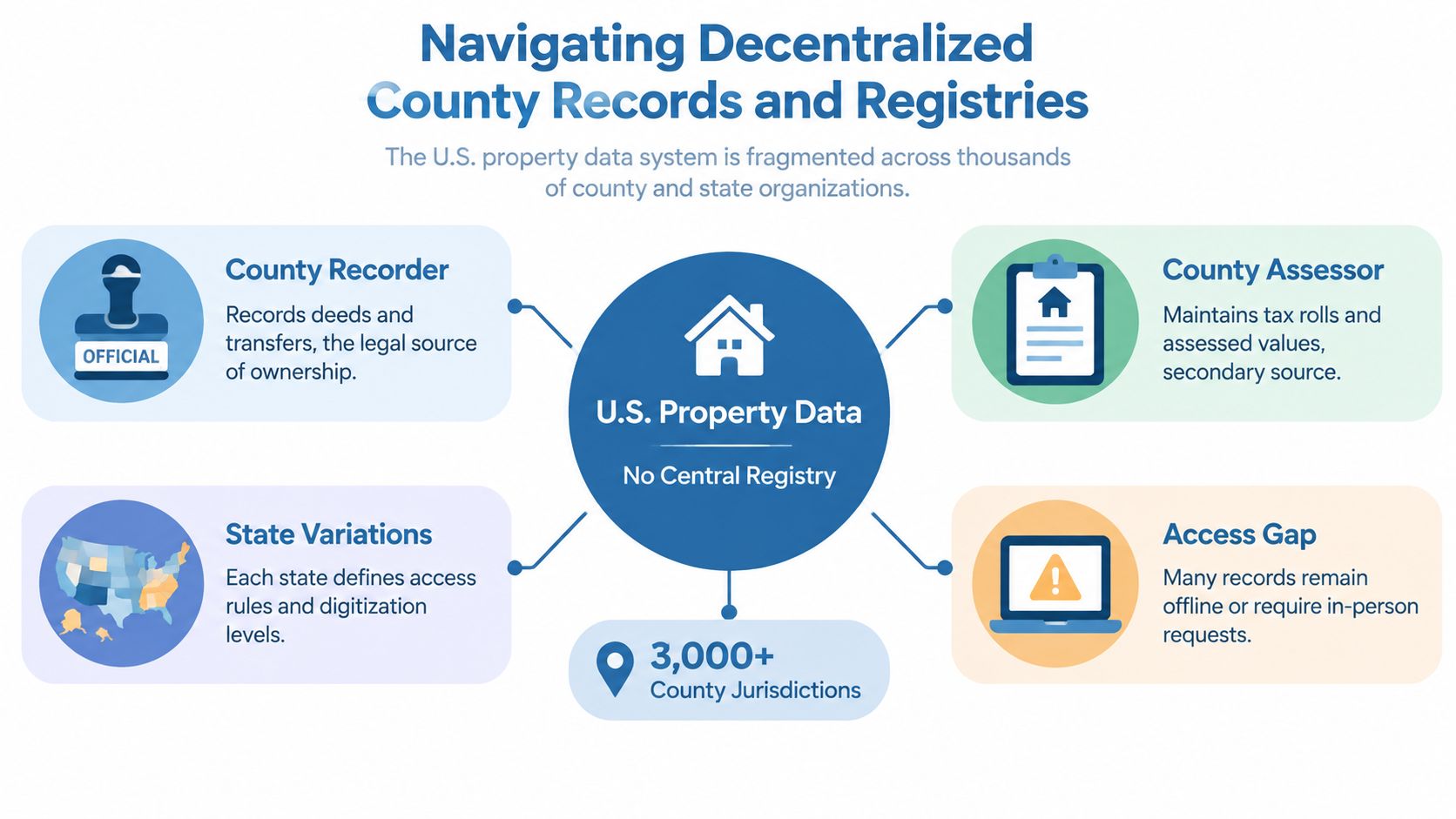
Navigating Decentralized County Records and Registries
A property owner history lookup cannot query one authoritative national file because the United States has no federal property registry. Counties generally maintain deeds, tax assessments, liens, and related land records locally. A national system therefore has to aggregate jurisdictions, reconcile their identifiers, and preserve each source's limits. An industry reference describes county records covering 158M+ properties, illustrating the scale of this fragmented model, as documented by SearchSystems' U.S. property records overview.
England and Wales provide a contrasting structure through HM Land Registry's centralized legal register. In the United States, one property may appear in a recorder index, assessor roll, tax collector file, court docket, mortgage record, lien index, and GIS layer. Each source can use different parcel identifiers, update schedules, access methods, and document conventions. That variation is why an API pipeline needs jurisdiction-specific adapters rather than a single national matching rule.
Barnstable County illustrates the depth of some local archives. Its Registry of Deeds says real-property ownership history reaches back more than three centuries, with property records beginning in 1742 and Land Court records beginning in 1898. An API may return a normalized record quickly, while older ownership still requires document-by-document tracing through predecessor deeds. The dates and archive scope are documented by the Barnstable County Registry of Deeds.
Why aggregation isn't the same as authority
National databases work well as discovery layers. They can normalize addresses, expose candidate parcel identifiers, and make cross-county searches practical. They do not replace validation against the county recorder, register of deeds, clerk, or other official land-record custodian.
A reliable aggregator should apply jurisdiction-aware logic:
- Resolve the address to a parcel candidate. Normalize street suffixes, unit formats, city names, and ZIP or postal fields.
- Select the county source. The responsible office may be a recorder, register of deeds, clerk, or land records department.
- Match by APN and document references. Address-only matching is fragile because addresses change, while parcel identifiers often persist.
- Compare event dates. Keep execution, recording, assessment, and tax-roll dates separate.
- Retain unresolved conflicts. A mismatch should enter a review state, not overwrite an existing value.
The property history research guide provides background for documenting this local-record workflow. A video can also help nontechnical stakeholders understand why a national result is not automatically a complete title history.
Access rules create another operational constraint. Some counties provide searchable indexes and downloadable documents. Others charge for copies, restrict bulk access, or require direct requests. One published county fee schedule lists $26 per instrument, a $4 state fee where applicable, a $15 address-search charge, $2 per-page copies, and a $10 certification fee, according to U.S. Title Records' deed-search explanation. A platform that ignores these rules will produce stale records, incomplete coverage, or compliance risk.
Sequencing Data Sources for Accurate Title Timelines
The correct sequence starts with the official recorder deed, then uses assessor, tax, lien, and GIS data to validate the interpretation. Deeds establish the transfer history. Assessor files help confirm parcel and tax-mailing status, but they may lag after a sale. Tax collector records add delinquency and exemption signals, while mortgage and lien records expose obligations that can affect control.
A practical validation sequence
Start with the recorder. Retrieve the latest deed and prior instruments connected to the parcel. Capture grantor, grantee, execution date, recording date, deed type, consideration when published, document number, and legal description. A property owner history lookup that omits the document reference can't be audited efficiently.
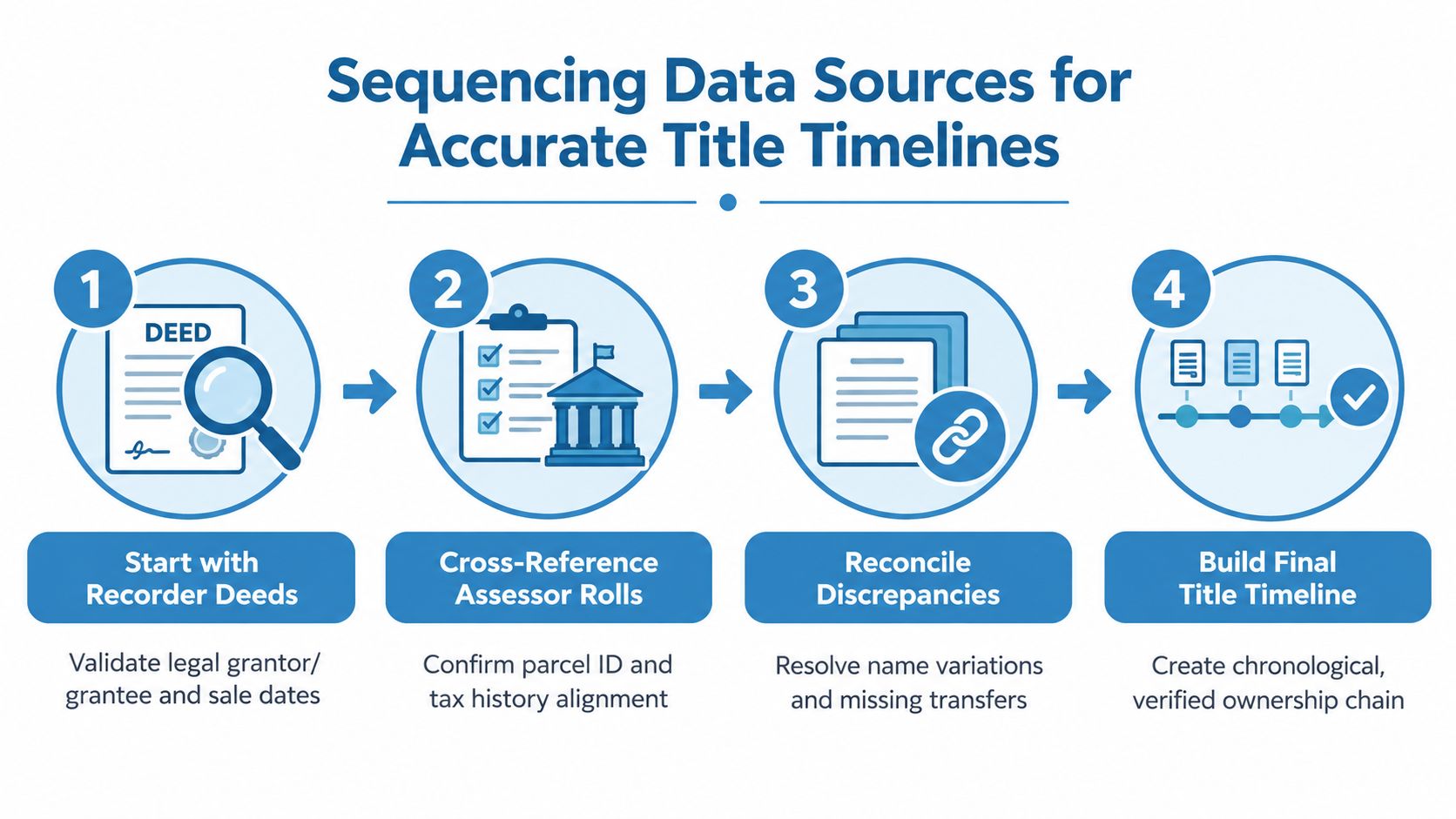
Cross-reference the assessor roll. Compare the recorded grantee with the tax-roll owner, mailing address, parcel number, assessed property, and change-of-ownership indicators. If the names differ, don't immediately label the deed invalid. The discrepancy may reflect a normal update lag, a tax-mailing arrangement, an estate, or an entity structure.
Validate taxes, liens, and mortgages. Current delinquency, exemptions, deeds of trust, reconveyances, judgments, and other recorded encumbrances belong in the same timeline, but they shouldn't be confused with ownership transfers. A mortgage affects title risk and control economics. It doesn't by itself establish a new owner.
Use GIS and plats to resolve parcel ambiguity. Address-to-APN matching breaks when a property has multiple units, a renamed street, merged parcels, subdivided lots, or a mailing address that differs from the situs address. Geometry, subdivision maps, legal descriptions, and neighboring parcel relationships can confirm whether two records refer to the same land.
The workflow is consistent with the guidance in HM Land Registry's public-data documentation, which emphasizes that public data can be accurate for recorded instruments yet unsuitable for a particular downstream decision without validation.
Store conflicts instead of hiding them
A production schema should include separate fields for recorded_owner, assessor_owner, tax_mailing_owner, effective_date, recording_date, source_timestamp, and confidence. Keep a discrepancy object that explains why values differ. That approach prevents a later consumer from assuming the latest row is automatically authoritative.
For consumer-facing transactions, the same discipline supports title insurance for homebuyers, because a title review must distinguish searchable public evidence from legally insured protection. For data teams, the benefits of enriched ownership history data provide useful context on why normalized history and enrichment are separate layers rather than interchangeable records.
Resolving Identity and Piercing the LLC Veil
An LLC name identifies a legal owner, but often does not identify the person a workflow needs to reach. Resolving that relationship requires matching deeds, business registrations, mailing addresses, mortgages, related parcels, contact records, and, in some cases, court or probate documents. The result should be a confidence-scored relationship with traceable evidence, not an unsupported claim that an individual owns the property.
Keep two facts separate throughout the pipeline:
- Title identity: The person or entity named in the recorded instrument.
- Control hypothesis: The person or organization connected through management, mailing, financing, or related ownership signals.
These roles can overlap without being equivalent. A trust may list trustees and beneficiaries with different responsibilities. An LLC organizer may not be its current manager. A deceased owner may have a transfer path through an estate, beneficiary deed, probate filing, or successor entity. Legal interpretation belongs with qualified counsel, such as the Law Office of Bryan Fagan PLLC, not with an automated match score.
Ownership Resolution Data Signals
| Data Signal | Primary Use Case | Reliability for History |
|---|---|---|
| Recorded deed | Establish grantor, grantee, instrument, and transfer event | High for the recorded transaction |
| Assessor roll | Compare tax ownership, parcel identity, and mailing status | Moderate, because updates can lag |
| Entity registration | Connect an LLC to registered business details | Limited for property chronology |
| Mortgage or lien record | Identify encumbrances and related parties | High for the recorded instrument, not ownership alone |
| Contact enrichment | Reach a possible decision-maker linked to an entity | Variable, and not proof of title |
A reliable matching model requires support from multiple fields. Normalize legal suffixes, punctuation, spacing, and entity aliases before comparing records. Check registered addresses, tax mailing addresses, signer names, phone numbers, email addresses, related parcels, and document chronology. Assign confidence from independent corroboration, source quality, and recency. A stale assessor roll should weaken a match, not override a newer recorded instrument.
Why name matching alone fails
Exact string matching misses variations such as “ABC Holdings LLC” and “ABC Holdings, L.L.C.” It can also join unrelated entities that share a common name. Address matching creates similar errors because a registered office, tax mailing address, and property situs address serve different purposes.
An entity graph should store:
- Canonical entity: normalized legal name and jurisdiction.
- Aliases: historical names and formatting variants.
- Relationships: manager, signer, registered agent, trustee, beneficiary, lender, or related property owner.
- Evidence: source document, date, field match, and confidence.
- Restrictions: signals that must not be exposed as verified ownership.
Skip tracing and contact enrichment can produce an outreach candidate connected to a corporate record. They should not rewrite the deed. Downstream users need that distinction, particularly when marketing teams may treat a contact as the decision-maker.
BatchData's identity resolution API fits workflows that must connect fragmented names and contact signals. Configure the response to include both the normalized identity and its supporting evidence. Users can then review a weak match, separate an LLC control hypothesis from title identity, and investigate conflicting records instead of accepting a black-box owner field.
Choosing Between Real-Time API and Bulk Data Delivery
Real-time APIs fit interactive searches. Bulk delivery fits portfolio analysis, historical model training, and repeated monitoring. The right architecture depends on whether the system needs one fresh answer now or a large, versioned dataset that can be processed repeatedly.
| Requirement | Real-Time API | Bulk Delivery |
|---|---|---|
| User experience | Immediate property or owner search | Search after ingestion and indexing |
| Best fit | Consumer portals, underwriting screens, agent tools | Portfolio surveillance, analytics, model training |
| Freshness strategy | Query-time retrieval or provider updates | Scheduled snapshots and incremental loads |
| Engineering burden | Authentication, retries, rate limits, response normalization | Storage, schema evolution, deduplication, backfills |
| Cost model | Request volume and enrichment usage | Storage, transfer, compute, and pipeline operations |
| Auditability | Log request, response, and source timestamp | Preserve raw files, versions, and transformation lineage |
A real-time integration should use idempotent request keys, bounded retries, response caching where permitted, and explicit handling for no-match, multiple-match, and conflict states. It should never turn an API timeout into “no owner found.” That distinction is operationally important because a transient failure and a genuine missing record have different remediation paths.
Bulk ingestion needs a different discipline. Store raw source files before transformation, partition by jurisdiction or update period, and preserve prior versions so a changed owner isn't mistaken for a corrected historical record. A warehouse such as Snowflake can support repeated joins across parcels, deeds, liens, and contacts. S3-style object storage can hold raw documents and normalized extracts for later replay.
Match architecture matters more than transport
Whether data arrives through an API or a file, the matching sequence should remain consistent:
- Normalize the input address and parcel identifiers.
- Generate candidate records using APN, address, owner, and legal-description signals.
- Score candidates with field-level evidence.
- Apply jurisdiction-specific rules.
- Return the match, alternatives, source dates, and conflicts.
- Log the decision for audit and reprocessing.
A hybrid model is often practical. Use an API for live searches and exception handling, then bulk-load frequently accessed markets or portfolio records. BatchData offers ownership history, owner contacts, property attributes, mortgage and lien details, and delivery through low-latency APIs or bulk formats such as S3 and Snowflake. The useful evaluation criteria are coverage, source recency, matching transparency, rate limits, export controls, and lineage, not a generic claim of completeness.
Historical depth also varies by source. One deed-search service describes histories going back up to 30 years, while another public-record system says it scans 350M+ property records across all 50 states. Those figures appear in PropertyChecker's deed-search information and should be read as vendor-specific coverage descriptions, not proof that every parcel has the same timeline.
Building Continuous Ownership Verification Workflows
Ownership history should be monitored, not searched once and archived. A static result becomes unreliable when a new deed, lien, mortgage release, court filing, tax change, or pre-foreclosure signal appears after the original lookup.
A continuous workflow begins with a baseline snapshot. Store the resolved parcel, title holder, assessor owner, tax status, liens, mortgages, source dates, and confidence state. Then compare each new source event against that baseline and classify the change before alerting a user.
Build event-driven checks
Useful triggers include:
- New deed recording: Reopen the ownership chain and verify grantor continuity.
- Entity change: Recheck an LLC name, registered address, signer, or related parcel.
- Lien or judgment filing: Flag a new encumbrance for underwriting or servicing review.
- Mortgage release: Confirm whether the instrument is a reconveyance or another title event.
- Assessor mutation: Compare the tax-roll change with the recorder's legal record.
- Parcel revision: Re-run APN and GIS matching after subdivision, merger, or boundary updates.
- Pre-foreclosure activity: Route the property to the appropriate risk or portfolio workflow.
The system should distinguish event detection from event interpretation. A new recorded document is a fact. Whether it changes control, creates a priority issue, or resolves a prior discrepancy requires rules, document extraction, and sometimes legal review.
Record-integrity principle: A clean dashboard isn't evidence of a clean title chain. It may only mean that the monitoring pipeline hasn't surfaced a conflict yet.
Use a state machine rather than a single “owner verified” Boolean. States might include candidate, corroborated, conflicting, stale, document-required, and manually reviewed. Each transition should record the triggering document, source timestamp, parser version, matching evidence, and human decision when applicable.
Design for human escalation
Automation should narrow the review queue, not pretend every title question is mechanical. Escalate when a deed names an unfamiliar entity, a transfer date precedes the prior grantor's acquisition, a parcel identifier changes unexpectedly, a tax record disagrees with the latest recorded instrument, or an estate-related transfer lacks supporting context.
Operations teams may use virtual legal assistants companies for document collection, indexing, and administrative follow-up, while attorneys handle legal conclusions. That separation protects the data pipeline from turning administrative assistance into unauthorized title advice.
The same architecture supports fraud monitoring. Some county clerks offer property-alert services that notify registrants when documents are recorded against a name or parcel. The Polk County Clerk and Comptroller property-alert guidance describes alerts for deeds, mortgages, liens, notices of commencement, court judgments, and other official records. A platform can apply the same event-driven principle to portfolio oversight, provided it respects each jurisdiction's access rules and source limitations.
BatchData can support a property owner history lookup workflow with ownership history, property records, owner-contact enrichment, mortgage and lien details, and API or bulk delivery options. Visit BatchData to evaluate a matching and monitoring pipeline that preserves source dates, confidence signals, and unresolved ownership conflicts.