


































Enriched ownership history data transforms fragmented property records into actionable insights. Unlike raw data, which is often incomplete and inconsistent, enriched data delivers accurate, verified, and detailed information about property ownership. This includes ownership duration, financial metrics, and contact details, enabling better decision-making and faster workflows. Real estate professionals save time, reduce costs, and improve outreach with enriched data, offering a competitive advantage in a fast-paced market.
Key Takeaways:
- Raw Data Issues: Incomplete, inconsistent, and error-prone, requiring manual validation.
- Enriched Data Advantages: Verified contact details, financial insights, and ownership clarity, with 99.9% accuracy.
- Efficiency Gains: Automates validation, reduces processing time by 50%, and improves outreach targeting.
For real estate professionals, enriched data is a game-changer, replacing time-consuming manual tasks with precise, ready-to-use insights.
Stop Growing Randomly: How Data Helps Property Managers Target the Right Properties First
1. Raw Ownership Data
Raw ownership data, often pulled from county offices, includes basic details like property owner names, mailing addresses, and property APNs (Assessor’s Parcel Numbers). While this data covers over 150 million U.S. properties and reaches 99% of the population, it’s riddled with challenges. Each county uses its own format, making the data fragmented and inconsistent. This lack of uniformity demands significant effort to parse and standardize the information. These challenges highlight the importance of enriched ownership history data, which can lead to better decision-making.
Data Completeness
One of the biggest issues with raw ownership data is what some call the "Swiss cheese effect." It’s there, but it’s full of gaps. Lauren Hoffman-Noark from Fello explains:
Most real estate databases resemble Swiss cheese – filled with gaps; they list some details but omit critical ones.
Typically, raw data provides only the basics – names, mailing addresses, and property identifiers – while leaving out the strategic insights needed for informed decisions. These gaps force real estate professionals to approach all contacts in the same way, leading to generic outreach rather than tailored, data-driven strategies. On top of that, inconsistencies in the data add another layer of accuracy problems.
Accuracy
Raw data often suffers from errors and inconsistencies because it relies heavily on manual input by property owners or agents when listings are created. Adding to the problem, county records update at varying speeds, resulting in outdated information and invalid contact details. These inaccuracies can cost businesses millions in missed opportunities.
Operational Efficiency
Working with raw data is a time-consuming process. Without standardization or verification, every record needs to be manually validated before it can be used. This eats up valuable time, but enrichment can change that. By reducing manual validation by up to 70% and cutting processing costs by 40%, enrichment significantly improves operational efficiency. Without these improvements, businesses are left spending unnecessary resources on making the data usable.
2. Enriched Ownership History Data
Enriched ownership data takes raw property records and transforms them into actionable insights by combining information from more than 50 providers, public records, and telecom databases. Instead of sifting through fragmented county records, you gain access to a consolidated dataset packed with over 1,000 data points spanning 155 million property records. This enhanced dataset goes beyond basic owner names, offering verified contact details, financial data, and a full view of nationwide property portfolios.
Data Completeness
A key advantage of enriched data lies in entity resolution, which reveals the true individuals behind LLCs, trusts, and corporate entities. For instance, while raw data might list "ABC Holdings LLC" as a property owner, enriched data uncovers the actual decision-makers behind the entity. Additionally, it links owners to their entire nationwide property portfolios. This comprehensive view is invaluable for understanding an owner’s financial capacity and investment motives.
| Data Category | Raw Data Components | Enriched Data Additions |
|---|---|---|
| Identity | Owner Name | True Owner (LLC Unmasking), Demographics |
| Contact | Mailing Address | Verified Mobile/Landline, Email, Reachability Scores |
| Portfolio | Single Property Record | Nationwide Property Linkage, Total Assets |
| Financial | Last Sale Price | Estimated Equity, LTV Ratios, Open Lien Counts |
| Status | Owner-Occupied Status | Foreclosure Status, Vacancy, Length of Ownership |
Accuracy
Enriched data achieves a 99.9% accuracy rate through multi-source validation. Additionally, its contact data delivers a 76% right-party contact (RPC) rate – three times higher than the industry average. This means your chances of directly reaching property owners are significantly higher compared to relying on raw county records. Real-time verification, including carrier information and reachability scores, ensures that outreach efforts focus on high-priority contacts. These accuracy levels provide a solid foundation for making smarter, data-driven decisions.
Insights and Actionability
Enriched data offers strategic insights that raw records simply can’t match. Financial details like estimated equity, loan-to-value (LTV) ratios, and open lien counts help pinpoint motivated sellers and high-equity property owners. Built-in compliance tools, such as DNC (Do Not Call) and litigator scrubbing, automatically filter out high-risk contacts before outreach begins. These features allow for targeted, informed outreach strategies that are tailored to detailed owner profiles rather than relying on generic methods.
Operational Efficiency
In addition to its accuracy and insights, enriched data dramatically improves operational workflows. Automation eliminates the need for manual data validation, delivering analysis-ready datasets 50% faster. This efficiency saves over 500 staff hours, which can then be redirected toward revenue-generating activities. Real-time API integration ensures that contact profiles are updated daily, so your outreach campaigns always rely on the most current and reliable data.
sbb-itb-8058745
Pros and Cons
Raw vs Enriched Ownership Data Comparison
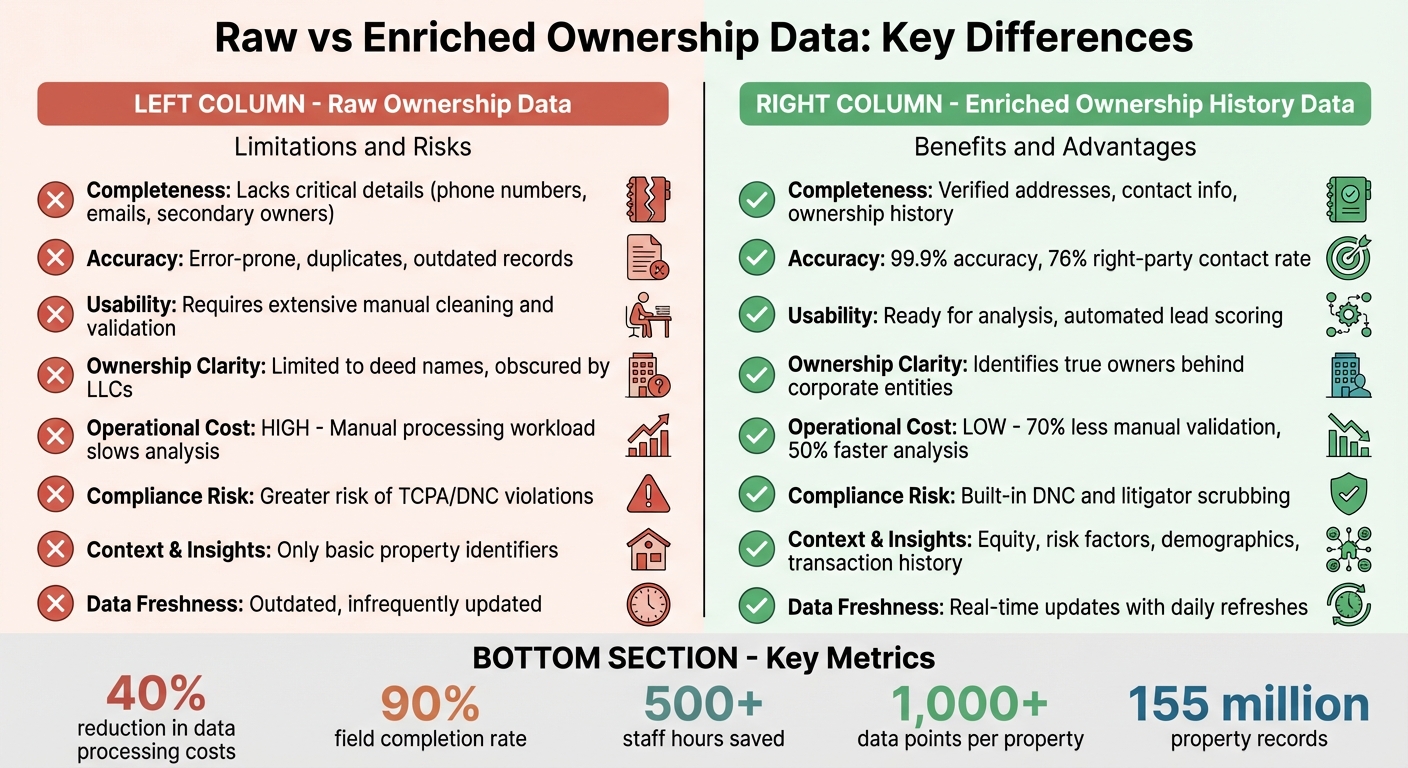
While raw data might seem like a budget-friendly option at first glance, it often comes with hidden costs – like the time and effort required for manual validation and the missed opportunities due to incomplete or inaccurate information. On the other hand, enriched data requires an upfront investment but delivers ready-to-use insights that can drive strategic decisions. The table below breaks down the key differences between raw ownership data and enriched ownership history data, focusing on aspects like completeness, accuracy, usability, and cost.
| Aspect | Raw Ownership Data | Enriched Ownership History Data |
|---|---|---|
| Completeness | Often lacks critical details like phone numbers, emails, or secondary owners | Fills in the gaps with verified addresses, contact information, and ownership history |
| Accuracy | Susceptible to errors, duplicates, and outdated records | Achieves 99.9% accuracy through multi-source verification, with a 76% right-party contact rate |
| Usability | Requires extensive manual cleaning and validation | Ready for analysis, enabling automated lead scoring and segmentation |
| Ownership Clarity | Limited to names on deeds or tax records, often obscured by LLCs | Identifies true owners by uncovering details hidden behind corporate entities |
| Operational Cost | High due to the manual processing workload, slowing analysis | Cuts manual validation by 70% and speeds up analysis preparation by 50% |
| Compliance Risk | Greater risk of TCPA/DNC violations | Includes built-in DNC and litigator scrubbing for compliance |
| Context & Insights | Provides only basic property identifiers | Offers deeper insights, including equity, risk factors, demographics, and transaction history |
| Data Freshness | Often outdated or infrequently updated | Features real-time updates with daily refreshes |
This comparison highlights the clear advantages of enriched data. It can slash data processing costs by about 40% while delivering a database with 90% field completion. Beyond the numbers, enriched data allows businesses to shift their focus from tedious manual tasks to more strategic initiatives. For organizations prioritizing speed and compliance, enriched ownership history data not only simplifies operations but also enables precise, targeted outreach.
Conclusion
Enriched data is revolutionizing real estate operations by providing contextual intelligence that raw records simply can’t match. With access to over 700 data points per property – like ownership duration and financial distress indicators – professionals gain insights that drive smarter decisions. This data is backed by multi-source verification with an impressive accuracy rate of up to 99.9%.
Automation plays a key role here, simplifying data processing and drastically reducing analysis time. As Chris Finck, Director of Product Management at Crexi, puts it:
What used to take 30 minutes now takes 30 seconds. BatchData makes our platform superhuman.
This kind of speed frees up teams to focus on high-value tasks, such as deal sourcing and portfolio strategy, instead of getting bogged down in data cleanup.
But it’s not just about speed and efficiency. Enriched data also helps minimize risks. Features like DNC and litigator scrubbing reduce the chance of TCPA violations, while metrics on natural hazards and financial risks add layers of protection. Advanced linking logic further enhances operations by uncovering the true decision-makers behind LLCs, streamlining negotiations and reducing exposure to fraud.
For real estate professionals and investors who prioritize speed, precision, and compliance, enriched ownership data is no longer a luxury – it’s a necessity. The combination of operational savings and predictive insights makes it a critical tool for automated valuations, lead scoring, and forecasting market trends – capabilities that raw data simply cannot deliver.
FAQs
How does enriched property ownership history data enhance real estate decision-making?
Enriched property ownership history data delivers a detailed look into a property’s ownership journey. It tracks past ownership changes, the length of time each owner held the property, and whether it’s owner-occupied or absentee-owned. It even differentiates between corporate and individual ownership, offering a clearer understanding of property rights.
This kind of detailed information is a game-changer for real estate professionals – whether you’re an investor, lender, or agent. It enhances accuracy in property valuation, helps evaluate potential risks, and pinpoints the right property owners to connect with. In short, this data empowers smarter, more strategic decision-making in the real estate world.
What are the key advantages of using enriched property ownership data instead of raw data?
Enriched property ownership data takes raw data to the next level by delivering cleaner, more actionable insights. It automates the process of verifying, standardizing, and filling in missing fields, cutting down on the need for manual data validation. This can save up to 70% of staff hours typically spent on data cleaning. Plus, it reduces processing costs and speeds up the integration of data into analytics systems, making operations far more efficient.
But it’s not just about saving time and money – enriched data provides a depth of information that raw data simply can’t match. It offers precise geocodes, detailed property attributes like zoning and construction details, and real-time updates. These extras lead to more accurate valuations, better risk assessments, and sharper marketing strategies. On top of that, it helps minimize errors and eliminate duplicate records. By leveraging enriched data, organizations can turn basic information into a strategic asset, driving smarter decisions and fueling operational growth.
Why is accurate property data important, and how does enriched data improve it?
Accurate property data is critical for making sound decisions in real estate. It helps prevent expensive errors, supports fair pricing, mitigates risks, ensures regulatory compliance, and builds trust with clients. When data is incorrect, it can result in financial setbacks or lost opportunities, making precision absolutely essential.
By cross-referencing property records from multiple reliable sources, enriched data improves accuracy. This approach keeps ownership and contact details current, verified, and dependable – empowering businesses to make informed, confident decisions based on solid information.