


































APIs are transforming the real estate industry by enabling instant access to critical property data, automating workflows, and streamlining decision-making. With investors responsible for 33% of home purchases in Q2 2025 and 40% of mortgages using appraisal waivers, speed and accuracy are now essential for staying ahead. APIs allow businesses to pull data like ownership records, valuations, and market trends in seconds, replacing manual processes that once took days.
Key benefits include:
- Efficiency: Companies report up to 900% workflow improvements by automating tasks like property research and financial reconciliation.
- Data Enrichment: APIs can provide up to 9,000 property attributes, AI-driven investment scores, and even renovation cost estimates using computer vision.
- Real-Time Insights: APIs deliver market data, cap rates, and climate risk assessments almost instantly, enabling faster, smarter decisions.
- Workflow Automation: From rent collection to contact enrichment, APIs eliminate repetitive tasks and improve operational accuracy.
For example, Housefolios saved over 2,000 hours of manual labor in 2025 by switching to API-powered workflows. Whether you’re a small investor or an enterprise, APIs provide tools to compete in a fast-changing real estate market.
BatchData’s APIs stand out with features like:
- Coverage of 155M+ properties and 700+ data points per property
- Sub-second response times and a 99.99% uptime SLA
- Flexible pricing starting at $1,000/month for property data or $2,000/month for skip tracing.
APIs are no longer optional – they’re essential for scaling operations, reducing manual work, and making data-driven decisions in real estate.
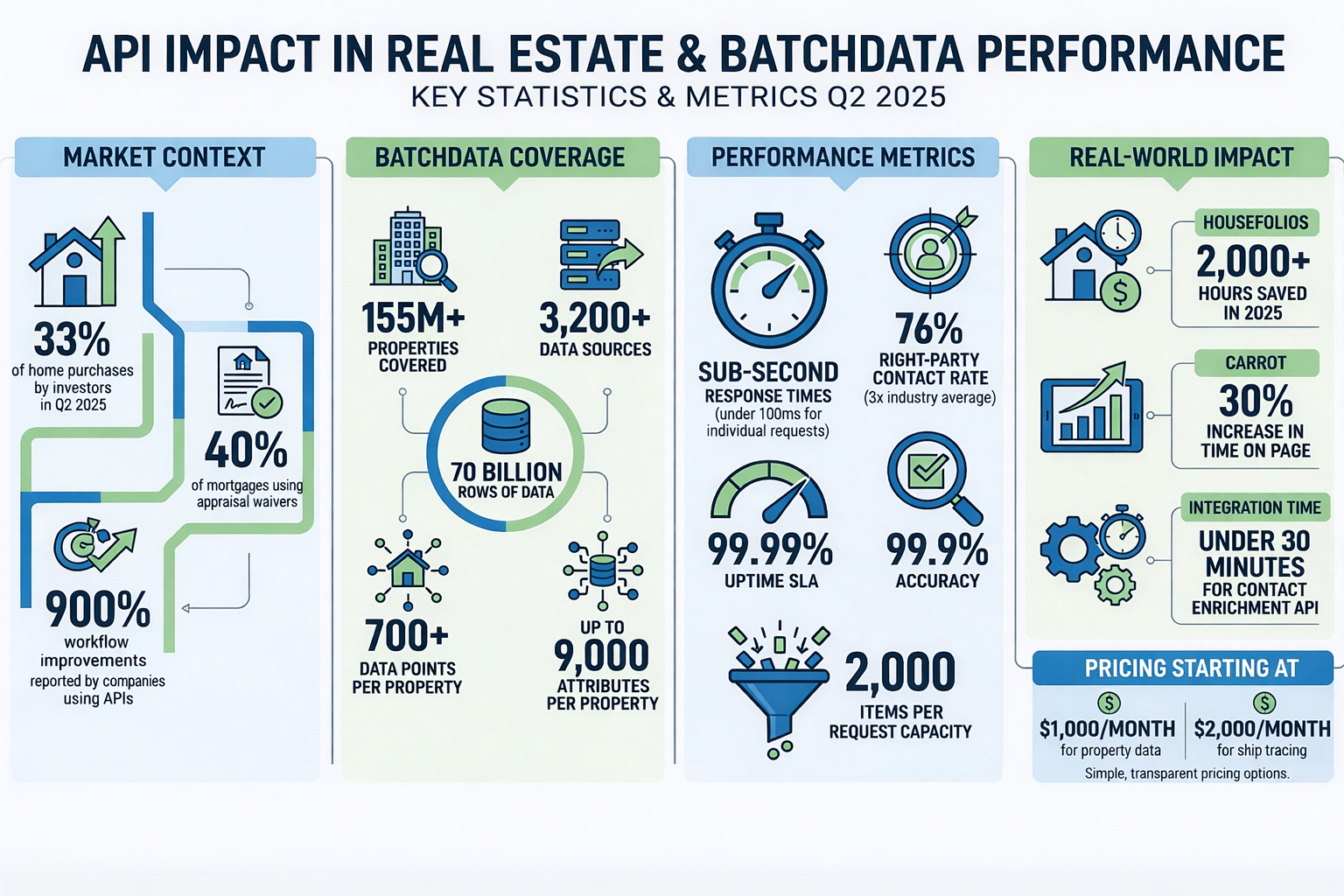
BatchData API Real Estate Statistics and Performance Metrics
sbb-itb-8058745
How APIs Deliver Value in Real Estate
APIs play a crucial role in transforming scattered data into actionable insights. They bring together county records, MLS listings, and market databases in an instant, shifting the focus from tedious research to proactive analysis. This transformation empowers real estate professionals to make smarter investment and portfolio management decisions.
The benefits of APIs are evident in three main areas: enhancing property data, providing real-time market insights, and automating repetitive tasks. Each addresses long-standing challenges that have hindered the growth and efficiency of real estate operations. Let’s explore how these advantages translate into tangible benefits for the industry.
Property Data Enrichment
APIs elevate basic property information by turning a simple address into a comprehensive intelligence profile. They pull ownership details, property characteristics, tax assessments, lien information, and valuation metrics from massive databases containing 70 billion rows of data with up to 9,000 attributes per property. This robust data is further refined through AI-generated investment scores like “Flip ROI”, “Price Flexibility Score”, and “Investment Potential”, helping investors quickly assess opportunities and gain negotiation leverage.
Advanced tools even use computer vision to analyze property photos, automatically evaluating conditions – rating properties from Excellent to Very Poor – and estimating renovation costs without requiring on-site inspections. Natural language interfaces, such as PropGPT, simplify complex queries into plain English, enabling users to search for specific properties like “Find 3-bedroom homes in Austin under $500k with pools”, making data analysis accessible to everyone, regardless of technical expertise.
Consider the case of Housefolios: in January 2026, they transitioned from manual CSV parsing to API-powered workflows, saving over 2,000 hours of manual labor in a single year. This shift not only freed up time, but allowed their team to focus on high-value activities like deal negotiations and relationship building. By enriching property data, APIs empower faster, more informed decisions, giving investors an edge in competitive markets.
Real-Time Market Analysis
In a market that changes daily, having access to real-time data is critical. APIs provide lightning-fast retrieval of property records, with enterprise-grade systems handling tens of thousands of records in under a second – some even achieving speeds below 100ms for individual requests. This speed can make all the difference when multiple investors are vying for the same distressed property or off-market deal.
APIs also calculate key investment metrics – such as cap rates, ROI, cash flow projections, and After Repair Value (ARV) – instantly through specialized endpoints. They even compare short-term rental potential (like Airbnb or Vrbo) against traditional leasing to identify the most profitable strategy for each property. Emerging features include climate risk assessments, which evaluate flood, wildfire, and drought risks for properties, projecting these risks as far as 2050. This forward-looking analysis helps investors avoid properties that may become uninsurable or lose value due to environmental risks, allowing for quicker decisions based on a complete market picture.
“APIs can dramatically improve operational efficiency, data visibility and satisfaction of stakeholders… By seamlessly connecting information across core systems… APIs help eliminate data silos and reduce manual work.” – Richard Patapoff, Head of Proptech Solutions, Commercial Banking, J.P. Morgan
Beyond providing rapid insights, APIs enhance workflows by automating repetitive tasks.
Workflow Automation
Automation is a game-changer for real estate operations. APIs streamline processes like address normalization and autocomplete, ensuring accurate databases while improving user experience during property searches. They also integrate banking services with property management systems, automating tasks such as rent collection and financial reconciliation.
Take Carrot, for example. Under the leadership of Carlos Zamora, Head of Business Development, the company integrated property reports through API connections. This led to a 30% increase in “time on page” as users engaged more deeply with enriched property intelligence.
BatchData APIs: Features and Applications
BatchData offers a robust suite of APIs designed to tackle the challenges of managing large-scale property data. With coverage of over 155 million properties nationwide and access to more than 700 data points per property, these tools provide businesses with the means to efficiently search, enhance, and connect with property owners. The infrastructure is built for reliability, boasting 99.9% uptime and response times measured in milliseconds, making it a dependable choice for real estate professionals working on production applications.
Property Search API
The Property Search API streamlines access to detailed property intelligence through a developer-friendly REST interface. Users can retrieve a wide range of data, including valuations, tax history, sales records, construction details, and lot sizes. By leveraging filtering options, searches can be customized based on property characteristics, financial metrics, and demographics. The API supports up to 1,000 items per request and allows multi-location queries, enabling searches across multiple cities, counties, or zip codes in a single call.
Chris Finck, Director of Product Management, shared his experience: “What used to take 30 minutes now takes 30 seconds. BatchData makes our platform superhuman.”
This API doesn’t just stop at property searches – it also enriches existing records by adding up to 300 additional data points. It even identifies motivated sellers using financial distress indicators and high-equity homeowner data. Developers can integrate the API seamlessly using official SDKs for Python and Node.js, ensuring a smooth implementation process.
Skip Tracing and Contact Data
To connect with property owners, accurate contact information is essential. BatchData’s Property Skip Trace API delivers a 76% right-party contact rate, which is about three times the industry average. By cross-referencing data from over 50 sources, including public records and telecom databases, the API provides multiple mobile and landline numbers (complete with carrier information), deliverable email addresses, and verified mailing details.
BatchData’s proprietary linking technology goes a step further by attempting to connect LLCs and trusts to the individuals behind them, providing a path to reach potential decision-makers without time consuming manual research. Results are typically delivered in milliseconds, and built-in compliance features like DNC and TCPA litigator scrubbing (updated every 24 hours), help users stay within legal boundaries. Contact confidence scores based on data recency and phone validity allow teams to focus on high-priority prospects, while property linkage via our Investor Profiles can identify an individual’s entire portfolio across the country.
Bulk Data and Custom Datasets
For businesses requiring large-scale market analysis or database backfilling, BatchData offers bulk delivery solutions. These datasets aggregate intelligence from over 3,200 sources and are delivered through platforms like AWS S3, SFTP, Snowflake Data Sharing, BigQuery, and Databricks. Users can tailor datasets by selecting specific geographic regions, property types, and up to 1,000 individual data fields to align with their investment strategies.
BatchData employs a multi-source resilience system to mitigate county-level outages, ensuring uninterrupted data flow for operations that demand consistent access. Additionally, historical snapshots included in bulk datasets enable trend analysis and predictive modeling of property value changes. The platform’s 99.99% uptime SLA ensures reliability for critical applications. Pricing for bulk data is customized based on factors such as geography, data elements, property count, and update frequency.
How to Integrate APIs into Your Workflow
Integrating real estate APIs into your workflow can be straightforward, depending on your specific needs. You can choose between the Real-Time REST API for quick, on-demand lookups or Direct Cloud Access for handling large-scale analytics, machine learning (ML), or business intelligence (BI) tasks. The Real-Time REST API provides data in milliseconds and keeps it updated in real time. Meanwhile, Direct Cloud Access, available through platforms like Snowflake, BigQuery, or Databricks, eliminates the need for ETL processes and can handle massive datasets effortlessly.
| Feature | Real-Time REST API | Direct Cloud Access |
|---|---|---|
| Best Use Case | On-demand lookups, apps, dynamic analytics | Large-scale analytics, ML, BI |
| Delivery Method | RESTful JSON API | Snowflake, BigQuery, Databricks, S3 |
| Data Freshness | Continuous live updates | Always up-to-date, no ETL required |
| Technical Tools | SDKs (Python, Node.js), Interactive Docs | Parquet files, direct warehouse sharing |
| Performance | Low latency, high availability | Scalable for massive datasets |
Once you’ve chosen the delivery method that aligns with your goals, you can leverage a variety of tools to make the integration process smooth and efficient.
Developer Resources and Documentation
The interactive developer portal is a great starting point. It allows you to explore API endpoints and test live API calls even before writing a single line of code. This hands-on approach helps teams quickly grasp data structures and response formats. Additionally, official client libraries for Python and Node.js simplify the development process by managing tasks like authentication, error handling, and request formatting for you.
Most developers can integrate the Contact Enrichment API in under 30 minutes. To ensure everything works as expected, you can test your integrations with mock data using free sandbox API tokens. This lets you validate data structure and response times before moving to a production environment.
Professional Services for Custom Implementation
If your requirements go beyond standard API integration, professional services are available to help. These services can assist with custom integrations, migrating legacy systems, or creating tailored datasets to meet specific needs. The Data Concierge team provides advanced support, conducting system audits to identify data gaps, normalizing inconsistent records, and enriching your databases with additional property details or contact information.
Whether you’re managing large-scale analytics or simply need quick, reliable data access, these tools and services ensure a seamless integration experience.
BatchData Pricing Plans
Choose a pricing plan (Growth, Professional, and Scale) that matches your data needs. BatchData offers flexible plans based on monthly record volume and required datasets, making it easy to adjust as your business evolves. For property data, plans start at $1,000 per month for 100,000 monthly records. You can also enhance your subscription by adding specific datasets – like Demographics or Property Valuation – for an additional fee. As an example, depending on the plan, adding Demographics costs between $100 and $1,000 per month. Skip tracing plans begin at $2,000 per month for 100,000 monthly records.
Custom Enterprise solutions provide custom pricing for businesses with higher data demands and/or specialized needs.
Pay-As-You-Go vs. Custom Solutions
BatchData offers two distinct pricing approaches:
|
|
Pay-As-You-Go |
Subscription Plans |
Custom Solutions |
|
Pricing |
Based on usage |
Plans start at $1,000 per month |
Customized to specific needs |
|
Best For |
Flexible, low-volume use |
Predictable pricing and volume flexibility |
Large-scale, enterprise needs |
|
Core Features |
APIs, bulk delivery, skip tracing |
APIs, bulk delivery, skip tracing |
Tailored datasets, GTM consulting |
|
Volume |
No minimum usage |
20,000 to 750,000 records/month |
Unlimited or high-volume capacity |
|
Support |
Standard documentation |
Prioritized Support |
Dedicated account management |
|
Contract |
N/A |
Monthly or annual options (Annual Commitment) |
Custom terms and volume discounts |
For moderate data needs, one of the standard subscription tiers will likely suffice. However, if you’re handling millions of records, require custom integrations, or need guarantees like 99.99% uptime, the Enterprise plan is a better fit. For fluctuating data volumes, the pay-per-match skip tracing option ensures you only pay for what you use, avoiding unnecessary costs.
Security, Scalability, and Compliance
Real estate data often contains sensitive details such as owner names, contact information, financial metrics, and property valuations. When working with APIs, security, scalability, and compliance are non-negotiable. These elements protect your business from data breaches, legal troubles, and system failures, while also ensuring reliable and efficient data delivery.
BatchData tackles these challenges with a combination of robust security measures and performance guarantees. For starters, it offers a 99.99% uptime SLA for its real-time API, ensuring your applications remain functional even during peak demand periods. This reliability is further bolstered by sourcing data from over 3,200 providers. By blending multiple data streams, BatchData ensures your operations have uninterrupted access to critical information.
On the compliance front, BatchData integrates safeguards directly into its data delivery processes. For example, it automatically scrubs contact data against the Federal Do Not Call (DNC) list and removes known litigators, shielding your business from TCPA violations and potential lawsuits. This automated compliance system also filters out disconnected numbers and high-risk contacts in real time, saving you from manual verification and speeding up your campaigns. To further protect data integrity, BatchData supports secure delivery methods like AWS S3, SFTP, and Snowflake Data Sharing, ensuring safe transfers for businesses managing millions of records.
Scalability is another cornerstone of BatchData’s infrastructure, designed to meet a variety of real estate investing data needs. The platform operates on two tracks: the real-time API delivers sub-second response times for on-demand property searches and data appending, while bulk delivery handles billions of records through scheduled updates or historical snapshots. This dual system allows you to address immediate customer inquiries while also managing larger-scale tasks like populating databases or training machine learning models. BatchData processes millions of documents daily with a mix of automated testing and human oversight to handle complex scenarios.
The platform is built to support enterprise-level demands without compromising on accuracy or security. With a 76% right-party contact accuracy rate – three times higher than the industry average – BatchData ensures you’re working with reliable data.
Conclusion
In the fast-paced world of real estate, success often boils down to speed, precision, and the ability to act on dependable insights. BatchData APIs transform property data into a powerful tool, offering access to over 1,000 data points spanning 155 million U.S. properties. This enables real estate professionals to make quicker, more informed decisions.
The key advantage lies in removing inefficiencies. Tasks that once consumed hours – like identifying motivated sellers, verifying property ownership, or ensuring addresses meet USPS standards – are now completed in seconds through automated workflows. This streamlined approach enhances every stage of the deal process, providing the speed and accuracy needed to stay ahead in a competitive market.
BatchData’s platform is designed for both immediate and long-term needs. Its real-time APIs, boasting a 99.99% uptime SLA, handle on-demand queries seamlessly for CRMs and customer-facing applications. Meanwhile, bulk delivery options via AWS S3, SFTP, and Snowflake Data Sharing cater to large-scale operations, such as training machine learning models or updating databases with historical data. This infrastructure not only supports day-to-day operations but also fosters sustained growth and scalability.
For real estate investors, brokers, and PropTech teams aiming to modernize their processes, the solution is clear: integrate property intelligence directly into your workflows. Whether it’s enriching records, automating skip tracing, or creating custom datasets for market analysis, BatchData delivers the tools to stay competitive. Flexible pricing options – from pay-as-you-go plans to tailored enterprise solutions – ensure you only pay for what you use. In a market where speed and actionable insights are critical, BatchData helps turn property data into decisions that drive success.
FAQs
How can real estate APIs improve decision-making and efficiency?
Real estate APIs integrate real-time property data directly into platforms like CRMs, websites, or analytics dashboards. This eliminates the hassle of manual tasks such as exporting and cleaning spreadsheets, giving real estate professionals access to accurate, up-to-date information for quicker, more informed decisions.
With ongoing data updates, users can track market trends, test various scenarios, and spot high-potential opportunities instantly. These APIs also support features like automated lead scoring and detailed property insights, enabling agents, investors, and developers to evaluate properties more thoroughly and efficiently. By simplifying workflows, APIs not only save time and minimize errors but also allow teams to concentrate on strategic planning instead of managing data.
What are the key benefits of using real estate APIs for property data enrichment?
Using real estate APIs to enrich property data comes with several key benefits:
- Instant access to up-to-date information: APIs deliver real-time updates on essential property details, such as ownership records, sales history, and neighborhood stats. This eliminates the hassle of manual data collection, cutting down on time and reducing errors.
- Broader market insights: APIs compile a wealth of data, including market trends, property values, and ownership details. This makes it easier for businesses to dive into market analysis, spot promising investment opportunities, and generate quality leads.
- Streamlined operations with automation: When integrated with tools like CRMs or custom applications, APIs automate repetitive tasks like lead tracking and portfolio management. This frees up teams to focus on strategic priorities, speeding up decisions and improving overall productivity.
How can real estate professionals use APIs to streamline their workflows?
Real estate professionals can use APIs to supercharge their existing tools – whether it’s a CRM, a listing platform, or a custom dashboard. APIs eliminate the need for manual data collection by offering real-time access to critical property information, like MLS listings, ownership records, sales histories, and neighborhood details.
Here’s how you can get started:
- Obtain access: Register for an API key to unlock the service.
- Connect seamlessly: Use the API provider’s tools or standard methods like HTTPS requests to integrate.
- Map the data: Match API fields – such as price or square footage – to your system’s database.
- Automate workflows: Simplify tasks like enriching lead profiles, tracking market trends, or pulling live property data directly into your processes.
By weaving APIs into their daily workflows, real estate professionals can make quicker, smarter decisions, save hours of effort, and stay ahead in a competitive market.