
When picking a real estate data API, the stakes are high. The right choice can streamline your workflows, improve decision-making, and help your business scale. But how do you make sure the API fits your needs? Start by asking these 10 key questions:
- How frequently is the data updated? Timely updates are critical for accurate property insights.
- What data attributes are available? Ensure the API provides detailed property, ownership, and mortgage data.
- What is the geographic and portfolio coverage? Confirm it covers your target regions and property types.
- Is the API developer-friendly? Look for clear documentation, sandbox environments, and testing tools.
- What are the performance and rate limits? Check response times, request limits, and bulk processing options.
- How secure and compliant is the API? Verify HTTPS, API key authentication, and adherence to privacy laws like GDPR and CCPA.
- What is the pricing model? Understand subscription tiers, add-ons, and potential overage fees.
- What level of support is offered? Dedicated support, SLAs, and onboarding assistance can make a big difference.
- What are the uptime guarantees? Look for SLAs with high uptime percentages and real-time monitoring tools.
- Can the API handle custom data and future growth? Check for flexibility, custom endpoints, and long-term support.
These questions cover the essentials: data quality, integration, security, pricing, and reliability. Use them to evaluate providers, run a pilot test, and ensure the API aligns with your business and technical needs.
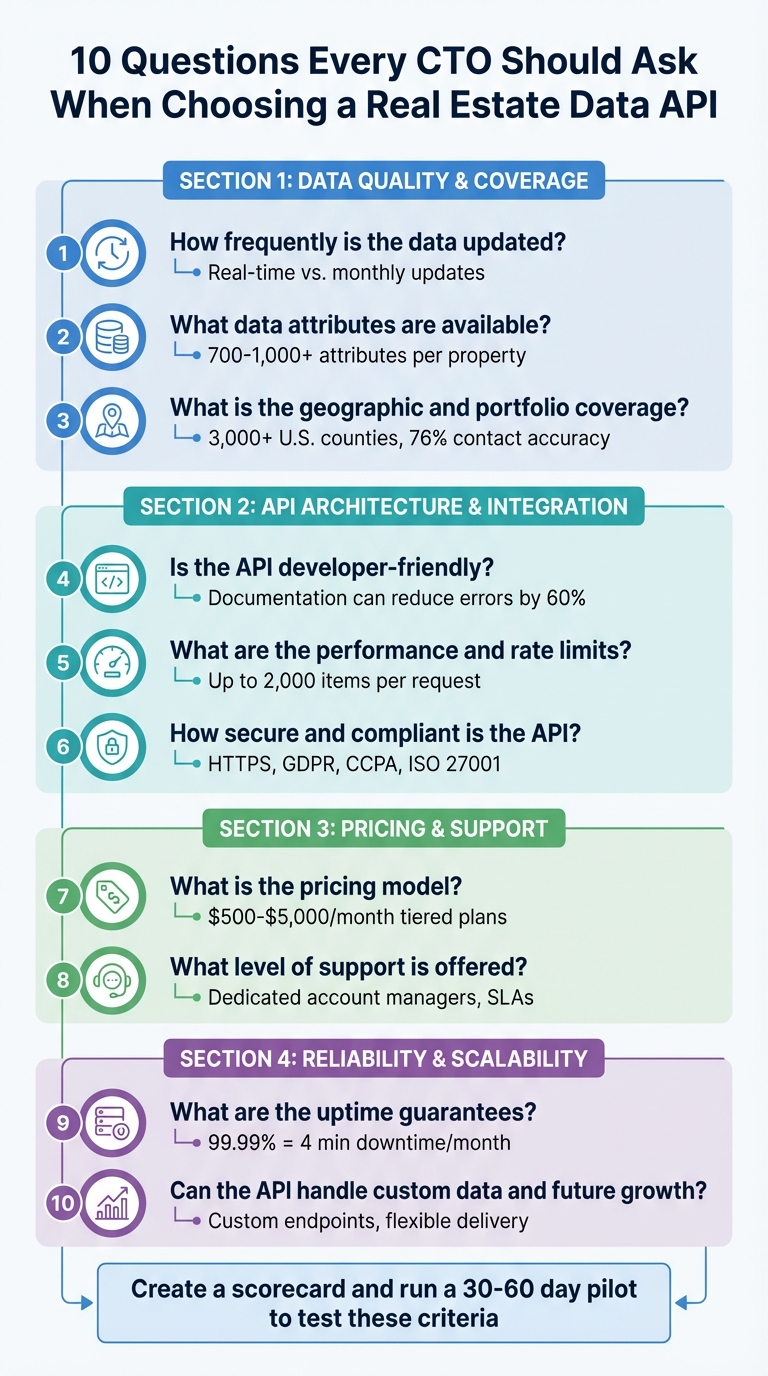
10 Essential Questions CTOs Should Ask When Choosing a Real Estate Data API
Data Quality and Coverage
When evaluating data reliability, it’s crucial to also assess data quality and coverage. These factors determine whether your application delivers accurate insights or risks misleading users with outdated or incomplete information. The following questions can help you gauge whether a data provider aligns with your technical needs and business objectives. Understanding these elements lays the groundwork for assessing API architecture and integration.
Question 1: How Fresh is the Data?
The timeliness of data updates plays a key role in ensuring accurate property valuations, ownership verification, and support for time-sensitive decisions. If the data is outdated, it can undermine your application’s functionality and erode user confidence.
Start by asking how often the data is updated. For instance, real estate APIs often provide real-time or near-real-time data, while bulk data licenses may only update on a weekly, monthly, or quarterly schedule. Some providers refresh MLS data multiple times per day, while others update short-term rental data daily. Bulk datasets might offer daily updates for specific fields to minimize delays. Leading APIs use low-latency pipelines to deliver the most current data directly from their sources.
“If your real estate data is refreshed only once a month, you could miss important changes. For active buying, selling, or investment analysis, you want updates every day or at least every week.” – Snehal Joshi, Hitech BPO
Don’t just settle for general update schedules. Ask how quickly real-world changes – like a new listing or a price reduction – are reflected in the API. Check if the provider supports real-time feeds or webhooks for critical updates, such as listing status changes or foreclosure notices. Additionally, confirm that update frequencies remain consistent across regions and request a coverage map showing refresh intervals for your target areas.
Beyond how current the data is, it’s equally important to evaluate the range of attributes provided.
Question 2: What Attributes and Details Are Provided?
The variety and depth of property data can determine whether your application performs advanced analyses or is limited to basic searches. Comprehensive APIs offer a wide range of datasets, from fundamental property details (such as bedrooms, bathrooms, and square footage) to more advanced metrics like ownership history, valuations, equity data, mortgage details, lien information, and pre-foreclosure status.
BatchData provides 700+ attributes across 155M+ properties. For example, Core Property Data includes 240+ data points, while Mortgage & Open Liens includes 140+ data points. such as loan maturity dates and interest rates. Advanced features like Automated Valuation Models (AVM), Loan-to-Value (LTV) ratios, and sale propensity scores are also often supported.
To ensure smooth integration, verify the consistency of the API’s JSON schema and confirm it supports “compound queries.” This capability allows you to pull multiple datasets – like property specs, owner contacts, and mortgage history – in a single request, reducing latency and simplifying workflows.
Geographic and portfolio coverage is another crucial factor to examine.
Question 3: How Complete is Geographic and Portfolio Coverage?
Geographic coverage ensures your application can serve users across all intended markets without missing key data. Ask providers about their total property count, the balance between rural and urban data availability, and their approach to handling incomplete data. Reliable APIs often maintain consistency using FIPS codes (unique 5-digit codes for states and counties) and ZIP+4 codes, covering over 3,000 U.S. counties.
In areas where postal codes are unavailable, inquire about how the provider addresses these gaps. Look for features like address standardization through CASS (Coding Accuracy Support System) and DPV (Delivery Point Validation) to ensure records align with USPS standards. For contact-related data, check the accuracy of owner information. High-quality APIs can achieve right-party contact accuracy rates of up to 76%.
API Architecture, Performance, and Integration
Once you’ve ensured the data quality meets your standards, the next step is to assess how well the API integrates with your systems and whether it can be maintained efficiently. A poorly designed API can slow down development, create bottlenecks during peak usage, and even expose your application to security vulnerabilities. A well-functioning API doesn’t just deliver reliable data – it integrates easily, performs efficiently under stress, and ensures security throughout the process.
Question 4: Is the API Developer-Friendly and Well-Documented?
To make integration smooth, thorough documentation is essential. This should include detailed endpoint references, query parameters, and response examples. Many providers simplify the process by offering “quick-start” guides, code snippets, and SDKs, which can greatly reduce the time needed for initial setup. Testing is another critical step – comprehensive documentation and robust test plans can identify up to 80% of potential issues before the API goes live. In fact, teams that maintain detailed test plans and have a deep understanding of API functionality can reduce testing errors by as much as 60% during development.
Look for providers that offer sandbox environments and free testing tiers (e.g., a limited number of free API calls per month), allowing your team to evaluate the API’s functionality without financial commitment.
“Understanding API functionality and maintaining comprehensive test plans are fundamental requirements that can reduce testing errors by up to 60%.” – API Testing Best Practices Guide
It’s also important to see how the API handles invalid inputs. Clear error messages and relevant status codes are far more helpful than generic failure responses. Additionally, check if the provider updates test cases and documentation whenever a new version of the API is released, ensuring ongoing reliability. Some providers even support integration with popular no-code tools, broadening accessibility. For more complex needs, prioritize vendors that offer live chat or dedicated engineering support to help with custom implementations.
Once the developer experience is addressed, the next step is to evaluate the API’s performance and scalability under high-demand scenarios.
Question 5: What Are the Performance and Rate Limits?
Performance metrics like response times, rate limits, and support for bulk processing are critical when dealing with high-throughput use cases. It’s important to ask providers for specific benchmarks that align with your expected traffic. For instance, APIs that allow retrieval of up to 2,000 items in a single request can significantly reduce overhead and minimize the number of calls required.
For even greater efficiency, look for APIs that support “Compound Queries,” enabling multiple datasets to be retrieved in a single call. Many higher-tier plans also include features like “Priority processing” and “Batch processing”, which are particularly useful for large-scale tasks like skip tracing or data enrichment.
For intensive use cases, such as machine learning model training or database population, ask whether the provider offers bulk data delivery options through platforms like Snowflake, AWS S3, or flat files. Rate limits can vary significantly depending on the plan – BatchData’s property data plans range from 100,000 records/month on Growth to 750,000 records/month on Scale, with Enterprise supporting 3,000,000 records/month. while higher request-per-second limits often require enterprise-level agreements with custom SLAs. Always request a demo or limited-use access to measure latency and response times under conditions that reflect your actual needs.
While performance is crucial, security cannot be overlooked, especially when dealing with sensitive data.
Question 6: How Secure and Compliant is the API?
When handling sensitive property and contact data, strong security measures are non-negotiable. At a minimum, the API should support HTTPS for secure data transmission, API key authentication, and role-based access control (RBAC) to manage permissions. Some providers go further by maintaining ISO 27001 certification, signaling a strong commitment to secure data handling.
The API should also comply with major privacy regulations like GDPR (General Data Protection Regulation) and CCPA (California Consumer Privacy Act). Additionally, real-time scrubbing against Federal DNC (Do Not Call) lists and known litigator databases can help avoid disconnected lines and minimize the risk of TCPA (Telephone Consumer Protection Act) lawsuits. Alarmingly, only 17% of AI vendors explicitly commit to adhering to all applicable laws in their standard terms, so it’s crucial to verify compliance upfront.
“A thorough review of vendor data practices shields your organization from legal complications, privacy breaches, and potential damage to your reputation.” – Netguru
To protect against intellectual property issues, request documentation confirming that the data is properly licensed or sourced. Additionally, negotiate ownership rights for all input data, generated outputs, and models trained using your data. Make sure contracts include provisions for continued access to your data after the relationship ends and prohibit vendors from using your confidential data for their own purposes post-termination.
Pricing, Contracts, and Support
Once you’ve assessed the technical capabilities of an API, it’s time to dig into pricing and support. These factors often determine whether your integration process is smooth or riddled with delays.
Question 7: What is the Pricing Model?
Most providers use tiered subscription plans that scale based on the volume of records you need each month. For instance, smaller teams might opt for a “Lite” plan, while larger operations might require premium tiers. BatchData’s property data plans include Growth at $1,000/month for 100,000 records, Professional at $2,500/month for 300,000 records, and Scale at $5,000/month for 750,000 records. Enterprise is available at $10,000/month for 3,000,000 records.For businesses handling millions of records, custom enterprise plans are typically the way to go.
It’s important to note that base subscriptions often don’t cover everything. Add-ons like specialized datasets – such as demographics, property valuations, deed history, or building permits – can quickly increase your costs. These extras usually range from $25 to over $1,500 per month, depending on your subscription tier. To avoid surprises, take stock of your data needs upfront and factor in these potential add-ons.
For additional services like skip tracing or contact enrichment, many providers offer pay-as-you-go pricing. This means you’re only charged for successful matches, which can be more cost-effective than committing to a flat monthly fee.
“BatchData offers flexible options for skip tracing and contact enrichment, including usage-based pricing.” – BatchData FAQ
Before committing, always ask for a comprehensive cost breakdown that includes all add-ons and any potential overage fees. Pricing is only half the equation, though – support can make or break your experience.
Question 8: What Level of Support is Provided?
Support is just as crucial as pricing when evaluating an API. It plays a significant role in how quickly you can integrate the service and how well it performs over time. Basic plans often come with standard documentation and access to general support teams. However, higher-tier subscriptions usually include perks like dedicated account managers, custom contract terms, SLA guarantees, and assistance with strategic planning.
For more complex setups, check if the provider offers dedicated experts to assist with sandbox testing and integration. This is far more efficient than relying on generic support queues. Some providers offer professional services such as custom data integration, tailored data delivery, and migration support. High-touch support might also include specialized communication channels like Slack for real-time collaboration.
“The engineers spent weeks helping us think through the best implementation and even built custom endpoints to ensure we could create the best possible version of our product.” – Jack Herbkersman, CEO, Investor Base
If you’re considering an enterprise plan, make sure it includes a formal Service Level Agreement (SLA) with uptime guarantees. These agreements are vital for production systems where downtime can directly affect your revenue. Additionally, structured onboarding and thorough documentation can significantly reduce integration time and minimize any hiccups along the way.
Reliability and Long-Term Fit
Question 9: What Are the Uptime Guarantees and Monitoring Options?
Uptime is a big deal: a 99.9% Service Level Agreement (SLA) means about 43 minutes of downtime per month, while 99.99% cuts that to just 4 minutes. For real-time processes like property searches, lead routing, or underwriting, even a few extra minutes offline can lead to missed opportunities and frustrated users.
To ensure reliability, ask for a formal SLA that spells out how uptime is measured – whether by region, endpoint, or globally. It should also cover planned maintenance exclusions and remedies, such as service credits or termination rights. Beyond the SLA, look for a public status page that shows component health, historical incidents, and real-time alerts. These updates could come through webhooks, email, or tools like Slack. Ideally, the provider should also offer analytics that track latency, error rates, and rate-limit usage on a per-customer basis. BatchData offers a 99.99% uptime SLA and sources data from 3,200+ sources.
This kind of operational reliability lays the groundwork for assessing scalability and customization for the long haul.
Question 10: Can the Provider Support Custom Data and Future Needs?
Once uptime and monitoring are squared away, it’s time to dig into whether the provider can meet your evolving data needs. Start by reviewing their product roadmap and API versioning policy. Ask about their plans for the next 12–24 months, particularly regarding new datasets, expanded geographic reach, or improved analytics features. Find out how long older API versions are supported, how they communicate deprecations, and whether they provide migration guides when updates are rolled out. Providers that offer early access to new features or endpoints can signal a strong commitment to long-term partnerships.
Custom data capabilities are another key consideration. Can the provider handle unique property attributes, create tailored endpoints, or deliver data in multiple formats? These might include real-time APIs, bulk flat files, S3 buckets, or streaming feeds. BatchData offers custom data integration, custom dataset creation, matching, and flexible delivery options for enterprise use cases.
For high-volume applications, look into custom enterprise plans. These often come with higher rate limits and dedicated infrastructure to prevent bottlenecks. Lastly, check the provider’s track record. How long have they been in business? Do they have U.S.-based customer references, such as lenders, brokerages, or institutional investors? Multi-year contracts with clear SLAs, escalation paths, and data-export rights can also provide peace of mind, ensuring you’re never locked into a system without options.
Conclusion: Making the Right API Choice for Your Business
Every decision you make – whether it’s about data freshness or long-term support – plays a critical role in your platform’s success. Selecting the right real estate data API comes down to asking the right questions. The 10-question framework outlined here offers a clear way to assess providers based on four key areas: data quality (covering freshness, attribute depth, and coverage), technical architecture (emphasizing developer experience, performance, and security), commercial terms (like pricing models and contract flexibility), and operational reliability (including support quality, uptime guarantees, and scalability).
These factors directly impact your API integration, influencing everything from data accuracy to pricing structure and uptime reliability. By carefully evaluating each area, you can identify potential risks and ensure your product remains competitive.
Today’s API landscape is all about delivering a seamless developer experience. Features like detailed documentation, SDKs, sandbox environments, and consistent JSON formats make integration smoother and help your team scale faster.
To make the most informed decision, create a scorecard based on the 10 questions, schedule demos, and conduct a 30–60 day pilot. This trial period allows you to test integration effort, latency, and data completeness – uncovering potential issues that documentation alone might not reveal. This approach ensures you select an API that aligns with your technical and business goals, streamlines development, improves accuracy, and supports your growth efficiently.
FAQs
How can I make sure the API provides data updates quickly enough for my business needs?
When assessing an API, it’s crucial to ensure the provider offers real-time updates or, at the very least, daily data refreshes. Check if they provide a service-level agreement (SLA) that guarantees timely updates for property and contact information – ideally within a few hours of any changes. This way, your business can rely on having the most up-to-date and accurate data at all times.
How can I evaluate if an API’s pricing model works for my budget?
When evaluating an API’s pricing to see if it fits your budget, start by looking at whether it provides a pay-as-you-go option or locks you into a fixed subscription. Compare the monthly cost with the number of records or API calls included, and check if there are any annual commitments or custom contract terms. Don’t overlook potential overage fees or the price of add-ons – these can impact the overall cost significantly. Make sure the pricing structure is clear and can grow with your needs.
What should I look for to ensure an API is secure and compliant with privacy regulations?
To make sure an API is secure and adheres to privacy regulations, start by checking if the provider uses strong encryption standards for data both in transit (like TLS 1.2 or later) and at rest. Confirm they implement robust authentication measures, such as OAuth 2.0 or API keys with carefully defined permissions. Look for certifications from independent audits, such as SOC 2, ISO 27001, or PCI-DSS, and ensure the API aligns with U.S. privacy laws like the CCPA, or GDPR if relevant.
It’s also important to inquire about operational safeguards. Does the provider perform regular vulnerability scans, penetration tests, and real-time threat monitoring? Verify that the API follows data-minimization practices, meaning it only returns the specific data requested. Additionally, ensure that any personally identifiable information (PII) is managed through consent-aware workflows. Providers who offer detailed audit logs, clear policies for data retention, and access to a dedicated compliance support team show a serious commitment to maintaining security and privacy.