



Deed & Sales History
Recorded Deeds and Sales on a Property
The deeds and sales recorded for a property: 30+ fields on the buyer and seller, the sale price, the dates and the type of deed.
TRUSTED BY LEADING BRANDS

























- 169M+Parcels
- 3,100+Counties
- 380M+Deed and sale records
- 131M+Properties
What's included
What is Deed & Sales History?
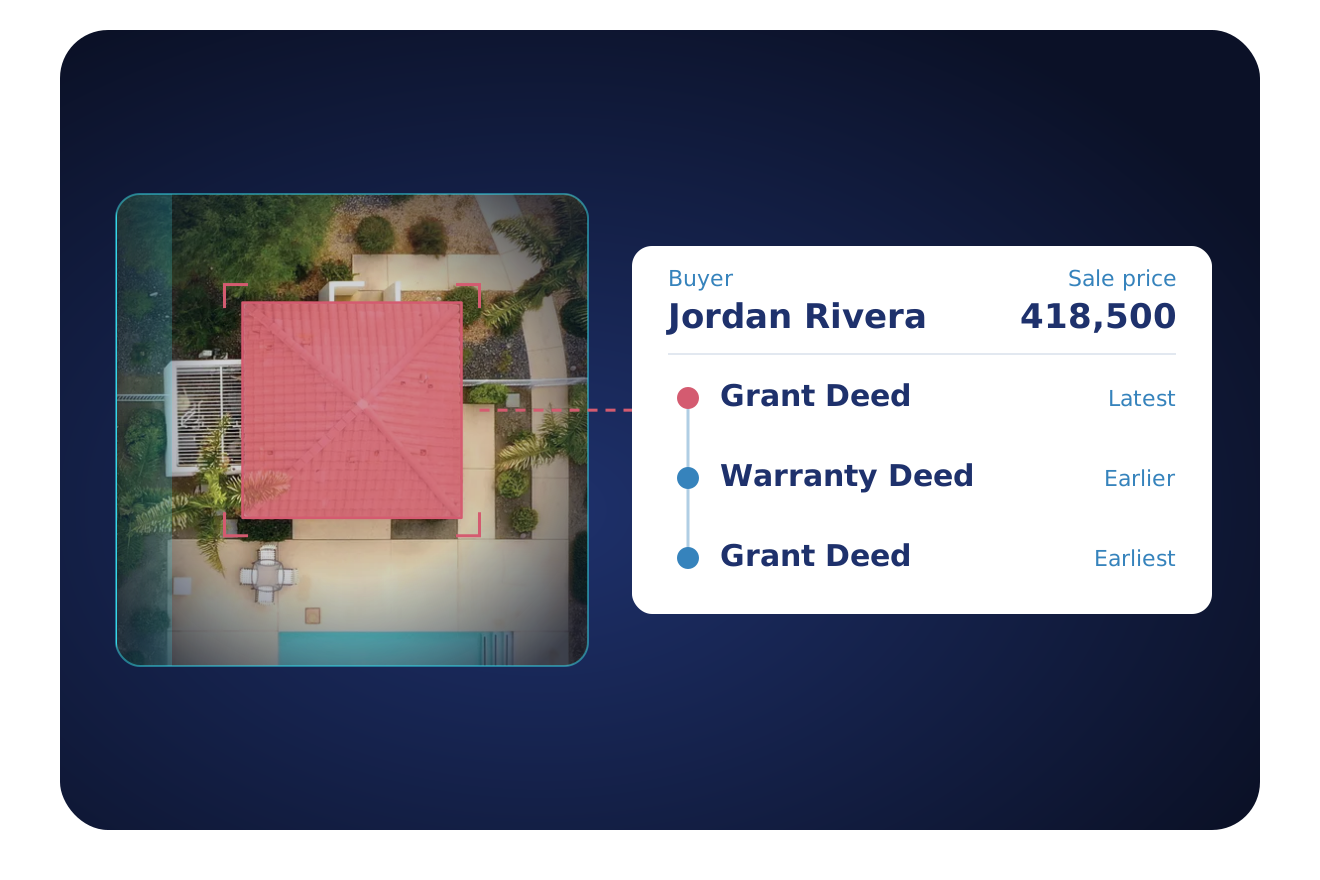
Deed history is the list of deeds and sales recorded for a property. Each record names the buyer and the seller. It also holds the sale price, the sale and recording dates, and the type of deed. BatchData returns these records in one standard format through its API or in bulk files. It is an add-on to a Property Data plan.
Parties
- Buyer names
- Seller names
Relationship
- Relationship between the parties on the deed
- Deeds that list more than one owner
- Partial interest type
Price
- Sale price
- Sale price qualifier, such as full or partial consideration
- Transfer tax paid at the time of sale
Dates
- Sale date
- Recording date
Document
- Document type, such as warranty, quitclaim or trustee's deed
- Recorder document number
- Document date
Recorder reference
- Recording book and page
- Transaction ID
Sale type
- Deed transaction type
- Resale flag
- New construction flag
Foreclosure sales
- Sale at auction or repossession by a lender
- Sale by a lender back to the open market after foreclosure
Mailing address
- Mailing address on the deed record
- Mailing address hash
What deed history lets you do
Use the recorded deeds to know how a property changed hands.
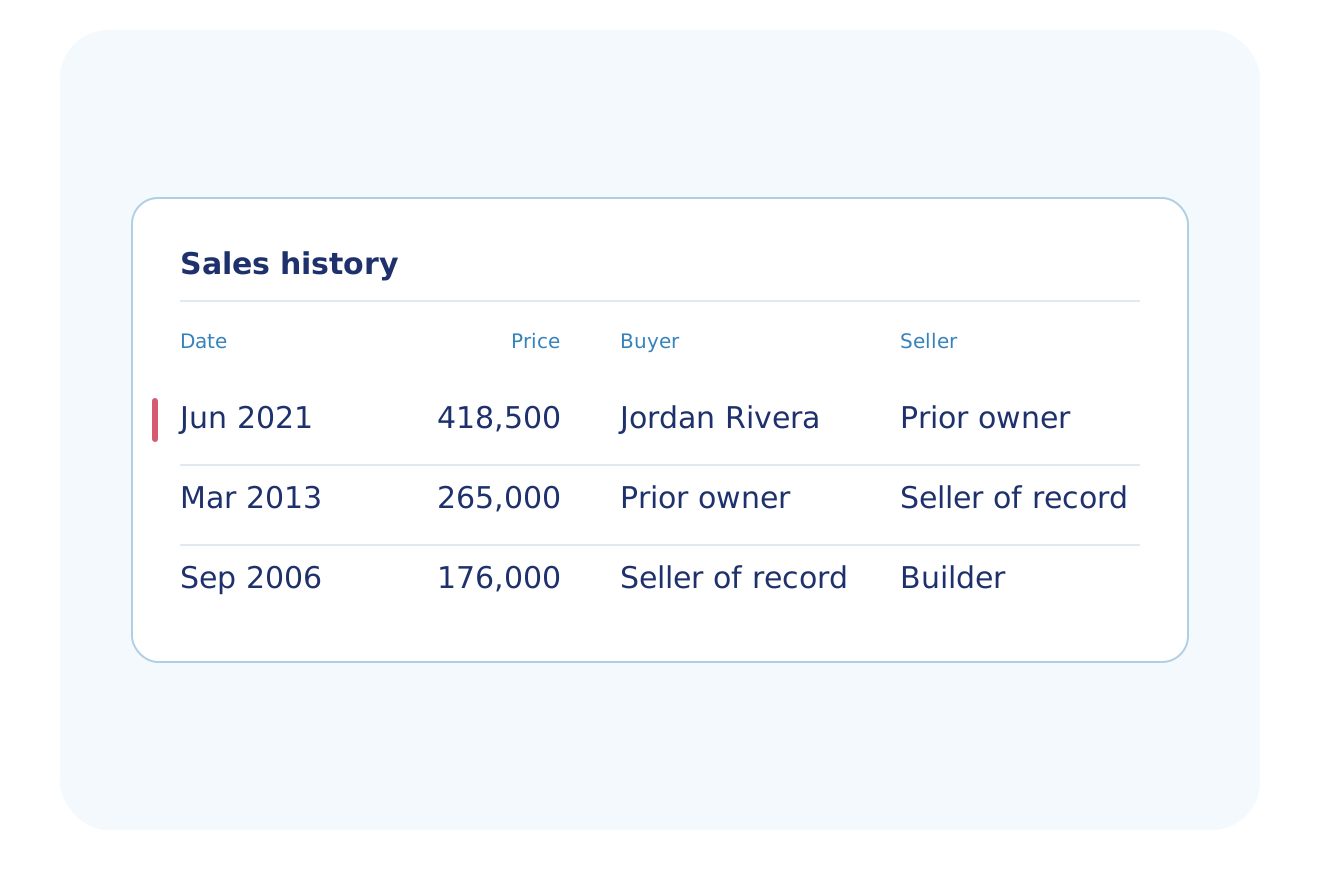
Read the sales history of a property
See the sales recorded for a property, with the price, the dates, the buyer and the seller.
- Sale price and sale date
- Recording date and document date
- Buyer and seller names
Know the type of sale
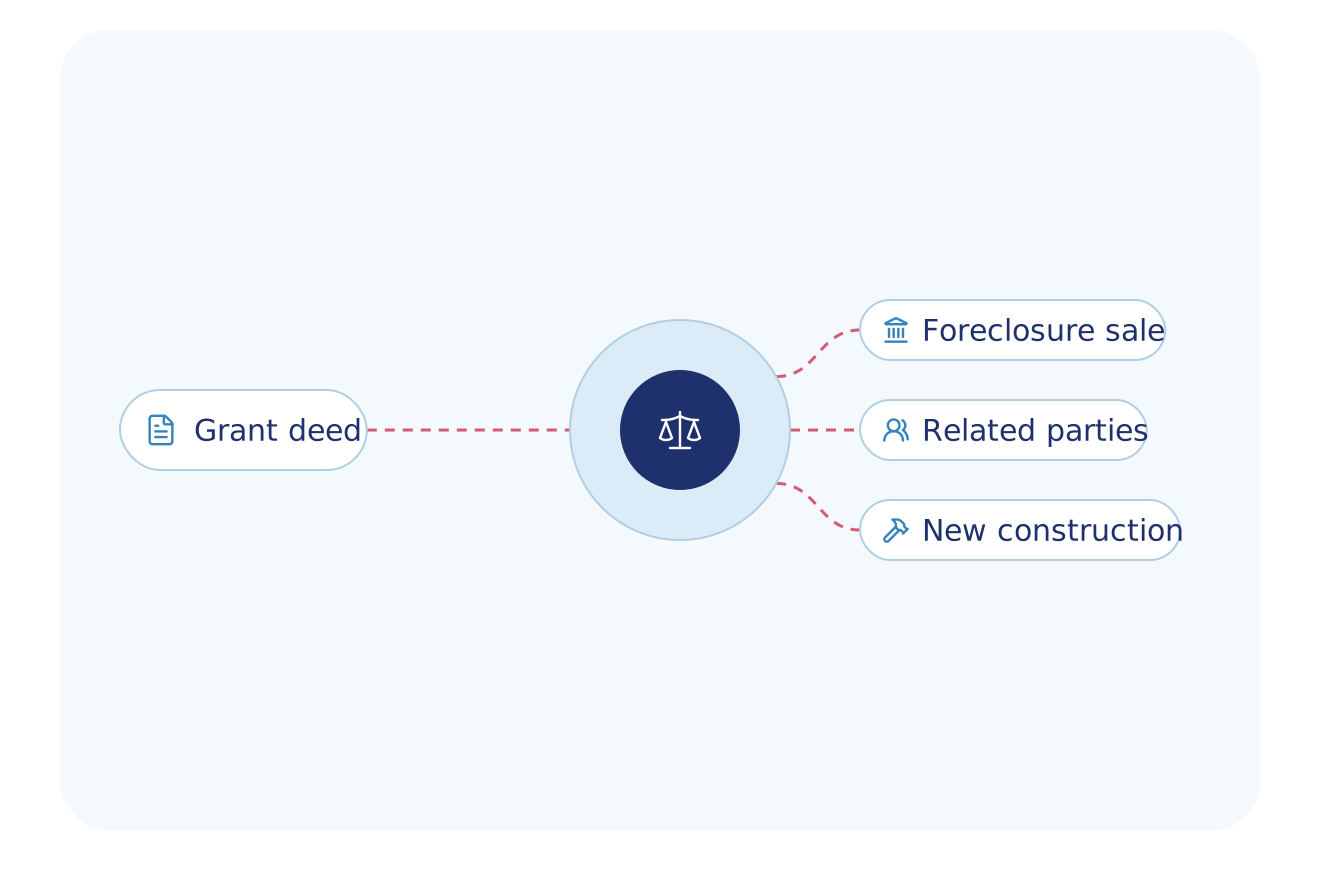
Tell a sale between related parties from other sales, and a foreclosure sale from a resale.
- Deed type, such as warranty, quitclaim or trustee's deed
- Flags for foreclosure sales, sales after foreclosure, resales and new construction
- Relationship between the parties and the related-party flag
Match each deed to its recorder file
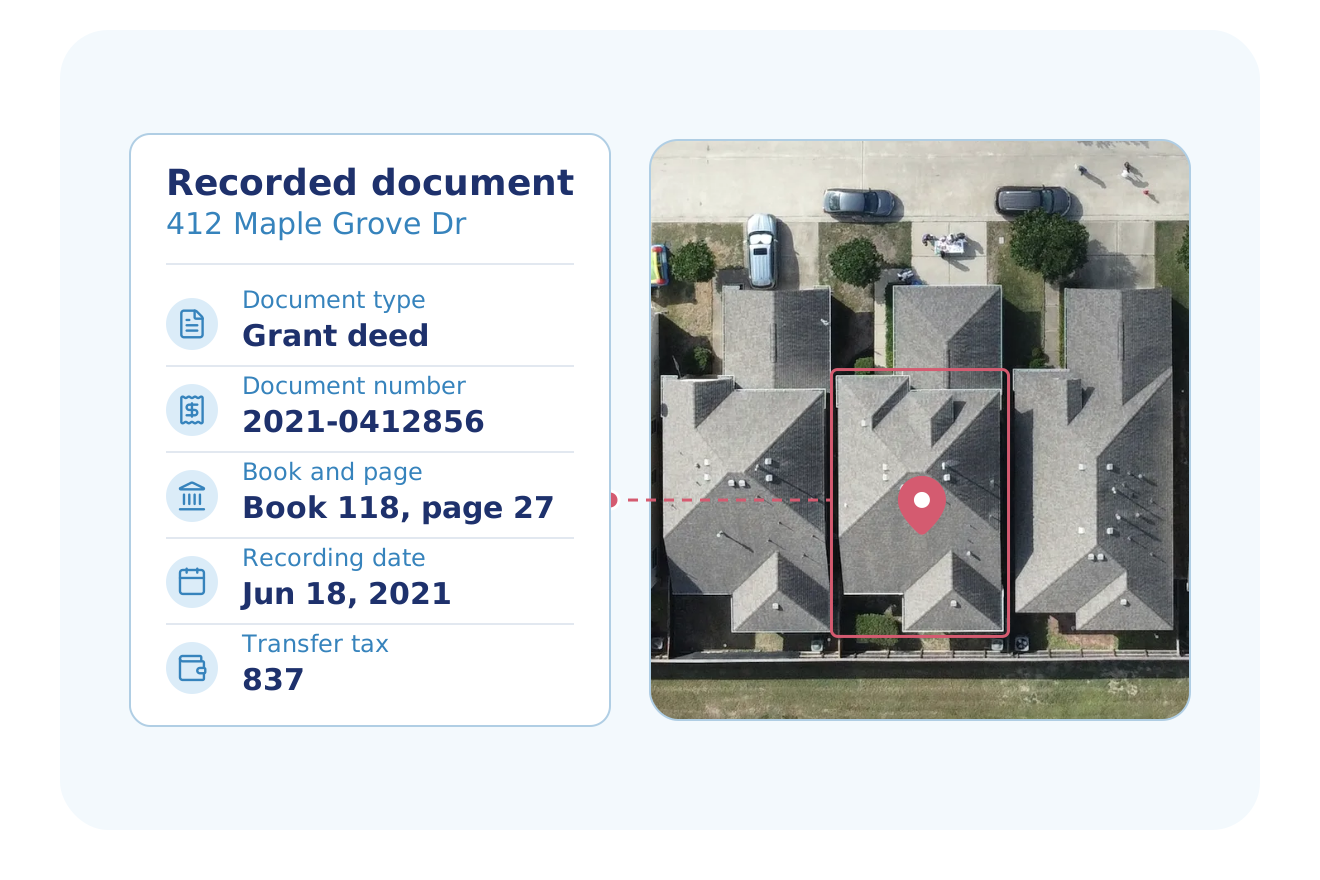
Use the recorder references to find the deed at the county and to join records.
- Recorder document number, book and page
- Transaction ID for each record
- Transfer tax and sale price qualifier
Built for Your Industry
See how each industry uses this data.
PropTech & Software
Show sale dates, prices, buyers, sellers and deed types on each property page.
Explore PropTech & SoftwareConstruction & Builders
Read the sale price, the recording date and the document type from deed records for lots and homes in a market.
Explore Construction & BuildersMortgage & Lending
Read sale dates, prices and deed types for the homes you finance, next to their mortgages.
Explore Mortgage & LendingProperty Services
Read the buyer named on each deed and the sale date for the buildings you serve.
Explore Property ServicesReal Estate Investing
Read each sale price and date, and spot foreclosure sales and resales after foreclosure, before you make an offer.
Explore Real Estate InvestingInsurance
See when a property sold, who bought it and the deed type, so a policy record matches the new owner.
Explore InsuranceAgents & Brokerages
Show an owner the sale history of a home: each sale price and date, and the type of deed.
Explore Agents & BrokeragesHome Services
Read the buyer's name and the sale date from the deed record of each home.
Explore Home ServicesFlexible Delivery Options
Choose the integration method that fits your workflow
Real-Time API
Get the deed history of a property in the same call as its other subscribed data.
- RESTful JSON API
- Property Search and Lookup return all subscribed datasets in one call
- Async delivery to your webhook for large batches
- Developer docs and no-cost sandbox tokens
Bulk Data
Nationwide deed history files for your data warehouse or data lake.
- Choose the datasets and markets you need
- Amazon S3, SFTP or Google Drive delivery; Snowflake and Databricks through Cloud Delivery
- CSV, JSON and Parquet formats
- Weekly, monthly, quarterly or annual deliveries
- Full refresh or delta files
MCP Server
Your AI assistant looks up the sale history of a property through the MCP server. Your account sets which datasets the tool returns.
- Your AI assistant calls BatchData tools to look up and search properties
- Connects to Claude, ChatGPT, Cursor and Claude Code with OAuth sign-in
- Runs on the same API, with datasets set by your account admin
Professional Services
Our Professional Services team helps you choose the deed fields, set up the delivery and match the data to your records.
- Help choosing datasets, delivery cadence and destination
- Account manager help with token and dataset setup
- Support by email and in-app chat
- Upload a CSV or Excel file and get property data back in the same file
Why BatchData
What You Get With BatchData
One source for property, owner and contact data, by API or by file.
3,100+ Counties
Records from 3,100+ U.S. counties, covering 169M+ parcels.
1,000+ Data Points
Owner, value, mortgage, tax, permit and listing data, with 1,000+ data points for each property.
API or File Delivery
Call the API, or get files in Snowflake, Databricks, Amazon S3, SFTP or Google Drive.
Frequently asked questions
What is deed history data?
BatchData deed history is the list of deeds and sales recorded for a property. Each record names the buyer and the seller, and holds the sale price, the sale and recording dates and the type of deed. Records come back in one standard format.
What is in BatchData's deed history data?
BatchData's deed history holds one record for each recorded deed or sale of a property. Each record covers the buyers and sellers, the sale price, and the sale, recording and document dates. It also covers the deed type, the recorder references, the transfer tax and the sale type flags.
How is deed history different from the sale fields in assessor data?
Deed history is a full list of recorded deeds, while assessor data holds the last and prior sale of a property. Each deed record in deed history covers the buyer, the seller, the price and the dates.
Which deed types does BatchData's deed history include?
BatchData deed history records carry the type of each recorded deed, such as warranty, quitclaim or trustee's deed. The types also include sheriff's deed, tax deed and deed in lieu of foreclosure. The sale price qualifier, such as full or partial consideration, is a separate field.
Can I tell a foreclosure sale from other sales in deed history?
Yes, BatchData deed history has a flag for a sale at auction or a repossession by a lender. A second flag marks a sale by a lender back to the open market after a foreclosure. Other flags mark resales and new construction.
Can I search by deed fields?
Yes, BatchData Property Search filters on the last sale's price, date and document type, and on the seller of the last two sales. The deed history list comes back in the response and has no filters of its own. Deed history is sold as an add-on to a Property Data plan.
Start with deed and sales data
Talk to a data expert about the deed fields, delivery options and pricing for your team.