


































When deciding how to structure your real estate investments, LLCs and trusts are two popular options, each offering unique benefits. An LLC helps protect your personal assets from lawsuits tied to your property, while a trust focuses on estate planning, privacy, and avoiding probate. Many investors use both to combine liability protection with long-term asset management.
Key Takeaways:
- LLCs: Ideal for day-to-day property management and shielding personal assets from legal risks. Using a precision property search can help identify the right assets for this structure. Rental income is taxed as "pass-through", avoiding double taxation.
- Trusts: Best for passing property to heirs, skipping probate, and maintaining privacy. Revocable trusts don’t offer liability protection, but irrevocable trusts can shield assets from creditors.
- Combined Use: Placing LLC ownership inside a trust can provide both liability protection and estate planning benefits.
Quick Comparison:
| Feature | LLC | Revocable Trust | Irrevocable Trust |
|---|---|---|---|
| Primary Purpose | Liability protection | Estate planning | Asset protection |
| Taxation | Pass-through (individual) | Taxed to grantor | Compressed tax brackets |
| Liability Shield | Strong | None | Strong |
| Probate Avoidance | No | Yes | Yes |
| Privacy | Moderate (varies by state) | High | High |
| Control Retained | High | High | Low |
For active property management, an LLC is often the better choice. For estate planning and privacy, trusts excel. Combining both can maximize protection and streamline asset transfers.
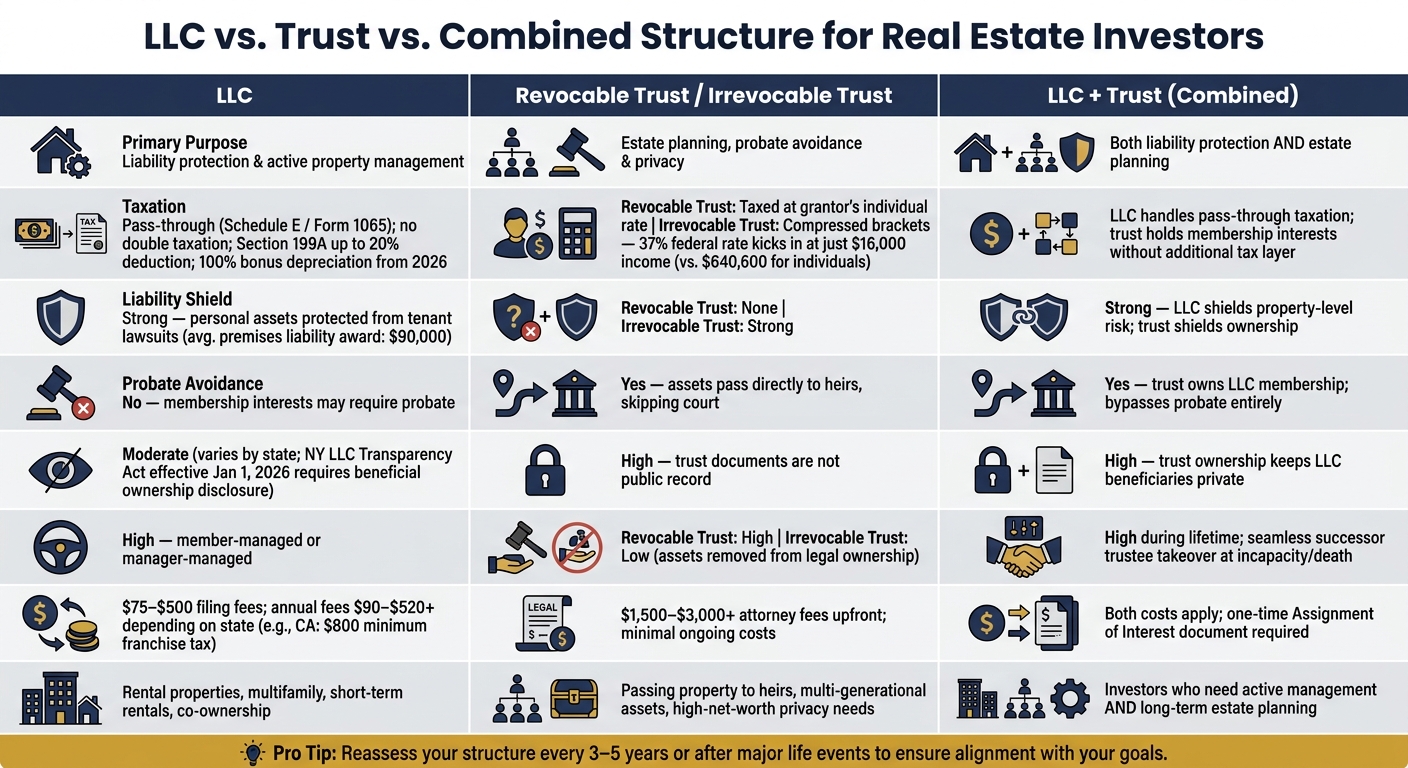
LLC vs. Trust vs. Combined: Real Estate Structure Comparison
Trust v LLC Which one is BEST for Real Estate?
sbb-itb-8058745
LLC vs. Trust: A Quick Overview
Before diving into taxes and liability, it’s important to grasp the core purpose of each structure.
What Is an LLC?
An LLC (Limited Liability Company) is a formal business entity created by filing Articles of Organization with your state. Its primary role is to separate your personal assets from the risks tied to property ownership. For instance, if a tenant sues you over a slip-and-fall accident, the LLC acts as a legal barrier, shielding your personal finances from the claim.
LLCs are built for active management: signing leases, hiring contractors, managing expenses, and collecting rent. As InCorp Services explains:
"LLCs are the default choice for many real estate investors because they combine limited liability protection, pass‑through taxation, and relatively simple ongoing compliance."
The cost to form an LLC varies by state, typically ranging from $75 to $500 in filing fees. Additionally, annual report fees can exceed $300 in some states.
What Is a Trust?
A trust isn’t a business entity but a fiduciary arrangement. It creates a legal framework where a trustee holds property on behalf of beneficiaries. Its main focus is estate planning – deciding how your assets are distributed after death or if you become incapacitated – while avoiding probate court.
Unlike LLCs, trusts don’t handle daily operations. As Luke Babich, Co-founder of Clever Real Estate, puts it:
"A trust has less to do with a property’s location or use and more to do with the management of the property."
Setting up a revocable living trust through an attorney usually costs between $1,500 and $3,000+ upfront. Ongoing costs are minimal once the trust is properly funded, which involves retitling property deeds into the trust’s name. Without this step, the trust offers no protection.
Here’s a quick comparison to highlight the differences:
| Feature | LLC | Trust |
|---|---|---|
| Primary Purpose | Business operations and liability protection | Estate planning, privacy, and probate avoidance |
| Management Style | Active (leases, repairs, tenants) | Passive (holding and transferring assets) |
| Liability Shield | Strong statutory protection | Limited (revocable) to strong (irrevocable) |
| Probate | Membership interest may require probate | Bypasses probate entirely |
| Ongoing Costs | Annual state fees and reports | Minimal once established and funded |
These distinctions lay the groundwork for understanding how each option handles taxes and liability protection.
Tax Treatment: LLCs vs. Trusts
Taxes often play a crucial role when deciding between an LLC or a trust. The tax differences between these two structures are substantial, influencing how they handle liability management and long-term financial planning.
Pass-Through Taxation in LLCs
The IRS treats LLC income as "pass-through", meaning the income flows directly to the owners without being taxed at the corporate level. For single-member LLCs, rental income is reported on Schedule E, while multi-member LLCs file Form 1065 with accompanying K-1 forms. This setup avoids double taxation entirely.
Rental income is considered passive, so it’s not subject to the 15.3% self-employment tax. As Martin Maxwell, Founder & Head of Research at REI PRIME, explains:
"Rental income from real estate – collecting rent, paying property taxes, doing maintenance, signing leases – is treated as passive income by default, and passive income is not subject to self-employment tax."
LLC owners may also qualify for the Section 199A deduction, which allows up to 20% of qualified business income to be deducted from federal taxable income. Additionally, under the One Big Beautiful Bill Act (OBBBA) starting in 2026, bonus depreciation has been restored to 100%, enabling investors to immediately write off qualifying property improvements. These provisions can significantly lower an investor’s annual tax burden.
Another advantage: LLCs taxed as partnerships maintain the step-up in basis at death. This can save heirs a considerable amount in capital gains taxes. For example, if a property appreciates from a $120,000 basis to $600,000, heirs could save between $95,000 and $115,000 in taxes.
Tax Rules for Trusts
Unlike LLCs, trusts follow different tax rules, and these vary depending on whether the trust is revocable or irrevocable.
A revocable trust is tax-transparent, meaning income is reported on the grantor’s personal tax return at their individual rate. As Danielle Justo and Yana Zheng from Rich May, P.C. point out:
"A revocable trust is primarily an estate planning tool… it generally does not reduce tax exposure."
An irrevocable trust, however, becomes its own taxpayer once assets are transferred into it. But this comes with a major downside: trust tax brackets are highly compressed. Starting in 2026, a trust will hit the top 37% federal marginal tax rate with just $16,000 of taxable income, compared to $640,600 for a single individual filer. Similarly, the 3.8% Net Investment Income Tax (NIIT) applies at the same $16,000 threshold for trusts, as opposed to $200,000 for individuals.
To reduce the tax burden, trustees of non-grantor trusts can distribute income to beneficiaries who are taxed at lower individual rates.
| Feature | Revocable Trust | Irrevocable (Non-Grantor) Trust |
|---|---|---|
| Taxpayer | The grantor (individual) | The trust or beneficiaries |
| Tax Rates | Individual marginal rates | Compressed (37% at $16,000) |
| Estate Tax Inclusion | Included in grantor’s estate | Can be excluded |
| NIIT Threshold | $200,000 (individual) | $16,000 (trust) |
| Step-Up in Basis | Yes, at death | Depends on structure |
How State Laws Affect Taxes
State-specific rules can heavily influence tax outcomes for both LLCs and trusts. For example:
- California imposes an $800 minimum annual franchise tax on LLCs regardless of income or profit.
- Illinois applies a 1.5% personal property replacement tax on partnership income.
- New York requires LLC owners to publish a formation notice in local newspapers, adding $500–$1,500 in extra costs.
On the positive side, 36 states and New York City have enacted Pass-Through Entity Tax (PTET) laws, allowing LLC owners to deduct state taxes at the entity level. This effectively bypasses the federal SALT deduction cap of $40,000 under the OBBBA. If you own property in a state with PTET elections, this can reduce your overall tax burden.
For trusts, state laws add an extra layer of complexity. Some states tax fiduciary income separately, and transferring property into an irrevocable trust in California can trigger a property tax reassessment under change-of-ownership rules. This could significantly increase your annual tax bill unless a specific exclusion applies. However, if you own real estate in multiple states, placing those properties in a revocable trust can help you avoid ancillary probate costs in each state, even though it won’t lower your income taxes.
"The 2026 entity decision is driven by your INCOME TYPE, not your entity preference – passive vs active is the line that matters." – Martin Maxwell, Founder, REI PRIME
Liability Protection: Keeping Your Assets Safe
For real estate investors, protecting assets from potential legal risks is a critical part of safeguarding financial stability. But what steps can you take to ensure your personal wealth remains secure if a lawsuit arises?
How LLCs Limit Personal Liability
An LLC (Limited Liability Company) acts as a protective barrier between your personal finances and your rental property. As John Heiser of WSFS Private Banking puts it:
"When an LLC owns a property, the company becomes the legal owner, and your assets from lawsuits related to that property are protected. If legal action occurs, only LLC assets are at risk, not your personal wealth."
This means if a tenant sues, the claim is directed at the LLC, not your personal assets. Considering that the average award in premises liability cases where landlords are found at fault is $90,000, this layer of protection is crucial. For those managing multiple properties, creating separate LLCs for each one adds an extra layer of security. A lawsuit involving one property won’t endanger the equity in others. Additionally, because the LLC’s name appears on public deeds instead of your own, it might discourage frivolous lawsuits.
However, to maintain this protection, it’s essential to separate personal and business finances. Using personal accounts for LLC-related expenses or signing leases under your own name can lead to courts "piercing the corporate veil", exposing your personal assets to liability. Keep in mind that an LLC should work alongside comprehensive insurance, such as landlord coverage and an umbrella policy, to provide complete protection.
While LLCs handle operational liability, trusts offer a different approach to asset protection.
Asset Protection Through Trusts
Trusts safeguard assets by creating a legal and, in some cases, private separation from your personal estate. However, not all trusts offer the same level of protection.
A revocable trust keeps assets under your control but provides no protection from lawsuits or creditors. Since these assets remain part of your personal estate, they are just as vulnerable as if held in your name.
An irrevocable trust, on the other hand, removes assets from your legal ownership entirely. By giving up control, these assets are typically shielded from personal creditors. The downside? You lose flexibility in managing or reclaiming the property.
Where trusts truly shine is in privacy. Structures like land trusts and real estate privacy trusts can obscure ownership in public records, making it harder for potential claimants to determine what you own. This is becoming increasingly relevant with the upcoming New York LLC Transparency Act, set to take effect on January 1, 2026. The act requires LLCs to disclose beneficial ownership, prompting more investors to consider trusts for maintaining confidentiality.
| Feature | LLC | Revocable Trust | Irrevocable Trust |
|---|---|---|---|
| Lawsuit Shield | Strong | None | Strong |
| Creditor Protection | Strong | None | Strong |
| Privacy | Moderate (varies by state) | High | High |
| Control Retained | High | High | Low |
This table highlights the unique strengths of LLCs and trusts in protecting assets. For active real estate investors, LLCs often strike the best balance between liability protection and operational flexibility – provided formalities are followed. Irrevocable trusts, while offering strong creditor protection, come with significant trade-offs in control. Ultimately, the right choice depends on your specific needs and long-term goals.
Estate Planning and Probate: Making Asset Transfers Easier
The way you hold real estate can significantly impact both asset protection during your lifetime and how smoothly those assets transfer to your heirs.
How Trusts Help You Avoid Probate
Using a trust allows assets to pass directly to beneficiaries, skipping the often lengthy, expensive, and public probate process. As Attorney Tom Torr of Cocheco Elder Law Associates PLLC explains:
"The minute something goes through probate, the perception is: this is a fire sale."
In cases of incapacity, a successor trustee can step in immediately to manage the property, eliminating the need for court involvement. Trusts also maintain privacy, keeping details about asset transfers and heirs confidential. For 2026, the federal estate and gift tax basic exclusion amount is set at $15,000,000 per individual, meaning most people won’t face federal estate taxes. However, avoiding probate remains a key benefit, regardless of tax thresholds.
These advantages make trusts a practical tool for ensuring a smooth and private transfer of assets.
LLCs and Estate Planning
On the other hand, individually owned LLCs are subject to probate when the owner passes away. As Tom Torr notes:
"An LLC on its own doesn’t avoid probate. If your name is the only one on the LLC and you pass away, the LLC becomes part of your probate estate."
An LLC held in your name alone can face delays in transferring assets, create public records, and complicate property management. However, you can avoid these issues by transferring your LLC membership interests into a trust. This requires a formal Assignment of Membership Interest document. Once the trust owns the LLC, a successor trustee can manage it immediately upon your death or incapacity, bypassing probate entirely.
Before making this transfer, check your LLC’s operating agreement for any restrictions or requirements, such as needing member consent. Additionally, consult your lender, as some loan agreements include due-on-transfer clauses that could be triggered by changes in LLC ownership. After the transfer, update the LLC’s membership ledger and sign future contracts as "[Your Name], Trustee of the [Trust Name], Member of [LLC Name]" to ensure legal clarity.
These probate-related considerations have a direct impact on tax strategies and asset protection. Delays in asset transfers can disrupt income, while public probate records might expose ownership details, reducing the privacy and liability benefits LLCs are designed to provide.
Here’s a comparison of trusts and LLCs in estate planning:
| Feature | Revocable Trust | LLC (Individually Owned) |
|---|---|---|
| Probate Avoidance | Yes; assets pass directly to heirs | No; membership interests must be probated |
| Privacy | High; trust terms are not public | Lower; public filings list owners/managers |
| Incapacity Planning | Strong; successor trustee acts immediately | Weak; may require court-appointed conservatorship |
| Liability Protection | None (for revocable trusts) | Strong; shields personal assets from property risks |
Ownership and Control: Who Runs the Property?
The day-to-day management of an LLC or trust is guided by its governing document. For an LLC, this is the operating agreement; for a trust, it’s the trust agreement. These documents spell out who holds authority, how decisions are made, and what happens during ownership transitions.
LLC Operating Agreements
An LLC’s operating agreement lays out the rules for ownership, profit distribution, and decision-making. It defines each member’s ownership percentage and clarifies who can sign contracts, manage bank accounts, or approve major decisions.
LLCs can operate in two ways:
- Member-managed LLCs: The owners handle daily operations themselves.
- Manager-managed LLCs: Members appoint someone (or an entity) to oversee operations, allowing owners to step back from day-to-day involvement.
As noted by Munizzi Law Firm:
"LLCs afford investors a range of choices in management structures and tax treatments, enabling tailored strategies that align with specific operational and financial objectives."
However, LLCs come with administrative responsibilities. These include maintaining separate bank accounts, filing annual state reports, and documenting business decisions. These steps are essential for preserving liability protection. Trust agreements, on the other hand, offer a different approach to property control.
Trust Agreements and Trustees
While LLCs are designed for active management, trusts focus on long-term oversight. A trust agreement appoints a trustee to hold legal title to the property and manage it according to the trust’s terms. Trusts involve three key roles:
- Grantor: The person who creates the trust.
- Trustee: The individual or entity managing the trust.
- Beneficiary: The person or group benefiting from the trust.
In a revocable living trust, the grantor often serves as their own trustee during their lifetime, maintaining full control. If the grantor passes away or becomes incapacitated, a successor trustee automatically takes over, ensuring smooth management without court involvement. While trusts are excellent for long-term planning and asset transfer, they aren’t as practical for active property management, as trust documentation can complicate routine transactions compared to LLC filings.
Trustees also have stricter legal obligations than LLC managers. As InCorp Services explains:
"The fiduciary duty requires trustees to manage assets solely for the beneficiaries’ benefit, creating legal obligations that exceed those governing corporate directors or LLC managers."
Here’s a quick comparison of how control differs between an LLC and a trust:
| Feature | LLC | Trust |
|---|---|---|
| Governing Document | Operating Agreement | Trust Agreement |
| Key Roles | Members and Managers | Grantor, Trustee, and Beneficiary |
| Management Style | Active; member-managed or manager-managed | Passive; trustee manages per trust terms |
| Day-to-Day Operations | Built for active transactions | May be less suited for routine tasks |
| Succession | Defined in the operating agreement (may involve probate) | Automatic transfer to successor trustee |
Choosing between these structures impacts not just daily management but also your broader strategies for taxes and asset protection.
When an LLC Is the Right Choice
An LLC can be a smart option when active management and immediate legal protection are top priorities. It offers flexibility and safeguards that make it particularly appealing for certain types of ventures.
Ideal for Rental Properties and Co-Ownership
LLCs are a great fit for rental properties – whether it’s buy-and-hold rentals, multifamily units, or short-term rentals. These types of investments often come with operational risks, like tenant injuries or maintenance disputes. With an LLC, those risks are contained within the business, keeping your personal assets out of harm’s way. This is a major advantage over general partnerships, where all partners could face unlimited liability. Plus, an LLC’s operating agreement clearly lays out ownership percentages and liability, making things more structured and secure.
"LLC structure is how I protect every single one of my multifamily investments from liability. I’ve seen investors lose everything to tenant lawsuits because they used the wrong legal entity." – Rod Khleif, Multifamily Real Estate Mentor
Some investors take this a step further with the "PropCo" strategy, setting up a separate LLC for each property to isolate risks even more effectively.
Better Legal Protection for Property Owners
Operating as a sole proprietorship leaves no separation between your personal assets and your business liabilities. An LLC, on the other hand, creates a legal barrier. To maintain this protection, it’s essential to keep separate bank accounts, sign contracts under the LLC’s name, and ensure your insurance policies reflect the LLC as the owner.
Setting up an LLC comes with costs, which range from $500 to $3,500 depending on the state. Annual fees also vary, from about $90 in Delaware to $520 in Massachusetts.
"An LLC provides the strongest overall liability protection. It protects assets outside the LLC from property-related liabilities…" – Danielle Justo and Yana Zheng, Rich May, P.C.
Tax considerations also play a role. The IRS treats rental income as passive income, and S-Corporations face penalties if more than 25% of their revenue comes from passive sources. This makes LLCs a better choice for managing rental portfolios.
Next, we’ll dive into when a trust might make more sense, especially for estate planning and avoiding probate.
When a Trust Is the Right Choice
If you’re focused on legacy planning – ensuring a smooth and private transfer of property to the next generation – a trust might be your best option. While an LLC is great for managing active rental portfolios, a trust shines when it comes to long-term planning. Trusts are particularly useful for inheritance and privacy, offering advantages that LLCs can’t match. As InCorp Services explains:
"Trusts are best viewed as estate‑planning and privacy tools, often layered on top of LLCs or corporations to handle probate avoidance, succession, and confidentiality rather than day‑to‑day business operations."
Best for Passing Property to Heirs
One of the key benefits of a trust is the level of control it provides over how and when assets are distributed. Unlike a standard deed transfer, a trust allows you to set specific conditions, stagger distributions, or include protections like spendthrift clauses. This flexibility is especially important for multi-generational properties, like family ranches or vacation homes, where dividing ownership among multiple heirs could lead to disputes or complications.
"A trust can decide who benefits, when they benefit, and who controls the assets over time." – UltraTrust
This level of customization helps avoid conflicts and ensures that assets are managed and distributed according to your wishes.
Skipping Probate and Keeping Ownership Private
Probate – the legal process of distributing a deceased person’s assets – can be both time-consuming and costly. For example, a $2.1 million real estate portfolio could face delays of up to 12 months and rack up $22,000 in legal and administrative fees during probate. A trust eliminates these hurdles. When properly funded, it bypasses the probate process entirely, allowing assets to transfer directly to beneficiaries without court involvement.
Privacy is another major advantage of using a trust. Unlike LLC filings, which are often public records, trust documents keep ownership details confidential. This feature is particularly appealing to high-net-worth individuals who value discretion.
"A revocable trust is primarily an estate planning tool. Its biggest advantage is avoiding probate, which allows properties held in the trust to pass directly to beneficiaries without going through a court process." – Danielle Justo and Yana Zheng, Rich May, P.C.
Using Both Structures Together
Real estate investors can gain a lot by combining an LLC with a trust. This approach leverages the liability protection of an LLC alongside the estate planning benefits of a trust, creating a comprehensive solution for managing and protecting assets.
Placing LLC Ownership Inside a Trust
Here’s how it works: the LLC holds the property title, acting as a shield against liability – for example, a tenant injury lawsuit won’t jeopardize your personal assets. Meanwhile, the trust owns the membership shares of the LLC, keeping ownership private and avoiding probate.
"The LLC protects against property-related lawsuits while the Trust shields ownership from probate and maintains privacy." – InCorp Services
To set this up, follow these steps:
- Form the LLC and draft its operating agreement.
- Establish the trust.
- Execute an Assignment of Interest to transfer the LLC membership shares to the trust.
- Update the LLC’s records to reflect the trust as the new owner.
That last step is crucial. If the LLC’s ownership records don’t list the trust, the LLC membership could still go through probate, undermining the entire purpose of the arrangement. This setup also enhances privacy, as the trust’s details aren’t public.
By layering these structures, you’ll streamline asset management while ensuring strong protections for both day-to-day operations and long-term planning.
Balancing Day-to-Day Management with Long-Term Planning
The beauty of this structure lies in its balance. The LLC handles the daily operations – like signing leases, hiring contractors, and collecting rent – while the trust acts as a passive ownership vehicle, focused on long-term goals. As attorney Aaron Kra, JD, explains:
"If the pain is ‘what happens when I die or I’m incapacitated,’ I lean trust. If the pain is ‘tenants, customers, vendors, and ongoing activity,’ I lean LLC. If I need both clean transfers and a risk boundary, I use both."
To keep things simple, it’s often best to name one person as both the LLC manager and the trustee. This avoids confusion and ensures that if the owner becomes incapacitated, a successor trustee can seamlessly take over LLC management without court involvement. For investors with multiple properties, a common strategy is to use a separate LLC for each property to isolate risks, with all LLCs held under a single trust to simplify the estate plan.
However, there are a few key considerations. If the property has a mortgage, you’ll need written lender consent before transferring it into an LLC. Unlike transfers to a revocable trust, this move could trigger a lender’s due-on-sale clause, requiring the mortgage to be paid off. Additionally, review your insurance policies after restructuring to ensure the correct entities are listed as insured parties.
Conclusion: Choosing the Structure That Fits Your Goals
When weighing the tax advantages and legal protections of LLCs and trusts, it’s all about pinpointing what fits your priorities. An LLC creates a legal shield around personal assets, while a trust keeps ownership private and sidesteps probate.
LLCs are ideal for liability protection and managing operations, whereas trusts shine in estate planning and avoiding probate complications.
If you need the benefits of both, combining these structures can offer a well-rounded solution. It’s a good idea to reassess your setup every 3–5 years or after significant life events. Aligning your structure with your goals ensures stronger asset protection and a more effective tax strategy, often supported by comprehensive real estate data.
FAQs
Should I put my rental property in an LLC or keep it in my name with insurance?
Deciding whether to place your rental property under an LLC or keep it in your name with insurance largely depends on your specific priorities.
An LLC can provide a layer of liability protection by separating your personal assets from those tied to the property. However, transferring a property into an LLC may trigger transfer taxes or create hurdles with financing, as some lenders may require refinancing under the LLC.
On the other hand, keeping the property in your name is a more straightforward option. It avoids the complexities of an LLC but doesn’t offer the same liability protection. Relying solely on insurance might leave you more exposed in the event of a lawsuit.
For those focused on estate planning, a trust could be a better fit. Trusts help avoid probate and streamline the transfer of assets to heirs, but they won’t protect you from lawsuits tied to the property.
To make the best choice, it’s essential to consult with legal or financial professionals who can address your unique situation and goals.
Will transferring an LLC into my trust trigger a mortgage due-on-sale clause?
Transferring a mortgaged property into an LLC can activate a due-on-sale clause, as the federal protections provided by the Garn-St. Germain Act generally don’t extend to LLCs. On the other hand, transferring property into a living trust where you remain the beneficiary is typically exempt from this clause. To avoid complications, it’s important to review your loan documents carefully or obtain written approval from your lender before making any transfers. For guidance with real estate decisions, tools like those offered by BatchData can be helpful.
How do trust tax brackets affect rental income compared to an LLC?
An LLC is generally treated as a pass-through entity for tax purposes. This means rental income flows directly to your personal tax return, helping you avoid the issue of double taxation.
In contrast, trusts are subject to compressed tax brackets. For example, starting in 2026, trusts reach the highest federal tax rate of 37% once income exceeds just $16,000. To put that into perspective, a single filer doesn’t hit the same 37% rate until their income surpasses $640,600. If trust income remains undistributed, the taxes can add up quickly compared to reporting the income on an individual return.