
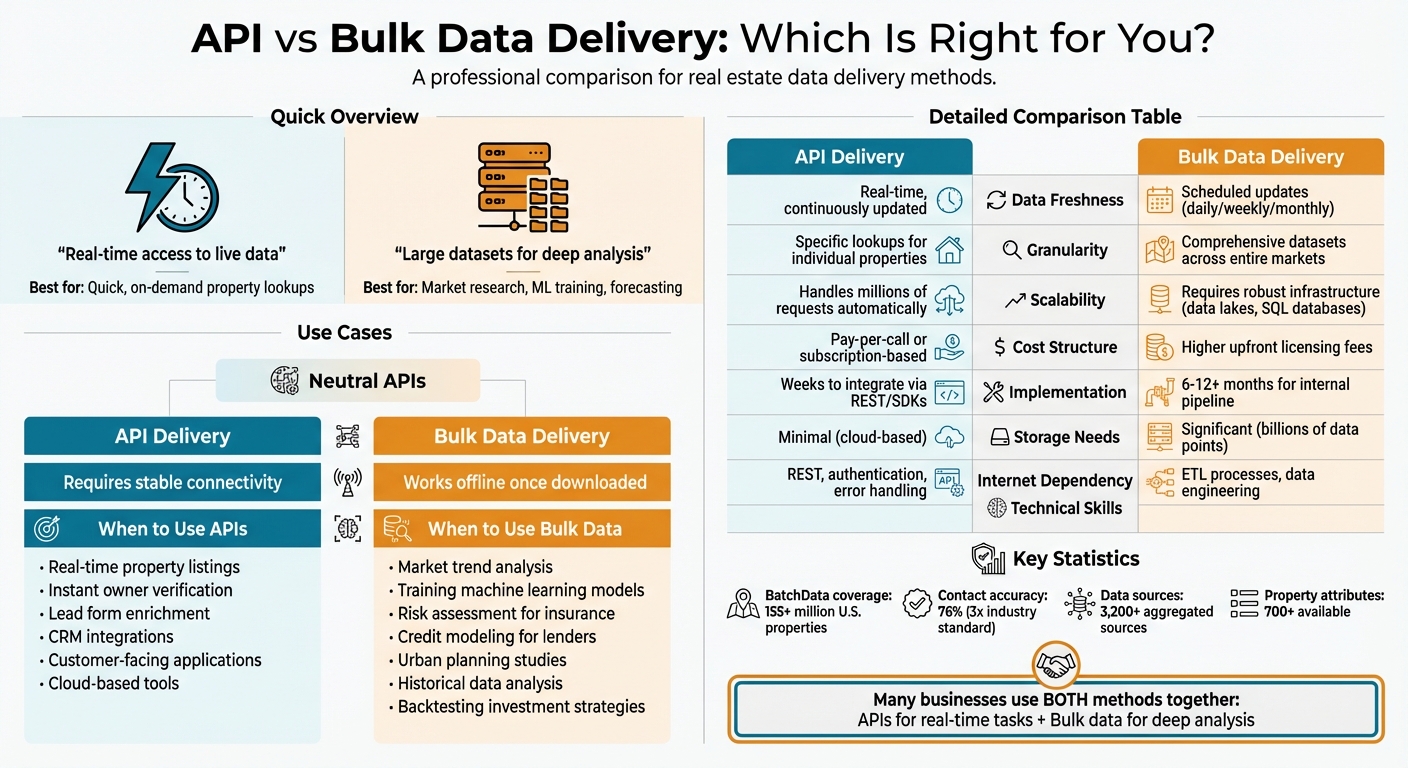
When deciding how to access real estate data, you have two main options: APIs and bulk data delivery. Here’s the gist:
- APIs give you real-time access to live data for quick, on-demand use. They’re ideal for tasks like verifying property details instantly or powering applications that need up-to-date information.
- Bulk data provides large datasets for deeper analysis and long-term projects. It’s best for tasks like market research, forecasting, or training machine learning models.
Key Differences:
- APIs: Real-time access, pay-per-use pricing, minimal storage needs, but requires stable internet and technical skills for integration.
- Bulk data: Scheduled updates, large upfront costs, requires significant storage and processing, but gives full control over data.
Quick Comparison:
| Factor | API Delivery | Bulk Data Delivery |
|---|---|---|
| Data Freshness | Real-time | Scheduled updates |
| Granularity | Specific lookups | Comprehensive datasets |
| Scalability | Handles millions of requests | Requires robust infrastructure |
| Cost | Usage-based pricing | Upfront licensing fees |
| Ease of Use | Easier to integrate | Requires advanced engineering |
Many businesses use both methods together: APIs for fast, real-time tasks and bulk data for in-depth analysis. Your choice depends on your needs, budget, and technical setup.
API vs Bulk Data Delivery for Real Estate: Complete Comparison Guide
Bulk Data Processing vs API – Which Is Best for Your Business?
API Delivery: Real-Time Data Access
Let’s dive deeper into how APIs enable seamless access to real-time real estate data.
What is a Property Data API?
A property data API (Application Programming Interface) serves as a direct link between your software and a live database packed with real estate insights. Instead of dealing with manual data entry or static files, your application can send a specific query – like "Who owns 123 Main Street?" – and get a structured response in mere milliseconds. This process replaces outdated spreadsheets with automated, continuously updated data pulled straight from official records.
Benefits of API Delivery
APIs offer instant, on-demand access to data, eliminating the need for local storage or complex extraction and transformation workflows. They’re built to handle massive volumes of requests, making them scalable for both small startups and large enterprises. For example, BatchData’s contact data boasts a 76% right-party contact accuracy rate, which is three times the industry standard. Plus, their SDKs for Python and Node.js make integration into your existing workflows a breeze.
"What used to take 30 minutes now takes 30 seconds. BatchData makes our platform superhuman." – Chris Finck, Director of Product Management
Drawbacks and Technical Needs
The main challenge with APIs is their reliance on network connectivity – if the network or API provider experiences downtime, your application might fail to deliver data to users. Additionally, APIs often come with rate limits or daily usage caps, which can restrict high-volume operations like scanning large property portfolios. Overcoming these limits may require negotiating higher tiers or batching requests effectively.
APIs also demand technical expertise. Developers need to be proficient in REST, authentication methods (like API keys or OAuth), error handling, and pagination. For large-scale operations, such as nightly processing of millions of properties, per-call costs can sometimes outweigh the savings of bulk licensing and in-house data processing.
When to Use APIs in Real Estate
APIs shine in real-time, event-driven workflows. They’re perfect for scenarios where up-to-date information is critical, such as displaying fresh property listings – including status, price, and days on market – in real time for agents or consumers. They’re also ideal for cloud-based applications, helping reduce the need for on-premises databases or complex ETL pipelines.
APIs are particularly useful for enriching or verifying data on the fly. For example, during lead form submissions, account creation, or skip tracing, APIs can instantly append verified owner data as users input property addresses. In a CRM, this means agents can access accurate, real-time property details without delay.
BatchData‘s API Services
BatchData offers a comprehensive suite of APIs tailored for real estate professionals:
- Property Search API: Provides real-time access to over 700 property attributes.
- Skip Tracing API: Delivers verified contact information with 76% accuracy.
- Address Verification: Cleanses mailing lists for accuracy.
- Phone Verification: Scrubs disconnected numbers and checks against Do Not Call and litigator lists.
- Geocoding API: Supplies precise location coordinates.
BatchData’s flexible pricing options cater to various needs, from pay-as-you-go plans for startups with unpredictable demand to subscription tiers for consistent usage. For enterprises, they offer custom plans with increased rate limits and dedicated infrastructure to handle high-volume workloads effortlessly.
Bulk Data Delivery: Large-Scale Datasets
Bulk data delivery is a solution designed for businesses that require extensive datasets to support deep analysis and informed decision-making.
What is Bulk Data Delivery?
Bulk data delivery involves providing entire property datasets directly to your internal systems, bypassing the need for individual API calls. These datasets include everything from assessor characteristics to mortgage histories and are delivered in formats like CSV, JSON, Parquet, or pipe-delimited files. Transfers occur via AWS S3 buckets, SFTP, or through cloud platforms like Snowflake, BigQuery, and Databricks. The data is pre-cleaned and standardized, making it ready for immediate use. This method is ideal for large-scale analysis, offering a more efficient alternative to piecemeal data collection.
Benefits of Bulk Data
Bulk data delivery is an economical way to handle large-scale datasets, giving you full control over how the data is used. For tasks like analyzing millions of properties, conducting market research, or training machine learning models, bulk licensing is far more cost-effective than traditional API pricing. With bulk datasets, you can integrate the data into proprietary models without relying on external system uptime or network stability.
BatchData’s bulk datasets cover over 155 million U.S. properties, accounting for 99% of the population. The data is aggregated from more than 3,200 sources, ensuring reliability even during county-level outages. This extensive coverage, often including historical data, enables long-term trend analysis and forecasting – something that real-time API calls simply can’t match.
"Bulk data licensing… is the most efficient way to acquire comprehensive real estate intelligence for analysis, product development, and strategic decision-making." – BatchData
However, bulk delivery does come with its own challenges.
Drawbacks and Infrastructure Needs
Handling bulk data requires substantial storage and processing capabilities. Managing billions of data points demands robust infrastructure and skilled data engineers to oversee tasks like ingestion, cleaning, validation, and standardization. Unlike APIs that provide continuous updates, bulk data is delivered on a set schedule – daily, weekly, or monthly – meaning your internal database might lag behind between updates. Additionally, managing sensitive information, such as property and ownership data, requires strict compliance with privacy regulations and strong security protocols.
When to Use Bulk Data in Real Estate
Bulk data delivery is best suited for scenarios requiring large-scale, comprehensive analysis. For example:
- Market research firms use it to analyze pricing trends across metropolitan areas.
- Insurance companies leverage it for risk assessments in underwriting.
- Lenders build proprietary credit models using population-wide data.
- Urban planners study development patterns using bulk datasets.
- Real estate tech companies train Automated Valuation Models (AVMs) and develop iBuyer platforms.
- Investors identify motivated sellers by analyzing financial distress indicators across extensive property portfolios.
BatchData’s Bulk Delivery Services
BatchData tailors its bulk datasets to meet your specific needs, whether you’re looking for nationwide data or a localized focus. Transfers can be scheduled via AWS S3, SFTP, or direct cloud sharing platforms like Snowflake, with formats such as Parquet for efficient storage or CSV for simpler database imports. Their datasets include over 700 property attributes, covering everything from assessor data and mortgage histories to demographics and pre-foreclosure records.
For added flexibility, BatchData’s Professional Services team offers custom integrations, data enrichment, and "match and append" services to clean and enhance your existing databases. You can also request data samples for your target areas to ensure compatibility with your systems before committing to a full license.
API vs Bulk Data: Side-by-Side Comparison
What We’re Comparing
Deciding between API and bulk data delivery comes down to six key factors: data freshness, granularity, scalability, cost structure, implementation effort, and compliance requirements. APIs are perfect for real-time property lookups in customer-facing applications, giving you instant access. On the other hand, bulk data delivery is ideal when you need large-scale datasets for tasks like market analysis or training machine learning models. Your choice will depend on whether your focus is on speed and flexibility (APIs) or full control over the data (bulk delivery).
Comparison Table
Here’s a quick breakdown of how APIs and bulk data delivery stack up against each other:
| Factor | API Delivery | Bulk Data Delivery |
|---|---|---|
| Data Freshness | Real-time access to live databases that are continuously updated | Periodic updates; platforms like Snowflake or BigQuery can provide near-real-time access |
| Granularity | Specific lookups for individual addresses or owners, ideal for transactional needs | Extensive datasets covering a wide range of property attributes across entire markets |
| Scalability | Handles millions of requests automatically; rate limits managed with techniques like exponential backoff | Supports massive datasets; scalability depends on your hardware or cloud storage capacity |
| Cost Structure | Pay-per-call or subscription-based pricing, making it flexible for startups or varying usage | Higher upfront licensing fees, often suited for larger, established businesses |
| Implementation Effort | Integrated via REST endpoints and SDKs; involves managing API keys and webhooks | Traditionally requires complex ETL processes, though modern tools like S3 or Snowflake simplify integration |
| Compliance | Comes with built-in tools like DNC and litigator scrubbing | Requires setting up internal security measures and ensuring privacy compliance for sensitive data |
APIs are great for businesses that need speed and minimal infrastructure management, while bulk delivery is better for those requiring full control over their data, even if it means more engineering work. As Mike Breed from The Warren Group explains, "APIs deliver agility; bulk licensing delivers sovereignty".
Many real estate companies actually use both – APIs for instant updates and on-demand lookups, and bulk data for deeper analysis of historical trends. Knowing how these methods differ will help you integrate the right combination of real-time updates and large datasets into your strategy.
How to Choose the Right Delivery Method
Decision Criteria
When deciding between APIs and bulk data delivery, the choice often depends on your specific workload and technical setup.
Workload Considerations: APIs are perfect for operational tasks requiring quick, on-demand access, such as real-time property lookups or verifying ownership details. On the other hand, bulk data delivery is better suited for large-scale analyses like backtesting investment strategies, training machine learning models, or creating market research reports. If you’re building tools like live-tracking dashboards, APIs shine with real-time updates. For historical analysis or trend forecasting, bulk feeds – delivered on a fixed schedule (daily or weekly) – are the better option.
Technical Infrastructure: Bulk data delivery requires significant internal resources, including data lakes, SQL databases, and dedicated engineering teams to handle and process large datasets. APIs, while easier to integrate, still demand robust maintenance and development. Building an internal pipeline for bulk data can take 6–12 months or more, while API integration is often completed in weeks. As Joshua Tauberer explains, "Bulk data, when possible, is always both less costly to implement and more powerful than a data API".
Cost Structure: Cost is another key factor. APIs typically operate on a usage-based pricing model, making them flexible for businesses with fluctuating needs. In contrast, bulk data delivery often requires a larger upfront investment but offers lower marginal costs for ongoing analysis.
Using Both Methods Together
Many real estate businesses find that combining APIs and bulk data delivery offers the best of both worlds. For instance, you could maintain a comprehensive database of over 150 million properties through bulk data delivery for in-depth historical analysis, while using APIs for real-time tasks like contact append (skip tracing) or retrieving the latest property details. This approach ensures operational tools remain fast and responsive, while analytical teams work with complete datasets.
To make this hybrid model work, it’s crucial to use consistent identifiers and enrichment logic across both data formats. This prevents discrepancies and ensures insights align. BatchData’s integrated solutions make it easy to adopt this strategy.
How BatchData Supports Both Approaches
BatchData provides flexible solutions for both real-time API access and large-scale bulk data delivery. With a database of over 150 million properties enriched with details like property characteristics, financial history, and ownership data, BatchData allows you to start with APIs for immediate operational needs and scale into bulk delivery as your analytical requirements grow.
For businesses exploring API integration, BatchData’s Pay-As-You-Go plan offers a low-commitment option. For those needing bulk feeds or custom data pipelines, the Custom Solutions plan delivers tailored datasets and professional support. BatchData’s team can help design workflows that balance speed and scale, enabling you to build a data strategy that evolves with your business needs.
Conclusion
Choosing between API and bulk data delivery depends on your business goals, technical setup, and specific use cases. APIs provide real-time access, making them ideal for tools that need instant property information, like customer-facing platforms or automated valuation models. On the other hand, bulk data gives you control and flexibility, perfect for deep analytics, machine learning training, or handling large volumes of data where cost per record is a key factor.
As Mike Breed from The Warren Group explains, "The best method (or a hybrid of both) depends on a clear-eyed assessment of your business model, technical capabilities, and growth trajectory". Many successful real estate companies don’t limit themselves to just one – they combine both approaches. Bulk data supports historical analysis and infrastructure, while APIs handle real-time updates and transactions.
Think about what you need: Are you aiming for rapid deployment with minimal infrastructure (go with APIs), in-depth offline analysis (opt for bulk data), or a mix of both? A hybrid approach might be the answer.
BatchData offers flexible solutions to match your needs, whether through Pay-As-You-Go API access or custom bulk data pipelines. With access to over 150 million enriched property records and expert support, you can create workflows tailored to your business. The right delivery method not only supports your current operations but also sets the stage for future growth.
FAQs
How do I decide between an API, bulk data, or both?
Choosing the right option – API, bulk data, or both – depends on what your business needs, how often you need data updates, and your overall workflow.
- APIs are perfect for real-time access to property information. They’re ideal for automating processes and making fast decisions.
- Bulk data is better suited for large-scale transfers, such as loading data initially or scheduling periodic updates.
By combining the two, you can enjoy the best of both worlds: real-time updates for immediate insights and bulk transfers for comprehensive, large-scale data management. This approach gives you a flexible and scalable way to handle your operations.
When do API rate limits make bulk delivery cheaper?
When data requests surpass an API’s capacity, rate limits can lead to throttling, delays, or increased costs due to the need for multiple calls. Bulk delivery offers a more cost-efficient alternative by allowing large datasets to be processed in fewer, larger operations, minimizing API usage. This approach is particularly useful for large-scale real estate data needs, where managing thousands or even millions of records more efficiently can significantly cut expenses.
What data infrastructure do I need for bulk files?
To manage bulk files effectively, having a solid data infrastructure in place is crucial for handling large-scale transfers smoothly. This setup typically involves:
- Reliable storage options: Securely store large datasets, whether you opt for cloud-based solutions or on-premises systems.
- Data processing tools: These help with importing, parsing, and organizing bulk files for better management.
- Automation tools: Simplify and speed up uploads, downloads, and synchronization tasks to save time and reduce manual effort.
- Batch processing systems: Ensure high-volume transfers are managed efficiently, avoiding delays or timeouts.
Each component plays a vital role in ensuring your bulk file operations run seamlessly.