In 2026, real estate data is critical for mortgage lenders, risk officers, and analysts. With housing market shifts and stricter regulations, accurate and timely data can mean millions in loan volume or compliance savings. Legacy systems often fall short due to slow updates and limited integration, while modern platforms like BatchData offer faster updates, enriched contact data, and flexible pricing.
Key Highlights:
- CoreLogic/ICE: Known for historical data and compliance tools but limited by slower updates and rigid pricing.
- BatchData: Offers daily updates, 76% contact accuracy, and API-ready integration, making it ideal for fast decision-making and outreach.
Quick Comparison:
| Feature | CoreLogic/ICE | BatchData |
|---|---|---|
| Update Frequency | Weekly/Monthly | Daily (24–48 hours) |
| Contact Accuracy | ~25% | 76% |
| Integration | Legacy APIs (SOAP, FTP) | REST API, Snowflake-ready |
| Pricing | Rigid enterprise contracts | Flexible pay-as-you-go |
| Best For | Historical analysis | Real-time decisions |
For institutions, combining legacy systems with modern platforms like BatchData ensures compliance while enabling faster, more accurate decision-making.
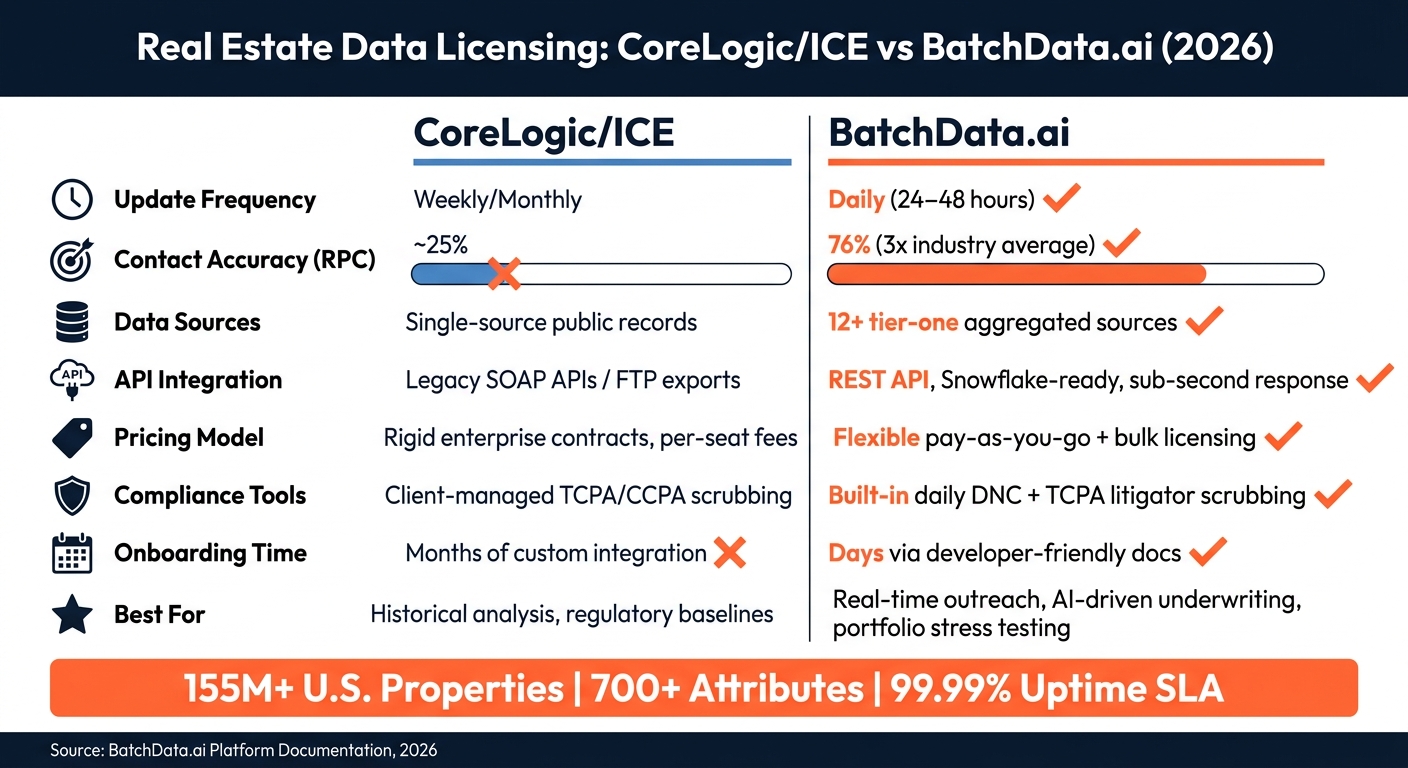
CoreLogic/ICE vs BatchData Real Estate Data Platform Comparison 2026
1. CoreLogic/ICE
CoreLogic and ICE, through its Black Knight division, serve as the backbone of U.S. mortgage data. CoreLogic is a trusted name in mortgage and risk analytics, providing critical data to banks, insurers, and government entities. ICE, on the other hand, manages the entire U.S. residential mortgage lifecycle – from origination to servicing – by integrating tools like MERS, Simplifile, Ellie Mae, and Black Knight into a unified electronic workflow. Their capabilities are evaluated based on data freshness, contact accuracy, technical integration, and pricing.
Data Coverage and Freshness
Both CoreLogic and ICE deliver highly current data as of 2026. ICE leverages AI technology to enhance the timeliness of its reference data and validate information from hundreds of sources. For portfolio stress testing, ICE also offers specialized climate risk and ESG analytics for the mortgage-backed securities market, utilizing geospatial modeling through its acquisition of risQ.
“As AI becomes more embedded in trading strategies, we expect our proprietary datasets to provide a competitive edge to users of models that require precision and large quantities of historical data.” – Intercontinental Exchange (ICE)
Contact Enrichment and Reachability
Legacy contact data from these platforms is often sourced from single-source lists updated on monthly or quarterly cycles. The average right-party contact (RPC) accuracy in the industry is around 25%, which poses a cost challenge for lenders targeting high-equity homeowners or pre-foreclosure candidates.
Operational efficiency is further influenced by how well these platforms integrate with other systems.
Integration and AI Readiness
ICE’s infrastructure, supported by the ICE Mahwah data center and the MERS System, still relies on older API technologies, such as SOAP APIs or manual FTP exports. These outdated systems create friction for teams looking to build modern, AI-driven workflows. Onboarding with these legacy systems can take months, and tasks that modern APIs could handle in seconds may take up to 30 minutes with these older setups.
Pricing and Scalability
CoreLogic and ICE’s Black Knight division operate in a higher enterprise pricing bracket, making their services less accessible to mid-market lenders or firms with fluctuating data needs. Their rigid contract structures can be a barrier for organizations needing more flexibility, especially in a fast-paced environment where seamless data integration is critical for staying competitive.
sbb-itb-8058745
2. BatchData
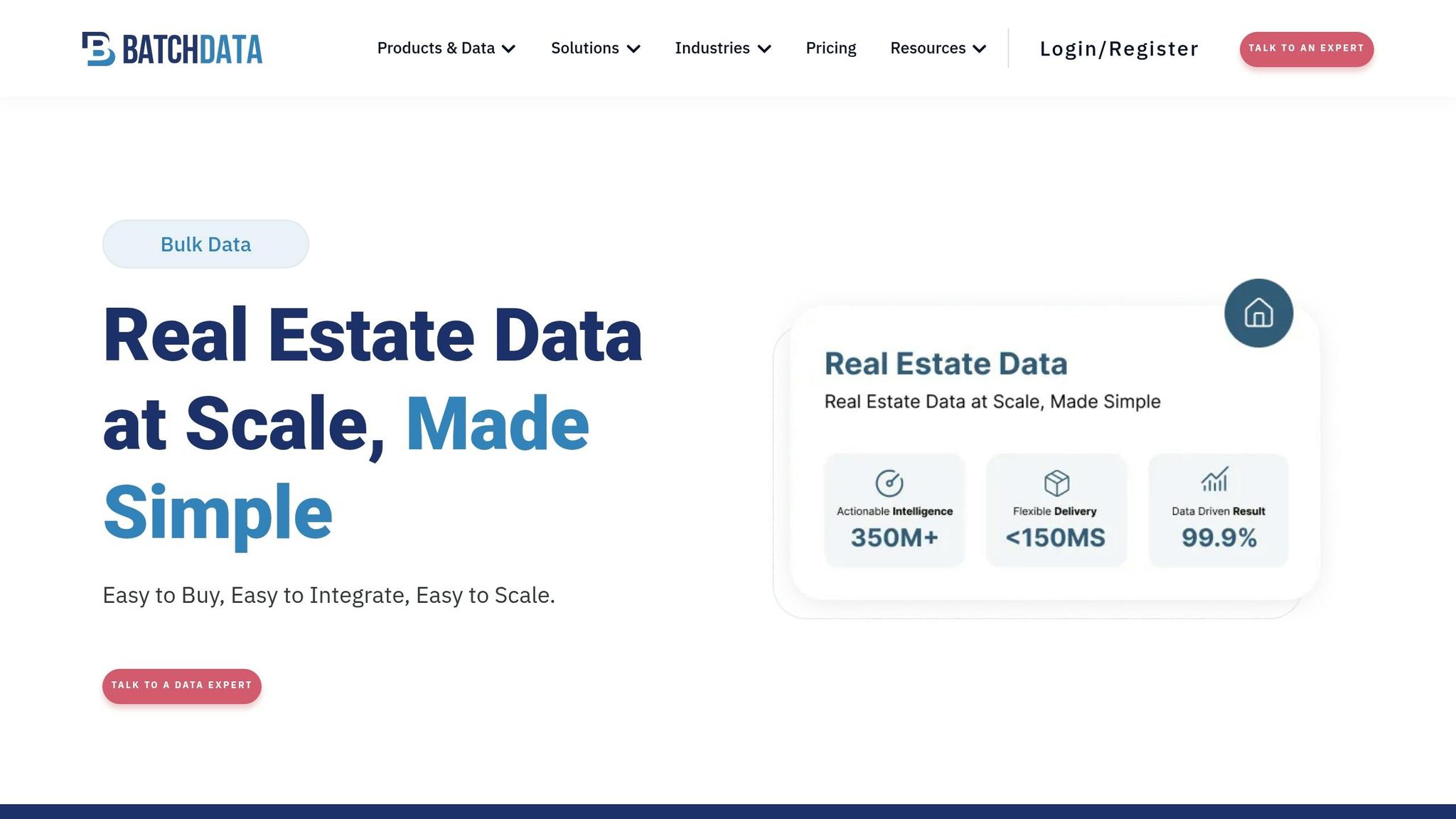
BatchData is built to keep pace with the fast-moving demands of mortgage lending and contact intelligence. It provides an actionable, data-driven platform that analyzes over 155 million U.S. properties across 3,200+ counties, offering a wealth of information – more than 700 attributes per property. These attributes include details like loan-to-value ratios, lien positions, interest rate types (fixed vs. adjustable), FHA/VA/Conventional loan indicators, and current estimated equity.
Data Coverage and Freshness
BatchData stands out for its ability to aggregate data from 12+ tier-one sources. By combining county assessor records, deed and mortgage data, tax files, and private feeds, the platform creates a unified dataset. What sets it apart is its speed: newly recorded documents are processed daily, and updates from most counties are available within 24–48 hours. As BatchData highlights:
“In most counties, you can access data on deeds, mortgages, and other transactions within 24-48 hours of them being recorded, giving you a significant speed advantage over services that update weekly or monthly.”
This rapid refresh rate ensures that users always have access to the most current property data.
Contact Enrichment and Reachability
BatchData excels at contact intelligence, boasting a 76% right-party contact accuracy rate – three times the industry average. To achieve this, it cross-references over 50 data sources to enrich property records with verified mobile numbers, emails, carrier details, and line-type classifications. Each contact is assigned a confidence score, ensuring teams can focus on high-quality leads.
To further support compliance, the platform includes daily updates for DNC (Do Not Call) and TCPA litigator scrubbing, reducing legal risks for refinance or retention campaigns. All this enriched data is seamlessly integrated via modern API solutions, making it easy to incorporate into existing workflows.
Integration and AI Readiness
BatchData is built for automation and modern workflows. Its REST API delivers sub-second response times and guarantees a 99.99% uptime SLA, ensuring reliability. For bulk data needs, the platform supports delivery through S3, SFTP, Snowflake Data Sharing, and flat files like CSV or Parquet. This flexibility makes it easy to integrate into machine learning pipelines or real-time underwriting processes.
The platform supports API-driven workflows that help businesses access and work with property data efficiently. By integrating supported BatchData APIs into their existing workflows, teams can streamline data retrieval and reduce manual processes. Refer to the official BatchData developer documentation for currently supported API capabilities and integration options.
Pricing and Scalability
BatchData offers flexible options to support different data requirements and usage volumes. API access and bulk data solutions can support a range of use cases, from smaller regional projects to larger PropTech and enterprise workflows. For information about available products, data delivery options, pricing, and commercial terms, contact the BatchData sales team.
Pros and Cons
Deciding between a legacy data foundation and a modern, contact-enriched platform depends on your specific needs. The table below highlights the strengths and weaknesses of each option, making it easier to weigh your choices.
| Category | Legacy Providers | BatchData |
|---|---|---|
| Data Freshness | Weekly or monthly refresh cycles | Daily refreshes; new recordings available within 24–48 hours |
| Contact Intelligence | Limited, often static contact data | 76% right-party contact (RPC) accuracy – 3x the industry average |
| Data Sources | Single-source public record archives | 12+ tier-one sources aggregated into one unified dataset |
| AI/ADMT Readiness | Batch-oriented; heavier ETL integration | MCP Server support, Snowflake-ready, sub-second real estate API response times |
| Pricing Model | Rigid enterprise contracts; per-seat fees | Flexible pay-as-you-go and scalable bulk licensing |
| Compliance Tools | Client-managed scrubbing; higher TCPA/CCPA exposure | Built-in daily DNC and TCPA litigator scrubbing |
| Best For | Regulatory baselines, historical valuation, legacy LOS integration | Real-time outreach, lead activation, AI-driven underwriting, portfolio stress testing |
| Onboarding Time | Often months of custom integration work | Days, via developer-friendly docs and prebuilt data joins |
This table gives a clear snapshot, but let’s dig deeper into what these differences mean for your business.
Legacy data systems are known for their extensive historical records and established compliance frameworks. These qualities are crucial for tasks like regulatory stress testing (e.g., CCAR). However, they fall short in areas like data freshness and adaptability. Weekly or monthly updates, combined with static contact data, make them less suited for fast-moving environments where real-time decisions are critical.
The slower refresh cycles of legacy systems also increase risks tied to TCPA/CCPA compliance. They struggle to meet the demands of modern ADMT pipelines, where millisecond-level decision-making is often required.
In contrast, BatchData is designed to address these challenges. With daily updates, built-in compliance tools, and industry-leading RPC accuracy, it’s tailored for businesses that need to act quickly. Whether it’s identifying high-equity homeowners for a refinance campaign or flagging at-risk borrowers for immediate outreach, this platform bridges the gap between analysis and action.
For large institutions, a hybrid approach might be the best solution. By combining legacy data for historical analysis with BatchData real-time capabilities, organizations can ensure compliance and responsiveness across all stages of decision-making.
Conclusion
The right data strategy today depends on turning insights into actions that drive results. BatchData stands out as a key tool for various players in the lending and PropTech space.
Institutional lenders relying on legacy systems can integrate BatchData to focus on high-equity borrowers with verified, compliant outreach. With features like daily DNC and TCPA litigator scrubbing, these lenders can maintain compliance in large-scale campaigns while minimizing risks tied to wrong-party contacts – an issue that has led to TCPA class action settlements reaching tens of millions of dollars.
PropTech startups can benefit from BatchData API-first design, which allows for onboarding in days instead of months. Its pay-as-you-go pricing aligns with the financial constraints of early-stage companies, while the 76% Right Party Contact accuracy supports innovative features, such as real-time call lists triggered by changes in homeowner equity. This capability helps startups develop competitive products at scale.
Mid-market lenders and regional banks can gain an immediate edge by leveraging BatchData extensive database of over 155 million U.S. properties. Flexible bulk licensing options empower smaller teams to conduct stress tests and identify high-risk segments for compliant outreach – without the burden of costly, long-term contracts.
In 2026, success will hinge on real-time, actionable intelligence rather than relying on outdated archives. BatchData delivers this critical advantage by combining top-tier property and lien data with a robust contact network, daily updates, and AI-ready integrations through MCP Server and Snowflake. This approach ensures unmatched speed, reach, and compliance, setting users up for success in a fast-moving market.
FAQs
How can I use daily property updates to improve mortgage risk models?
Daily property updates play a key role in keeping mortgage risk models in sync with current market trends. They allow lenders to track borrower equity and liens in real time, spot distressed properties early, and make more precise risk evaluations. This helps lenders make timely, well-informed decisions.
What does ‘Right Party Contact accuracy’ mean for lender outreach?
“Right Party Contact accuracy” measures how often verified contact details – like phone numbers and emails – accurately identify and connect with the actual property owner or decision-maker. BatchData boasts an impressive 76% accuracy rate, outperforming the industry average. This higher rate means lenders can rely on more effective and dependable outreach efforts.
What licensing options work best for a small team vs. an enterprise?
For small teams, BatchData offers options designed to support different data requirements and usage volumes. These options provide API-driven access to property and contact data. For current pricing, plan availability, and commercial terms, contact the BatchData sales team.
Larger enterprises, on the other hand, often require customized solutions. These typically include SLA guarantees, dedicated management, and real-time data access, which are usually available through higher-tier plans or specially tailored enterprise contracts.