



SEO Title: Real Estate Email Lists Built as a Data Pipeline
Meta Description: Learn how to source, verify, segment, deliver, and measure real estate email lists as a scalable data pipeline.
Meta Keywords: real estate email lists, email verification, email deliverability, real estate lead generation, proptech data pipeline, email list segmentation, BatchData, real estate marketing
Most real estate email lists fail because teams treat them like a file to buy, not a system to operate.
The useful unit isn’t the spreadsheet. It’s the pipeline that acquires contacts, verifies them, enriches them, segments them, and pushes them into campaigns without degrading sender reputation or compliance posture.
Core takeaways:
- Source from multiple channels: enterprise data, public web signals, and owned opt-in capture each solve different problems.
- Clean before sending: a raw list with stale or irrelevant contacts costs more than it produces.
- Segment aggressively: segmented and targeted emails generate 58% of all revenue and get a 14.31% higher open rate than non-segmented emails, according to SmartZip’s real estate email segmentation analysis.
- Protect delivery: relevance, authentication, and list hygiene work together. You can’t fix poor targeting with infrastructure alone.
- Measure business outcomes: email can deliver $42 for every $1 spent according to AvenueHQ citing HubSpot’s 2025 State of Marketing Report, but only if your system ties sends to pipeline and revenue.
Where Do You Source Real Estate Email Lists?
You should source real estate email lists from three lanes at once: enterprise data providers for scale, public-source collection for precision, and owned opt-in capture for intent.
That answer is more useful than the usual “buy vs. build” framing because institutional email programs don’t run on one source. They run on a blended acquisition layer. One source gets you coverage. Another gets you freshness. A third gives you consent and intent.

Enterprise providers give you immediate scale
If you need national coverage, provider-backed datasets are the fastest path. The market already runs on very large data layers. Frescodata’s overview of real estate email lists notes providers with over 5 million real estate agents and 8+ million renters globally as of 2026, while ATTOM has delivered data on 155+ million U.S. properties since 1996. The same source notes that platforms such as BatchData provide 155M+ U.S. property records with 1,000+ attributes including emails, AVMs, and propensity scores via APIs.
That matters because list sourcing stops being a marketing task once you operate at platform scale. It becomes a data access problem. You need stable schemas, predictable update cycles, and a way to move records into your CRM, warehouse, and outbound tooling without manual exports.
Use provider-backed data when you need:
- Broad coverage: nationwide owner, renter, agent, or investor audiences.
- Fast deployment: campaigns that can’t wait for months of list building.
- Structured joins: property, ownership, and contact data in one model.
- Operational consistency: APIs and bulk delivery instead of ad hoc files.
A practical signal to watch is whether the provider supports data delivery in a way your engineering team can use. If your analysts still spend their time normalizing columns and deduplicating CSVs, you’re not buying data. You’re buying cleanup work.
Public-source collection gives you freshness and narrow targeting
Scraping and public aggregation are useful when provider coverage is broad but your campaign needs local relevance. This is common with agent outreach, brokerage prospecting, and highly targeted city or zip-based campaigns.
Public sources help when you need to answer questions like:
- Which agents are active in one submarket right now?
- Which offices recently added reviews, listings, or team members?
- Which property businesses changed contact details before a central directory caught up?
This route has trade-offs. Scraped data can be fresher, but it’s less standardized. You’ll spend more time on parsing, deduplication, and confidence scoring. You also need governance. A scraper that produces emails without source lineage creates downstream risk when legal or compliance asks where a record came from.
Practical rule: Use scraping to sharpen a target, not to replace your core source of truth.
For teams building outbound systems beyond real estate, Fypion Marketing on B2B lead gen is a useful companion read because the same pipeline logic applies. Acquisition quality and targeting discipline matter more than raw contact volume.
Owned capture gives you the highest-intent records
Opt-in capture is slower, but the intent is stronger. That makes it the best source for newsletters, nurture tracks, valuation requests, seller guides, investor updates, and webinar follow-up.
The mechanics are straightforward:
- Lead magnets: market snapshots, buyer guides, seller prep checklists.
- On-site capture: popups, embedded forms, valuation tools, saved-search prompts.
- Offline-to-online capture: QR signups at open houses and events.
- Content subscriptions: hyperlocal updates, rental alerts, investor briefings.
This source matters because even a massive provider-backed database won’t tell you who actively wants your content today. Owned capture does.
It also improves downstream segmentation. If someone signs up for a neighborhood report, their first-party behavior tells you more than a generic “homeowner” flag ever will.
For teams that want a model for how market intelligence can feed top-of-funnel capture, Investor Pulse reports show the kind of asset that can attract a more serious subscriber than a generic newsletter form.
The right sourcing model is hybrid
A one-source strategy creates blind spots. The better design is to route each source into a shared identity layer, then assign confidence and usage rules.
| Sourcing path | Best use | Main strength | Main weakness |
|---|---|---|---|
| Enterprise data providers | Large-scale campaigns and platform workflows | Immediate coverage and structured records | Can include records that need further relevance filtering |
| Public-source collection | Local or niche targeting | Freshness and narrow market visibility | More cleanup and governance work |
| Owned opt-in capture | Nurture and high-intent outreach | Stronger intent and clearer expectations | Slower to scale |
A durable operating model looks like this:
- Seed with provider data for coverage.
- Layer public signals for freshness and niche precision.
- Convert traffic into opt-ins to build a durable owned audience.
- Score every record by source, freshness, and confidence.
- Set send policies so not every sourced record gets the same campaign treatment.
Teams get into trouble when they ask, “Where can I get a big real estate email list?” The better question is, “Which source should feed which workflow?”
How Do You Turn Raw Data into Actionable Intelligence?
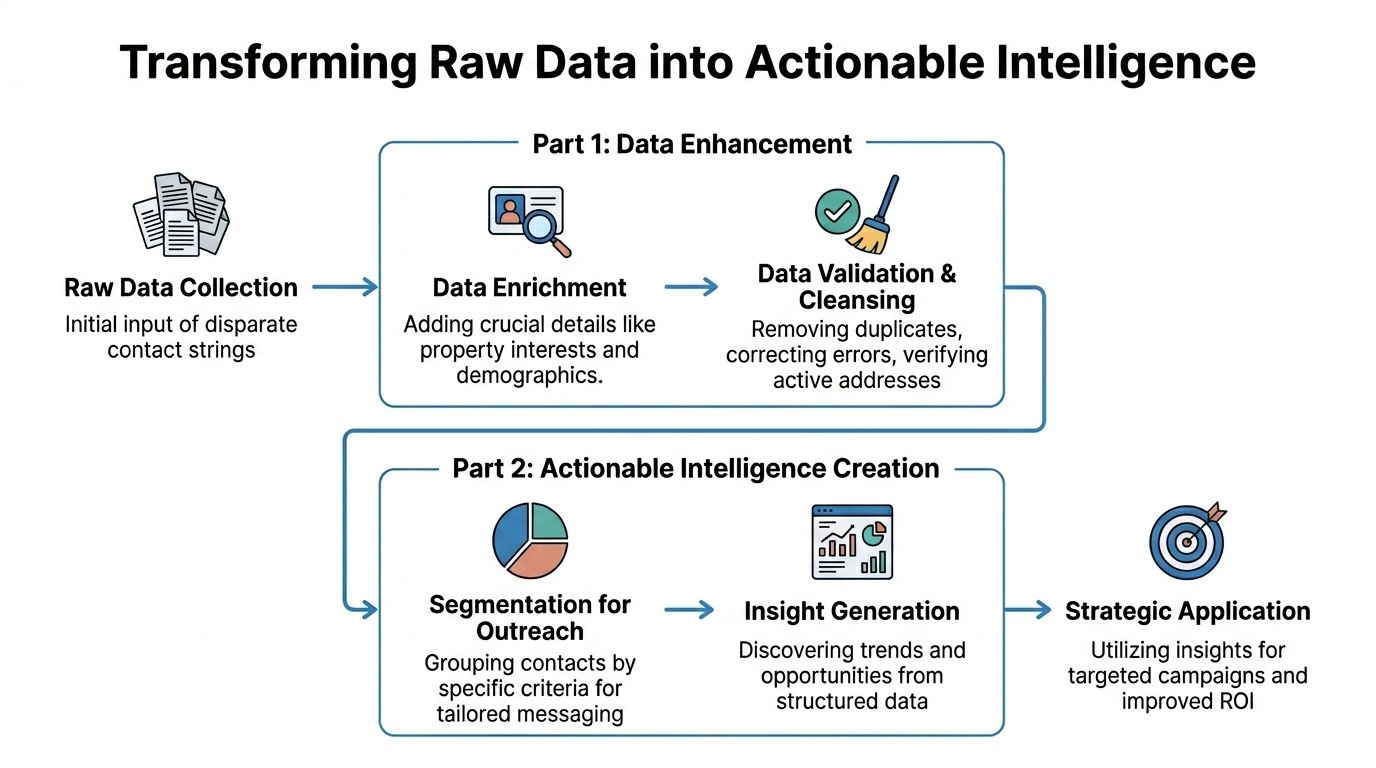
You turn raw data into actionable intelligence by verifying deliverability first, then enriching contacts with property, ownership, and behavioral context.
A raw email string is not an asset. It’s an unproven identifier. Until you validate it and connect it to a usable profile, it can damage sender reputation, pollute attribution, and waste outbound volume.
Verification removes obvious waste
The fastest way to hurt an email program is to send to records that were never ready for deployment. That problem gets worse with pre-made lists. Mailpro’s analysis of real estate agent email lists highlights the downside clearly: purchased, non-opted-in lists can produce under 2% open rates and near-zero clicks, while also creating compliance issues and wasting resources on outdated contacts.
Verification should be a staged process, not a single pass.
A practical workflow usually includes:
-
Syntax validation
Catch malformed addresses before they enter outbound systems. -
Domain and mailbox checks
Confirm the domain accepts mail and the mailbox is likely active. -
Role-account filtering
Decide whether addresses like info@ or support@ belong in outbound or only in special workflows. -
Duplicate resolution
Merge repeated contacts across imports, appends, and CRM activity. -
Confidence scoring
Keep “verified,” “risky,” and “unknown” in separate states. Don’t let marketing flatten them into one list. -
Suppression management
Persist unsubscribes, complaints, and internal do-not-contact flags across every source.
The point isn’t perfection. The point is risk separation. Your sending platform should never treat a newly acquired contact the same way it treats a known, engaged subscriber.
Raw contacts belong in quarantine until they pass validation, identity checks, and suppression screening.
Enrichment creates usable profiles
Verification tells you whether an email is likely reachable. Enrichment tells you whether it’s worth contacting and how to message it.
In real estate, enrichment should connect a person to the property and market context around them. That means pulling attributes like ownership history, lien context, equity indicators, permit activity, listing history, and transaction signals into the contact profile.
A property data platform becomes more useful than a generic lead list. A system with real estate coverage can join contact records to parcel-level facts and then expose that data to marketing, underwriting, servicing, or portfolio teams. BatchData is one example. It provides property and owner records with contact enrichment, and teams can use geospatial analysis for automated valuation models as part of a broader data stack where location intelligence and contact intelligence work together.
Build an enrichment model that supports action
A practical schema usually needs more than email, name, and city. At minimum, create fields that answer four operational questions:
| Data layer | What it answers | Why it matters |
|---|---|---|
| Identity | Who is this contact? | Deduplication, CRM matching, suppression |
| Property linkage | What asset is tied to the contact? | Relevance in message copy and segmentation |
| Ownership and financial context | Why might this contact act? | Lead scoring and campaign selection |
| Engagement state | What has this contact done? | Timing, cadence, and automation |
With that in place, marketing can stop sending generic “checking in” emails and start triggering based on actual conditions.
Examples:
- Absentee owner plus long hold period can route into investor-offer education.
- Recent permit activity can route into home services or insurance outreach.
- Fresh listing or valuation request can route into agent or lender follow-up.
- Repeated engagement with one market report can trigger hyperlocal content.
Keep the pipeline moving
The biggest technical mistake isn’t bad enrichment logic. It’s treating enrichment as a one-time append. Property and contact data change. Ownership changes. Deliverability changes. Intent changes faster than either.
That means the pipeline needs recurring jobs for:
- Reverification
- Change detection
- Profile refresh
- Source-level confidence updates
- Outbound eligibility checks
If you skip that cadence, your list starts decaying the moment you create it.
How Should You Segment and Personalize Your Outreach?
Segmentation determines whether a real estate email list behaves like a revenue channel or a liability. At scale, the list is not a spreadsheet of contacts. It is a stream of entities, events, and eligibility states that need to route into the right campaign logic at the right time.
Personalization starts in the data model, not in the copy block. If the pipeline cannot tie a person to a property, an ownership structure, a market, and a recent behavior, the message will default to generic language and broad CTAs. That is where performance drops. You end up sending high volume with low relevance, which hurts response quality and makes optimization harder.

Segment by decision path
A segment should exist only if it changes one of four things: message, timing, CTA, or suppression rule.
That standard rules out a lot of vanity segmentation. Sorting contacts by county, contact owner, or import source may help reporting, but it does not improve outreach unless those fields drive a different treatment. Good segmentation sits closer to operations. It answers questions like who should get an investor disposition email, who should get a refinance scenario, who should be suppressed from promotional mail, and who has shown enough intent to justify a higher-frequency sequence.
In practice, the strongest segments combine multiple signals:
- Property state: owner-occupied, absentee, listed, off-market, distress indicator
- Ownership profile: individual owner, trust, LLC, fund, institutional holder
- Financial posture: equity range, mortgage age, lien activity, rate sensitivity
- Market context: neighborhood cluster, submarket trend, local inventory pressure
- Behavioral signals: report downloads, valuation requests, repeat page views, email clicks
Single-field segments rarely hold up for long. Composite segments do, because they map closer to real intent.
Three segmentation plays that work
Investor acquisition segments
Investor outreach works best when the segment reflects both asset fit and seller probability. Absentee ownership alone is too broad. Add hold duration, ownership type, neighborhood turnover, and engagement with seller or investor content, and the campaign starts to behave like targeted outreach instead of county-wide blasting.
The message should reflect the owner’s likely decision path. A long-term absentee owner may respond to timing, tax treatment, or local demand. A small LLC with multiple holdings may care more about portfolio liquidity and transaction speed. Those are different conversations, so they should not share the same template.
For California-focused investor audiences, a regional intelligence asset like the Investor Pulse reports can serve as both a lead magnet and a segmentation event. The download itself is useful behavioral input.
Mortgage and refinance segments
Lender segmentation fails when it starts with “all homeowners” and stops there. Financing intent usually appears as a combination of tenure, loan age, equity position, recent valuation interest, and repeat engagement with affordability or payment-related content.
That segment needs expiration logic. A refinance-oriented contact from six months ago is not the same lead today. Rates change. Property values move. The contact may have already closed elsewhere. If event recency is not part of the segment definition, personalization gets stale fast.
Brokerage and portal nurture segments
Brokerages and portals often have the richest first-party behavior and still send generic follow-up. A lead viewing luxury listings in one ZIP code should not enter the same nurture path as someone reading suburban school-district market updates.
Useful routing fields include:
- Search geography
- Property type preference
- Price band
- Inquiry stage
- Recency and frequency of site activity
- Content category consumed
Event design matters. If the site only logs page views and ignores saved searches, repeat neighborhood views, and form abandonment, the campaign logic will miss strong intent signals.
Good personalization feels informed because the underlying routing logic is informed.
Personalization should change campaign logic
First-name merge tags are formatting. Personalization is operational.
A personalized program changes the subject line, the examples inside the email, the CTA, send timing, and the sequence that follows. It also changes who does not receive the email. Suppression is part of personalization. If a contact is already in an active disposition workflow, they should not keep getting top-of-funnel educational mail about selling options.
A few examples:
- A seller-intent contact should see valuation, timing, and local-demand language.
- An investor-intent contact should see yield, inventory movement, and acquisition-oriented CTAs.
- A borrower showing rate sensitivity should get scenario-based financing content, not generic homeownership tips.
Here’s a practical benchmark for training teams on this distinction:
Keep segment design maintainable
Over-segmentation breaks fast. If marketing creates dozens of micro-audiences that data engineering cannot refresh reliably, the warehouse fills with stale logic and campaign ops starts hand-editing lists. That is how errors enter the system.
A workable model separates stable routing from fast-changing triggers:
| Segment type | Good use | Common failure |
|---|---|---|
| Lifecycle segments | Entry points, nurture structure, high-level routing | Too broad to support specific copy |
| Market segments | Hyperlocal content, regional offers, territory ownership | Weak content depth for every market slice |
| Trigger segments | Timely follow-up based on behavior or change events | Missing recency controls or broken event capture |
Build segments your content team can support, your CRM can enforce, and your data jobs can refresh on schedule. If one of those three breaks, the segment may still exist in the database, but it will stop performing in production.
How Do You Ensure Your Emails Actually Get Delivered?
You ensure your emails get delivered by treating compliance, authentication, list hygiene, and relevance as one operating system.
Teams often split these into separate owners. Legal handles policy. Marketing handles creative. IT handles the sending domain. That structure creates gaps. Mailbox providers don’t care which department made the mistake. They only see sender behavior.
Compliance affects deliverability
A compliant email program is easier to deliver because it behaves like one. Clear identification, honest subject lines, visible opt-outs, and suppression discipline reduce the kinds of complaints that damage sender trust.
A practical compliance checklist for real estate email lists includes:
- Clear sender identity: the recipient should know who is contacting them.
- Accurate message purpose: no deceptive subject lines.
- Visible unsubscribe path: easy to find and easy to execute.
- Physical business details: include the required sender information.
- Suppression persistence: once someone opts out, every connected system must respect it.
- Data request handling: privacy requests need a real process, not a mailbox nobody checks.
- Campaign eligibility rules: not every sourced contact should enter promotional workflows.
The trade-off is simple. Loose controls create short-term volume and long-term damage.
Technical setup matters, but it won’t save irrelevant mail
Authentication and sender configuration are table stakes. You need a properly configured sending environment, domain alignment, and a warmup process for new infrastructure. You also need clear separation between transactional and promotional streams so one doesn’t poison the other.
That said, technical correctness doesn’t rescue poor audience selection.
Propphy’s real estate email KPI benchmarks are useful here because they connect engagement to deliverability. The source states that industry CTR for real estate emails ranges from 2–5%, with 3–4% achievable through deliberate optimization, and that personalized emails achieve 29% higher open rates and 41% higher click-through rates. It also notes that a CTR below 1% usually signals weak CTAs or poor relevance, while teams should monitor bounce rates toward 95%+ delivery and keep unsubscribe rates below 0.5%.
That tells you something operationally important. A weak campaign is not just a copy problem. It’s often a routing problem.
Use a deliverability control loop
The best operators watch early signals and react before mailbox placement degrades.
Use this control loop:
-
Pre-send screening
Check audience eligibility, suppression, recent verification status, and segment fit. -
Controlled deployment
Start with smaller sends on new segments or reactivated domains. -
Immediate diagnostics
Review delivery, bounce behavior, unsubscribes, and CTR by segment. -
Root-cause analysis
If CTR falls under expected levels, inspect CTA strength and relevance before changing infrastructure. -
List correction
Remove stale sources, down-rank weak segments, and revalidate uncertain contacts.
If mailbox providers see low engagement and rising complaints, they trust you less on the next send. Recovery takes longer than prevention.
Content architecture matters more than most teams think
A lot of “deliverability” problems start in the message itself.
Good real estate emails usually share the same structure:
- one clear purpose
- one primary CTA
- short paragraphs
- obvious local or property relevance
- no mismatch between subject line and body content
Bloated emails create confusion. Confused recipients ignore the email, delete it, or mark it as spam. Every one of those actions feeds back into your sender reputation.
Which KPIs Actually Measure Email List Performance?
The KPI stack for a real estate email list starts with pipeline contribution, then works backward into data quality. If the list is producing inbox activity but not meetings, valuations, applications, or acquisitions, the problem is usually upstream in sourcing, identity resolution, segmentation, or consent state.
Open rate still has some diagnostic value. It can help spot subject-line issues, domain-level placement changes, or weak segment selection. It is not a performance metric on its own because mailbox privacy controls and image prefetching distort the signal. Mailchimp’s email marketing benchmarks are useful for broad context, but they should not drive decisions without tying results to downstream business events.
Separate signal types before you build the dashboard
A clean measurement model uses three layers.
| Metric Category | Example KPIs | What It Actually Measures |
|---|---|---|
| Exposure metrics | Delivered, inboxed, opened, clicked | Whether the message reached the contact and generated initial interaction |
| List health metrics | Hard bounce rate, soft bounce rate, unsubscribe rate, spam complaint rate, re-verification pass rate | Whether the underlying contact stream is current, permissioned, and safe to keep mailing |
| Business metrics | Qualified replies, booked calls, valuation requests, loan applications, opportunities created, attributed revenue | Whether the list is creating commercial outcomes |
This structure matters because teams often blend transport metrics with outcome metrics and call the whole thing performance. That hides where the system is failing.
A list can post acceptable click volume and still be low quality. I see this often with over-enriched owner datasets that have broad coverage but weak intent. The opposite happens too. A smaller cohort of recently verified, high-intent records may generate fewer total clicks and far more pipeline.
Measure the record, not just the campaign
Real estate email lists behave like a data pipeline, not a static file. KPI design should reflect that.
At the contact level, the system should answer five questions:
- What source created this record?
- What verification event last confirmed the email?
- What enrichment jobs changed the record after intake?
- What segment rules allowed the contact into this send?
- What downstream event counted as success?
That requires stable IDs across the ESP, CRM, enrichment layer, and property database. It also requires event capture that survives sync jobs and deduplication. If source tags disappear during enrichment or consent history sits only inside the ESP, attribution breaks and list performance gets overstated.
Cohort analysis is where list quality becomes obvious
Campaign averages hide too much.
Break reporting out by acquisition cohort, verification age, source type, and enrichment path. A batch of fresh broker opt-ins should not be judged the same way as county-derived owner contacts enriched six weeks later. Their expected bounce profile, reply pattern, and commercial value are different.
Useful cohort cuts include:
- owned opt-ins vs third-party sourced contacts
- newly verified vs stale records
- enriched owner contacts vs direct lead form submissions
- reactivated records vs net-new records
- by geography, asset class, or investment intent
The point is operational, not academic. Once cohort reporting is in place, weak sources become easy to cut. Strong sources get more volume. Suppression logic gets sharper because the team can see which records decay fastest.
The dashboard leadership actually needs
Executives do not need fifty email metrics. They need a chain of accountability from record quality to revenue.
Use a top-line dashboard with four views:
-
Data quality
Record freshness, verification status, consent coverage, duplicate rate. -
Send health
Delivery rate, hard bounces, complaints, unsubscribes, inbox placement where available. -
Response quality
Qualified replies, booked appointments, form completions, conversion by segment and source cohort. -
Commercial output
Opportunities created, pipeline value, closed revenue, or acquisition outcomes tied back to the originating contact stream.
That setup makes trade-offs visible. For example, increasing volume with lower-confidence records may lift total clicks while pushing bounce rate and complaint rate high enough to reduce future inbox placement. The short-term gain is real. The downstream penalty is real too.
A real estate email list is performing well when verified records move into campaigns, campaigns create qualified actions, and those actions convert without degrading sender reputation or violating consent rules.
If you are operating at scale, build KPI logic close to the data warehouse, not only inside the ESP. Warehouse-level models let the team join property records, contact refresh history, campaign events, and CRM outcomes into one attribution layer. That is the only reliable way to measure list performance once multiple vendors, enrichment passes, and sales systems are involved.
If you’re building real estate email lists as a real pipeline instead of a one-time purchase, BatchData is relevant because it provides property records, owner contacts, enrichment, and delivery-ready data inputs that can feed marketing, underwriting, and portfolio workflows from the same operating layer.