




































Want to handle massive real estate data without the headaches? This guide breaks down how to design scalable data pipelines that manage diverse property data sources, ensure reliability, and deliver actionable insights for decision-making. Here’s what you’ll learn:
- Why scalability is crucial: Real estate data is messy and grows fast. Without the right pipeline, errors multiply and decisions falter.
- Key pipeline stages: From planning business needs to ingesting, normalizing, and enriching data.
- Architectural patterns: Batch, streaming, or hybrid setups tailored to your needs.
- Data quality and reliability: Automated checks to prevent costly errors.
- Delivering insights: Turn raw data into analytics and real-time applications.
Whether you’re building for nightly updates or real-time alerts, this guide walks you through every step, ensuring your pipeline can handle the complexities of U.S. real estate data.
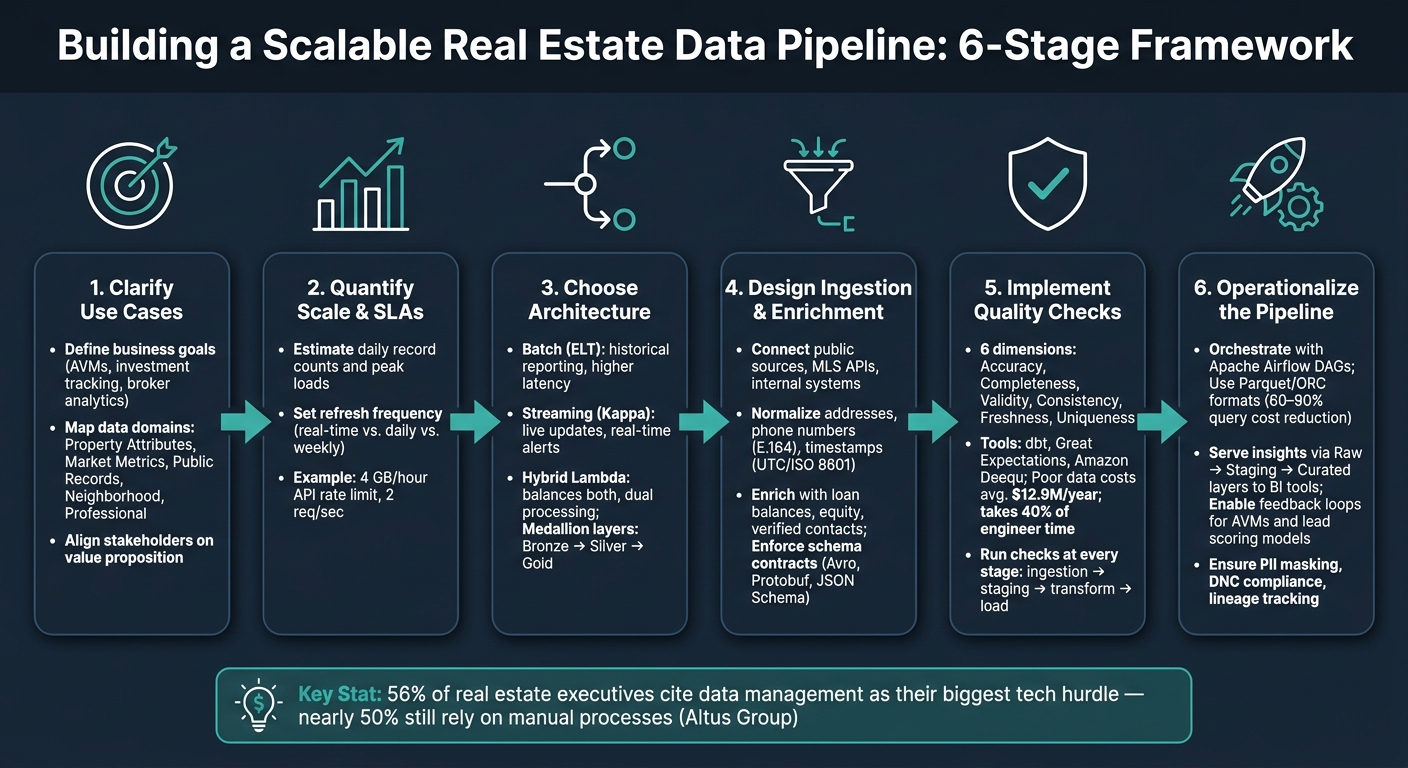
Real Estate Data Pipeline: 6-Stage Architecture Framework
Real Estate End to End Data Engineering using AI
sbb-itb-8058745
Planning Real Estate Data Pipeline Requirements
Before diving into coding, it’s crucial to define system requirements. Skipping this step could lead to costly rework and inefficiencies.
Defining Business Use Cases and Data Domains
Business use cases help determine the type of data needed, how current it must be, and the complexity of any required transformations. In the U.S. real estate market, common applications include:
- Automated Valuation Models (AVMs): These estimate property values using sales history and current market data.
- Investment Opportunity Identification: Tracks supply and demand trends, such as rising rents and falling vacancy rates, to spot promising opportunities.
- Broker and Agent Analytics: Monitors agent movements and market share changes to fine-tune sales strategies.
Each use case ties directly to specific data domains. Here’s a breakdown of common domains and their typical sources:
| Data Domain | Key Data Points | Source Examples |
|---|---|---|
| Property Attributes | Beds, baths, square footage, year built | MLS Grid, county assessor |
| Market Metrics | Rent prices, vacancy rates, sales history | MLS feeds, listing portals |
| Public Records | Property taxes, ownership info, GIS data | County assessor, treasury office |
| Neighborhood | School ratings, crime stats, amenities | GreatSchools, mapping APIs |
| Professional | Agent names, affiliations, contact info | MLS Grid, agent directories |
For tasks like property data enrichment or contact verification, tools like BatchData provide real estate APIs and bulk delivery options that integrate seamlessly with your pipeline’s ingestion layer.
These data domains serve as a foundation for setting realistic volume and Service Level Agreement (SLA) requirements.
Quantifying Data Volume and SLA Requirements
Once use cases are clear, the next step is to quantify data volumes and define SLA targets. This involves estimating daily record counts, peak loads, and historical retention needs.
Not all data types require the same refresh frequency. For example, pricing and listing statuses may need updates multiple times a day, while ownership records or permit data might only need weekly or monthly updates. A 2024 project illustrates this principle: an automated pipeline built with Azure Data Factory for a real estate insurance provider ingested MLS Grid data daily. It managed API rate limits of 4 GB per hour and two requests per second, replacing a manual process that previously consumed over 72 hours of labor weekly.
"In aggregation, the hard part isn’t pulling data – it’s guaranteeing that today’s source change becomes a test case, not tomorrow’s outage." – Dmytro Naumenko, CTO, GroupBWT
Latency requirements also play a key role in deciding your architecture. For example, real-time fraud detection or instant listing alerts demand a streaming approach. On the other hand, end-of-day reporting or monthly summaries are better suited to batch processing.
Choosing Pipeline Architecture Patterns
With volume and SLA requirements defined, the next step is to choose an architecture pattern that aligns with your needs. Real estate data engineering typically relies on three main patterns: batch (ELT), streaming (Kappa), and hybrid Lambda architecture. A hybrid approach often works best, using streaming for immediate needs and batch jobs for more structured data.
Modern pipelines favor ELT (Extract, Load, Transform) over ETL. This method involves loading raw, unaltered data into a cloud lakehouse or warehouse first, then transforming it later. It simplifies backfills and ensures auditability. The Medallion architecture has become a popular framework, organizing data into:
- Bronze Layer: Raw, unprocessed data.
- Silver Layer: Cleaned and deduplicated data.
- Gold Layer: Aggregated, business-ready data.
Cloud platforms like Snowflake or BigQuery handle analytical queries, while object storage supports large datasets like parcel records or imagery tiles.
| Pattern | Best For | Main Trade-off |
|---|---|---|
| Batch (ELT) | Historical reporting, tax records | Higher latency; unsuitable for real-time needs |
| Streaming (Kappa) | Live listing updates, real-time alerts | Expensive for large historical reprocessing |
| Lambda | Balances real-time needs with history | Requires dual processing systems |
"The most important question to ask is: ‘What business outcome does this pipeline drive, and what are its latency requirements?’ The answer will determine your architecture." – Dmitriy Rudakov, Director, Solution Architecture at Striim
Designing Data Ingestion for Real Estate at Scale
Once you’ve chosen your architecture, the next hurdle is pulling in data reliably and at scale while maintaining its integrity. U.S. real estate data is fragmented across proprietary MLS systems, county assessor databases, government census sites, and third-party vendors – each with its own quirks in format and update schedules.
Connecting to Data Sources
Your ingestion layer needs to accommodate three main types of sources: public data sources, internal systems, and vendor APIs.
Public sources, like county assessor records or GIS databases, often provide bulk file exports in formats such as CSV, XML, or fixed-width files. These are typically updated periodically. MLS feeds, on the other hand, usually rely on REST or RETS APIs, which often come with strict rate limits. Internal systems, such as CRMs or older property management platforms, may lack native API access. In such cases, tools like Change Data Capture (CDC) can track transaction logs in real time without placing a heavy load on these systems.
For bulk data, services like BatchData simplify the process by offering APIs for property searches, contact enrichment, skip tracing, and phone verification, eliminating the need to build custom scrapers.
Once you’ve established these connections, the next step is to implement ingestion mechanisms suited to your latency requirements.
Implementing Ingestion Mechanisms
The ingestion method you choose should align with the latency needs you identified during the planning phase. Batch ingestion is ideal for large, scheduled datasets, such as county records, bulk contact lists, or historical sales data. File formats like Parquet or ORC are better suited than CSV for these use cases because they offer efficient compression, faster columnar reads, and lower storage costs for massive datasets.
If data freshness is critical – like live MLS listing updates or real-time lead activity – streaming ingestion is the way to go. Tools like Apache Kafka can handle data bursts, ensuring your pipeline absorbs variability without losing records. Using a message broker to manage backpressure is essential when dealing with such bursts.
Some universal best practices, regardless of the ingestion method:
- Assign UUIDs to every record to avoid duplication during backfills.
- Route malformed records to a Dead Letter Queue (DLQ) for later review.
"One of the most common causes of broken pipelines is schema drift, when upstream producers change the shape of data without warning." – Tullie Murrell, Shaped
To counter schema drift, enforce data contracts at the ingestion gateway using schema definitions like Avro, Protobuf, or JSON Schema. Reject records that fail to comply before they can disrupt downstream systems. This approach ensures your pipeline can grow alongside increasing data demands.
Normalizing U.S. Real Estate Data
Once you’ve established a steady data flow, the next step is normalization. Raw real estate data often comes in inconsistent formats. For example, one source might list a property as "St." while another spells it out as "Street." Similarly, phone numbers, ownership names, and other details can vary widely. Normalizing data during ingestion minimizes the need for extensive cleanup later.
For addresses, split them into distinct columns (e.g., Street, City, State, ZIP) to optimize columnar queries and enable consistent joins across sources. Validate ZIP codes against USPS data and flag records with missing or incorrect values. For contact information, format phone numbers according to the E.164 standard and verify them using a phone verification API.
Timestamp normalization is equally critical. Store all event times in UTC using the ISO 8601 format. This eliminates errors caused by differences in U.S. time zones and ensures accurate time-series analysis and SLA calculations. Similarly, standardize categorical values early on. For instance, map property types like "SFR", "Single Family", and "Single-Family Residential" to a single, unified term before downstream systems process the data. This early-stage normalization is key to enabling consistent and scalable transformations in later pipeline stages.
Building Data Transformation and Enrichment Processes
Once normalized data is flowing into your pipeline, the next step is turning that data into actionable insights. This involves standardizing, transforming, and validating the information to ensure it’s ready to support property-related decisions.
Standardizing Schemas for Real Estate Data
After ingestion, creating standardized schemas ensures that diverse data points integrate smoothly. A consistent schema is essential for a reliable data pipeline. Without stable entity definitions, linking a property record from a county assessor with a transaction record from an MLS can become error-prone. To avoid this, define clear schemas for key domains: properties, transactions, rentals, and ownership/contact records.
Each core entity needs a stable primary key. For instance, properties might use a parcel ID that remains consistent even if the address changes or data sources are updated. Transactions should have unique Transaction IDs linked to their parent properties. Ownership records should include both a contact ID and a property reference to track owners across multiple assets. When you need to update schemas – like adding a field for flood zone classification – use versioned migrations to prevent issues for downstream users.
Transforming and Enriching Datasets
With schemas in place, transformation processes can be executed effectively. Whether you choose ETL (transform before loading) or ELT (load raw data first, transform within the warehouse) depends on your infrastructure. Tools like BigQuery and Snowflake are great for transforming large datasets while retaining raw data for debugging.
During transformation, address gaps identified during ingestion. For example, studies show that up to 80% of contacts lack addresses during synchronization, which highlights the importance of enrichment for improving data utility. BatchData’s property and contact enrichment APIs can help fill in missing details like loan balances, ownership duration, and verified phone numbers.
"Raw data alone isn’t enough to deliver the insights businesses need to thrive. You’ll need to perform some data enrichment to improve the quality and depth of your data." – Austin Chia, Data Analyst
Beyond contact enrichment, adding geospatial context – like parcel boundaries or flood zones – enhances risk assessments. Financial data, such as tax history or equity positions, can help identify high-potential leads. For instance, an ownership duration of over 10 years combined with strong equity often signals a prime selling opportunity. Additionally, data indicates that 7% of contacts in a typical real estate database are likely to transact within a year, so enriching high-intent records can significantly improve ROI.
Implementing Data Quality Checks
Once data is enriched, rigorous quality checks ensure it’s reliable before reaching end users. Poor data costs organizations an average of $12.9 million annually and takes up to 40% of engineers’ time.
Focus your checks on six key dimensions: accuracy, completeness, validity, consistency, freshness, and uniqueness. Here’s how these checks apply to real estate:
| Check Type | Real Estate Example | What to Flag |
|---|---|---|
| Uniqueness | Parcel ID, Listing ID | Duplicate IDs (COUNT(id) > 1) |
| Completeness | Owner name, Tax ID, Address | Missing values (NULL fields) |
| Range | Sale price, Year built, Acreage | Invalid ranges (e.g., sale price ≤ 0) |
| Validity | ZIP code, Property type, State code | Values outside allowed categories |
| Freshness | Last listing update, Price change | Outdated timestamps (MAX(timestamp) < NOW()) |
| Integrity | Sales linked to property records | Missing property_id in the master property table |
Tools like dbt make it easy to apply tests such as unique, not_null, and relationships directly to your schemas. For Spark environments, Amazon Deequ can handle profiling and anomaly detection. A great example is the Urban Institute’s Housing Finance Policy Center, which used Great Expectations in 2026 to automate validation for mortgage and housing data, producing reports and alerts to quickly diagnose issues.
Run these checks at every stage – ingestion, staging, transformation, and load. If errors are caught early, they can often be fixed in minutes. But if they propagate through multiple downstream tables, resolving them could take days. Always route failures to alerts rather than silently dropping records to maintain transparency and efficiency.
Orchestrating and Operating Real Estate Data Pipelines
Setting Up Orchestration Frameworks
Once your data is enriched, the next step is orchestrating the pipeline’s workflow. Tools like Apache Airflow help you map out your pipeline as a Directed Acyclic Graph (DAG). In this setup, each task – whether it’s ingestion, transformation, quality checks, or loading – follows a clear sequence with defined dependencies.
There are two critical configuration tips to keep your pipeline running smoothly in production:
- Retries and Delays: Use
retriesandretry_delayin the default arguments of your DAG. Setting 2 retries with a 15-second delay can handle temporary issues like API timeouts or network hiccups , especially when integrating a real estate API. - Catchup Behavior: Set
catchup=Falseto prevent Airflow from running a backlog of historical tasks when you activate or resume a pipeline.
These configurations ensure your pipeline remains scalable and reliable, automating the ETL process to handle failures, recover seamlessly, and send alerts when needed. By following these practices, you’ll have a strong foundation for optimizing performance and managing costs.
Optimizing Performance and Costs
Real estate datasets can be enormous, and working with such large volumes of data can drive up both query times and storage expenses. To address this, consider these strategies:
- Columnar Storage Formats: Use formats like Parquet or ORC instead of row-based formats like CSV. These allow you to read only the columns you need, cutting query costs by 60–90% for analytical tasks.
- Event-Driven Data Loading: Implement Snowflake’s Snowpipe with
AUTO_INGEST=TRUEto process AWS S3 notifications. This ensures your analytics layer stays up-to-date with the latest data, avoiding the inefficiency of scheduled full-table refreshes.
These optimizations not only improve performance but also help keep your costs under control as your data scales.
Ensuring Reliability and Compliance
Performance is only part of the equation – trust in your pipeline is equally important. Observability and compliance play a huge role in ensuring reliability:
- Observability: Log critical details like start times, row counts, and failure reasons at every stage of the pipeline. Use tools like Slack, PagerDuty, or email to route failure alerts.
- Lineage Tracking: Tools such as dbt’s lineage graphs or OpenLineage let you trace the sources of your data. This can save hours when debugging data quality issues by quickly identifying which source tables contributed to a specific output.
In the U.S., compliance is especially critical for real estate pipelines, as they often handle personally identifiable information (PII), such as owner names, phone numbers, and addresses. To stay compliant:
- Field-Level Masking or Tokenization: Apply these techniques before sensitive data reaches analytics dashboards or third-party tools.
- Do Not Call (DNC) Compliance: Ensure any pipeline feeding a dialer filters records against the National DNC Registry during the transformation stage.
Finally, if you’re running orchestration servers in the cloud (e.g., AWS EC2), secure the Airflow UI (usually on port 8080) by restricting access to authorized IP addresses. This simple step can help mitigate security risks.
Delivering Insights to Real Estate Applications
Serving Analytics and BI Use Cases
Once your pipeline is dependable and compliant, the next step is turning raw data into actionable insights. A practical way to achieve this is by using a three-layer architecture: the Raw Landing layer, the Normalized Staging layer, and the Curated Serving layer. The Curated Serving layer provides clean, queryable datasets to analytics tools like Tableau, Looker, or Power BI, making it easier for teams to extract value from the data.
The goal of a strong analytics layer is to go beyond simply storing raw MLS fields. Instead, it should generate meaningful metrics like price-per-square-foot changes, days-on-market trends, and renovation proxy scores. These insights help drive market analysis and guide property acquisition strategies.
Another important feature is displaying data freshness on dashboards. For example, if the dataset was last updated 48 hours ago, analysts need to know that to avoid basing decisions on outdated information. Including freshness indicators alongside confidence bands helps maintain trust and ensures users rely on accurate, up-to-date data.
While these analytics focus on historical trends, operational applications require even faster, real-time data delivery.
Powering Operational Applications
With the earlier transformations in place, operational applications can now deliver precise, real-time insights. Unlike analytics dashboards that answer historical questions, operational tools – such as Automated Valuation Models (AVMs), lead scoring systems, and marketing automation platforms – focus on immediate decision-making. For instance, a lead scoring model might combine features like owner tenure, equity estimates, and listing intent to create a priority score. This allows sales teams to quickly identify and act on high-value leads.
Services like BatchData enhance these models by providing enriched property and contact data, including verified phone numbers, owner demographics, and detailed property attributes. These data points are essential for scaling lead scoring and similar applications.
A key to improving these systems over time is the feedback loop. By capturing outcomes – such as whether a lead converts or if a valuation matches the sale price – and feeding that information back into the pipeline, you can refine scoring models and improve accuracy continuously.
Testing and Deployment Strategies
Once analytics and operational models are aligned, it’s time to test and deploy the pipeline. To expand from a single metro area to nationwide coverage, start with one use case and region. Monitor performance over 30 to 60 days to validate the reliability of your identity resolution logic, which matches records using APN, geocode, and fuzzy address similarity. This step ensures the system can handle larger data volumes without breaking down.
Before deployment, version your data, features, and scoring rules. This allows teams to track and audit changes in recommendations or valuations. Additionally, establish data contracts with third-party vendors to document requirements like field completeness, acceptable latency, and freshness SLAs. These contracts help identify issues with schema changes or delivery delays before they disrupt downstream applications. These strategies ensure that your real estate pipeline remains scalable, reliable, and compliant as it grows.
Conclusion and Key Takeaways
Building a scalable real estate data pipeline is not a one-and-done task – it’s a process that evolves over time. The six-step framework – clarify use cases, quantify scale and SLAs, choose architecture, design ingestion and enrichment, implement quality checks, and operationalize the pipeline – provides a structured approach to ensure success. Everything starts with clear business goals. Whether you’re targeting investor lead generation, portfolio valuation, or acquisition underwriting, these goals should guide every technical decision, from architecture to data ingestion and enrichment.
Skipping foundational steps, like normalization and identity resolution, can lead to serious issues down the line. Teams often face challenges like duplicate records, inaccurate valuations, and flawed reporting when these steps are overlooked. In fact, poor data quality is a major obstacle for many in the real estate industry. A study by Altus Group found that 56% of real estate executives see data management and integration as their biggest tech hurdle, with nearly 50% still relying on manual processes. Automating quality checks from the start is a game-changer, helping to avoid these pitfalls.
Once quality controls are in place, the focus shifts to enrichment – turning raw data into actionable insights. Building enrichment capabilities in-house rarely scales effectively. Instead, leveraging services like BatchData, which provide nationwide property and owner data, skip tracing property owners, phone verification, and bulk delivery, can streamline the ingestion and enrichment layers of your pipeline. This allows teams to dedicate their efforts to high-value tasks like scoring models, valuation, and market analytics, rather than getting bogged down in the complexities of raw data management.
The best approach? Start with one high-impact use case, validate it thoroughly, and scale from there. Automate quality checks early, refine as you grow, and let this iterative process guide your pipeline’s expansion. This method aligns perfectly with the strategies outlined in the six-step framework, ensuring a solid foundation for long-term success.
FAQs
How do I choose between batch, streaming, and hybrid pipelines?
When deciding on a data pipeline for real estate, think about how quickly you need the data and the size of your dataset.
- Batch pipelines are great for processing large datasets at set times. If you’re okay with periodic updates, this is a solid choice.
- Streaming pipelines, on the other hand, deliver real-time data, making them ideal for tasks that require instant insights and decisions.
- Hybrid pipelines blend the two, handling bulk data processing while also providing real-time updates.
If your work demands immediate action, go with streaming or hybrid. For less frequent analysis, batch pipelines are the way to go.
What’s the best way to handle schema drift from MLS and public sources?
Handling schema drift means putting solid data validation and schema management practices in place. One effective approach is using data contracts between different layers of your data pipeline. Tools like Great Expectations can help you spot schema violations or missing values early in the process, preventing bigger issues down the line.
Automating schema mapping, updates, and alerts allows you to respond quickly to changes. Pair that with regular monitoring to maintain high data quality. This approach ensures smooth integration of MLS and public data sources into real estate pipelines that can scale effectively.
How can I match the same property across multiple data sources?
Matching properties from different data sources starts with standardizing key details like addresses, identifiers, and attributes to maintain consistency. Leveraging unique identifiers such as parcel numbers or MLS IDs can significantly improve accuracy. When these are unavailable, probabilistic matching comes into play, analyzing attributes like ZIP codes, property features, and ownership details. By combining normalization techniques, advanced matching algorithms, and validation processes, you can accurately identify properties, ensuring smooth integration and reliable analysis within real estate data workflows.