



SEO Title: Due Diligence in Real Estate for 2026
Meta Description: Learn what due diligence means in real estate, common mistakes, and how automated data APIs support portfolio-level monitoring.
Meta Keywords: due diligence, do diligence or due diligence, real estate due diligence, property due diligence, portfolio monitoring, real estate data API, technical due diligence, financial due diligence
The correct phrase is due diligence. “Do diligence” is a common but incorrect variation, and in business practice the term means a disciplined investigation of risk, value, and fit before you commit capital, sign a contract, or scale a portfolio decision.
That sounds basic. It isn’t. Too often, due diligence is still treated like a one-time document chase tied to a closing date. In real estate, that mindset is outdated. The modern job is broader: verify the asset, verify the counterparty, verify the assumptions, then keep monitoring what can change after the first review.
If you’re still asking “do diligence or due diligence,” the language question is easy. The harder question is whether your process can handle fast-moving deals, thin margins, and portfolio-scale exposure without missing liens, permit issues, ownership changes, or operational risk.
Core takeaways:
- The term is due diligence. It means structured investigation, not casual review.
- Single-deal checklists aren’t enough. Real estate operators now need continuous monitoring.
- Financial review must go deep. Multi-year analysis beats one clean reporting period.
- Data infrastructure matters. Manual review breaks when you’re managing portfolios, not just properties.
- Speed only helps if the data is reliable. Fast bad decisions are still bad decisions.
What Is Due Diligence and Why Does It Matter?
Due diligence is the process of verifying what you’re buying, what you’re inheriting, and what can go wrong before the risk becomes yours.
In real estate, that means more than reading a listing package or trusting a broker summary. It means checking title issues, permits, liens, physical condition, financial performance, legal exposure, and market assumptions with enough rigor to make a defensible decision.

Why the term matters
People searching “do diligence or due diligence” are usually asking a language question. Operators should ask a process question instead. If your team treats due diligence as an admin task, you’ll miss the point. The point is to validate the investment thesis before you lock yourself into the downside.
That’s true in acquisitions, lending, servicing, insurance, and proptech workflows. The stakes are obvious in M&A, where 25 to 30 percent of acquisitions and mergers end in outright failure, and some research puts strategic failure as high as 70 to 90 percent when all goals are considered according to the AMA Handbook of Due Diligence summary from EBSCO.
Real estate teams should pay attention to that gap between closing and actual value creation. Deals don’t have to collapse to fail. They can close on time and still underperform because the buyer validated paperwork but didn’t validate reality.
Practical rule: If the process only confirms what you hope is true, it isn’t due diligence. It’s deal justification.
What due diligence looks like in practice
A serious process answers three questions:
- What is this asset or opportunity?
- What hidden liabilities can change return assumptions?
- What needs ongoing monitoring after the initial review?
That third question gets ignored too often. It matters because the risk surface doesn’t stop moving after signing. Ownership changes. Distress signals emerge. Municipal records update. New permit activity changes the use case. Teams that track those shifts make better follow-on decisions.
For market context and broader investment trend analysis, Investor Pulse reports are useful because they help connect property-level findings to wider investor behavior and regional patterns.
What works and what fails
| Approach | What it does | What usually happens |
|---|---|---|
| Checklist-only review | Confirms documents exist | Misses context, dependencies, and timing risk |
| Memo-driven review | Summarizes findings for approval | Compresses nuance and can hide unresolved issues |
| Cross-functional diligence | Combines legal, financial, operational, and property review | Produces a more usable decision |
| Continuous monitoring | Tracks changes after initial diligence | Reduces blind spots across active portfolios |
The practical distinction is simple. Old due diligence asks whether a deal can close. Good due diligence asks whether the outcome still makes sense when the assumptions are stressed.
What Are the Main Types of Due Diligence?
The main types of due diligence are financial, legal, commercial, and operational. In real estate, you may also run technical and property-level review as separate workstreams because they create different kinds of risk.
Teams get into trouble when they collapse all of this into one generic checklist. Different diligence types answer different questions, use different records, and involve different specialists.
Core types of due diligence
| Type | Primary Objective | Key Documents & Data |
|---|---|---|
| Financial | Verify earnings quality, cash flow, debt, and working capital reality | Financial statements, cash flow statements, AR/AP records, sales contracts, pricing records, forecasts |
| Legal | Confirm ownership, obligations, disputes, and compliance issues | Contracts, entity records, title records, litigation history, permits, leases |
| Commercial | Test whether the business or asset fits market demand | Comparable sales, market trends, customer concentration, pricing assumptions, local supply and demand |
| Operational | Check whether the asset or company can execute reliably | Process documentation, staffing structure, vendor dependencies, systems, service levels |
| Technical | Assess software, infrastructure, data delivery, and security for platform-driven businesses | Codebase review, architecture documentation, API performance, CI/CD setup, cloud configuration |
Financial diligence is where weak reviews get exposed
A surprising number of teams still overreact to one strong year. That’s a mistake. Effective financial due diligence demands analysis of at least three to five years of financial data, because a single good period can be an anomaly while multi-year patterns reveal whether performance is durable, as outlined in this financial due diligence checklist.
That matters in property investing and in proptech acquisitions. A clean trailing period can hide customer concentration, weak collections, unstable pricing, or expense drift. Multi-year review gives you trend quality, not just headline quality.
What each type is really trying to answer
- Financial diligence asks whether the numbers hold up when you inspect the mechanics behind them.
- Legal diligence asks what obligations transfer with the asset or entity.
- Commercial diligence asks whether your revenue and valuation assumptions are grounded in real demand.
- Operational diligence asks whether execution can support the plan after closing.
- Technical diligence asks whether the platform can scale, integrate, and operate without becoming a drag on the business.
A document isn’t evidence just because someone uploaded it to a data room. Evidence is a document that survives cross-checking.
Where real estate teams often blur the lines
Real estate operators often mix commercial and financial diligence, then under-resource legal and operational review. That’s backwards. You can survive an imperfect rent-growth thesis. It’s much harder to survive title defects, bad lease language, misread zoning constraints, or brittle servicing workflows.
For platform businesses and data-heavy operators, technical diligence also deserves direct attention. If your business depends on APIs, automated underwriting, or portfolio surveillance, infrastructure quality becomes part of the investment risk, not just an IT concern.
Use the categories above as separate lanes. That creates cleaner ownership, better escalation, and fewer assumptions slipping through the gaps.
How Is Due Diligence Conducted in Real Estate?
Real estate due diligence is conducted by verifying the property’s legal status, physical condition, financial performance, market position, and contractual obligations before capital is committed.
That sounds straightforward. In practice, it fails when teams rush the sequence or rely on summary reports instead of original records.
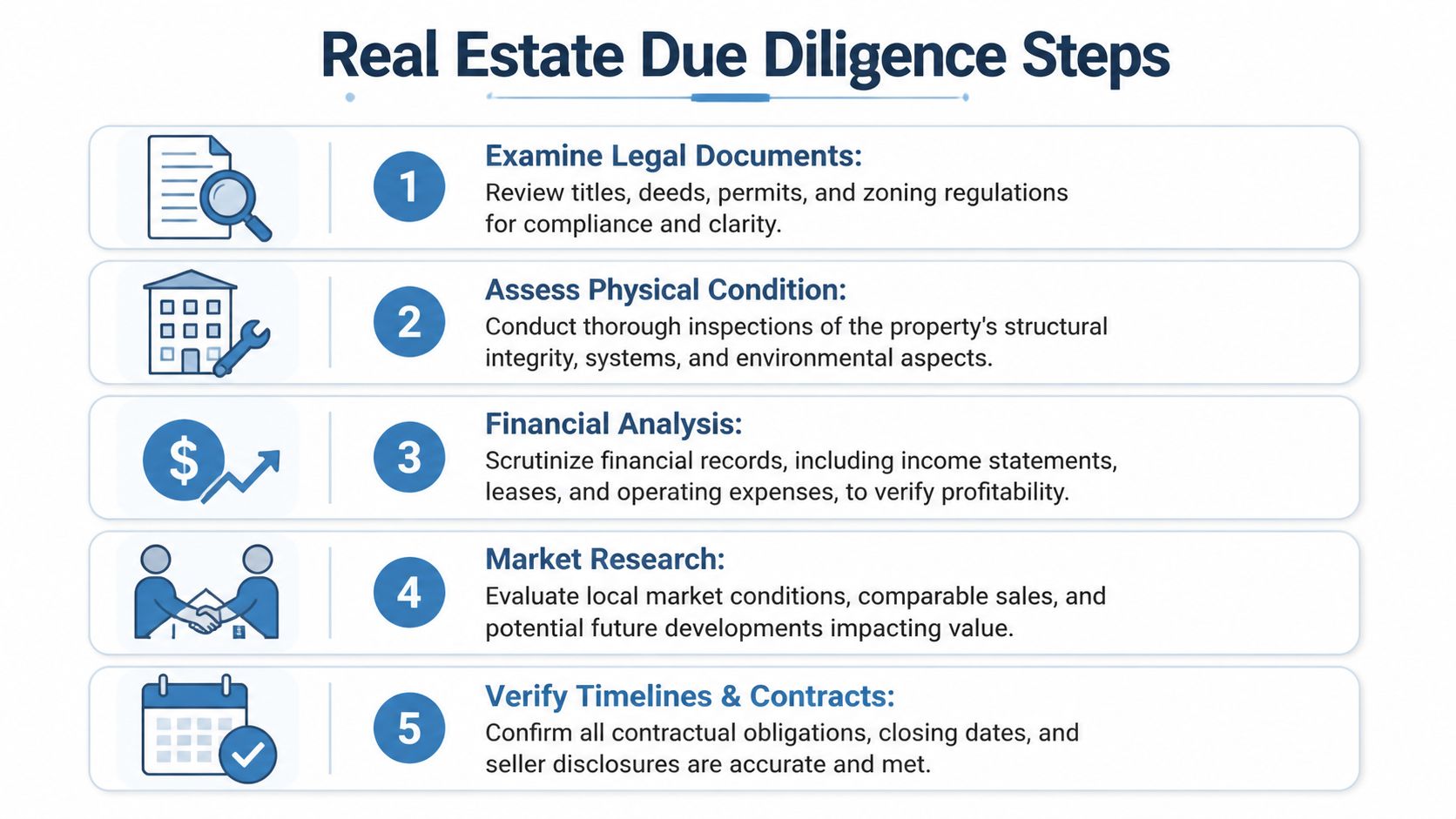
Start with the records that can kill a deal
The first pass should focus on issues that can stop financing, change value, or delay closing.
Title and ownership review
Confirm who owns the asset, how title is held, and whether recorded claims affect transferability or use. Don’t treat ownership history as background noise. It can point to unresolved disputes, distressed transfers, or layered entity structures that deserve more scrutiny.Liens, judgments, and encumbrances
“Good enough” diligence gets expensive. The practical cost of incomplete real estate diligence is rarely quantified, but missing lien information or permit violations can add 5 to 10 percent in unforeseen costs, which can wipe out deal profitability according to this discussion of due diligence gaps in real estate.Zoning, land use, and permit status
Verify permitted use, pending changes, open violations, and whether past improvements were properly authorized. Investors often assume current use equals compliant use. It doesn’t.
Then inspect the asset, not just the file
Paper review won’t tell you whether the building has deferred maintenance, moisture intrusion, unsafe systems, or unreported modifications. That’s why buyers still need on-site validation and specialist review where appropriate.
For physical condition, teams often benefit from independent building inspections because a third-party inspection can surface structural, safety, and maintenance issues that don’t appear in seller-prepared materials.
Physical diligence checklist
Structure and envelope
Roof, foundation, drainage, facade, signs of movement, and visible water damage.Core systems
HVAC, electrical, plumbing, fire safety systems, elevators where relevant.Environmental exposure
Site history, contamination indicators, flood exposure, and any records tied to environmental concern.Code and life safety
Existing violations, nonconforming improvements, and occupancy-related risks.
If a seller says an issue is minor, verify whether it’s minor to repair, minor to disclose, or minor only because they aren’t the one inheriting it.
Validate income and operating assumptions
A real estate deal doesn’t become safe because the property looks clean. The underwriting still has to hold up.
Use a working review structure like this:
| Review Area | What to verify | Why it matters |
|---|---|---|
| Income | Rent roll, lease terms, concessions, collections | Prevents inflated revenue assumptions |
| Expenses | Repairs, taxes, insurance, utilities, vendor contracts | Exposes underwritten margin risk |
| Tenant or occupant profile | Concentration, turnover patterns, lease quality | Tests stability of future cash flow |
| Capex exposure | Deferred maintenance, near-term replacements | Protects return assumptions after close |
Don’t stop at the property
A full real estate diligence process also checks the transaction itself.
- Seller disclosures need to be matched against independent findings.
- Purchase agreement timelines should align with inspection, financing, and cure periods.
- Third-party reports should be read, not just ordered.
- Market comps should support the exact use case, not a nearby story someone wants to tell.
The disciplined way to run this is simple: pull the public record, inspect the asset, reconcile the economics, test the contract, then decide whether the opportunity still works after the bad news is priced in.
What Are the Most Common Due Diligence Mistakes?
The most common due diligence mistakes are bias, shallow scope, poor follow-through, and overreliance on manual workflows.
Most failures don’t come from one dramatic oversight. They come from a chain of small compromises that feel efficient at the time.

The mistakes that keep repeating
Confirmation bias
Teams fall in love with the deal and start treating diligence as a closing requirement instead of a test. Every red flag gets reframed as manageable. That’s not analysis. That’s negotiation with reality.Surface-level review
Summary memos, broker packages, and seller-prepared exports save time, but they also flatten risk. If no one checks underlying records, the team is trusting packaging, not facts.Scope confusion
Some teams review everything and prioritize nothing. Others focus so narrowly on title or cash flow that they miss operational or municipal issues that later become expensive.One-and-done thinking
This is a major blind spot for lenders, servicers, insurers, and portfolio investors. Risk changes after the initial screen. If your process ends at acquisition or onboarding, your team will react late.
Why manual diligence breaks first
Manual diligence can work on a single asset when the timeline is generous and the people are disciplined. It breaks under volume. The moment you’re reviewing many properties, many counterparties, or many change events, spreadsheets and inbox threads stop being a control system.
That’s when teams start missing version changes, stale reports, open issues with no owner, and contradictory findings across workstreams.
A due diligence process without a clean audit trail usually means decisions are being made from memory, not evidence.
What to do instead
| Mistake | Old habit | Better move |
|---|---|---|
| Bias | Start from the desired outcome | Assign someone to challenge assumptions |
| Shallow review | Accept summaries at face value | Reconcile summaries against source records |
| Bad scope | Treat every item equally | Rank issues by value impact and decision risk |
| No monitoring | Stop at closing or onboarding | Track change events across the asset life cycle |
The biggest mindset shift is this: due diligence isn’t there to help you say yes faster. It’s there to help you make the right call, including a fast no.
How Do Data APIs Automate Real Estate Due Diligence?
Data APIs automate real estate due diligence by turning fragmented record pulls and one-off checks into repeatable workflows that can screen, enrich, and monitor properties continuously.
That changes the operating model. Traditional diligence is transaction-based. Modern diligence is event-driven and portfolio-aware.

The real shift is from lookup to monitoring
Old workflows ask, “What do we know about this property today?”
Modern workflows ask:
- What changed since last week?
- Which properties in the portfolio need attention now?
- Where are the same risk signals appearing at scale?
That’s the difference between buying data and building an operating system for diligence. Acquisition teams, mortgage servicers, insurance underwriters, and real estate platforms all benefit from the same idea: stop rechecking everything manually and let systems surface the exceptions.
What APIs actually automate
A useful real estate data API can automate several layers of work:
| Workflow | Manual method | API-driven method |
|---|---|---|
| Property screening | Search county records one asset at a time | Pull standardized property, ownership, and event data programmatically |
| Risk flagging | Review records only during transaction windows | Trigger alerts for permits, liens, ownership changes, or distress signals |
| Portfolio review | Maintain spreadsheets and periodic exports | Refresh monitored records continuously across many assets |
| Data delivery | Copy-paste from multiple tools | Push structured data into underwriting, CRM, or servicing systems |
A platform like BatchData’s geospatial analysis perspective on automated valuation models becomes relevant. Geospatial context helps teams connect property-level facts to spatial patterns that affect value, underwriting, and monitoring decisions.
Why technical diligence now matters to real estate teams
If your due diligence relies on data pipelines, technical quality becomes part of operational risk. That includes architecture, performance, testing discipline, and the ability to support bulk workflows without degrading data usability.
According to DFIN’s technical due diligence overview, technical diligence should assess code quality, architecture, scalability, security, and known issues. In the context provided for real estate data platforms, that includes support for 155M+ property records, low-latency API delivery, bulk data operations, and handling 1,000+ property attributes without performance degradation. That’s not abstract engineering language. It determines whether automated diligence is trustworthy at portfolio scale.
One practical model that works
The strongest model I’ve seen is a layered one:
- Screen first with standardized property and ownership data.
- Escalate exceptions such as permit anomalies, lien activity, or distress indicators.
- Route findings into the right system, underwriting, servicing, claims, or acquisitions.
- Monitor continuously instead of rebuilding the file every time someone asks a question.
Used this way, BatchData is one example of a platform that supplies property records, valuations, owner contacts, mortgage and lien detail, permit data, pre-foreclosure activity, and bulk or API delivery for teams that need repeatable diligence workflows rather than one-off lookups.
The competitive edge isn’t just faster access to records. It’s knowing which records changed, which assets are affected, and who needs to act.
That’s why “due diligence” in 2026 won’t mean a closing binder. It will mean an automated review layer that keeps working after the first decision.
Is Your Due Diligence Process Ready for 2026?
A due diligence process is ready for 2026 only if it can move from one-time review to continuous monitoring without losing accuracy or accountability.
That means your team can’t depend on scattered PDFs, spreadsheet trackers, and memory-based follow-up. You need a process that verifies the asset, documents decisions, and keeps watching for changes that affect value or risk after the initial review.
If your team is modernizing adjacent workflows too, guides to Top Web3 and AI outsourcing firms can be useful when evaluating external technical partners for data, automation, or platform work. The point isn’t trend chasing. It’s making sure the infrastructure around diligence is as current as the market pressure you’re operating under.
For a broader read on where investor attention is moving, review our Investor Pulse reports. It helps frame the competitive context around faster, data-driven decisions.
A weak process asks whether the file is complete. A strong process asks whether the decision is still sound when conditions change.
If your team needs a more scalable way to investigate properties, monitor portfolios, and operationalize due diligence across acquisitions, servicing, underwriting, or outreach, BatchData provides property records, ownership data, valuations, lien and permit details, and API or bulk delivery that can plug directly into modern real estate workflows.