





































In real estate, the most valuable data is often the hardest to acquire, a problem that becomes critical in non-disclosure states—specific U.S. states where the final sales price of a property is not required to be public record. This single policy creates a significant information gap, forcing investors, lenders, and real estate professionals to navigate opaque markets without access to publicly available comparable sales data. This guide provides a definitive list of these states and outlines the data-driven strategies required to succeed within them.
- Direct Impact: The primary consequence is the inability to publicly access property sales prices, which cripples standard valuation methods.
- Key Challenge: Automated Valuation Models (AVMs) are less accurate, and market analysis requires alternative data sources.
- The Solution: Success depends on leveraging proxy data signals like mortgage records, tax assessments, and owner-centric information to uncover opportunities.
This reality forces a strategic shift from analyzing past transactions to predicting future opportunities based on a mosaic of alternative data.
What Are Non-Disclosure States in Real estate?
A non-disclosure state is a U.S. state where laws prioritize the financial privacy of property owners over public transparency, legally shielding the final sales price of a real estate transaction from public records. While most of the U.S. operates on a full disclosure model—where the sales price is recorded and publicly accessible—non-disclosure states treat this figure as confidential information.
This fundamental policy difference directly impacts every facet of the real estate market within these states, from property valuation to investment analysis.
The downstream effect is severe. Automated Valuation Models (AVMs), the algorithms powering countless real estate platforms, rely on comparable sales data ("comps") to function. In non-disclosure states, AVMs are deprived of their most critical data input, leading to unreliable and often inaccurate home value estimates.
Core Difference
The central distinction boils down to a single question: Is the property's final sales price public information?
As of 2025, there are 11 non-disclosure states in the U.S. In these locations, the sales price is kept private, which fundamentally alters market analysis. These states—Texas, Utah, Idaho, Wyoming, Montana, New Mexico, Oklahoma, North Dakota, South Dakota, and the hybrid states of Arizona and Washington—cover approximately 20% of the U.S. landmass. They include some of the nation's fastest-growing markets, such as Texas, which records over 1.2 million home sales annually. For a complete analysis, see the report on real estate non-disclosure states from GoliathData.com.
This data opacity impacts:
- Property Tax Assessments: County assessors cannot rely on recent sales to determine market value, forcing them to use indirect methods that can result in valuation inconsistencies.
- Investment Analysis: Pulling comps to calculate a property's After Repair Value (ARV) or gauge market trends becomes a data-intensive challenge.
- Lending and Risk: Mortgage lenders face greater difficulty verifying a property's true market value, adding a layer of risk to underwriting.
This environment requires professionals to utilize alternative datasets and sophisticated analytical methods. For more on the various data sources, our guide on where real estate data comes from provides essential context.
Comparison: Disclosure vs. Non-Disclosure States
The following table provides a direct comparison of the two regulatory environments, highlighting how data availability dictates market dynamics and strategy.
| Attribute | Full Disclosure States (39 States) | Non-Disclosure States (11 States) |
|---|---|---|
| Sales Price Data | Publicly recorded and accessible. | Legally confidential and not public record. |
| AVM Accuracy | Generally high (1-2% margin of error). | Lower and less reliable (10%+ margin of error). |
| Market Transparency | High; market trends are easily tracked. | Low; analysis requires private or proxy data. |
| Appraisal Method | Heavily reliant on direct comparable sales. | Uses a mix of MLS data, tax assessments, and models. |
| Investor Challenge | Analyzing vast amounts of public data. | Acquiring accurate and sufficient data for analysis. |
The core challenge shifts from managing an abundance of public data in disclosure states to the difficult task of acquiring reliable data in non-disclosure states.
What Is the Complete List of Non-Disclosure States?
There are exactly 11 non-disclosure states in the U.S. where property sale prices are kept private and are not required to be part of the public record. For any investor, lender, or proptech platform building valuation models or sourcing opportunities, understanding these specific markets is non-negotiable. Operating in these states requires a data strategy fundamentally different from the one used in the other 39 states.
Below is the definitive list and map outlining these states.

The Official List
While all 11 states shield sales price data, each possesses unique market dynamics.
- Texas: The largest non-disclosure state, with massive metro areas like Dallas-Fort Worth, Houston, and Austin. Its size and growth make it a critical but difficult market to analyze.
- Utah: Home to the "Silicon Slopes," its tech-driven economy creates a competitive real estate market where accurate valuations are a major challenge.
- Idaho: One of the fastest-growing states, particularly around Boise. The high migration rate forces investors to use alternative data to determine true market values.
- Wyoming: Landowner confidentiality is a core legal value, creating significant data gaps for rural and high-end recreational properties.
- Montana: Similar to Wyoming, Montana prioritizes privacy. The popularity of luxury and second homes in areas like Bozeman makes private data essential for valuation.
- New Mexico: A diverse market where the absence of public sales data can obscure trends in key cities like Albuquerque and Santa Fe.
- Oklahoma: A growing market where non-disclosure rules create hurdles for large-scale investment analysis in Oklahoma City and Tulsa.
- North Dakota & South Dakota: Smaller markets tied to agriculture and energy where privacy laws create frustrating data gaps for both residential and commercial real estate.
Key Insight: The problem is not a lack of real estate transactions; it is a lack of publicly recorded transactional data. This reality forces professionals to rely on proxy data—such as mortgage amounts, tax assessments, and proprietary MLS information—to construct a complete picture.
Hybrid and Partial Disclosure
The landscape is further complicated by states like Arizona and Washington, often termed "hybrid" or partial disclosure states. In these locations, an affidavit of property value is typically filed, but the full sales price may not be easily accessible in public records. While real estate agents can access sales data via their local Multiple Listing Service, this information is proprietary and not available for bulk analysis without expensive licensing. This creates a two-tiered system where industry insiders hold a significant data advantage.
Profile of the 11 States
This table summarizes each non-disclosure state, highlighting its key markets and the primary data challenges investors and analysts encounter.
| State | Key Real Estate Markets | Disclosure Status Detail | Primary Data Challenge |
|---|---|---|---|
| Texas | Dallas, Houston, Austin, San Antonio | Strictly non-disclosure; privacy protected by statute. | Inability to access public sales prices for AVMs and comps. |
| Utah | Salt Lake City, Provo, St. George | Pure non-disclosure; sales prices are not public record. | Valuing properties in a rapidly appreciating tech-driven market. |
| Idaho | Boise, Coeur d'Alene, Idaho Falls | Sale prices are not collected or publicly recorded. | Tracking rapid market shifts driven by high in-migration. |
| Wyoming | Cheyenne, Jackson, Casper | Strong privacy laws; sales price is confidential. | Opacity in high-value recreational and rural property markets. |
| Montana | Bozeman, Missoula, Billings | Property transfer tax does not require price disclosure. | Valuing luxury and second-home markets with limited data. |
| New Mexico | Albuquerque, Santa Fe, Las Cruces | Sales prices are not part of the public record. | Assessing diverse urban and rural property values accurately. |
| Oklahoma | Oklahoma City, Tulsa | Non-disclosure status complicates market-wide analysis. | Sourcing reliable comps for investment and lending decisions. |
| North Dakota | Fargo, Bismarck | Sales prices are not publicly recorded by the state. | Difficulty in tracking values in energy and agriculture markets. |
| South Dakota | Sioux Falls, Rapid City | Adheres to non-disclosure principles for property sales. | Limited data transparency for residential and rural properties. |
| Arizona | Phoenix, Tucson, Scottsdale | Hybrid; affidavit of value filed but not easily accessible. | Proprietary MLS data creates a barrier for public analysis. |
| Washington | Seattle, Spokane, Tacoma | Hybrid; Real Estate Excise Tax (REET) affidavits filed. | REET data is available but often requires specialized access. |
Success in these markets is contingent on understanding these nuances and implementing a data strategy that overcomes the inherent information gaps.
How Does Data Opacity Impact Property Valuations?
The lack of public sales data in non-disclosure states directly erodes the accuracy of property valuations, making the system for determining property worth less reliable, more expensive, and significantly riskier. The primary casualty is Automated Valuation Models (AVMs), the algorithms that produce instant home value estimates. These models require a massive diet of comparable sales data ("comps") to function effectively.
In a non-disclosure state, this critical ingredient is absent. AVMs are forced to rely on secondary, less reliable data points, leading to valuations with a much wider margin of error.
The Breakdown of AVMs
Without direct access to sales prices, AVMs must use proxy data to generate an estimate, creating a cascade of reliability issues.
- Reliance on Assessed Values: AVMs often default to county tax assessment values, which are used for taxation, not real-time market pricing, and are updated too infrequently to be accurate.
- Mortgage Data as a Proxy: Another method involves using public mortgage records to reverse-engineer an estimated sale price by assuming a standard loan-to-value (LTV) ratio (e.g., 80%). This is an educated guess that fails to account for cash buyers, large down payments, or non-standard financing.
- Fragmented MLS Data: The Multiple Listing Service (MLS) contains accurate sales data, but it is a private, fragmented system. Access is restricted, and the data is not uniformly available for the large-scale analysis required by a robust AVM.
This dependence on flawed proxies means AVMs in non-disclosure states can have an error margin of 10% or more, compared to just 1-2% in data-rich disclosure states. For an investor analyzing hundreds of properties, this level of inaccuracy is unacceptable. For more on tools addressing these challenges, see our overview of modern real estate valuation software.
Increased Reliance on Manual Appraisals
When technology fails, the market reverts to more expensive, traditional methods. The data opacity in non-disclosure states forces an over-reliance on manual human appraisals.
Non-disclosure states saw a 15-20% higher reliance on appraisal services in 2024. In Texas alone, over 300,000 appraisals were conducted as the median home price surged to $320,000. This opacity leads to pricing inefficiencies; a 2024 study found that homes in states like Arizona sold for 4-7% above assessed values on average due to limited comps, inflating risk for mortgage originators. Discover more on how non-disclosure status impacts the market at GoliathData.com.
This not only adds $400-$700 per appraisal and significant delays to each transaction but also injects subjectivity into the valuation process. Two appraisers can arrive at different valuations for the same property, particularly when solid comps are scarce.
Elevated Risk for Lenders and Insurers
Inaccurate property valuations represent a systemic risk for mortgage lenders, servicers, and insurers. These institutions manage portfolios worth billions, and their risk models depend on precise asset valuation. When a property's value is inflated due to poor data, the lender's collateral is worth less than recorded, increasing the risk of loss in the event of a borrower default. Insurers face the same issue, relying on accurate valuations to set premiums and manage exposure.
Why Do These States Restrict Data?
The existence of non-disclosure states is a deliberate policy choice rooted in a philosophy of financial privacy that contrasts sharply with the open-records approach of most of the country. These states have enacted laws to shield property owners from public financial scrutiny. The core principle is that the sales price of a home is private financial information, akin to a bank account balance.
This legal stance reframes the sales price from a public data point into a protected detail of a private contract between two parties.
The Legislative Roots
This privacy-first approach was established over decades through state property and tax laws emphasizing individual rights.
In Texas, for example, Texas Tax Code § 22.27 was specifically enacted to protect information that property owners voluntarily provide to appraisal offices. Similarly, Government Code § 552.149 creates an explicit exception in the state's open records laws for any sales data obtained from private sources, legally walling it off from public access. These laws reflect a foundational belief that a property owner's financial transactions are their own business.
A Contrast to Open-Record States
This model is the direct opposite of that found in full-disclosure states like California or Florida, where the public's right to know and the government's need for transparent data are prioritized. In those markets, every sale is publicly recorded to ensure fair taxation and a predictable market. Laws shielding buyer and seller information from public view began appearing as early as the 1990s in states like Idaho and Wyoming. Meanwhile, in the other 39 full-disclosure states, that same sales price data is easily accessible. You can explore a deeper analysis of these regulations and their modern-day implications at GoliathData.com.
The Bottom Line: Non-disclosure is a feature, not a bug. It compels the real estate ecosystem—from investors to proptech developers—to operate within this legal framework. Understanding this privacy-first mindset is the first step toward developing effective strategies.
How Can You Overcome Sales Price Opacity?
Operating in a non-disclosure state requires a multi-layered data strategy that pieces together various signals to create a complete property profile. Success is not about finding a single data point to replace the sales price; it's about building a data mosaic from disparate sources.
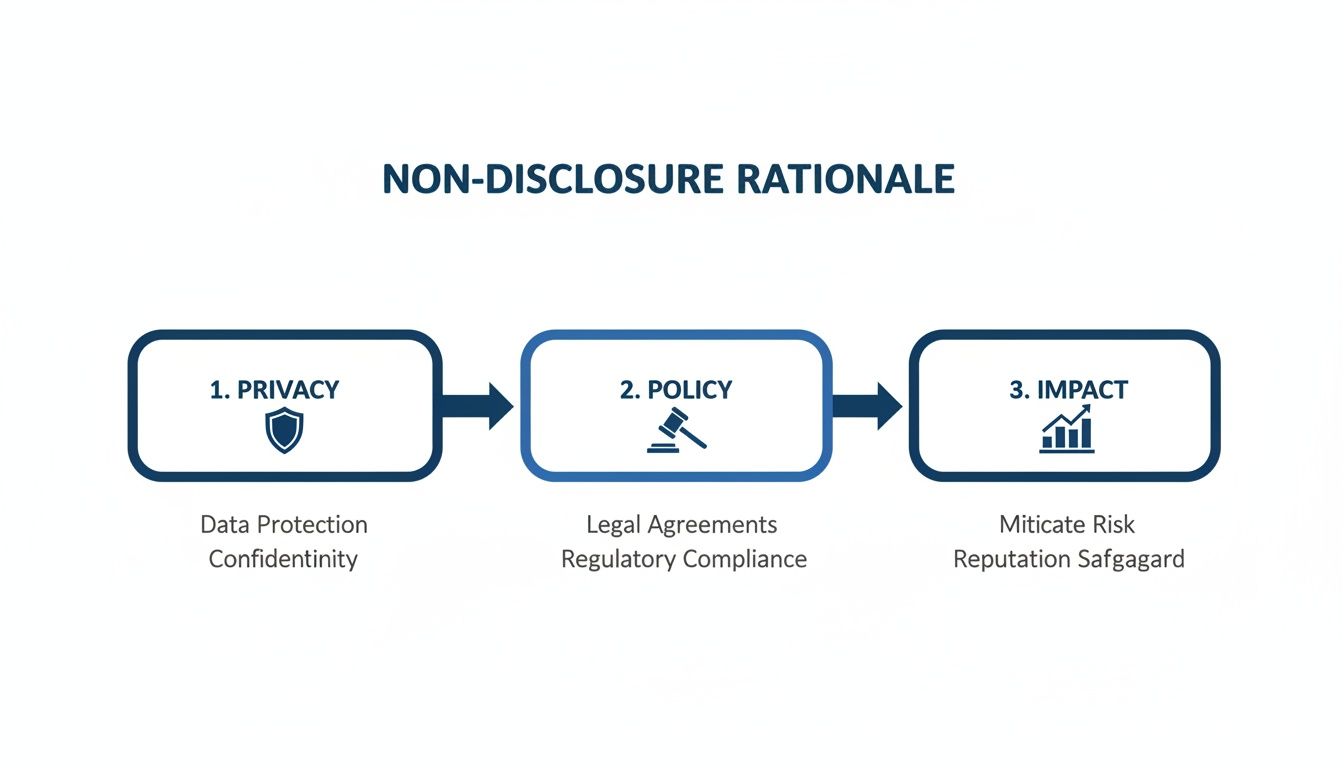
The chart below breaks down the rationale behind non-disclosure laws and their market impact, underscoring why the following strategies are essential.
Use Alternative Data as Proxies
When direct sales data is unavailable, the most effective approach is to use proxy indicators.
- Tax Assessment Data: While not the market value, it serves as a solid baseline. Calculate the ratio of assessed value to actual market values in nearby disclosure states to create a correction factor for more accurate estimates.
- Deed Transfers and Mortgage Records: A deed transfer confirms a sale. Pairing that event with its corresponding mortgage record reveals the loan amount, lender, and date—a critical piece of the valuation puzzle.
- Building Permits: A surge in permits for renovations or new construction often indicates a property is being prepared for sale or has recently been improved by a new owner, signaling a potential value increase.
Reverse-Engineer a Sales Price
Using mortgage data to work backward and estimate the sales price is a highly effective technique.
- Find the Mortgage Amount: The new mortgage amount is publicly recorded when a property is financed.
- Estimate the Loan-to-Value (LTV) Ratio: This requires market knowledge. Conventional loans often have an 80% LTV (20% down payment).
- Calculate the Estimated Sales Price: Divide the mortgage amount by the estimated LTV. For a $400,000 mortgage with an assumed 80% LTV, the estimated sales price is $500,000 ($400,000 / 0.80).
Pro Tip: This method is most accurate for conventional loans on primary residences. It is less reliable for all-cash deals or investor financing with different LTV requirements. Always cross-reference with other data signals.
Aggregate Data Signals with Platforms
Manually assembling this data for an entire market is impossible. Modern data platforms are essential for success in these states. Platforms like BatchData, which processes 155 million U.S. property records, aggregate tax records, deed transfers, mortgage details, and permit data into a single, unified property profile. This creates a holistic view that approximates the clarity of a full-disclosure state. For those looking to collect public data independently, learning to web scrape with Python is a practical skill.
Mastering these alternative data strategies can turn the challenge of non-disclosure states into a significant competitive advantage. For more on using data to connect with property owners, see our guide on skip tracing for real estate.
How Can You Find Investment Opportunities?
The data gaps in non-disclosure states create a competitive advantage for investors who pivot from analyzing past transactions to predicting future opportunities using owner-centric data signals. By focusing on the property owner's situation, you can identify high-intent leads that are invisible to those relying on traditional valuation models. This strategy involves using modern data tools to spot indicators of distress, equity, and significant life events.
Focus on Owner-Centric Data
In markets where property values are a black box, the owner's narrative becomes your most valuable intelligence.
- High Equity: An owner with significant equity has the financial flexibility to sell.
- Long-Term Ownership: An individual who has owned a property for 15+ years is statistically more likely to sell due to life changes like retirement or downsizing.
- Financial Distress Signals: Data points like pre-foreclosure notices, tax delinquencies, or other liens are direct indicators of a motivated seller.
- Recent Life Events: Signals such as divorce filings or probate cases often precede a property sale.
Use Data Tools to Uncover Leads
Specialized data platforms are essential for identifying these signals at scale, turning the privacy hurdles of non-disclosure states into an actionable advantage.
Investors using platforms with contact enrichment and propensity modeling gain an edge by accessing scrubbed owner data and pre-foreclosure signals. With Sun Belt metros in these states driving 25% of national migration per Census data, tools that unify tax, lien, and market signals are indispensable for due diligence. Discover more insights on how market signals reveal opportunities on GoliathData.com.
These platforms enable you to filter for specific combinations of signals, such as properties with over 70% equity, owned for more than 10 years, and currently in pre-foreclosure—a trifecta indicating a highly motivated seller. A wholesale real estate virtual assistant can be invaluable for sourcing deals and conducting initial due diligence in these complex markets.
Execute a Skip Tracing Workflow
Identifying a promising property is the first step. Making direct, respectful contact is critical in states where owners value privacy.
- Identify High-Intent Properties: Use a data platform to filter for properties matching your investment criteria (e.g., high equity, long-term ownership, lien records).
- Run Skip Tracing: Input the list of addresses into a skip tracing service to obtain verified phone numbers and email addresses for the owners.
- Initiate Outreach: Launch a targeted, professional outreach campaign that clearly communicates the value you offer.
This owner-first approach allows you to bypass market noise and engage directly with sellers who have a compelling reason to transact.
What Are Some Frequently Asked Questions?
Here are answers to common questions about navigating real estate in non-disclosure states.
Why Do Non-Disclosure States Exist?
The policy is rooted in a philosophical commitment to financial privacy. States like Texas and Idaho legally treat a home's sale price as confidential information between the buyer and seller, not a matter of public record. While the majority of the U.S. prioritizes open records for market transparency and fair taxation, these 11 states view financial privacy as a fundamental component of property rights.
Can You Get Accurate Property Valuations?
Yes, but it requires a different methodology. Standard Automated Valuation Models (AVMs) are unreliable in these states. The solution is to synthesize alternative data points:
- Mortgage Records: Use the public loan amount and an estimated loan-to-value (LTV) ratio to reverse-engineer an approximate sale price.
- Tax Assessments: Provide a baseline value that can be adjusted based on local market trends.
- MLS Data: The Multiple Listing Service contains agent-reported sales prices and is the most reliable source, though access is typically restricted.
Combining these signals allows for the creation of a valuation model that can be as accurate as those based on public records.
Are There Legal Risks to Finding Sales Data?
Generally, no. The laws in non-disclosure states are directed at government agencies, preventing them from compelling the disclosure of a sale price. These laws do not prohibit private parties from collecting, sharing, or using this information.
Important Distinction: The laws restrict public disclosure requirements, not private data collection. Real estate professionals and data firms regularly use sales data from private sources like the MLS without violating any laws. The primary challenge is access, not legality.
Is Finding Motivated Sellers Harder?
It can be if you rely on traditional metrics like sales history. However, the lack of transparency creates an opportunity for investors who shift their focus from property-centric data (like comps) to owner-centric signals. By tracking indicators like pre-foreclosure status, high equity, long-term ownership, and lien activity, you can identify motivation that is independent of public sales data. This owner-first strategy is often a more direct path to the best off-market deals.
Ready to turn data opacity into your competitive advantage? BatchData provides the comprehensive property data, owner contact information, and advanced analytics needed to find high-intent opportunities in any market, including all 11 non-disclosure states. Explore our platform today and see how better data drives better deals.