

































Skip tracing is the process of finding accurate contact information for property owners who are hard to reach. For real estate investors, it’s a critical tool to connect with absentee landlords, owners of vacant properties, or individuals behind LLCs and trusts. Modern skip tracing platforms like BatchData have transformed this process, making it faster and more reliable by using automated data enrichment from multiple sources.
Key Takeaways:
- What it does: Provides phone numbers, email addresses, and mailing details for property owners.
- Why it matters: Helps investors access off-market deals, save time, and reduce wasted marketing costs.
- How it works: Combines public records, utility data, and credit bureaus to generate accurate contact details.
- Accuracy: BatchData achieves a 76% right-party contact rate, far above the industry average.
- Cost: For current BatchData pricing and available options, contact the BatchData sales team.
BatchData also simplifies identifying owners behind LLCs or trusts, ensuring you reach decision-makers. With compliance safeguards like “Do Not Call” and “Litigator Scrub” features, it minimizes legal risks. Whether you’re targeting absentee owners or pre-foreclosure properties, skip tracing is an essential step to close more deals efficiently.
How Skip Tracing Has Changed Over Time
From Manual Research to Automated Data Systems
In the past, skip tracing was a painstaking process. It involved flipping through phone books, knocking on neighbors’ doors, and making trips to courthouses to track down property owners. Private investigators were often brought in for more challenging cases, spending hours sifting through local assessor’s office files and court records to connect the dots.
Fast forward to today, and the landscape has completely shifted. Modern skip tracing platforms pull data from a variety of sources – property records, court filings, tax documents, utility data – and compile it in seconds. What once took half an hour or more now happens almost instantly. Instead of physically chasing leads, investors can simply upload a list of properties and get enriched contact details in no time.
This evolution has been a game-changer, especially in competitive markets where speed is critical. In low-inventory areas, being the first to contact a property owner can mean the difference between landing a deal or losing it. Automated systems allow investors to handle thousands of records at once, turning what used to be a tedious, manual job into a streamlined, scalable process.
How Data Enrichment Improves Contact Accuracy
Automation hasn’t just made skip tracing faster – it’s made it more reliable. Data enrichment plays a key role by cross-checking information across multiple sources to ensure contact details are up-to-date. Instead of relying on a single, outdated database, these systems tap into credit bureaus, social media profiles, utility records, and public databases to verify phone numbers, addresses, and other critical details.
The results speak for themselves. Manual methods often struggled with accuracy rates below 50% because of outdated or incomplete information. In contrast, modern automated systems can achieve accuracy rates between 70–90% by continuously validating and updating data across various platforms. For real estate investors, this means fewer dead ends and more productive conversations with property owners – often at speeds 5–10 times faster than traditional methods.
One of the toughest challenges in skip tracing has also been addressed: identifying the real owners behind LLCs and trusts. Today’s systems can uncover the decision-makers behind these entities, bypassing registered agents or management companies to connect directly with the people who matter. This advancement has added a new layer of efficiency and effectiveness to the process, making it an indispensable tool for real estate professionals.
When to Use Skip Tracing in Real Estate
Common Skip Tracing Use Cases
Skip tracing has become a go-to tool for real estate professionals when traditional property records fail to provide the information they need. For example, absentee landlords can be particularly hard to reach since they live at a different address than the property they own. Similarly, tracking down owners of vacant or abandoned properties often requires more than just the mailing address listed in public records.
Another common scenario is dealing with pre-foreclosure properties. Homeowners in financial trouble may have disconnected their phones or stopped checking mail sent to their listed address. Skip tracing allows you to connect with these sellers before others even know they’re an option. Likewise, with probate properties, locating heirs – who might be scattered across the country and have no ties to the property – becomes much easier with skip tracing.
One of the trickiest challenges involves properties held by LLCs or trusts. Public records often only list a registered agent or a generic business address, leaving you without a clear path to the actual decision-makers. Skip tracing can dig deeper, uncovering the individuals behind these entities, even when ownership structures involve multiple layers of LLCs.
Skip tracing is also invaluable for tenant screening and collections. Property managers use it to verify application details, check employment history, or track down former tenants with unpaid rent or repair fees. These practical applications show how skip tracing simplifies locating hard-to-reach individuals, ultimately driving more business opportunities.
What Skip Tracing Does for Your Business
One of the biggest perks of skip tracing is gaining access to off-market deals. By reaching property owners who aren’t listing on the MLS, you’re competing with far fewer buyers, which gives you better leverage in negotiations and increases your profit margins.
In fast-paced markets, speed is critical. With accurate, targeted data, skip tracing can help you quickly identify and contact property owners who match your target profile, such as those with specific demographic or financial characteristics. Bulk workflows can help you process large numbers of records efficiently while focusing on leads that align with your investment criteria.
Skip tracing also helps you cut down on wasted marketing expenses. Without accurate contact details, you risk sending mail to outdated addresses, calling disconnected numbers, or spending money on outreach that doesn’t reach the right people. With verified contact information, your efforts are more targeted and effective. At just $0.07 per match for high-volume batches, the investment in accurate data is a fraction of the cost of failed marketing campaigns.
6 Real Estate Skip Tracing Techniques
How BatchData Improves Skip Tracing Results

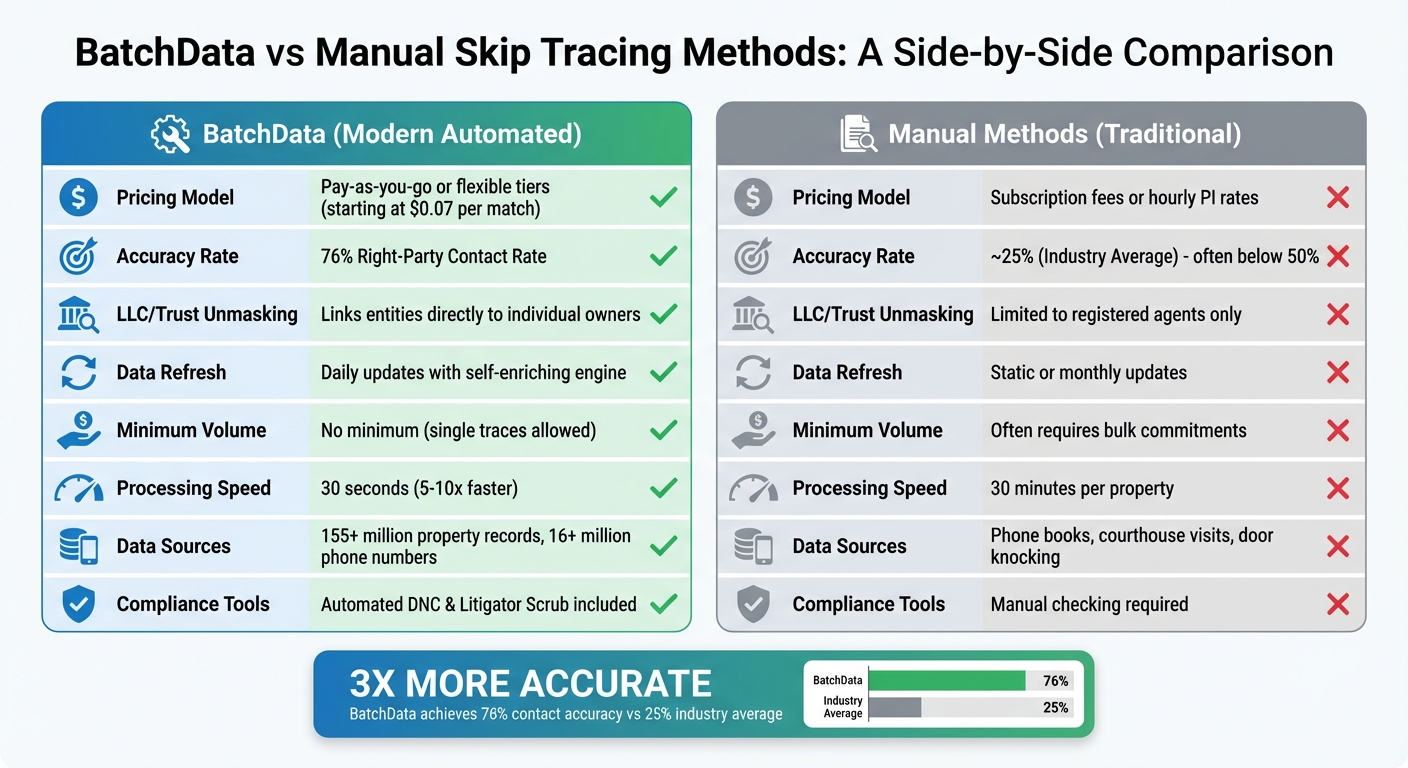
BatchData vs Manual Skip Tracing Methods Comparison
BatchData takes skip tracing to the next level by leveraging modern data enrichment techniques. It stands out with three key benefits: a flexible pricing model that avoids unnecessary costs, a high accuracy rate that minimizes wasted efforts, and the ability to uncover the real owners behind corporate entities.
Pricing
BatchData offers options designed to support different data requirements and usage volumes. Available plans and commercial terms depend on the products and services required. For current pricing and available options, contact the BatchData sales team.
For investors focused on high-value properties, the “Single Skip Trace” option is particularly useful. It enables one-off investigations without requiring a bulk purchase commitment.
Additionally, compliance tools are included at no extra charge. Each search automatically checks the National Do Not Call registry and flags potential TCPA litigators, helping you avoid costly fines.
This pricing flexibility ensures you can make the most of your data, while BatchData’s accuracy further enhances its value.
76% Contact Accuracy Rate
BatchData delivers a 76% right-party contact rate by aggregating and cross-verifying information from more than a dozen top-tier sources. The platform’s data is updated daily and refined using feedback from over 20,000 active users, ensuring contact details remain up-to-date.
This high level of accuracy has a direct impact on efficiency. With three out of four phone numbers connecting to the actual property owner, you’ll spend less time chasing dead ends and more time engaging with real prospects. Access to 155+ million property records and 16+ million phone numbers further strengthens your ability to connect with the right people.
To help prioritize leads, BatchData also provides Reachability Scores and Phone Number Confidence Scores, guiding you toward the most promising contacts.
“What used to take 30 minutes now takes 30 seconds. BatchData makes our platform superhuman.”
- Chris Finck, Director of Product Management
While accuracy is vital, knowing who to contact is equally important – especially when dealing with complex ownership structures.
Finding Owners Behind LLCs and Trusts
Properties held by LLCs or trusts often present challenges, as public records typically list only a registered agent or a generic business address. BatchData’s proprietary technology cuts through this barrier, linking LLCs and trusts directly to their actual owners.
This feature is a game-changer for investors targeting commercial properties or estates managed through trusts. By identifying the decision-maker, you can avoid weeks of manual research and sidestep countless dead-end calls.
| Feature | BatchData | Manual Methods |
|---|---|---|
| Pricing Model | Flexible options | Subscription fees |
| Accuracy Rate | 76% Right-Party Contact | ~25% (Industry Average) |
| LLC/Trust Unmasking | Links entities to individual owners | Often limited to registered agents |
| Data Refresh | Daily updates | Often static or monthly updates |
| Minimum Volume | No minimum (Single traces allowed) | Often requires bulk commitments |
sbb-itb-8058745
How Skip Tracing Works: Data Sources and Methods
Skip tracing involves piecing together information from various sources, using real-time verification to ensure accuracy. Modern tools gather data from public records, business directories, utility databases, and even social media profiles to create a detailed profile of property owners. The combination of automated data collection and verification ensures that the right individual is identified. These interconnected data sources are the foundation of effective skip tracing.
Where Skip Tracing Data Comes From
Skip tracing relies on several primary data sources:
- Public records: These include property deeds, tax assessments, court filings, and voter registrations. They provide essential details about ownership history and legal ties to properties.
- Corporate and business data: When properties are owned by LLCs, business license registries and platforms like Open Corporates are used to uncover the key individuals behind these entities. This step is especially important when public records don’t provide complete information.
- Utility and directory data: Utility mailing addresses and directory listings help confirm current residency. Advanced services also incorporate social media and phone carrier data to match phone numbers with previous addresses.
Different property types can influence accuracy. For instance, skip tracing for single-family homes achieves an accuracy rate of 85–95%, while vacant land lags behind at 70–80% due to fewer records. Advanced tools can improve first-attempt success rates by up to 40%.
To improve match rates, it’s essential to clean your lists beforehand. Remove duplicates, correct formatting errors, and update data quarterly based on tax records. By tapping into multiple data streams, modern skip tracing enhances precision while ensuring compliance with legal standards. Platforms like BatchData incorporate these methods to deliver highly accurate results.
Legal Rules and Ethical Guidelines
Following legal and ethical standards is a cornerstone of responsible skip tracing. While it’s legal to use public records and aggregated data, certain practices are strictly off-limits. Prohibited activities include hacking, stalking, pretexting to obtain financial data, and accessing bank accounts without authorization.
Several federal laws regulate skip tracing practices:
- Fair Credit Reporting Act (FCRA): Skip tracing cannot be used to pull credit reports for lending decisions without explicit consent.
- Gramm-Leach-Bliley Act (GLBA): This law bans impersonating someone to obtain personal information.
- Telephone Consumer Protection Act (TCPA): Violations of phone outreach rules can result in fines of up to $1,500 per illegal call or text.
State-level regulations further complicate compliance. For example, the California Consumer Privacy Act (CCPA) mandates risk assessments and grants consumers specific privacy rights. In states like California and Texas, skip tracers may need a Private Investigator (PI) license or specific debt collection certifications.
BatchData incorporates automated safeguards to help users stay compliant. Features like “Litigator Scrubs” identify known TCPA litigators, and cross-referencing with the National Do Not Call (DNC) Registry ensures adherence to outreach laws. Before initiating contact, it’s crucial to run lists through the DNC and TCPA databases. Keeping detailed records of permissions and documenting the purpose of every skip trace are vital for avoiding legal issues.
“Ethical skip tracing is as much about following the law as it is about being responsible and professional.” – Grace Caraan, Headley Legal Support
How to Use BatchData for Skip Tracing
BatchData simplifies skip tracing through options like bulk uploads, manual entry, and API integration. If you’re not a developer, the BatchLeads platform allows you to upload lists easily. For developers, the high-speed API can be directly integrated into your software. Whether you choose API or bulk uploads, BatchData provides enriched results quickly.
Uploading Your Property List
To get started with skip tracing on BatchData, you’ll need to submit either the property address (street, city, state, ZIP) or the APN along with its county and state. You can upload CSV files for bulk processing or use the API for faster handling of up to 100 properties per request. Before uploading, make sure your addresses follow USPS formatting guidelines to improve match accuracy.
For larger batches, use the asynchronous endpoint to avoid timeout issues. The system charges only for matches where contact information is successfully retrieved.
Reading Your Enriched Data Results
Once processed, the enriched data is available on the BatchLeads platform and as downloadable CSV reports. Results include multiple phone numbers categorized as “mobile” or “landline”, helping you choose the best way to reach out. Additionally, Reachability Scores or Phone Number Confidence Scores help you focus on the most reliable and active contacts.
You’ll also see flags like “DNC” (Do Not Call) and “Litigator Scrub”, which identify numbers on the national do-not-call list or those linked to known TCPA litigators. For properties owned by LLCs or trusts, the data includes the names and contact details of the actual decision-makers. Comparing the Mailing Address with the Property Address can help identify absentee owners who might be more motivated to sell.
“What used to take 30 minutes now takes 30 seconds. BatchData makes our platform superhuman.” – Chris Finck, Director of Product Management
With this enriched data, you’re ready to connect with property owners effectively.
Reaching Out to Property Owners
Using the prioritized contacts from your enriched data, BatchData supports a range of outreach methods, including cold calling, SMS, email, and direct mail. The platform provides mobile/landline numbers, email addresses, and verified mailing addresses to guide your approach. Start with leads that have the highest Reachability Scores to make the most of your time and marketing budget. Use mobile and landline indicators to decide whether to send a text or make a call.
BatchData boasts a 76% right-party contact rate, increasing the likelihood of reaching the actual property owner on your first attempt. To ensure your direct mail reaches valid addresses, rely on the platform’s Address Standardization and DPV features. With daily data updates powered by a self-enriching engine, you can trust that your outreach efforts are based on the most current information available.
Understanding Your BatchData Results
Once your skip trace is complete, you’ll receive a report packed with key data fields to help you contact property owners quickly. These fields, generated through BatchData’s precise skip tracing process, are designed to connect you with high-value leads.
What Each Result Field Means
BatchData provides detailed, actionable data to support effective outreach. Here’s what you can expect:
- Contact details: You’ll receive multiple phone numbers, labeled as either “Mobile” or “Landline”, along with verified email addresses. Each phone number includes a confidence score (ranging from 0 to 100) that indicates how likely it is to belong to the property owner. Numbers marked as “reachable=true” are currently active and ready for contact.
- Compliance flags: To help you avoid legal risks, you’ll see indicators like the “DNC” (Do Not Call) flag, which shows if a number is listed on the National Do Not Call registry. There’s also a “Litigator” flag to identify contacts associated with known TCPA litigators. It’s crucial to exclude numbers flagged as litigators from your campaigns.
- Property metadata: These fields help you evaluate seller motivation. For instance:
- Equity %: This shows the owner’s equity share in the property. Higher equity (typically 35% or more) often means better leverage during negotiations.
- Vacant: Indicates whether the property is unoccupied, which can suggest a motivated seller.
- Absentee: Flags when the property owner lives at a different address than the property itself, often identifying landlords or investors.
| Result Field | Meaning | How to Use It |
|---|---|---|
| Score | Confidence level (0-100) for contact accuracy | Focus on scores 90 and above |
| Type | Mobile or Landline classification | Give priority to “Mobile” for calls and texts |
| Reachable | Indicates if the number is active (True/False) | Contact numbers marked “True” |
| Litigator | Identifies known TCPA litigators (True/False) | Exclude “True” results to avoid legal issues |
| Equity % | Percentage of property value owned | Target 35%+ for stronger negotiation opportunities |
| Vacant | Property occupancy status (True/False) | “True” may point to a motivated seller |
| Absentee | Owner lives elsewhere (True/False) | Useful for identifying landlords or investors |
These insights allow you to segment your list effectively and focus on the most promising leads.
How to Prioritize Your Best Leads
With this data in hand, you can refine your outreach strategy for maximum results. Start by focusing on contacts with a confidence score of 90 or above and numbers marked as “reachable=true.” Mobile numbers should take precedence, as they generally lead to higher engagement through both calls and texts.
To identify your top prospects, combine multiple data points. For example, a vacant property owned by someone with significant equity is likely a strong lead. Similarly, absentee owners – where the mailing address differs from the property address – often own investment properties and may be more open to receiving tailored offers.
Before launching your campaign, ensure compliance by removing contacts flagged as litigators and checking DNC regulations. By focusing on high-scoring, legally compliant leads, you can make the most of your time and budget. BatchData’s 76% right-party contact rate – around three times the industry average – underscores the value of targeting the right leads.
Additionally, cross-referencing the mailing address with the property address can confirm absentee ownership. When these addresses don’t match, you’ve likely identified a landlord or investor, enabling you to customize your outreach strategy for better results.
Conclusion: Getting Started with BatchData Skip Tracing
Key Takeaways
BatchData helps businesses turn property and contact data into actionable insights and support data-driven workflows. Its skip tracing and property data capabilities can help investors identify and evaluate potential opportunities, including properties associated with LLCs, trusts, and other corporate entities. For current product capabilities, data availability, and commercial terms, contact the BatchData sales team.
These advantages help streamline the deal-making process, enabling faster closings and generating more qualified leads.
Getting Started with BatchData
If you’re ready to see these benefits in action, here’s how to get started with BatchData for your next project. First, sign up for a free account at app.batchdata.com. Then, upload your CSV file containing property addresses, choose your skip tracing options, and pay only for successful matches. Once your results are ready, download the enriched data, which will include phone numbers, email addresses, ownership details, and compliance indicators like DNC and litigator alerts.
After receiving the data, focus on evaluating high-confidence leads to maximize your outreach efforts. Pay special attention to leads with high reachability scores and prioritize mobile numbers for better engagement. Cross-check mailing addresses with property addresses to identify absentee owners, and use litigator filters to ensure compliance with TCPA regulations.
For a hands-on trial, consider uploading a batch of 100–500 distressed property addresses. With BatchData’s 76% accuracy rate, you’ll uncover a significant number of high-quality contacts. Often, this process will even reveal owners hidden behind LLCs, giving you the opportunity to initiate seller conversations and start converting leads into deals within just a week.
FAQs
How does skip tracing reveal the owners behind LLCs and trusts?
Skip tracing is a method used to identify the actual individuals behind entities like LLCs and trusts by examining publicly accessible records. These records often come from sources such as county recorder offices, property assessor databases, and Secretary of State systems, which may list members, managers, officers, or trustees. By piecing this information together, skip tracing reveals the connection between a legal entity and the person who controls it.
BatchData simplifies this process by automating the search across multiple data sources to build a comprehensive contact profile. This profile can include details like the owner’s name, mailing address, phone number, and, when available, their email address. With this automation, skip tracing removes the hassle of manual searches, enabling investors to quickly find and reach out to the decision-makers behind properties owned by corporations or trusts.
What legal factors should I consider when using skip tracing for real estate?
When using skip tracing in real estate, it’s critical to stay within the boundaries of federal and state privacy laws that regulate how personal data is collected, stored, and used. Steer clear of unethical actions like pretending to be law enforcement, accessing private financial records without permission, or using intimidation to obtain information.
If skip tracing is part of a legal process, such as serving notices or pursuing claims, make sure to follow the correct legal steps. For instance, accessing certain protected records might require a court order. Skipping these procedures can result in delays or even legal consequences.
Always treat the information you gather with care, respect privacy regulations, and be aware of the limits of skip tracing services. Sticking to these principles helps you avoid legal troubles and ensures you uphold ethical standards in your real estate activities.
What pricing options are available for BatchData?
BatchData offers options designed to support different real estate data requirements and usage volumes. Available products, pricing, and commercial terms depend on the specific data and services required. For current pricing and available options, contact the BatchData sales team.
This setup puts you in charge of your budget while still delivering top-tier accuracy and comprehensive property owner data. It’s a smart, flexible option tailored for both beginners and seasoned investors.