





































APN stands for Assessor's Parcel Number (APN), the unique identifier for real estate that links tax, ownership, and assessment records. This permanent code eliminates the ambiguity of street addresses, ensuring every legal and financial record is correctly assigned to one specific parcel. Unlike a mailing address, which can change or apply to multiple units, the APN is the definitive key used by tax assessors to identify land, making it the bedrock of property data accuracy.
| Key Takeaway | Description |
|---|---|
| Unique Identifier | The APN is the single source of truth for identifying property for tax and legal purposes. |
| Data Synchronization | It's the primary key that links tax records, deeds, permits, and liens to the correct parcel. |
| Essential Tool | For investors, lenders, and proptech, the APN is indispensable for due diligence and data analysis. |
Mastering APNs is essential for anyone working seriously with property data.
What is an APN in real estate?
The APN is the single source of truth for identifying a specific piece of property for all legal and tax matters. A street address is designed for mail delivery, not permanent identification; addresses are often reformatted, reassigned, or may cover an entire multi-unit building, making them unreliable for official records. The APN solves this problem by providing a unique, unchanging identifier tied directly to the land itself.

This unique code is assigned by the local county assessor’s office to every parcel of land within its jurisdiction. It serves as the primary key for all official records connected to that property, including tax assessments, liens, and building permits.
Anatomy of an APN
An APN is not a random string of digits; it is a geo-coded serial number that acts like coordinates within the county's assessment grid. While formats vary wildly from state to state, many follow a logical structure where each segment of the number corresponds to a specific physical location.
In my experience reviewing county records, the format changes every time you cross a jurisdictional line, but the underlying logic often remains consistent. Consider a typical format like 0221-450-08:
- Map Book (022): The volume containing the official assessor's map for this area.
- Page (1): The specific page within that book.
- Block (450): The cluster of parcels on that page.
- Parcel (08): The specific lot within the block.
This structure matters in practice because real estate data platforms, lenders, and title teams often rely on the APN to link tax, ownership, and assessment records. Sacramento County, for instance, uses a 14-digit format that encodes map book, page, block, and parcel number, making it useful for organizing millions of records at scale.
The Core Function of an APN
At its heart, the APN connects a physical plot of land to a massive web of critical data, documented in assessor data. The power of an APN lies in its permanence and uniqueness. It guarantees that every tax bill, lien, permit, and title record is attached to the correct asset, preventing catastrophic errors in transactions and data analysis.
This level of precision is critical in an industry of immense scale. The global real estate market was valued at USD 4.34 trillion in 2023 and is projected to reach USD 7.03 trillion by 2034, according to these real estate market projections here.
Decoding the APN Structure
While the exact format varies by county, most APNs follow a logical, segmented structure. Each segment corresponds to a specific geographic breakdown, acting like coordinates that become progressively more specific.
Here is an anatomy of a typical APN:
| Segment | Description | Example Value |
|---|---|---|
| Book Number | Identifies the largest geographical area, similar to a city or a large region within the county. | 5021 |
| Page/Map Number | Narrows the location down to a specific assessor's map within that book. | 022 |
| Block Number | Refers to a specific cluster of properties on that map, much like a city block. | 01 |
| Parcel Number | The final segment, which pinpoints the individual lot within that block. | 023 |
Understanding this structure reveals the logic behind what initially appears to be a random string of digits.
What Does an APN Look Like?
Because APN structures are defined by individual counties, there is no single visual standard. However, they generally appear as a series of numbers separated by hyphens or presented as a long continuous string on tax documents and deeds.
When you pull up a property record on a county portal, you will often see the APN labeled as "Parcel ID," "Legal Description," or "Folio Number" depending on the state. In California, you might see a format like 012-345-67-89 (map book-page-block-parcel-subparcel). In Texas, it might be a simpler alphanumeric code.
I’ve analyzed parcel data across dozens of counties, and the only constant is that the APN always sits alongside the legal description. If you are looking at a spreadsheet of raw property data and trying to identify the parcel number, look for the field that remains constant even when the street address or owner name changes. That is your APN.
How to Find Your APN Number: A Step-by-Step Guide
Finding your property's APN is a straightforward process, but the method depends on whether you are looking up your own home or researching a property you intend to purchase. Here is the operational workflow I recommend for accurate results.
Method 1: The Property Tax Bill (Fastest)
If you have access to a property tax bill, the APN is almost always printed prominently near the top. It is usually next to the words "Parcel Number," "Account Number," or "Folio."
- Step 1: Locate the most recent tax bill or assessment notice for the property.
- Step 2: Look for the header section. The APN is typically the first numeric string listed.
- Step 3: Verify the number against the "Legal Description" if available to ensure it matches the specific lot, not just the county-wide tax account.
Method 2: The County Assessor’s Website (Most Reliable)
For off-market properties or vacant land, the county assessor’s online GIS (Geographic Information System) or parcel search tool is the gold standard.
- Step 1: Navigate to your county’s official assessor or treasurer website. For example, you can find Pennsylvania parcel data via ReloMaps or through direct county portals.
- Step 2: Use the search bar to enter the street address, owner name, or parcel number directly if known.
- Step 3: Once the property record loads, look for the "Parcel ID" or "APN" field. Download or screenshot the full record.
Note: Some jurisdictions require you to draw a boundary box on a map to reveal the parcel details due to data privacy laws.
Method 3: Physical Records (Fallback)
If online searches fail due to poor digitization in older counties, physical records at the county clerk or recorder’s office are the final authority.
- Step 1: Bring a government-issued ID and any known property details (address, owner name) to the county recorder’s office.
- Step 2: Request a copy of the deed or plat map for the property.
- Step 3: Locate the legal description within the deed; the APN is usually cited at the beginning or end of the description block.
How do you find a property's APN?
A property's APN can be found online through official county websites or on physical property documents. Digital government portals are the most direct and reliable sources, allowing you to search by property address or owner's name, effectively eliminating the need for in-person visits to a county courthouse.

If you have the address, finding the APN typically takes only a few minutes.
Public and Physical Records
Your two main avenues for finding an APN are official county websites and the physical documents tied to the property.
- County Assessor/Tax Collector Websites: This is the most accurate source. Go to the official site for the county and find the "Property Search" or "Parcel Search" tool. You can search by street address or owner's name. The APN is typically displayed prominently on the property details page.
- Physical Property Documents: The APN is a critical identifier on any legal or tax document.
- Property Tax Bill: The APN will be clearly listed, often labeled as "Parcel Number," "AIN" (Assessor's Identification Number), or "Folio Number."
- Deed or Title Report: The APN is almost always included in the legal description section for reference.
Verifying APN Accuracy
Finding the number is only the first step; verification is critical. Public records are not infallible, and a single incorrect digit can invalidate a transaction or corrupt a dataset. For any serious real estate operation, 100% accuracy is required.
The gold standard for verification is cross-referencing the APN with a professional-grade property data platform. These systems aggregate data from thousands of counties, standardize diverse APN formats, and validate the number against other identifiers like the address and legal description. A powerful property data lookup tool not only confirms the APN but also links it to a full property profile, converting a simple number into the actionable intelligence that drives a successful apn real estate strategy.
How do APNs compare to other property identifiers?
APNs are different from other identifiers like mailing addresses, legal descriptions, and MLS numbers. The APN is the gold standard for tax and legal records, tied directly to the physical land. Confusing it with other identifiers is a common and costly error that leads to data corruption and flawed analysis.
A mailing address is designed for one purpose: mail delivery. It is an unreliable identifier because it can change, be inconsistent, or apply to multiple units on a single parcel. I’ve seen due diligence fail because a team relied on address matching rather than APN verification, resulting in them analyzing the wrong property in a complex subdivision.
This distinction is critical in the U.S. real estate market, a sector valued at USD 130.02 billion in 2024 and projected to reach USD 172.13 billion by 2030, according to Grand View Research's U.S. real estate market forecast.
Identifier Hierarchy
Instead of a simple table, think of these identifiers as a hierarchy of reliability:
- APN (Highest Reliability): Used for tax rolls, legal titles, and government databases. It does not change when the owner moves out or the street name is updated.
- Legal Description (High Reliability): The metes-and-bounds or lot-and-block description used in deeds. It defines the exact physical boundaries.
- Mailing Address (Low Reliability): Used for consumer-facing purposes. Subject to USPS changes, new developments, and ambiguous formatting (e.g., "Apt 4B" vs "Unit B").
- MLS Number (Temporary): Only exists while a property is listed for sale. Useless for historical data or unlisted properties.
Why This Matters
Using the correct identifier prevents serious operational errors. A lender placing a lien on a condo using only its mailing address could accidentally target the wrong unit. An investor tracking market trends with MLS numbers would have incomplete data, as those numbers disappear once a property is sold.
The core principle is this: Addresses are for locating, legal descriptions are for defining, MLS numbers are for selling, and APNs are for identifying. Every data-driven real estate strategy depends on this foundational understanding. You might use an address to find a property, but any serious analysis or legal action must be anchored to the APN. Learn more about the process in our guide on how an address lookup tool works.
How do APNs power modern real estate operations?
The APN is the fundamental organizing principle for modern real estate technology, acting as the primary key that links dozens of disconnected datasets into a single, coherent property profile. Without it, the industry operates on imprecise street addresses. With the APN, precision becomes the standard, powering everything from automated underwriting to surgical investment strategies.
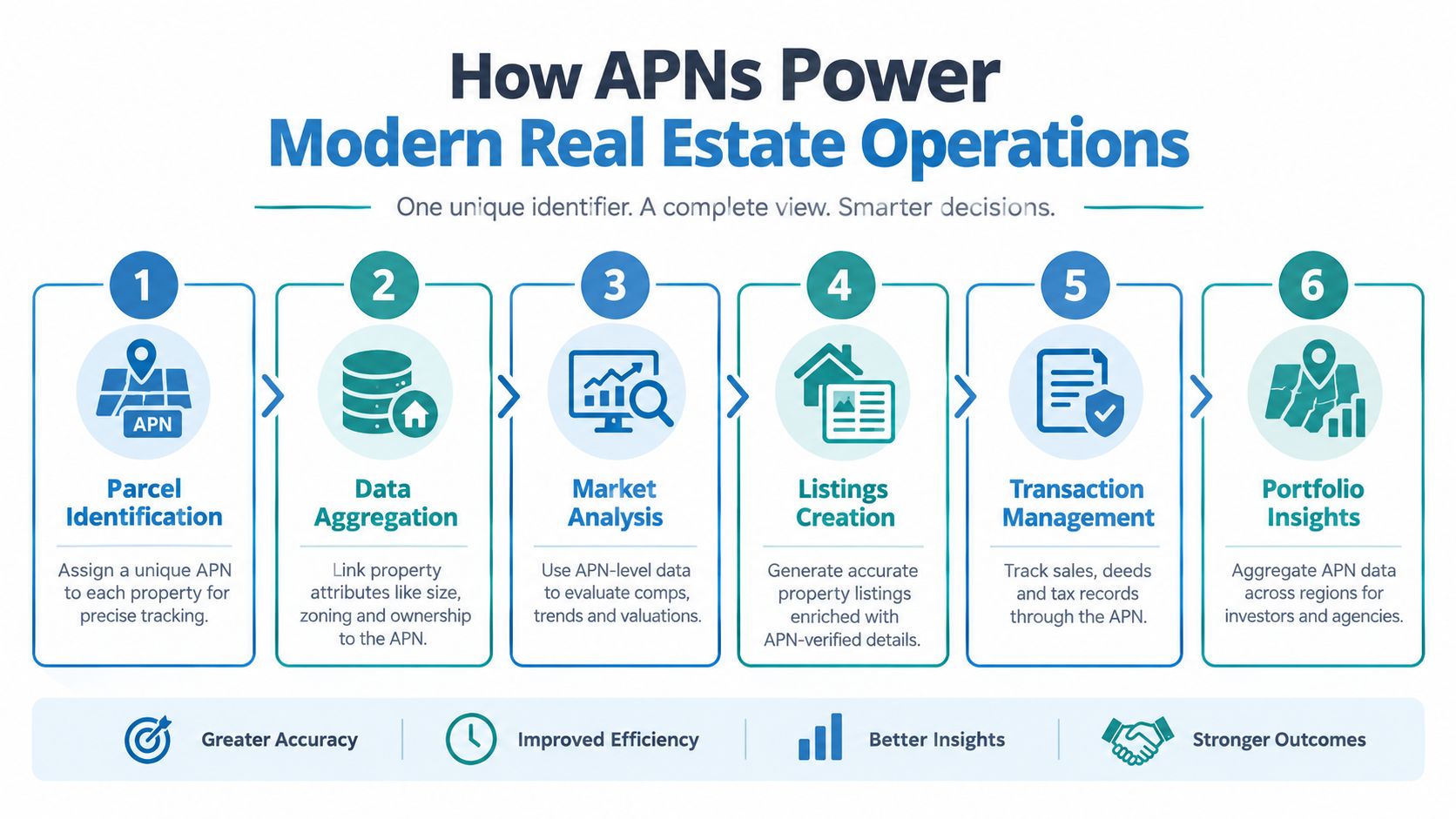
Proptech Data Aggregation
For proptech companies, the primary challenge is data integration. Tax history, mortgage records, permits, and liens exist in scattered databases. The APN is the only reliable identifier to merge them.
- Data Integrity: Keying all incoming data to the APN creates a "golden record" for each property, eliminating duplicates.
- Historical Analysis: An APN enables the construction of an accurate property timeline, tracking ownership changes and lien filings without ambiguity.
- Scalability: Standardizing data around the APN is the only viable method to manage and analyze millions of properties from over 3,000 county jurisdictions.
Mortgage Lending and Underwriting
In lending, accuracy is a legal and financial necessity. The APN serves as the definitive link between a loan and a property. It guarantees that a title search is conducted on the correct parcel and that any resulting mortgage lien is legally attached to the exact asset being financed, not the one next door. This precision is critical for automated valuation models (AVMs) and risk assessments, which depend on pulling correct property data indexed by the APN.
Real Estate Investing
For investors, the APN is a tool for finding opportunities others miss. APN-based searches provide hyper-targeted results that are impossible with address-based queries. This is foundational for effective analyzing real estate deals due diligence.
- Identify Adjoining Parcels: Search for owners of multiple adjacent APNs, signaling potential for a larger land assembly deal.
- Target Vacant Land: Isolate parcels with no associated building information, a classic sign of vacant land that often lacks a formal street address.
- Find Off-Market Deals: Cross-reference APN data with other indicators (e.g., pre-foreclosure status) to build lists of motivated sellers before a property hits the market.
What are the best practices for integrating APN data?
To effectively use APN data, you must build a resilient data operation that can handle the complexities of public records. With over 3,100 counties in the U.S., there are thousands of unique APN formats. Working with raw, unformatted data from these sources leads to operational chaos and costly errors.
Implement a Normalization Engine
The first step is to build a normalization engine. This system functions as a universal translator for APNs, taking thousands of chaotic formats and converting them into a single, clean, consistent style. Without normalization, your database cannot accurately match records or eliminate duplicates. A database will treat 123-45-678 and 12345678 as two different properties. A strong normalization process is the foundation of any clean apn real estate dataset.
Establish the APN as the Golden Record
Once normalized, the APN must become the "golden record" for every property in your system. This primary key is the single source of truth to which all other information—ownership details, sales history, liens—is tied.
- Data Matching: When importing new data, match records using the normalized APN, not the address.
- Deduplication: Run regular cleanup processes to merge duplicate property records identified by their shared APN.
Adopting an APN-first model prevents data fragmentation and ensures you have a complete, 360-degree view of every property.
Leverage API Integration Workflows
Static data files become outdated almost immediately. A property database remains current and valuable only through API integration. This allows your systems to automatically communicate with data providers, pulling fresh information on demand.
A typical workflow is:
- Initial Query: Your system sends a normalized APN to a data provider's API.
- Data Enrichment: The API returns a wealth of verified data, including owner information, AVMs, and recent transactions.
- System Update: Your platform automatically absorbs the new data, enriching the correct property record.
This automated process is essential for scalability, delivering the speed and accuracy required for modern real estate applications.
What are common questions about APNs?
Real-world scenarios often present complexities. Here are direct answers to common questions about APNs.
Can a single property have more than one APN?
Yes, though it is uncommon. This occurs when a large property, like a farm or commercial complex, was assembled from several smaller, legally distinct lots. Each original lot may retain its own APN until the owner legally consolidates them through a parcel merger, at which point a single new APN is generated.
Does the APN change when a property is sold?
No. The APN is tied to the physical land, not the owner. When a property is sold or transferred, the county assessor updates the ownership records linked to that APN. The number itself remains unchanged unless the property's legal boundaries are physically redrawn through a lot split (dividing one parcel into multiple) or a parcel combination. The APN follows the land, not the owner.
How accurate is public records APN data?
County assessor websites are the source of truth, but they are not flawless. Data entry errors occur, and records in smaller counties may be updated infrequently. While sufficient for a one-off lookup, relying solely on a single public source for commercial use is risky. Enterprise-grade accuracy comes from commercial data providers who aggregate data from thousands of sources, run daily updates, and use validation algorithms to ensure the APN, address, owner, and legal description all match.
At BatchData, we provide the clean, verified, and standardized APN-keyed data that modern real estate businesses require. Our platform offers 155M+ U.S. property records with enterprise-grade accuracy. Learn more at BatchData and build your next project on a foundation of data you can trust.
| Identifier | Primary Purpose | Stability | Best Use Case |
|---|---|---|---|
| APN | Tax assessment & legal identification | Very High (Changes only with lot splits/mergers) | Tax record searches, due diligence, portfolio management |
| Mailing Address | Mail delivery & general location | Low (Can change or be ambiguous) | Marketing mailers, GPS navigation, general correspondence |
| Legal Description | Defines official property boundaries | High (The legal foundation of the property) | Title transfers, deeds, resolving boundary disputes |
| MLS Number | Marketing a property for sale | Temporary (Exists only during a listing period) | Tracking sales listings, analyzing market activity |