

































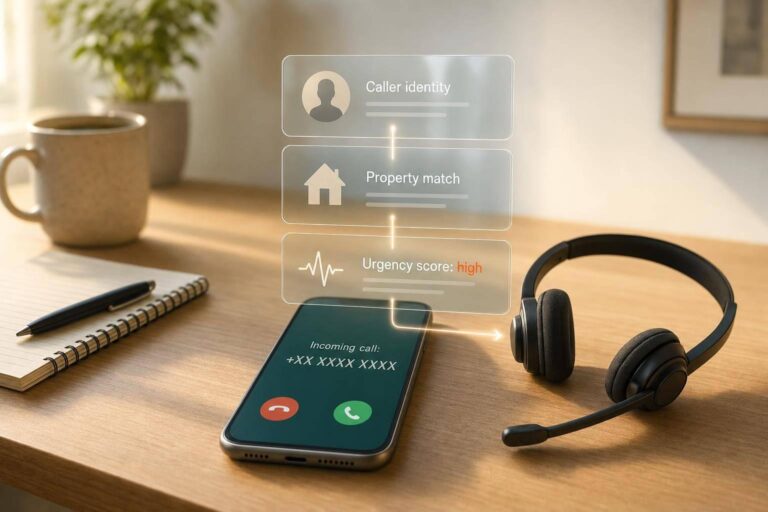
A phone number is not a lead record. If I only have a caller’s number, I still don’t know who called, which property they mean, or how fast my team should act.
For U.S. property teams, that gap hurts twice: data is split across 3,143 county offices, and lead response drops hard after 5 minutes. On top of that, free phone verification tools now sit around 68% accuracy, while 30% to 50% of CRM data goes stale each year. So the job is simple to say, but hard to do: turn an inbound number into a checked person, property, and priority record before reply or routing.
If I want inbound lead ID to work, I need to connect:
- Person: name, entity type, line type, match confidence
- Property: address, parcel, owner match, market fit
- Priority: equity, mortgage age, distress, response SLA
- Action: route, hold, suppress, or send for manual review
A raw number cannot tell me any of that on its own. This article explains the gap, the data needed to close it, and the step-by-step process I’d use to turn unknown inbound calls into usable lead records.
How an unknown number breaks routing, prioritization, and follow-up
Routing gaps at intake
When a call hits intake without a verified match, routing turns into guesswork.
The first issue is simple: if you don’t know who the caller is, you also don’t know where that lead should go. Caller ID may show a name, carrier, and line type, but that still doesn’t tell your team whether the person on the line is the owner, a tenant, an agent, a vendor, or spam. At intake, all of those callers can look identical unless you add enrichment.
That lack of clarity costs money fast. A high-equity absentee owner in your target market can get treated the same as a cold inquiry from outside it. The result is messy handoffs, bad assignments, and missed deals.
Missing property context leads to poor lead handling
If you can’t verify the address or match the caller to the right parcel, often requiring you to skip trace property owners to find the decision-maker, things go sideways fast. The wrong owner can be tied to the wrong property, which pollutes the CRM and throws off later outreach. On top of that, your team can’t confirm whether the lead is even inside a target ZIP code, service area, or acquisition market.
Here’s how missing data turns into day-to-day problems:
| Missing Detail | Impact on Routing & Follow-up |
|---|---|
| Verified address | Team cannot confirm if the lead is in a target service area or acquisition market |
| Ownership match | Reps may spend time talking to tenants or relatives instead of the decision-maker |
| Equity/mortgage data | No way to prioritize motivated sellers (e.g., high equity or distressed) |
| Line type (VoIP) | High-risk lines may slip past fraud checks or create compliance exposure |
When the property match is off, every decision that comes after it gets weaker.
Low-confidence contact data wastes time and budget
Contact data goes stale fast. Between 30% and 50% of CRM records become outdated each year. And even skip-traced lists still have a 15% to 25% rate of disconnected or wrong numbers.
Some numbers also carry more risk than others. Non-fixed VoIP lines are less reliable and riskier than long-held mobile or landline numbers. If your team skips that check, those contacts land in the same priority queue as actual prospects. That means reps spend time calling people who were never likely to convert in the first place.
It also creates workflow drag. A manual lookup process becomes a bottleneck pretty fast. Free verification tools don’t solve that either, since they match at only 68% accuracy because of carrier data limits after STIR/SHAKEN went into effect.
Without a confidence score, teams can’t sort leads cleanly. They can’t tell which calls deserve an immediate callback and which ones should be held for review. And that confidence level shapes the next move: route now, pause, or send for manual review.
sbb-itb-8058745
What inbound lead ID needs to connect before your team acts
That routing call comes down to three linked matches: person, property, and urgency. Before your team does anything, inbound lead ID needs to answer three plain questions: who called, what property they own, and how urgent the chance is.
Inbound lead ID only works when those three layers connect before the call hits the queue.
| Decision | Data needed | Why it matters |
|---|---|---|
| Who called? | Name, line type (mobile, landline, or VoIP), confidence score | Assess reachability and identity risk |
| What property? | Parcel ID, normalized address, owner-match status | Confirm the lead is tied to a target property |
| How urgent? | Equity band, mortgage age, lien/distress signals | Determine response priority |
Phone-to-person enrichment and contact verification
The first layer answers a basic question: does this number belong to a real, reachable person or entity? To do that, you need carrier data, public records, and historical signals that can attach a name, line type, and confidence score.
Line type and confidence score help decide if the lead is ready for routing. Non-fixed VoIP often needs a closer look because it carries more fraud or spam risk. Free U.S. phone verification tools have dropped to 68% accuracy after STIR/SHAKEN-related restrictions, so that confidence score helps split leads into two groups: route now or hold for review.
A phone number should do more than sit in a contact field. It should work as an identity signal.
Phone-to-property matching and address verification
Once identity is verified, the next step is tying that person or entity to a specific parcel. That means normalizing the address, verifying the parcel, and confirming the owner match.
If that link is weak, routing gets messy fast. A caller may be real, but if the property match is off, your team can end up working the wrong record.
Ownership data and local market context
Ownership and distress signals help separate a reachable homeowner from a low-priority or misrouted inquiry. Absentee ownership, where the mailing address does not match the property address, often points to an investor-owned or rental property. That changes how the lead should be handled.
Equity position, mortgage age, and distress signals like liens or pre-foreclosure status let your team score response priority instead of guessing. Recent listing status or recent transfers can point to active sale intent. A high-equity absentee property with a tax lien is not the same kind of lead as an owner-occupied home with no distress indicators.
Once those matches are in place, the next move is to route the lead by signal strength, not guesswork.
How qualified routing works in practice
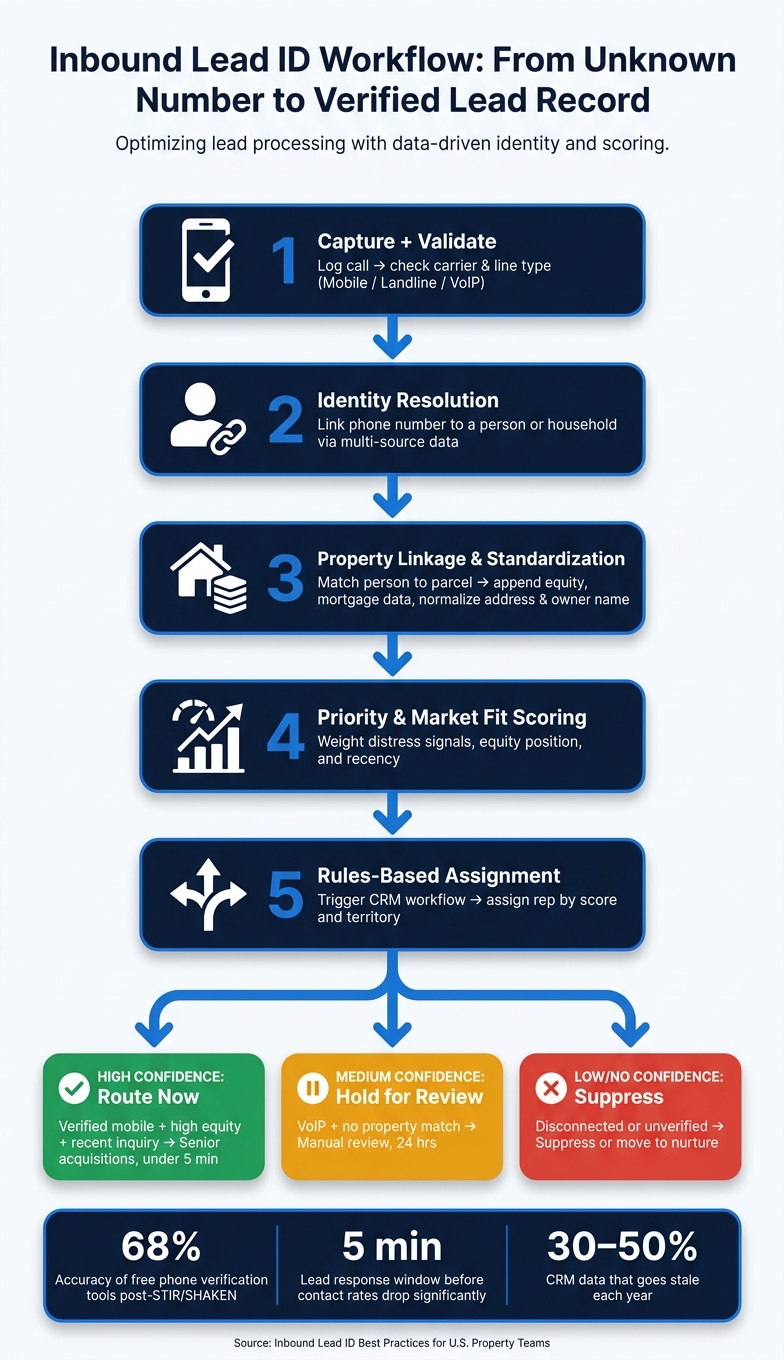
Inbound Lead ID Workflow: From Unknown Number to Verified Lead Record
Routing only works after capture, verification, matching, enrichment, scoring, and assignment. The order isn’t random. Each step depends on the one before it.
If you skip a step, the problem usually shows up later. A rep gets a bad handoff. A hot lead lands in the wrong queue. Time gets burned on records that never should’ve moved forward.
A step-by-step inbound lead ID workflow
This workflow takes a raw inbound call and turns it into a verified lead record. Each step feeds the next one, so gaps early on tend to snowball.
| Step | Action | What it does |
|---|---|---|
| 1. Capture + validate | Log the call, then check carrier and line-type status | Records the raw number and timestamp; identifies mobile, landline, or VoIP |
| 2. Match | Identity resolution | Links phone to a person or household via multi-source data |
| 3. Enrich | Property linkage and data standardization | Matches person to parcel; appends equity, mortgage data, and normalizes address and owner name for clean CRM entry |
| 4. Score | Priority and market fit | Weights distress signals, equity position, and recency |
| 5. Route | Rules-based assignment | Triggers CRM workflow to assign rep by score and territory |
The key habit here is sequential enrichment. First, verify that the number is reachable. Then build the property record. Then score it. Then route it. Flip that sequence, and your priority tiers start resting on guesswork instead of clean data.
How data signals change response priority and assignment
Once a record has a score, routing should reflect confidence and urgency, not just who’s free. That’s where scoring stops being a reporting exercise and starts driving action.
Lead contact rates improve significantly when teams respond within 5 to 15 minutes.
| Signal combination | Confidence | Routing destination | Target response |
|---|---|---|---|
| Verified mobile + high equity + recent inquiry | Highest | Senior acquisitions | Under 5 minutes |
| Verified landline + owner-occupant + service-area fit | High | Standard sales queue | Under 15 minutes |
| Verified tenant + service-area fit | High | Leasing or service dispatch | Same day |
| Distressed property + confirmed owner match | High | Acquisitions, top of queue | Urgent |
| VoIP number + no property match | Low | Hold for manual review | 24 hours |
| Disconnected or unverified number | None | Suppress or move to nurture | N/A |
| Landline + out-of-market address | Low fit | Automated referral or nurture | N/A |
A verified mobile tied to high equity and a recent inquiry should not sit in the same queue as a VoIP number with no property match. One deserves fast follow-up from a senior acquisitions rep. The other probably needs a human check before anyone reaches out.
When to suppress, hold, or manually review a lead
Not every record belongs in the active queue. Some should be suppressed right away. Others need a pause before assignment.
Suppress the record when the number is disconnected, flagged for high spam risk, or returns no match at all. Pushing those leads to a rep wastes time and can create compliance exposure. TCPA violations for unverified outreach can average $1,500 per violation.
Hold for manual review when the signals don’t line up. That might mean the caller’s name doesn’t match the property owner of record, the number is a non-fixed VoIP with no identity match, or the address sits outside your service area. When data conflicts, routing should stop until someone verifies the record.
A phone number should do more than fill a contact field. It should work as both an identity signal and a routing signal. For every automated action, log the timestamp, normalized number, provider status, and routing rule. That audit trail gives teams a way to tune routing rules over time and cut down on misassigned leads.
Building a repeatable inbound lead ID process that improves conversion
What better inbound lead ID changes for each team
Once a number is tied to a person and property, you need clear rules to keep that signal usable as volume grows.
A structured inbound lead ID process changes the day-to-day work for every team. Engineering teams spend less time on manual data work because normalization and batch processing clean up formatting issues and remove duplicate records before anything lands in the CRM. Intake teams stay on top of SLAs more often because stale leads get auto-escalated. Acquisitions teams get ownership and property context before the first call, which means less time wasted on records that were never a fit.
Core process and data capabilities to standardize
The process should follow the same path every time: intake, validation, matching, enrichment, scoring, and routing.
| Building Block | What It Does |
|---|---|
| Intake & normalization | Standardizes phone numbers and addresses before matching |
| Phone validation | Checks line type (mobile, landline, or VoIP) and reachability status |
| Person/property matching | Connects the caller to a specific parcel or ownership record |
| Ownership enrichment | Appends equity position, mortgage details, ownership tenure, and occupancy status |
| Confidence scoring | Ranks match reliability before the record moves to sales |
| Routing & escalation | Assigns leads by score and territory; reassigns stale leads after 15 minutes |
| Compliance & audit logging | Runs DNC checks and logs each action for auditability |
It also helps to add score-decay rules. If a lead sits untouched for a set period, its priority should drop. That keeps the queue honest and helps teams focus on people who are still likely to respond.
Conclusion: A phone number is a signal, not a lead record
A phone number is a signal, not a lead record.
FAQs
How do I match a caller to the right property?
Use an identity-resolution workflow, not the phone number alone. Start with a reverse phone lookup to pull the caller’s name and address history.
Then compare that identity against public records, tax assessor data, and deed records to confirm the legal owner. If the names don’t match, verify the caller’s relationship to the property before you treat them as the decision-maker.
What data signals matter most for inbound lead priority?
Prioritize inbound leads based on the signals most likely to confirm identity, reachability, and fit.
Start with the confidence score:
- 90%–100%: highest priority
- 60%–89%: lower priority
- Below 60%: not ideal for direct contact
Then look at line type. Put mobile numbers first, followed by VoIP and then landline.
You should also check connectivity and compliance. Focus on leads with an active status, clear DNC screening, and ownership that matches the property owner or mailing address.
When should a lead be routed, held, or suppressed?
Route, hold, or suppress leads based on data quality, confidence, and risk.
- Route high-fit leads when the owner match is verified and the lead shows high-intent actions.
- Hold leads for review when signals conflict, confidence is low, or no match is found.
- Suppress records that fail compliance checks, including DNC, known TCPA litigants, or disconnected numbers.
Related Blog Posts
- Best Practices for Lead Assignment in Real Estate CRM
- Stop Wasting Time on Cold Leads: Automate Lead Prioritization with BatchData + Your CRM
- How Data Enrichment Improves CRM Lead Segmentation
- “Reverse Phone Lookup vs. Skip Tracing: What’s the Difference (and Why Real Estate Investors Need Both)” – owns “reverse skip trace” conceptually without needing a product name; strong internal-linking bridge to your existing skip-tracing cluster.