


































Want to close more deals in real estate? Start with faster and smarter lead assignments. Automated lead routing in CRMs helps you respond instantly, prioritize high-value prospects, and balance workloads across your team. Here’s why it matters:
- Speed wins deals: Responding within 1 minute boosts conversions by 391%, and 78% of customers choose the first responder.
- Save time: Automation reduces admin tasks by 60%, letting agents focus on selling. Integrating a real estate API can further streamline these workflows.
- Better matching: Assign leads by location, expertise, or urgency to connect prospects with the right agent.
- Fair distribution: Round-robin systems prevent workload imbalances, improving team morale.
- Lead scoring: Focus on high-priority leads based on factors like financial readiness and engagement.
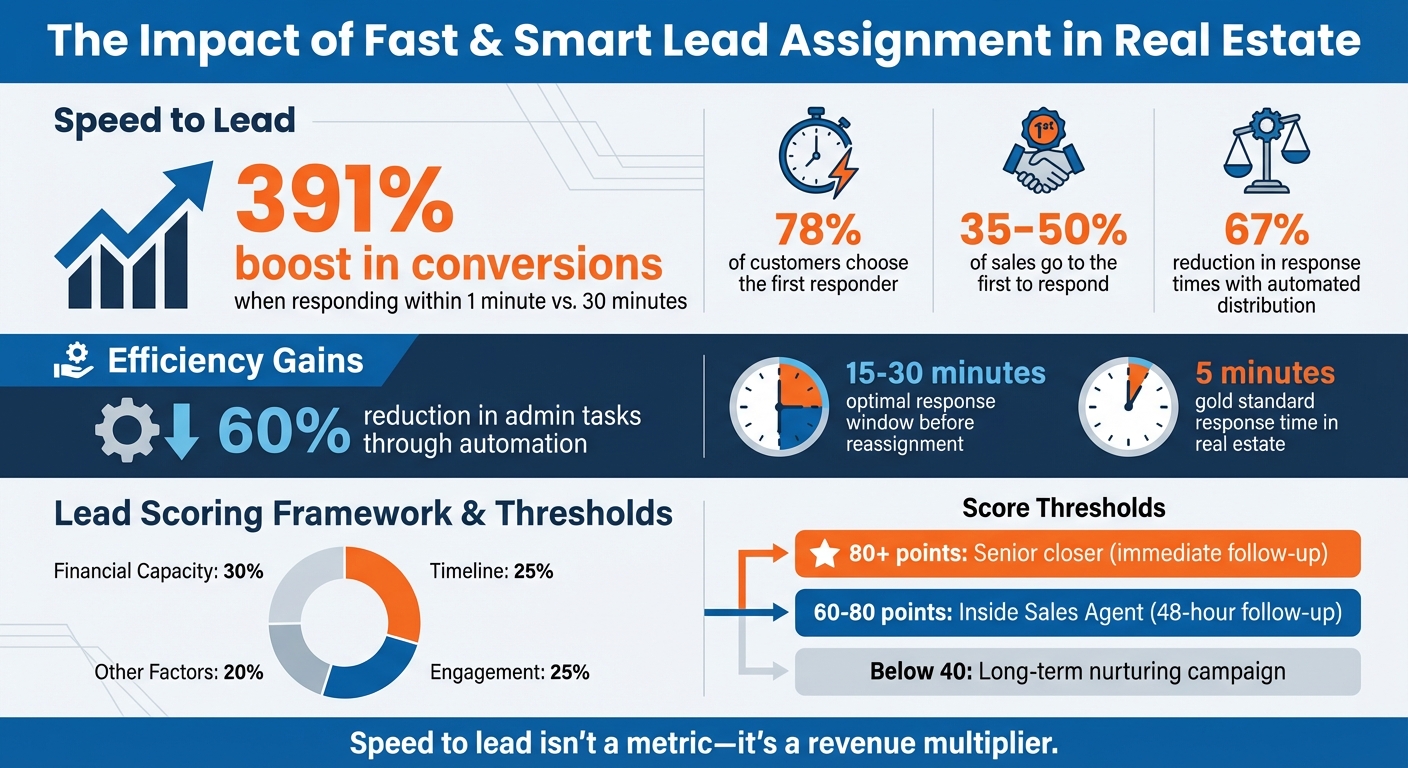
Lead Assignment Impact Statistics for Real Estate CRM
How to Manage Real Estate Leads & Follow Up with Them [A-to-Z Guide]
sbb-itb-8058745
Lead Assignment Best Practices Checklist
Here’s a guide to help real estate teams streamline lead routing while ensuring fairness, quick responses, and strategic alignment. These methods tackle challenges like agent burnout and connecting high-value prospects with top performers.
Set Up Geographic-Based Lead Routing
Assign leads based on specific geographic areas. Clearly define boundaries like ZIP codes, neighborhoods, or counties, and designate agents for each area. For leads with incomplete location details, set fallback rules, and review territories quarterly to keep up with market trends.
Within each territory, use a secondary distribution method – like round-robin routing – to share leads evenly among agents. For example, if three agents cover the same county, rotate leads sequentially to balance their workloads.
"Your business could win 35-50% of sales by being the first to respond. Every minute matters after a prospect reaches out." – Ethan Davon, SparrowCRM
Monitor lead volume and conversion rates regularly. If needed, group multiple counties into larger zones (e.g., "West Side" or "North Zone") for simpler management.
Once geographic routing is in place, ensure fairness with round-robin distribution.
Configure Round-Robin Assignment for Fair Distribution
Round-robin assignment ensures leads are distributed in a continuous loop – Agent A gets the first lead, Agent B the next, and so on. This system prevents cherry-picking and gives every agent a fair share of leads. Automated lead distribution can cut response times by up to 67%.
For even more precision, use weighted round-robin. This approach assigns more leads to top performers while skipping agents who are at capacity or unavailable (e.g., on leave). Integrate this system with agent calendars to keep things smooth. Set a response window of 15–30 minutes, and reassign unacknowledged leads automatically. Regularly review the system to keep it running efficiently.
Next, focus on prioritizing high-value leads through scoring.
Apply Lead Scoring for Priority Assignments
Lead scoring ranks prospects based on their likelihood to convert, helping agents focus on the most promising opportunities without feeling overwhelmed.
Use a 100-point scale to evaluate factors linked to closed deals. For instance:
- Financial capacity: 30% of the score
- Timeline: 25% (e.g., readiness to close within 0–30 days)
- Engagement: 25% (like property views or email interactions)
Set clear thresholds: leads scoring 80 or above might go straight to a senior closer with an immediate follow-up call, while those between 60 and 80 could be routed to an Inside Sales Agent for follow-up within 48 hours. Leads scoring below 40 might enter a long-term nurturing campaign.
Behavioral signals also matter. For example:
- A prospect viewing 10+ properties in a week might earn extra points for active interest.
- A seller requesting a comparative market analysis could indicate high intent.
Negative scoring can flag disqualifiers, and score decay (gradual point reduction for inactivity) keeps your "hot" lead list current.
Enable Skill-Based and Source-Specific Routing
Beyond geographic and round-robin models, refine assignments by matching leads to agent expertise and lead sources. Assign leads based on agent skills or property type specialization. For instance:
- A luxury condo inquiry should go to an agent experienced in high-rises.
- A first-time buyer might be routed to someone familiar with FHA financing.
Source-specific routing is another layer to consider. Referrals and repeat clients often have higher conversion rates and might benefit from direct attention. Meanwhile, website inquiries could be handled by Inside Sales Agents for initial qualification, while direct phone calls might go straight to licensed agents for immediate response. Combining skill-based and geographic routing ensures both local knowledge and subject matter expertise are utilized effectively.
Apply Performance-Based Assignment Rules
Performance-based routing fine-tunes lead distribution by factoring in real-time agent metrics like conversion rates, response times, and deal velocity. This approach allows high-performing agents to handle more leads while easing the workload for others. It not only rewards top agents but also ensures high-value prospects are handled by the best team members.
However, it’s essential to balance fairness with results. Performance-based routing works well for high-stakes leads (like luxury properties or pre-qualified buyers) but should be paired with round-robin for standard opportunities. Regularly review performance data to adjust and optimize your assignment rules over time.
Tools to Improve Lead Assignment Accuracy
Using advanced tools to refine data accuracy can significantly enhance automated lead routing.
Even the most well-designed lead assignment rules can falter when dealing with incomplete or outdated data. Missing details – like incorrect addresses, absent phone numbers, or insufficient property information – can disrupt the routing process. That’s where data tools come into play, helping to fill in these gaps before leads are processed by your system.
Use BatchData for Data Enrichment and Verification

BatchData is a powerful tool designed to enrich incoming leads with detailed property insights, equity data, owner information, and verified contact details, all sourced from a database containing over 600 million records. Its APIs add crucial data points – such as property value, mortgage status, and absentee owner indicators – and update daily to keep information current. This ensures your CRM can make more precise routing decisions.
BatchData also validates property addresses against USPS databases, reducing errors caused by typos, and uses skip tracing to verify phone numbers and email addresses, ensuring only reachable leads are distributed.
"We want to supplement your work and make you superhuman so you can do things in seconds not hours. That’s where BatchData comes in. What used to take 30 minutes now takes 30 seconds." – Chris Finck, Director of Product Management
For delivery, BatchData’s Smart Search pushes qualified leads directly to your system, while non-developers can receive automated file deliveries via Amazon S3, Google Drive, or SFTP.
Once your data is enriched, the next priority is ensuring your team can act on leads quickly.
Set Up Real-Time Notifications for Faster Responses
Timing is everything in lead management. To enable swift follow-up, set up real-time, multi-channel notifications across platforms like Slack, email, or mobile push alerts. These notifications should include detailed context – such as property address, lead score, source, and estimated value – rather than a generic "new lead assigned" message. Providing one-click links to the CRM record can further streamline the process.
For teams handling a high volume of leads, consider enabling a "first-to-claim" system, allowing the first available agent to secure the lead. Additionally, implement automated escalation protocols: send a follow-up alert if no action is taken within 15 minutes, and by 30 minutes, reassign the lead or notify a manager. This tiered approach ensures that no lead slips through the cracks.
Monitor and Optimize Lead Assignment Strategies
Keeping lead assignment strategies effective requires constant attention. As your team expands, territories evolve, and market trends shift, your routing rules need to keep pace. Regular evaluations ensure your system stays sharp and responsive. Without this oversight, even the most well-thought-out logic can result in missed opportunities and lower conversion rates.
Track Key Performance Metrics
Once you’ve implemented updated routing strategies, tracking performance is crucial to ensure they deliver results. Here are some key metrics to focus on:
- Lead Response Time: This is critical. In real estate, responding within five minutes is the gold standard. Companies that respond within one minute experience a staggering 391% boost in conversions compared to those that take 30 minutes or longer.
- Contact Conversion Rate: This measures the percentage of leads that engage in a conversation.
- Appointment Set Ratio: Tracks how many contacted leads move forward to schedule consultations.
- Lead Distribution Balance: Review this monthly to confirm that workloads are evenly spread across your team.
- Escalation Frequency: If leads are frequently reassigned because agents fail to respond, it’s a sign your routing logic might be overloading certain team members.
- Sales Cycle Length: Measure the average time it takes to move from lead capture to closing. A shorter cycle often indicates effective lead-to-agent matching.
"Speed to lead isn’t a metric – it’s a revenue multiplier." – Sushma Shetty, LeadSquared
In addition to quantitative metrics, gather feedback directly from your team. If agents report that leads are outside their expertise or assigned to the wrong territories, it’s a clear sign your routing rules need adjustment.
Review Assignment Rules Regularly
Real-time tracking is essential, but periodic reviews are equally important to keep your system aligned with changing conditions. Schedule quarterly reviews to evaluate whether your routing logic still fits your business goals, market changes, and team dynamics. For territory-based routing, audits should reflect any shifts in regional workloads.
Major changes, like launching new products, redefining territories, or restructuring your sales team, demand immediate updates to your rules. Before rolling out updates, test them in a sandbox environment with sample leads. This precaution prevents costly routing errors.
Keep a centralized document outlining all routing rules and their purposes. This makes it easier for the team to understand why specific leads are assigned to particular agents. To avoid missed opportunities, set up automated escalation rules. For instance, reassign leads if the initial agent doesn’t engage within 15–30 minutes. And don’t forget fallback logic to handle incomplete lead data, ensuring no lead gets overlooked.
Conclusion
Streamlining lead assignment can significantly boost revenue by cutting out manual delays and instantly routing leads based on factors like location, expertise, and agent availability. This ensures every prospect connects with the right agent at the right time, paving the way for higher conversions.
The checklist outlined earlier integrates multiple routing strategies – such as round-robin distribution and lead scoring – to balance workloads while prioritizing high-value prospects. Using tools like BatchData to verify and enrich property and contact details prevents errors caused by incomplete data. Meanwhile, real-time notifications through Slack, email, or mobile alerts empower agents to act promptly, and automated escalation rules ensure no leads are lost when a primary agent is unavailable.
As industry expert Ethan Davon from SparrowCRM puts it:
"Lead assignment is no longer a back-office task. It is a frontline revenue lever."
However, lead assignment strategies can quickly become outdated as teams grow and markets evolve. Regularly auditing your rules and monitoring metrics like response times, workload distribution, and escalation rates is critical for maintaining optimal performance.
FAQs
What lead assignment rules should I set up first?
Start by implementing automated lead routing to ensure leads are distributed quickly and accurately. Use criteria like geography, expertise, or availability to match leads with the most suitable sales reps. Some effective routing methods include:
- Round-robin assignment: Distribute leads evenly across your team to ensure fairness and prevent overload.
- Territory-based routing: Assign leads based on specific geographic regions or markets to align with your team’s expertise.
- Lead scoring: Prioritize leads by their potential value or likelihood to convert, ensuring high-priority leads get immediate attention.
These strategies streamline the process, improve response times, and set the stage for better conversion rates.
How can I prevent leads from going stale if an agent doesn’t respond?
When an agent is unavailable, stale leads can quickly become a problem. The solution? Use CRM automation to assign leads instantly based on predefined rules. This ensures no lead is left waiting for a response.
You can also automate follow-ups, such as sending emails or setting reminders. This keeps the communication flowing and nurtures leads consistently, even during gaps in agent availability. These tactics help you stay engaged with potential clients and improve your chances of converting them.
How can I improve routing when lead data is missing or wrong?
Improving routing when lead data is incomplete or incorrect can be a challenge, but there are tools and strategies that make it easier. Start by using automated lead routing systems with clear, predefined rules to cut down on mistakes and delays. For example, tools like BatchData can help by enriching and verifying incomplete information, ensuring leads are assigned accurately.
It’s also important to regularly audit and update your routing rules. This keeps your system aligned with current business needs and ensures smoother operations. Additionally, incorporating behavioral and property data into the process can fine-tune accuracy and make routing more efficient overall.