






































Demographic data is the statistical DNA of a population, breaking down groups of people by measurable attributes like age, income, household size, and location. In real estate, it's the raw intelligence that explains who lives in a market, how much they can afford, and what they will need next, directly driving property values and investment opportunities. This data transforms market analysis from guesswork into a predictive science.
- What it is: Statistical characteristics of a human population.
- Why it matters: It reveals market demand, risk, and growth potential.
- Core attributes: Age, income, education, and household structure.
- Primary use: To make data-driven decisions in real estate, marketing, and urban planning.
This guide breaks down exactly what demographic data is, where it comes from, and how to weaponize it for a competitive advantage in the real estate market.
What is demographic data?
The direct answer: Demographic data is a structured, statistical summary of a specific population's characteristics. It moves beyond a simple headcount to create a detailed profile of a group, which is non-negotiable for making informed decisions in real estate, marketing, and urban planning. This data reveals dynamic patterns of migration, growth, and societal change, signaling future risks and opportunities for investors.
By analyzing demographic data, you answer critical investment questions:
- Is this neighborhood attracting young, high-income professionals or an aging population of retirees?
- Does the local economic base support rising property values and rental rates?
- Are new households forming at a rate that justifies new construction?
Core Attributes
Demographic information is organized into key categories that form the foundation of any market analysis. While dozens of data points exist, a few are universally critical for a clear picture.
Key Demographic Attributes & Their Impact
| Attribute Category | Includes | Primary Use Case |
|---|---|---|
| Age | Age ranges, median age, generational cohorts (e.g., Millennials, Gen Z) | Determines demand for everything from school-district homes to senior living facilities. |
| Income | Household income, individual income, disposable income | Signals purchasing power and affordability, directly impacting property valuations and retail potential. |
| Household Size | Number of people per household, family vs. non-family households | Influences demand for specific property types, such as single-family homes versus studio apartments. |
| Education Level | High school diplomas, bachelor's degrees, advanced degrees | Correlates strongly with income levels, employment stability, and the economic resilience of a market. |
These attributes provide a powerful lens for understanding market dynamics. For instance, the global population is approximately 8.3 billion people, with 59.27% residing in the Asia-Pacific region. This concentration drives massive urbanization in markets like India, which added nearly 12.9 million residents in a single year. You can explore more global population statistics to see these macro trends firsthand.
How is demographic data collected?
The direct answer: Demographic data is collected from primary sources like government censuses and secondary sources like private data compilers. Trustworthy data is the result of rigorous collection and validation processes designed to capture a reliable snapshot of a population. Without this foundation, any decision is built on a high-risk assumption.
The collection methods fall into two main categories: primary and secondary. Understanding the difference is critical for judging data quality and reliability.
Primary Data Sources
Primary data is raw, unfiltered information collected directly from the population. It is the gold standard for accuracy because it is a firsthand account with no intermediary interpretation. The most authoritative primary sources are government-led initiatives.
- Censuses: The U.S. Census Bureau conducts a nationwide count every ten years, gathering foundational data on age, race, and household composition. It is the definitive source for pure population counts.
- Vital Statistics Registries: Government agencies continuously record life events like births, deaths, and marriages. This provides a real-time pulse on population change and family structure evolution.
- Government Surveys: To fill the 10-year gap between censuses, ongoing surveys like the American Community Survey (ACS) provide more frequent and detailed demographic and economic snapshots.
A significant challenge for primary sources is declining public participation. As fewer households respond to government surveys, agencies must use alternative data and advanced validation techniques to maintain statistical reliability.
Secondary Data Sources
Secondary data is information previously collected, processed, and analyzed by another entity. If primary sources are raw ingredients, secondary sources are pre-packaged meals ready for a specific purpose.
- Market Research Firms: Companies like NielsenIQ and Circana aggregate and analyze consumer data, providing detailed demographic profiles used for corporate strategy.
- Academic Institutions: Universities produce specialized demographic datasets, often focusing on specific trends or regions.
- Private Data Compilers: Platforms like BatchData aggregate data from thousands of public and private sources, including property records, credit bureaus, and consumer files. You can see how BatchData unifies and verifies contact and demographic data for enterprise-level accuracy.
All credible data undergoes a strict verification process involving cleaning (error correction), updating (ensuring freshness), and cross-referencing to confirm accuracy. For real estate investors, this precision separates a profitable investment from a costly failure.
Which demographic trends define real estate markets?
The direct answer: The most impactful demographic trends are population aging, urbanization, and changing household structures. Raw data is just numbers; the strategic value comes from identifying patterns that signal where a market is headed. Understanding these macro shifts allows investors to anticipate market needs instead of reacting to them.

Global Aging
One of the most powerful forces reshaping markets is global aging. Due to lower birth rates and longer life expectancies, the median age is rising in most developed nations. The world’s median age is already 30.9 years, and the U.S. CBO projects that both the population and its average age will continue to increase through 2056. Explore the data on the shifts in the world population to see the full picture.
Market Impact: An aging population directly increases demand for senior living facilities, assisted care homes, and accessible single-story houses. This also creates a significant market for contractors who can retrofit existing homes with features like walk-in showers and ramps.
Urbanization
Urbanization is an unstoppable trend, particularly in emerging economies. As people move to cities for employment, they create intense demand for housing, retail, and services. Projections show that Africa’s share of the global population will reach 25.6% by 2050, signaling an explosive need for affordable urban housing and commercial infrastructure. This migration pressures housing supply, creating a clear opportunity for developers and a massive demand for rental properties.
Evolving Household Structures
The traditional nuclear family is no longer the dominant household type. The sharp rise in single-person households and non-family living arrangements has massive implications for housing demand. A market dominated by singles and couples without children has entirely different needs than one built for large families.
Real Estate Implications:
- Smaller Units: Demand is skyrocketing for smaller, more efficient living spaces like studio apartments and one-bedroom condos.
- Amenity Focus: Single-person households often seek community and convenience, making buildings with co-working spaces, gyms, and social lounges highly desirable.
- Rental Market Strength: Single residents tend to rent for longer periods, adding stability and profitability to the multifamily rental market.
How do you use demographic data in business?
The direct answer: Demographic data is used to identify high-growth investment markets, execute hyper-targeted marketing campaigns, and develop accurate risk models. Applying this data to concrete business decisions is where it generates ROI. This is how demographic intelligence moves from a buzzword to a tool for calculated, profitable actions.
Real Estate Investment
For a real estate investor, demographic data is a treasure map. It reveals opportunities in emerging neighborhoods before they become saturated with competition. By tracking population growth, income trends, and household formation, investors can spot areas on the verge of a boom.
- Pinpoint Growth Corridors: An investor sees a zip code where median household income grew 15% in three years while the 30-45 age cohort surged. This is a clear signal that affluent professionals are moving in, driving demand for high-end homes and renovations.
- Inform Risk Models: Lenders use this data to build risk models. When evaluating a loan for a new apartment complex, they analyze local employment rates and income stability to project rental demand and default risk with high confidence.
- Power Proptech Platforms: Modern Automated Valuation Models (AVMs) now integrate demographic shifts into their algorithms. An AVM might increase a property's value in a neighborhood where the percentage of households with children is rising, correctly forecasting a rush for homes in good school districts.
A skilled investor doesn't just evaluate a property; they analyze the demographic trajectory of its entire community. They know a rising tide of prosperity, driven by population trends, lifts all property values.
Hyper-Targeted Marketing
In marketing, generic messaging is a fast way to burn capital. Demographic data enables laser-precise audience segmentation, ensuring messages connect with people likely to convert. Our guide on audience segmentation for real estate marketing details these strategies.
A high-end kitchen remodeler (average job: $50,000+) uses demographics to build a hyper-specific target list:
- Household Income: >$200,000/year
- Home Age: Built before 2000
- Owner Age: 45-65
- Household Type: Married with children
By layering these filters, the company can target a few thousand highly qualified households instead of an entire city, dramatically increasing its return on investment.
Industry Application Comparison
The table below breaks down how various industries use specific demographic indicators to drive their primary objectives.
| Industry | Primary Objective | Key Demographic Indicators Used | Example Action |
|---|---|---|---|
| Real Estate | Identify high-growth investment markets | Population growth, median income, age, household size | Purchasing multi-family properties in a zip code with a rising number of young professionals. |
| Retail | Optimize store location and product mix | Income level, age distribution, ethnicity, lifestyle | Stocking high-end organic brands in a store located in an affluent, health-conscious suburb. |
| Healthcare | Plan for community health needs | Age (e.g., aging population), insurance status, disease prevalence | Opening a new geriatric care facility in an area with a high concentration of residents over 65. |
| Financial Services | Develop targeted financial products | Age, income, life stage (e.g., new parents, retirees) | Marketing 529 college savings plans to households with young children. |
| Automotive | Forecast demand for specific vehicle types | Household size, income, geography (urban vs. rural) | Increasing dealership inventory of SUVs in suburban areas with growing families. |
How do you combine demographic and property data?
The direct answer: You combine demographic and property data to move from market-level analysis to asset-level intelligence. Demographics tell you who and where, but property data reveals the critical what and why. This fusion is the foundation of propensity modeling, which identifies not just a promising area but the exact properties within it that are most likely to sell, need financing, or require specific services.
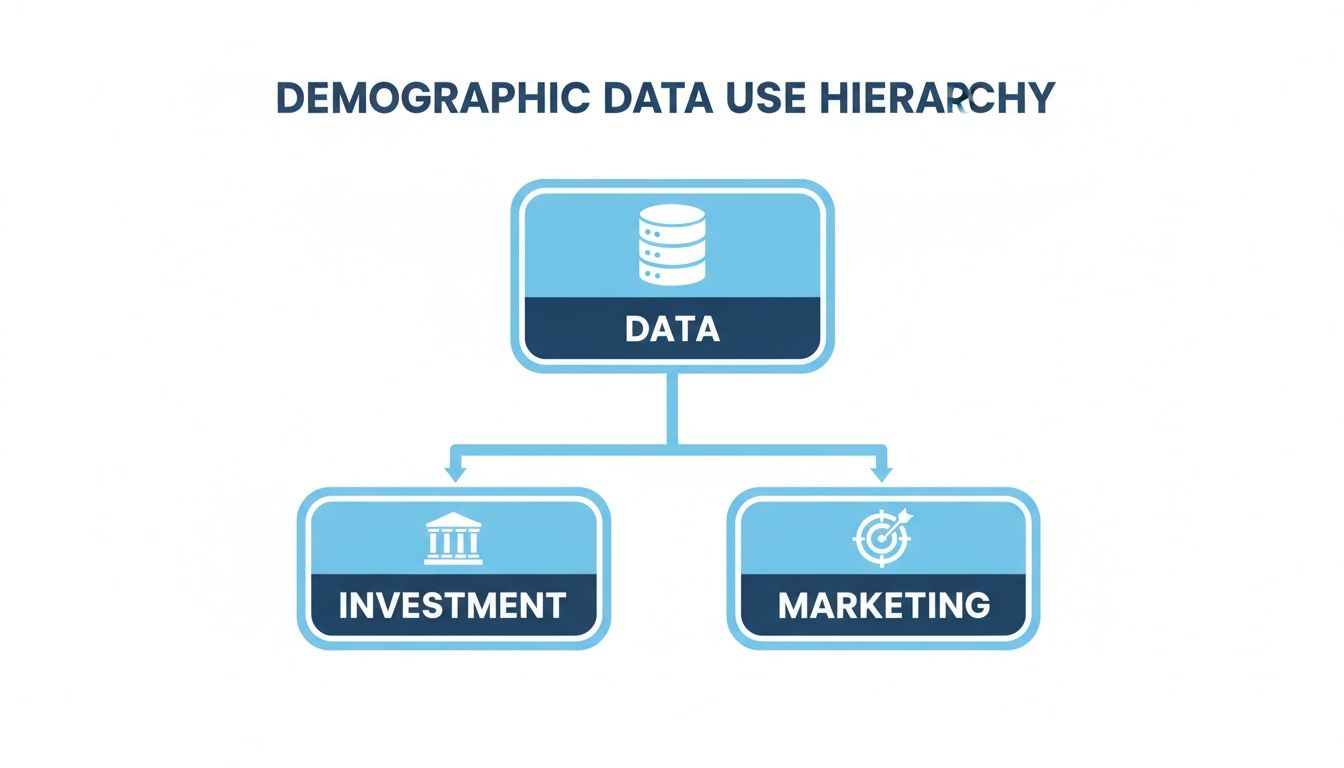
Foundational data is the engine that powers more complex, profitable strategies across the entire real estate ecosystem.
Pinpoint High-Intent Opportunities
This combined approach moves you from educated guessing to data-driven certainty. For example, a real estate investor can zero in on a neighborhood with rising incomes (demographic data). Then, they can drill down to find homeowners who have lived in their property for over 20 years and have more than 60% equity (property data). This combination is a powerful signal that an owner may be ready to sell.
This granular targeting is how top real estate professionals consistently find off-market deals. They aren't just looking at a market—they are dissecting it down to the individual property.
From Demographics to Actionable Intelligence
Combining datasets unlocks insights that demographics alone cannot provide. While demographics paint broad strokes, property and behavioral data add the fine details that reveal true motivation. Our guide on the top behavioral data sources for real estate insights offers a comprehensive look at this next layer of analysis.
Data Synergy Comparison
| Data Type | Standalone Insight | Combined Insight |
|---|---|---|
| Demographic Data | Identifies a zip code where the average age is over 65. | Pinpoints which senior homeowners in that zip code have recently had a life event (e.g., death of a spouse) and may be motivated to sell. |
| Property Data | Shows a list of homes with expired listings. | Filters that list to show only properties owned by people whose household income can support a higher asking price, indicating they will not accept a lowball offer. |
| Financial Data | Reveals properties with a high loan-to-value ratio. | Overlays demographic data to find high-LTV homeowners in areas with rising employment, indicating they may soon qualify for refinancing. |
Fusing demographic and property data is what separates reactive strategies from proactive ones. It allows you to anticipate market shifts and spot high-value opportunities before they become obvious to everyone else.
What are the most frequently asked questions about demographic data?
Here are direct answers to the most common questions about using demographic data in real estate.
Is demographic data the same as psychographic data?
No. Demographic data is the who—objective, statistical facts about a person like their age, income, and location. Psychographic data is the why—subjective insights into their values, lifestyle, and opinions. Demographics might identify a 45-year-old with a $150,000 income, while psychographics reveal they are an eco-conscious hiker who prefers modern architecture. Elite strategies blend both.
How often is demographic data updated?
It depends entirely on the source. Government sources like the U.S. Census are updated decennially, with more frequent estimates from surveys like the ACS. In contrast, private data compilers like BatchData constantly refresh their datasets, often on a monthly or even weekly basis, by ingesting new information from property records, credit bureaus, and other dynamic sources. For time-sensitive applications like lead generation, this freshness is non-negotiable.
Can demographic data predict real estate trends?
Yes, but it is not a crystal ball. Demographic data is extremely effective at identifying the direction and momentum of market trends. For example, rising median incomes and an influx of young families in a zip code are powerful indicators that property values will likely increase. However, the most reliable predictions layer demographic trends with property-level data, economic indicators, and local market knowledge to build a multi-dimensional forecast.
A true competitive advantage comes from combining the sharpest demographic insights with the most accurate property data. With over 155 million property records refreshed daily, BatchData gives you the enterprise-grade intelligence to spot high-intent opportunities, model risk, and build a winning real estate strategy. Discover the BatchData difference today.