


































Duplicate data in real estate can ruin your metrics, waste money, and cause compliance risks.
Here’s what you need to know:
- What is it? Data deduplication identifies and merges duplicate entries into one reliable record, like spotting that "123 Main St" and "123 Main Street, Unit 4B" refer to the same property.
- Why it matters: Duplicate records inflate inventory counts, distort property prices, and waste up to 25% of marketing budgets. They also risk legal penalties for violating regulations like the TCPA.
- How it works: Techniques like exact matching, standardization, fuzzy matching, and conflict resolution help clean data. Tools ensure accuracy by creating a "golden record" for properties, owners, and transactions.
- Results: Businesses that tackle duplicates improve ROI by 20–40%, cut down wasted outreach, and gain reliable insights for better decisions.
Want cleaner, more reliable real estate data? Start with deduplication and property data enrichment to fix duplicates before they cause problems.
Types of Duplicates in Real Estate Data
Managing real estate data from multiple sources can be messy. Each source has its own format and update schedule, which inevitably leads to duplication. These duplicates can appear at the property, owner, or transaction level. Let’s break down the main types of duplicates that complicate real estate datasets.
Property-Level Duplicates
Property-level duplicates occur when the same property is recorded differently across datasets. A common issue is address variation. For instance, one database might list "123 Main St", while another records it as "123 Main Street, Unit 4B." To a system relying on exact matches, these look like two separate properties.
Parcel boundary changes also create duplicate records. Counties often update or subdivide parcels, generating new records while older ones remain in the system. This is especially frequent in rapidly developing areas where land is divided for new projects. In commercial real estate, the problem can grow even more complex. A single building might have separate records for suites, floor plates, or leases. Without standardization, creating a unified property record becomes a challenge.
Owner and Contact Duplicates
Owner duplicates arise from inconsistent name formatting. For example, "Alice M. Johnson", "alice johnson", and "A. Johnson" might all refer to the same person, but without normalization, systems treat them as different individuals.
The issue becomes even trickier with ownership entities like LLCs, trusts, or corporations. Variations such as "Sunrise Properties LLC" and "Sunrise Properties, L.L.C." are technically different strings but represent the same legal entity. Missing details – like phone numbers or emails – further complicate accurate matching. Reliable owner data is crucial for resolving conflicts and building a single, trustworthy record.
Transaction and Listing Duplicates
Transaction and listing duplicates can distort key market metrics. A nationwide MLS audit revealed that about 30% of records resembled duplicate relists.
One major culprit is price-triggered relisting. When a seller lowers their asking price, some systems create a new listing ID instead of updating the original record. This inflates inventory numbers and resets the days-on-market (DOM) counter to zero.
Another issue is status terminology drift. Different platforms might label the same transaction as "contingent", "pending", or "Active Under Contract." Without normalization, these statuses are treated as separate listings. Similarly, properties listed across multiple MLS boards or re-entered after an expiration often result in redundant records.
| Factor | What Happens | Impact on Data |
|---|---|---|
| Relisting after price cut | New listing IDs inflate inventory and reset DOM | Inflated inventory; DOM resets to zero |
| Multi-board MLS entry | Same property listed across different MLS systems | Redundant records with varied MLS IDs |
| Status terminology drift | "Contingent" vs. "Pending" vs. "Under Contract" | Overcounting of active listings |
| Listing expiration & renewal | Expired listings re-entered with new IDs | Duplicate records, broken property timeline |
"In aggregation, the hard part isn’t pulling data – it’s guaranteeing that today’s source change becomes a test case, not tomorrow’s outage." – Dmytro Naumenko, CTO, GroupBWT
When near-duplicate rates exceed 3–5% in a dataset, key metrics like days-on-market and inventory counts lose accuracy. Up next, we’ll dive into the techniques used to tackle these duplicate challenges.
sbb-itb-8058745
Core Techniques for Real Estate Data Deduplication
No single approach can catch every duplicate in a real estate dataset. The best strategies combine multiple techniques, each designed to address specific gaps left by the others.
Exact Matching Using Unique Identifiers
Exact matching is a quick and reliable method to start with. It compares records based on fields that are inherently unique, such as Assessor’s Parcel Numbers (APNs), MLS listing IDs, parcel IDs, or recorded document IDs. For example, if two records share the same APN, they almost certainly refer to the same property. This method produces minimal false positives, making it safe for automated merging without manual review. However, it only works when these identifiers are consistently present and formatted – a challenge in datasets from MLS feeds, public records, or permit databases.
Data Standardization and Normalization
Before applying any matching logic, the raw data needs cleaning. Standardization ensures uniform formatting across fields, turning entries like "123 Main St., Apt 4" into "123 MAIN ST UNIT 4" or "alice johnson" into "Alice Johnson". This step eliminates inconsistencies that can cause matching algorithms to overlook duplicates.
"Standardize incoming records during ingestion… This step ensures structured information and simplifies future comparisons." – Repliers
Normalization takes this a step further by harmonizing data schemas from different sources into a unified structure. This is especially crucial for multi-unit properties, where inconsistent formatting can either merge separate units incorrectly or fail to identify duplicate records for the same unit. Applying these processes during data ingestion, rather than after the data is already in the system, saves time and effort.
Fuzzy Matching and Similarity Scoring
When exact matching falters due to minor differences in records, fuzzy matching steps in. Algorithms like Levenshtein distance calculate the number of edits needed to transform one string into another, while Jaro-Winkler prioritizes matching prefixes, making it effective for names. For longer text fields, such as property descriptions, methods like Jaccard similarity and cosine similarity are useful.
These algorithms assign a similarity score between 0 and 1. Records with scores above a high threshold (e.g., 0.95) can be auto-merged, while those in a middle range are flagged for manual review. This tiered approach helps maintain efficiency without compromising accuracy on edge cases.
Rule-Based and Composite Matching
Composite matching evaluates multiple fields simultaneously to make a matching decision. For instance, a system might flag records as duplicates only if the address, ZIP code, and parcel number all match. This layered approach forms the basis of a "Property Identity Graph", which links listings, deeds, permits, and tax records to create a unified property profile.
"If a dashboard can’t show lineage at the field level, your team will eventually stop trusting it – and then the whole system becomes overhead." – Alex Yudin, Head of Data Engineering, GroupBWT
Rule-based matching is especially useful for entities like LLCs or trusts, where name variations are common. In such cases, attributes like a registered address or tax ID can act as tiebreakers.
Batch vs. Real-Time Deduplication
The choice between batch and real-time deduplication depends on the data source and the specific business need. Here’s a quick comparison:
| Feature | Batch Deduplication | Real-Time Deduplication |
|---|---|---|
| Timing | Scheduled (weekly/monthly) | Instant (point of entry) |
| Data Volume | High (millions of records) | Low (single record/API call) |
| Primary Goal | Historical cleanup & deep analysis | Prevention & data freshness |
| Real Estate Use Case | Reconciling years of MLS relists | Web forms, portal price updates |
| Latency | High (hours to days) | Low (milliseconds) |
Batch processing excels at reconciling large datasets like public records, deeds, or permits, which often have reporting delays of weeks or months. On the other hand, real-time deduplication is vital for preventing duplicates at the point of entry, such as web forms, agent portals, or API pipelines. Mature data operations typically use both: real-time deduplication to stop duplicates from entering the system and batch processing to address discrepancies that build up over time.
Conflict Resolution and Building a Golden Record
What is a Golden Record in Real Estate?
A golden record serves as the ultimate source of truth for a property, owner, or transaction by merging duplicate entries into one reliable profile. It’s the go-to record that your organization depends on for accurate data.
In real estate, this concept applies across several levels: property, owner/contact, and transaction. It consolidates information from various sources like MLS feeds, county tax records, CRMs, skip trace results, and recorded documents into a single authoritative profile. (For a detailed breakdown of each level, refer to earlier sections.)
Without a golden record, teams risk working with conflicting data, leading to wasted outreach efforts and flawed underwriting processes. This inefficiency can cost organizations up to $12.9 million annually. Once you understand the importance of a golden record, the next step is resolving conflicts between duplicate entries using specific survivorship rules.
Conflict Resolution Strategies
Survivorship rules help determine which data values remain during the merging process. Skipping this step can lead to losing critical information.
"Deleting duplicate records without defining which values survive is data destruction." – MatchLogic
These strategies work hand-in-hand with deduplication techniques, ensuring that only the most reliable data builds your master record. The choice of strategy depends on the type of data field and its business context. Below is a summary of the five main survivorship rules used in real estate data management:
| Rule Type | Logic | Best Used For |
|---|---|---|
| Most Recent | The most recently updated value wins. | Dates, addresses, phone numbers, email |
| Most Complete | The longest or most detailed value wins. | Names, full address strings |
| Source Priority | Values from the most trusted source win. | Identifiers, legal descriptions |
| Aggregate | Combines all unique values from duplicates. | Multi-value fields: emails, phones, tags |
| Manual Override | A reviewer selects the correct value. | Ambiguous records, high-value edge cases |
For real estate, source priority is particularly critical. Data from a county tax record or recorded deed holds more legal authority than a portal listing, so ownership details and identifiers should default to these trusted sources. Meanwhile, recency is key for time-sensitive fields. For example, in mortgage lending, even a small delay in updating property values or lien statuses could lead to underwriting decisions based on outdated information.
Once you’ve applied resolution rules, it’s time to focus on designing a robust golden record.
Best Practices for Golden Record Design
Start by profiling your data to identify gaps in completeness and inconsistencies in formatting before setting up any match rules.
"First profile revealed 40% missing data and format chaos we never suspected. Helped us fix issues before migration." – Michael Chen, VP Data Governance, Global Logistics Inc.
Begin with high-confidence auto-merges – set conservative thresholds initially and adjust them gradually as you confirm the system’s accuracy.
Another critical element is field-level lineage. Every field should be traceable back to its original source, extractor, and the most recent update. As Alex Yudin, Head of Data Engineering at GroupBWT, explains: "If a dashboard can’t show lineage at the field level, your team will eventually stop trusting it – and then the whole system becomes overhead." Tools like BatchData can help streamline this process by cross-referencing data against authoritative sources before it becomes part of your golden record.
Finally, assess the quality of your golden record using three key metrics: an accuracy rate of 98% or higher (verified against trusted sources), a completeness score that tracks how many records include all critical fields, and data freshness, which measures how quickly real-world events like property sales are reflected in your database. A well-designed golden record strengthens data reliability, enabling more accurate decisions and laying the groundwork for dependable real estate operations.
Building a Deduplication Pipeline for Real Estate Data
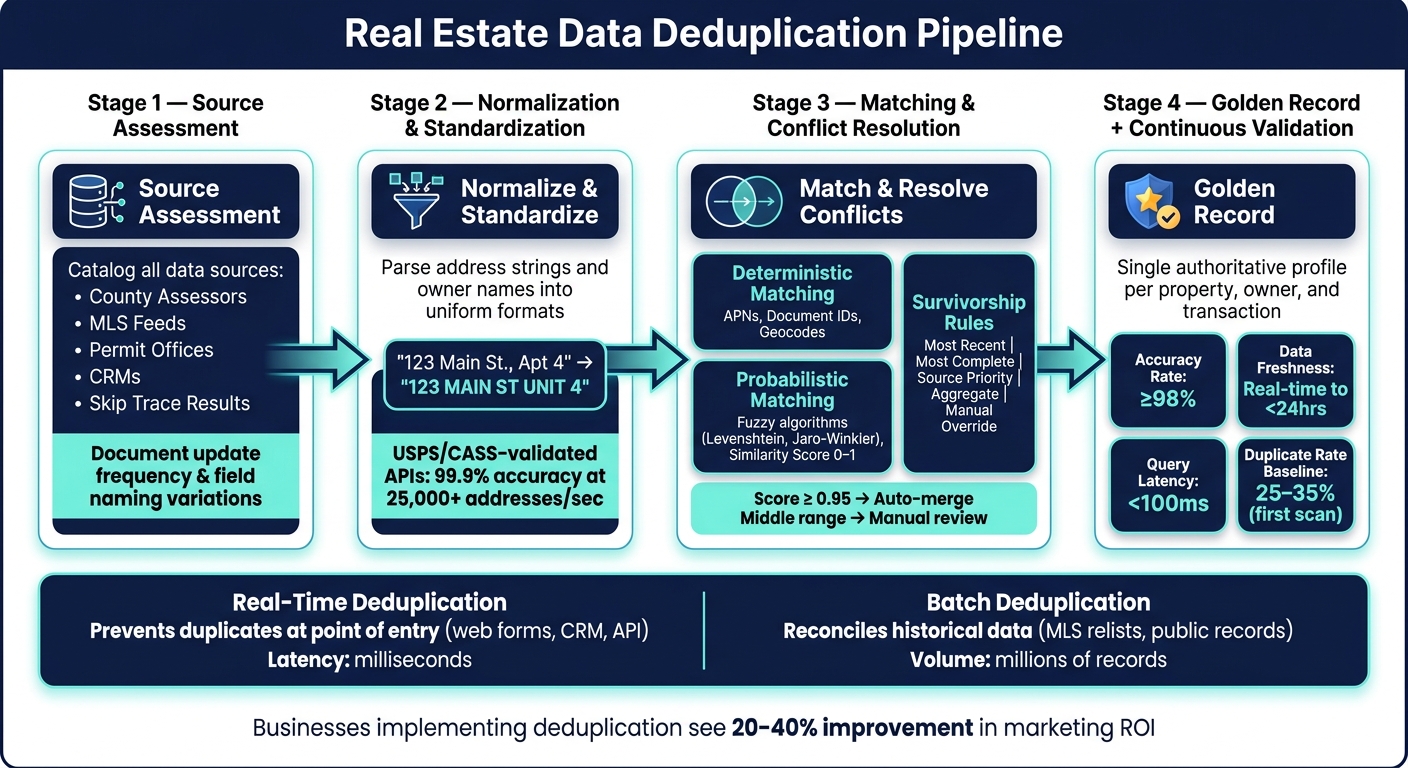
Real Estate Data Deduplication Pipeline: From Raw Data to Golden Record
Pipeline Architecture Overview
A deduplication pipeline transforms raw real estate data into dependable records through four key stages: source assessment, normalization, matching with conflict resolution, and generating a golden record with ongoing validation.
Start by cataloging and documenting each data source, such as county assessors, MLS feeds, permit offices, CRMs, and skip trace results. Pay close attention to how often these sources update and the variations in field naming. This documentation is crucial for configuring effective match rules.
Next, standardize the data by parsing address strings and owner names. Only after this normalization step should matching algorithms be applied. Begin with deterministic methods (like APNs, document IDs, or geocodes) for clear matches, and move to probabilistic methods for records without obvious unique identifiers. Finally, apply survivorship rules to create a golden record that ensures data reliability. Continuous validation ensures the data remains clean over time.
With these stages outlined, the next step is selecting the appropriate tools and techniques to execute each phase effectively.
Tools and Techniques for Real Estate Deduplication
The choice of tools depends on whether you require real-time processing, bulk historical cleanup, or a combination of both. The table below highlights three common implementation patterns:
| Pattern | Best For | Trade-off |
|---|---|---|
| Real-Time API | Capturing data at the point of entry (e.g., web forms, CRM systems) | Requires low latency, ideally under 100ms |
| Bulk Batch Processing | Cleaning up historical data and preparing for enrichment | Not suitable for catching errors in real-time |
| Workflow Integration | Maintaining data hygiene through automated CRM processes | Relies heavily on consistent process adherence |
For address normalization, USPS/CASS-validated APIs are a strong choice, capable of processing over 25,000 addresses per second with 99.9% accuracy. Adding geospatial indexing to this process enhances precision, as rooftop-level geocoding converts cleaned addresses into exact coordinates. This approach enables parcel-level matching, which simple text-based comparisons might miss.
When dealing with contact and property data, tools like BatchData provide API-driven solutions for enrichment and address verification tailored to real estate workflows. These tools integrate geocoding and entity resolution, making them ideal for cloud-based environments. They not only standardize data but also support the creation of a unified, authoritative record. As Chris Finck, Director of Product Management, explains: "What used to take 30 minutes now takes 30 seconds. BatchData makes our platform superhuman."
A helpful rule of thumb is to clean your data first, then enrich it. Adding third-party data to unresolved records can waste resources and amplify existing errors.
"If your address field is unreliable, your enrichment layer is unreliable too." – BatchData
Measuring Deduplication Performance
Once your pipeline is live, measure its success using key performance indicators (KPIs). Below are five critical metrics to track:
| KPI | Definition | Target |
|---|---|---|
| Accuracy Rate | Percentage of records verified as correct against authoritative sources | 98% or higher |
| Completeness Score | Percentage of records with all required fields populated | Varies by use case |
| Data Freshness | Time it takes for real-world updates to appear in your system | Real-time to under 24 hours |
| Query Latency | Response time for real-time deduplication via API | Under 100ms |
| Enrichment Rate | Percentage of records successfully enhanced with third-party data | High 90th percentile |
Before starting cleanup, establish a baseline by measuring your duplicate rate. Many enterprises discover that 25% to 35% of their data consists of duplicates during the first scan. Never assume your data is cleaner than it looks. When upgrading or migrating to a new deduplication system, run it in parallel with the existing system for 30 to 90 days. This ensures the new logic is more effective and avoids disruptions to live operations.
"A parallel run is non-negotiable. It is the only way to prove the new system’s value and catch integration issues before they impact a live customer or a critical business decision." – BatchData
Conclusion: Keeping Real Estate Data Clean and Reliable
Key Takeaways for Real Estate Practitioners
Maintaining a clean, deduplicated real estate dataset is essential for success. The dynamic nature of the industry – daily listing updates, shifting ownership records, and new contact data from sources like MLS feeds, county assessors, CRMs, and marketing platforms – means duplicates can quickly pile up. These duplicates lead to wasted marketing dollars, redundant outreach efforts, and misleading pipeline reports. The financial consequences are significant, making deduplication a priority.
Using a layered matching strategy that combines exact identifiers, standardization, fuzzy matching, and composite rules – along with both batch and real-time processing – can help keep data accurate and actionable. The benefits are clear: businesses that implement deduplication and standardization programs often see a 20–40% improvement in marketing campaign ROI. By eliminating redundant outreach and improving segmentation, teams can rely on a single, dependable "golden record" for every property and contact.
Next Steps with Professional Data Solutions
To put these strategies into action, consider these immediate steps:
- Standardize your data: Use USPS conventions to clean up addresses and contact information before applying matching rules.
- Enforce unique keys: For properties, use APN plus county; for contacts, rely on email and phone combinations to prevent duplicate entries from the start.
- Assign a data steward: Task someone with reviewing borderline matches and tracking metrics like duplicate rates and match accuracy.
For scalable solutions that go beyond manual processes, tools like BatchData – Ivo Draginov are designed for U.S. real estate workflows. Their Match & Append service enriches deduplicated records with over 1,000 data points, such as owner demographics, mortgage history, and pre-foreclosure status. Meanwhile, their Smart Monitoring engine ensures your property database stays up to date by refreshing records daily and automatically detecting changes like ownership transfers, new liens, or listing status updates.
"We want to supplement your work and make you superhuman so you can do things in seconds not hours." – Chris Finck, Director of Product Management
FAQs
How do I choose match thresholds for fuzzy matching?
When setting up your system, aim for a conservative range to maintain a balance between automation and accuracy. For minor typos, stick to 90–100% thresholds, while broader variations can fall within the 80–89% range. Automatically merge matches that exceed your high-confidence threshold, but send lower-confidence matches to a manual review queue. This method reduces the risk of errors and helps maintain data integrity – after all, it’s much simpler to handle missed duplicates than to undo incorrect merges.
What survivorship rules should I use to build a golden record?
To build a golden record, you need to apply survivorship rules that determine which data values are kept during the merging process. Here are some common strategies:
- Source Priority: Choose the value from the most trusted source for each attribute.
- Most Recent Update: Retain the value that was updated last.
- Non-Null Value: Opt for fields that aren’t empty or null.
- Highest Score: Assign scores to sources based on reliability, and use the value from the source with the highest score.
Make sure to give preference to authoritative sources and handle critical conflicts manually when necessary.
When should I use real-time vs. batch deduplication?
Real-time deduplication is perfect for quick, on-the-spot checks. For example, it’s ideal for catching duplicates during form submissions or API calls. This method ensures that data is validated with minimal delay as it enters your system, keeping processes smooth and efficient.
On the other hand, batch deduplication is better suited for more detailed and comprehensive tasks. Think of cleaning up historical records or preparing datasets for large-scale campaigns. It’s designed for deeper analysis, allowing you to tackle complex data challenges.
A hybrid approach often works best – using real-time deduplication for immediate checks and batch deduplication for in-depth cleanup. Tools like BatchData make it easier by offering advanced features to handle both methods, ensuring your data stays accurate and reliable.