

































Predictive analytics is reshaping how real estate professionals generate leads and improve ROI by using data-driven property services to forecast which homeowners are most likely to sell. This approach replaces outdated methods like cold calls and generic ads with targeted strategies that save time and boost conversion rates.
Key takeaways:
- Conversion rates: Predictive analytics can increase conversion rates from 3.4% to 22.6%.
- Lead time advantage: Identify potential listings 42.5 days before they hit the market.
- Focus on high-potential leads: Tools prioritize the top 20% of homeowners with the highest likelihood to sell.
- Efficiency: Automate manual tasks, reducing research time by up to 80%.
- Cost savings: Targeted outreach minimizes wasted marketing spend.
3 Ways Predictive Data Can Scale Your Real Estate Lead Gen w/ DataFlik‘s Monica Fullerton
sbb-itb-8058745
How Predictive Analytics Works
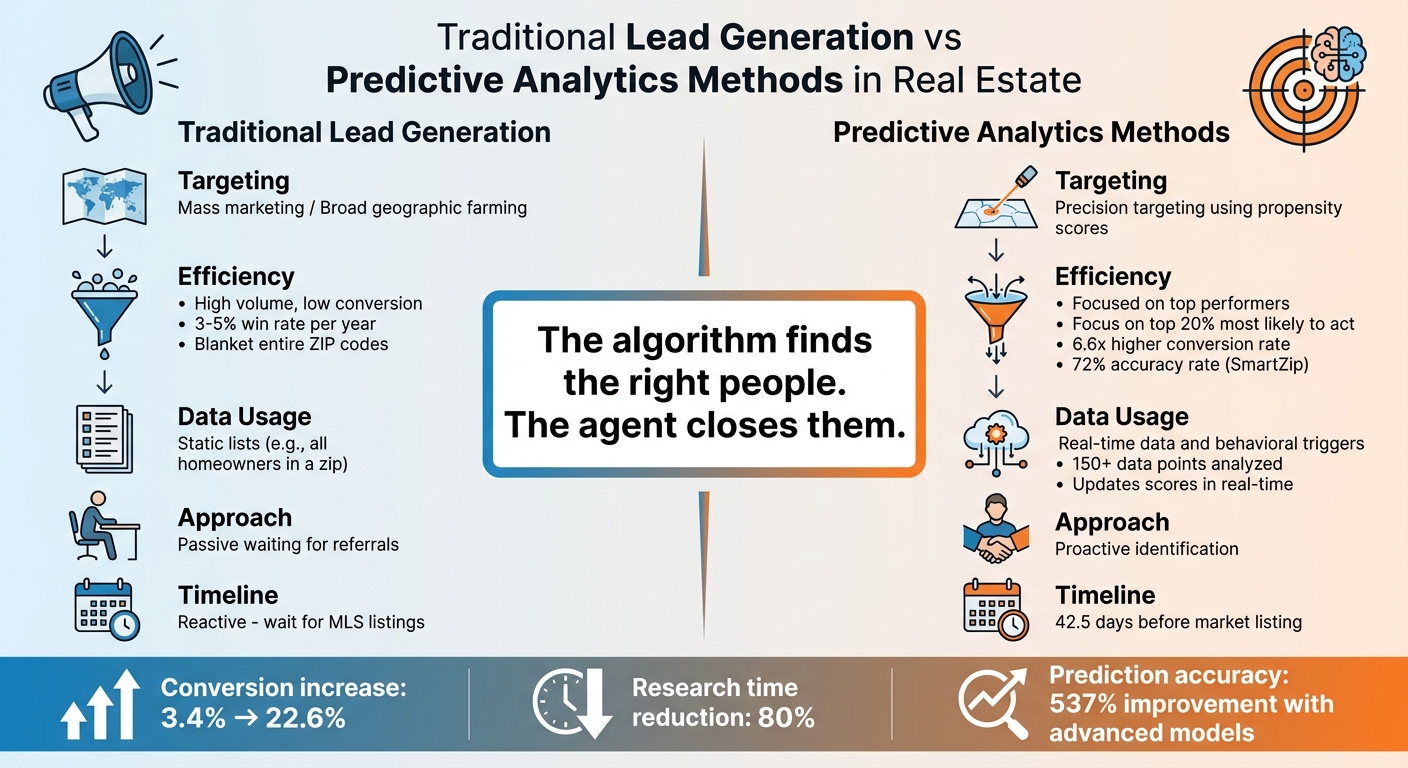
Traditional vs Predictive Analytics Lead Generation in Real Estate
What Is Predictive Analytics?
Predictive analytics relies on machine learning and statistical techniques to forecast behaviors, such as when someone might list their home for sale or default on a mortgage. It accomplishes this by gathering, modeling, and analyzing data from various sources, including public property records, tax and ownership histories, mortgage details, demographic information, and even behavioral signals from online activity.
The raw data is then processed into predictive signals through a process called feature engineering. For instance, instead of using the "last sale date" directly, it can be converted into "years of ownership", which is more effective in predicting a homeowner’s likelihood to sell.
Some of the commonly used machine learning algorithms in this field include Logistic Regression, Decision Trees, and Gradient Boosting. These methods can uncover patterns that would often go unnoticed by human analysts. When applied effectively, predictive models in real estate can achieve an impressive 80–90% accuracy in predicting whether a property will sell within 90 days. These predictive signals form the basis for the specialized real estate models discussed further below.
Predictive Analytics in Real Estate Operations
Predictive analytics plays a key role in identifying motivated sellers by tracking life events that often lead to property sales. Events like job changes, divorce filings, estate activities, or even welcoming a new child are strong indicators of selling intent. In fact, these life events account for over 74% of off-market transactions and drive more than 40% of motivated seller activity. Properties ranked in the top 10% of predictive scores are 18 times more likely to enter foreclosure than average properties.
What makes modern predictive systems particularly effective is their ability to update scores in real time. For example, if a homeowner files a building permit in the morning, their predictive score could adjust by the afternoon to reflect this new data. These systems are also integrating unconventional data sources, such as satellite imagery to identify property upgrades (e.g., a new roof) and geospatial data to monitor neighborhood trends like gentrification. Unlike static lists, predictive scores are dynamic and evolve as new information – like a mortgage balance dropping below a key threshold – becomes available. This level of precision sets predictive analytics apart from traditional approaches.
Traditional Lead Generation vs. Predictive Methods
Predictive analytics offers a sharper, more focused approach compared to traditional lead generation methods. While traditional geographic farming relies on mass marketing and broad outreach, predictive methods use data to pinpoint high-potential prospects with greater accuracy.
Traditional farming typically yields listing wins from only 3–5% of a target area each year, as it casts a wide net without much precision. In contrast, predictive analytics focuses on the top 20% of prospects most likely to act, using propensity scores to refine targeting.
"The algorithm finds the right people. The agent closes them." – Tech & Real Estate Editorial
| Feature | Traditional Lead Generation | Predictive Analytics Methods |
|---|---|---|
| Targeting | Mass marketing/Broad geographic farming | Precision targeting using propensity scores |
| Efficiency | High volume, low conversion (3–5% win rate) | Focuses on the top 20% most likely to act |
| Data Usage | Static lists (e.g., all homeowners in a zip) | Real-time data and behavioral triggers |
This shift from passive to proactive strategies empowers agents to move beyond waiting for referrals or running generic ads. Instead, they can leverage predictive tools to uncover off-market opportunities before they hit the MLS. For example, platforms like SmartZip boast a 72% accuracy rate in predicting which homeowners will list their properties within six to twelve months. Advanced models that analyze over 150 data points can even boost prediction accuracy by 537%.
How Predictive Analytics Improves ROI
Performance Metrics Improved by Predictive Analytics
Predictive analytics has transformed real estate lead generation, enhancing nearly every performance metric. For example, predictive models achieve a 6.6x higher conversion rate compared to the industry average. These tools also offer a major timing advantage, identifying listings an average of 42.5 days before they hit the market. In premium markets, this lead time is even longer – 17.4% earlier than the national average. This timing is critical because 70% of homeowners choose the first real estate agent they meet. Early outreach directly increases the likelihood of closing deals.
Automation plays a huge role in efficiency. Tasks that used to take 30–45 minutes per lead are now processed instantly, cutting manual research time by up to 80%. This allows teams to scale from 20 leads per week to over 200 leads per week without adding staff. By focusing on the 5% of homeowners most likely to sell, instead of blanketing entire ZIP codes, marketing costs are reduced significantly.
Predictive analytics also reshapes the conversion timeline. Nearly 60% of predictive lead conversions happen after 30 days, with the highest conversion rate – 30.7% – occurring between days 31 and 60. This extended timeline rewards agents who stick to structured follow-up routines. These measurable improvements are backed by real-world examples.
Case Studies: Measured ROI Gains
The impact of predictive analytics is clear in real-world case studies. Between May 2024 and April 2025, Real Intent analyzed 1,871 leads distributed to agents across the U.S. Their predictive algorithm delivered the conversion rates and timing advantages mentioned earlier. In high-value markets like Massachusetts and California, the average sale prices for predictive leads hit $2.13 million and $1.34 million, respectively.
SmartZip, another leader in predictive farming tools, conducted a three-year study comparing its system to national averages. In the first year, SmartZip outperformed the market by 1.9x. By Year 3, it achieved a 27% turnover rate, a 4.6x improvement over the 5% national average. During this time, Becky Williams, an agent with Keller Williams, reported closing 19 homes in her farm in a single year, thanks to these data-driven strategies.
"SmartZip provides great marketing for a geographic farm. Because of their consistent marketing during some very tough years, I closed 19 homes in my farm in 2021." – Becky Williams, Agent, Keller Williams
The financial benefits extend beyond conversion rates. By narrowing marketing efforts to high-probability sellers, agents lower acquisition costs while boosting average deal values, especially in premium markets where early engagement pays off.
Targeting and Segmenting Leads with Predictive Analytics
Moving from Mass Marketing to Targeted Outreach
Predictive analytics is transforming real estate marketing by replacing broad campaigns with precision-targeted strategies. Instead of casting a wide net, agents can now focus their efforts on the small percentage of homeowners most likely to sell – around 5% – using data-driven insights. This is achieved through propensity modeling, a machine learning approach that evaluates thousands of signals, such as market trends, property history, and consumer behavior, to score prospects based on their likelihood to transact.
"With SmartTargeting, your ‘farm’ isn’t just a ZIP code. It’s a narrowed list of the best realtor leads of homeowners most likely to sell." – SmartZip
The results speak for themselves. Dana Hall-Bradley of Better Homes and Gardens Real Estate Fine Living closed 38 listings in her second year using SmartZip’s predictive tools. Similarly, Maddy Mattson of Coldwell Banker saw her income triple within three years by applying predictive SmartTargeting to her marketing efforts. Scott Newman and Scott Kabel of Newman Realty secured 19 listings by identifying motivated sellers within their territory. These success stories highlight the value of reallocating marketing budgets from mass outreach to high-intent prospects, aligning perfectly with the broader goal of maximizing ROI through data intelligence.
Using Data to Segment Your Audience
Effective audience segmentation relies on layering multiple data filters to uncover hidden opportunities. Public records, for instance, can help identify homeowners who have owned their properties for 15+ years or those with over 40% equity. Financial indicators, such as loan-to-value ratios, tax delinquencies, or mechanic’s liens, can signal financial pressure. Life events like probate filings or divorce records often point to an urgent need to sell. Even property activity – like building permits for major renovations – can indicate an upcoming sale or refinance.
By combining these data points, agents can create highly specific prospect profiles. For example, you might target out-of-state owners with 50%+ equity and a 10-year ownership history. Leads can then be divided into high, medium, and low-intent tiers, with the majority of your marketing budget allocated to the high-intent group. To stay ahead, monitor triggers like ARM resets and set up alerts for distress signals – such as tax liens – so you can act within 24–48 hours.
This kind of detailed segmentation allows agents to identify motivated sellers before they even consider listing their properties.
Identifying Sellers Before They List
One of the key advantages of predictive analytics is its ability to identify potential listings well before they hit the market. On average, these tools provide over a month’s lead time, which is crucial since 70% of homeowners choose the first agent they meet. In high-value markets (over $1 million), this timing advantage can be even greater, giving agents the opportunity to establish relationships before competitors step in.
Trigger-based identification uses real-time data shifts – like equity increases, drops in LTV ratios, or new building permits – to detect when a lead is becoming motivated. For instance, homeowners pulling permits for major renovations, such as new roofs or accessory dwelling units (ADUs), often signal an upcoming sale. Daily monitoring of filings like Notices of Default or Lis Pendens ensures agents can act quickly, reaching out to potential sellers within 24–48 hours, well before their properties are listed.
Connecting Predictive Analytics to CRM Systems
How CRM Systems Support Predictive Lead Management
When you integrate predictive analytics with your CRM, lead management becomes far more efficient, reducing manual tracking time by 72%. By syncing property intelligence platforms with CRMs through tools like APIs (e.g., Zapier), data such as lead scores, equity values, and trigger events are updated automatically. This allows you to set automated rules – like routing leads with scores over 80 directly to your top salespeople, while lower-scoring leads are added to nurture sequences tailored to their specific motivation levels.
The results speak for themselves. A mid-size real estate investing firm used AI-powered lead scoring integrated with their CRM to manage all inbound leads through automated workflows. Over just 45 days, they generated 40 qualified leads and closed 5 deals, resulting in over $120,000 in net profit – all without needing to hire additional staff.
Trigger-based nurturing enhances this process even further. For example, when a homeowner’s equity surpasses 50%, the CRM can automatically launch a HELOC-focused email sequence. Similarly, if a new building permit is detected, the system can assign a follow-up call task within 24 hours. Advanced CRMs even enable AI to begin conversations with prospects, handing them off to human agents with full context, including transcripts and intent signals. This ensures no leads slip through the cracks and sets the stage for a more streamlined and scalable operation.
Creating a Scalable Data Infrastructure
To build a scalable data system, you need to unify property intelligence, skip tracing, and CRM data into one proactive ecosystem. A critical component of this is establishing feedback loops that refine predictive models over time. By tracking actual conversion outcomes in your CRM and feeding that data back into your analytics, you create a system that continually improves with each campaign.
Real-time syncing plays a key role here. Advanced platforms now offer near-instant data syncing across CRM systems, keeping sourcing, underwriting, and investor workflows aligned in a single, live feed. This eliminates the chaos of managing leads across multiple spreadsheets. For example, BatchData‘s API integration allows real estate professionals to enrich CRM records with property data, contact details, and verification services – all without switching between tools. By automating data enrichment at scale, you can focus your efforts on meaningful conversations that close deals, rather than wasting time tracking down outdated contact information or missing data points.
Steps to Implement Predictive Analytics in Your Business
Selecting Predictive Analytics Tools
Once your CRM and predictive data framework are in place, the next step is choosing the right tools for the job. Start by evaluating your business model and identifying platforms that align with your goals. For example, SmartZip (about $500/month) focuses on geographic farming with predictive seller insights. Fello (around $165/month) helps reactivate inactive databases by scoring existing contacts. Meanwhile, Ylopo (approximately $600/month) uses AI voice assistants to qualify large volumes of inbound leads.
Take a close look at your current data – are you missing key details like phone numbers, equity information, or life-event data? Fill these gaps with real-time data enrichment strategies that integrate property details, contact information, and verification services. To test the waters, run pilot campaigns in specific ZIP codes and monitor performance metrics like Cost Per Acquisition before rolling out on a larger scale.
Once you’ve selected the right tools, the next step is leveraging AI for fast and personalized lead nurturing.
Automating Lead Nurturing with AI
AI-driven systems can engage prospects within seconds using a mix of channels like SMS, email, and voice calls. For instance, if a homeowner checks property valuations on your website or clicks on listings in a targeted area, AI triggers can automatically initiate tailored outreach. An AI voice assistant might call the lead just minutes after they submit a form, confirm their details, and even schedule a consultation – all before your competitors can respond.
Combining social media ads with automated voice follow-ups can bring your cost per booked call down to a range of $15–$50. As Juan Adrogué, Founder & Lead Strategist at Propphy, explains:
"AI doesn’t replace agents; it replaces inefficiency".
To keep things running smoothly, adopt a human-in-the-loop approach. Regularly review AI conversation transcripts to refine prompts, update FAQs, and adjust handoff processes. This ensures your lead generation remains efficient and profitable.
Gaining an Edge Through Early Adoption
By 2026, 82% of real estate professionals are expected to use AI tools, but only 17% report meaningful results due to insufficient training and underutilization. Many agents rely on AI for low-impact tasks like drafting listing descriptions instead of tapping into its potential for lead generation. Early adopters who use predictive analytics for uncovering sellers and activating databases gain a distinct advantage, identifying homeowners 3–12 months before they list their properties. This allows them to secure opportunities while competitors wait for MLS updates.
Using propensity modeling, you can focus on individuals most likely to sell or refinance, rather than casting a wide net over all high-equity owners. This targeted approach reduces acquisition costs, improves conversion rates, and drives a stronger ROI, giving you a clear advantage in any market you serve.
Conclusion
Predictive analytics is changing the way real estate professionals approach lead generation, turning it into a proactive process rather than a passive waiting game. With automation reducing lead research time by as much as 80%, agents can focus their energy on engaging with high-intent prospects instead of chasing cold leads. By analyzing a wide range of data signals – such as equity levels and life-event indicators – predictive models can pinpoint homeowners who are likely to sell, often before they even list their properties on the MLS.
This creates a unique edge. Many in the industry fail to use AI tools effectively, leaving opportunities on the table when it comes to data-driven lead generation. Early adopters who embrace predictive analytics for tasks like database activation and propensity scoring are already gaining ground, capturing leads that others miss while waiting for public listings.
For the best ROI, it’s smart to allocate your budget toward the top 20% of likely sellers. This strategy eliminates wasted outreach and ensures your efforts are focused where success is most probable. By categorizing leads into high-, medium-, and low-intent tiers, you can better allocate both your time and marketing resources.
Integrating public records and enriched property data with your CRM adds another layer of efficiency. For example, when a property meets specific criteria – such as reaching 50% equity or filing for a new permit – your automated outreach sequence can kick off immediately. This system acts like a "nervous system" for your business, ensuring that prospects are engaged within minutes of a trigger event. The result? Faster and more effective outreach.
Looking ahead to 2026, those who succeed will be the professionals who combine predictive analytics for identifying opportunities with their own expertise to close deals. This technology isn’t about replacing agents – it’s about eliminating inefficiencies. By working smarter, you can close more deals with fewer resources, transforming lead generation into a data-driven, strategic process that delivers results.
FAQs
What data do predictive models use to identify likely sellers?
Predictive models sift through an extensive array of data, such as ownership history, property values, behavioral patterns, transaction records, tax filings, satellite images, and more than 800 signals, including financial and economic metrics. This analysis helps identify homeowners who are most likely to sell their properties.
How soon can predictive analytics show ROI in my market?
Predictive analytics has the potential to show measurable ROI in as little as 6 to 12 months. The timeline largely depends on factors like the quality of your data and how swiftly the system is implemented. While outcomes can differ, a carefully planned and executed strategy often leads to quicker insights and better results.
What do I need to connect predictive scoring to my CRM?
To link predictive scoring with your CRM, you’ll need BatchData’s API, an API key, and an automated workflow setup. By integrating the API with your CRM, you can analyze property details like equity, ownership duration, and distress status, enabling instant lead scoring. Automation tools can then ensure lead scores are updated in real-time, allowing your team to prioritize prospects with the highest potential.