






































API integration for tax data saves time, reduces errors, and lowers costs for businesses dealing with property tax information. By automating data retrieval through APIs, companies can eliminate manual processes, improve accuracy, and handle large volumes of data efficiently. APIs provide quick access to property tax details like assessed values, annual taxes, and jurisdiction codes across 155+ million U.S. properties, ensuring reliable and consistent information.
Key Benefits:
- Lower Labor Costs: Automation replaces manual tasks like data entry and report formatting, freeing up staff for higher-value work.
- Fewer Errors: Built-in validation ensures accurate, up-to-date tax data, reducing costly mistakes.
- Scalability: APIs handle growing data demands without additional staff or infrastructure.
BatchData offers flexible pricing options for businesses with different property tax data requirements, including monthly plans, custom datasets, and bulk data delivery. Their solution simplifies tax data management, making it faster and more cost-effective for businesses to access and utilize property tax information.
Cost Benefits of Tax Data API Integration
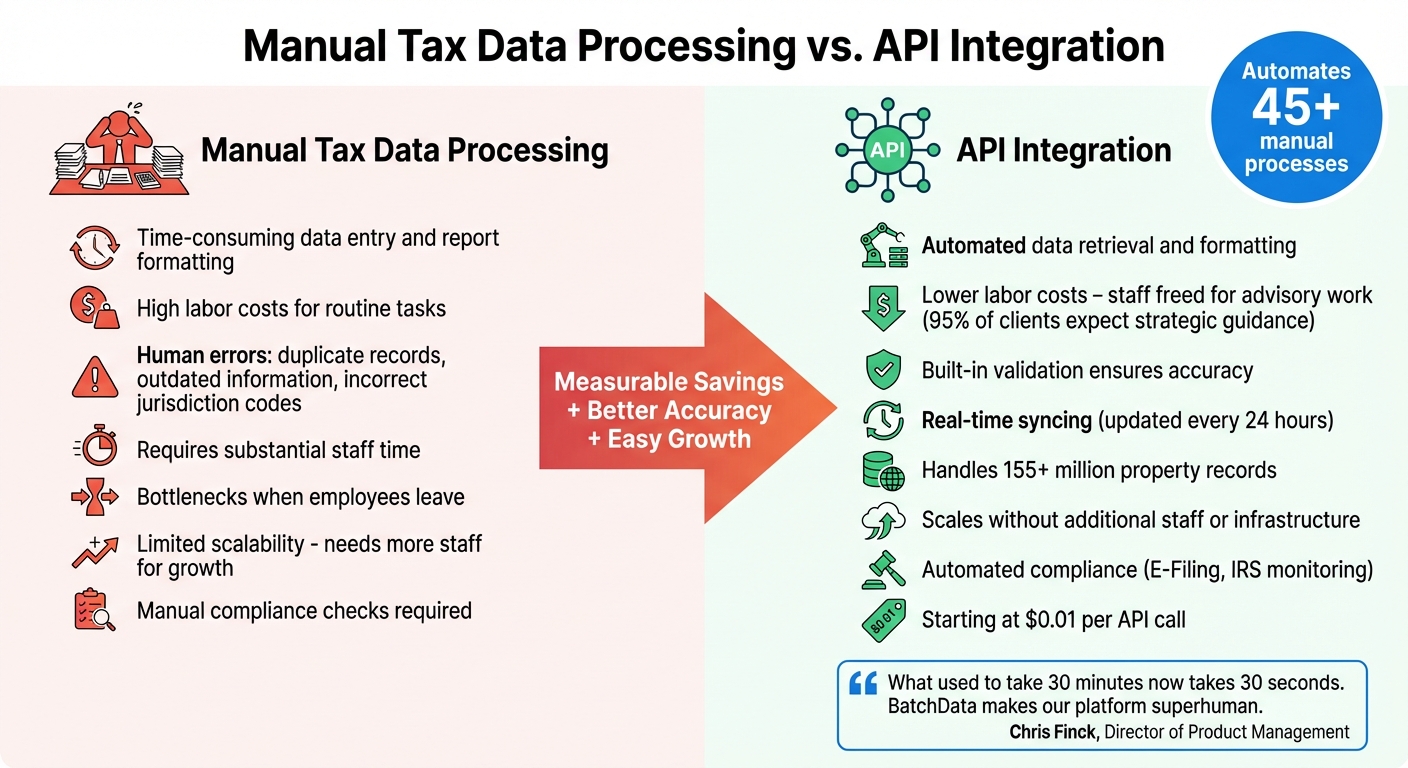
Cost Comparison: Manual Tax Data Processing vs API Integration
Shifting from manual tax data collection to API integration can significantly lower labor costs, reduce expenses tied to errors, and easily adapt to increased transaction volumes. These improvements translate into measurable savings, better accuracy, and the ability to grow without added strain.
Lower Labor Costs and Faster Processing
Manual tax workflows often require substantial time and effort from staff. Tasks like retrieving client lists, formatting reports, and cleaning up spreadsheets can eat up hours that could be spent on more valuable work. By using APIs, businesses can streamline these processes. APIs serve as a central data hub, automatically feeding information into multiple systems. This automation frees up staff to focus on high-value services, such as advisory roles, which are increasingly in demand.
Fewer Errors and Lower Error-Related Costs
Beyond labor savings, reducing human error is another major benefit. Manual data entry and CSV uploads often lead to duplicate records, outdated information, or incorrect jurisdiction codes, all of which require time and money to fix. APIs minimize these risks by incorporating built-in validation for critical elements like addresses, tax jurisdictions, and identification numbers. Regular data updates help businesses maintain current property tax assessments, tax amounts, and related property records. This level of precision is vital, as even a single tax calculation error can disrupt transactions, delay invoices, and strain client relationships.
“Calculating tax rates manually or through CSV uploads can lead to costly human errors that hurt your relationships with customers and/or suppliers and lead to lost revenue.”
- Jon Gitlin, Senior Content Marketing Manager, Merge
Scalability Without Proportional Cost Increases
APIs are built to handle increasing data demands without requiring more staff or infrastructure. With pre-built connectors, businesses can integrate systems using drag-and-drop tools, bypassing the need for specialized developers. This ensures continuity, as API-driven workflows reduce reliance on individual employees’ knowledge, preventing bottlenecks when team members leave. APIs also offer modular flexibility, allowing businesses to add new software or third-party tools to their tech stack without disrupting operations. Many integration platforms connect to thousands of web services, providing extensive functionality with minimal manual effort. Since providers have already invested in development, businesses can take advantage of these integrations without needing extra IT resources.
BatchData‘s API Solutions for Tax Data Integration

BatchData takes the hassle out of tax data integration with tailored solutions designed to simplify processes and boost efficiency. Their platform ensures uninterrupted access to a vast database of property records, even during local outages, making it a reliable choice for businesses.
BatchData’s system taps into 155+ million U.S. property records sourced from over 3,200 locations, delivering a steady stream of data. This reliable infrastructure powers their real-time tax data solutions, which are outlined below.
Real-Time Property Tax Data Access
BatchData’s REST API enables on-demand access to property tax information with minimal delay. Key data points include assessed values, tax amounts, tax years, and Assessor’s Parcel Numbers (APNs). The Core Property dataset alone offers over 240 data points, covering tax assessor records, building details, and legal descriptions – all accessible in a single API call.
Flexible Pricing Models
BatchData offers flexible plans designed to accommodate different business requirements and data volumes.
The right option depends on factors such as your expected usage, data requirements, and integration needs. For current plan availability and pricing tailored to your requirements, contact the BatchData sales team.
Custom Datasets and Professional Services
BatchData’s professional services team takes care of legacy system migrations, handling data mapping and normalization to lighten the load on internal teams. By delivering data directly to platforms like Snowflake, BigQuery, or Databricks, they eliminate the need for complex ETL infrastructure. Businesses can start working with standardized datasets right away.
Additional services include system audits, custom dataset creation, and match-and-append capabilities to fill in missing tax or ownership details. For large-scale projects like analytics or machine learning, BatchData supports bulk data delivery via AWS S3 or SFTP, offering scheduled updates and historical snapshots that integrate seamlessly into existing workflows.
How to Implement Tax Data API Integration
Integrating a tax data API can streamline operations and help manage costs effectively. Here’s a practical guide to ensure your integration is both efficient and reliable. These steps combine technical precision with cost-conscious strategies.
Choosing the Right Tax Data API
Start by selecting a RESTful API that uses predictable URLs and JSON responses. This format works smoothly with popular programming languages like Python, PHP, Node.js, and Ruby. For secure communication, ensure the API uses API key authentication via custom HTTP headers (e.g., “apikey”) and requires all requests to be sent over HTTPS.
Look for an API that offers nationwide coverage across all U.S. This allows you to validate authentication and transaction processes without incurring production costs.
Automating Workflows to Reduce Overhead
Automation begins with efficient data retrieval. Use the fields parameter to request only the data you need, enabling server-side aggregation and reducing the load on your client system. For handling large datasets, implement pagination with parameters like page[size] and page[number] to prevent timeouts and manage memory usage effectively.
Error handling is another critical component. Handle HTTP response codes like 429 (rate limiting) and 304 (caching) to optimize bandwidth and processing power. Use filters in your API calls, such as filter=record_date:gte:2024-01-01, to ensure you’re working with current and relevant data. This step automates tax calculations across various product categories, reducing the need for manual intervention.
Tracking Usage to Control Costs
Accurately tracking API usage is key to managing costs. Monitor the meta object for metrics like total-count and total-pages to gauge your data consumption. Pay attention to your call ratios – specifically, the ratio of calculation and address validation calls to committed documents. This helps you avoid unnecessary API usage fees.
| Parameter | Function | Cost Benefit |
|---|---|---|
fields |
Limits response to specific data points | Reduces payload size and triggers server-side aggregation |
filter |
Returns only records matching criteria | Minimizes data processing and transfer |
page[size] |
Sets number of rows per request | Prevents memory overloads and manages data flow |
Finally, implement back-off logic for rate limits. If you receive a 429 response code, configure your system to pause and retry instead of continuing to send failed requests. This approach helps conserve resources and ensures smoother API interactions.
Cost Comparison Before and After Integration
Integrating a tax data API delivers undeniable financial advantages by automating more than 45 manual processes. This shift not only reduces non-billable hours but also allows teams to dedicate more time to advisory and strategic tasks. The result? Tangible ROI and noticeable cost savings.
By automating repetitive data retrieval and validation tasks, businesses can reduce manual processing time, minimize data-entry errors, and handle larger property datasets without proportionally increasing staffing costs.
Additionally, advanced security measures ensure client data remains protected. By consolidating information into a unified system, these integrations simplify data management and reduce the costs associated with maintaining multiple platforms.
Conclusion
Integrating tax data APIs has transformed how property data is managed, offering businesses a way to significantly reduce labor costs, limit mistakes, and scale operations without a proportional increase in expenses. BatchData is a standout example of these advantages, offering solutions designed to meet these needs.
BatchData provides access to detailed tax assessor information for over 155 million U.S. properties, with more than 240 data points per property.
With flexible delivery methods, including real-time lookups via REST API or direct cloud delivery, BatchData eliminates the need for costly ETL processes.
One satisfied client shared their experience:
“What used to take 30 minutes now takes 30 seconds. BatchData makes our platform superhuman.”
- Chris Finck, Director of Product Management
This integration isn’t just about convenience – it delivers measurable returns and boosts operational efficiency, no matter the scale.
FAQs
How can API integration help lower labor costs in tax data management?
API integration simplifies tax data management by automating essential tasks such as data extraction, calculations, and transfers. This automation not only reduces the reliance on manual data entry but also frees up staff from spending time on repetitive processes.
Additionally, APIs eliminate the need for extensive in-house development and ongoing maintenance, which can significantly lower operational costs. With these savings, your team can concentrate on more strategic, higher-priority tasks, ultimately boosting efficiency while cutting labor expenses.
How does API integration ensure accurate tax data and minimize errors?
API integration plays a key role in maintaining precise tax data by blending secure technology, thorough testing, and built-in validation tools. Secure authentication methods – like API keys and HTTPS encryption – help guard against unauthorized access while ensuring the integrity of the data being exchanged. To further streamline operations, error-handling features, such as detailed status codes and validation flags, enable developers to quickly spot and resolve issues before they escalate.
Many APIs also offer testing environments, allowing teams to simulate various scenarios without impacting live data. These controlled spaces, combined with practices like integration testing and data validation scripts, help identify potential problems early on. Platforms like BatchData take accuracy a step further by cross-referencing property and ownership records from multiple sources, flagging any inconsistencies for review. By using these tools and strategies, organizations can ensure their tax data workflows remain dependable and free of errors.
How does BatchData’s pricing model support businesses with different tax data needs?
BatchData provides flexible pricing options designed to support different business needs and data requirements. Plans and available options can be tailored based on factors such as usage volume, datasets, and integration requirements. For current pricing and the option that best fits your needs, contact the BatchData sales team.
This flexibility ensures businesses can select a plan that matches their tax data integration needs and budget.