Solar panel data is transforming property evaluation by providing critical insights into home value, buyer preferences, and investment opportunities. Here’s what you need to know:
- Owned solar panels increase home value: Homes with owned systems sell for 6.9% more on average, adding $25,000–$79,000 depending on location and system age. Leased systems, however, add no value and may complicate sales.
- Faster sales: Solar-equipped homes sell 20% faster, closing 7–10 days sooner than homes without panels.
- Market trends: By 2026, 93% of new utility-scale energy capacity will come from solar, wind, and batteries, reshaping property markets.
- Large-scale solar farms: These can reduce nearby residential property values by 4.8% within 3 miles but boost agricultural land values by 19.4% within 2 miles.
Comprehensive solar and property datasets, including roof characteristics, energy production potential, and permit history, helps real estate professionals assess property value, identify high-potential investments, and refine valuation models. Tools like satellite imagery and APIs streamline the process, specifically through real estate API solutions, enabling smarter decisions in a rapidly evolving market.
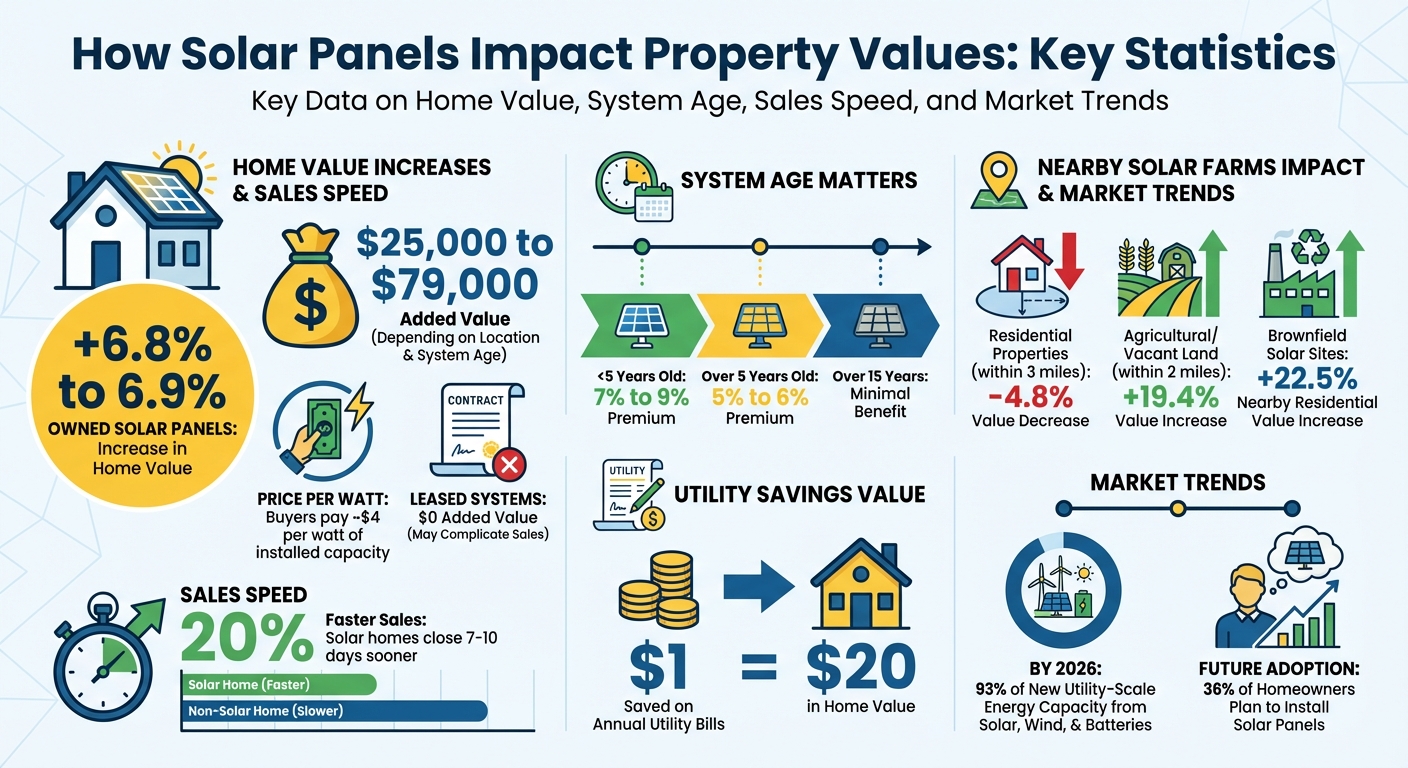
How Solar Panels Impact Home Values and Sale Times: Key Statistics
Do Solar Panels Affect Home Values?
How to Collect and Analyze Solar Panel Data
Understanding how to gather and interpret solar panel data is key to evaluating a property’s solar potential. By leveraging satellite imagery, aerial photography, and property records, you can assess solar viability across thousands of properties, even remotely.
Collecting Solar Panel Data Using Technology
Modern tools, like satellite-based machine learning, have made large-scale solar data collection possible. For instance, Google’s Solar API recently expanded its database to include 125 million additional buildings across 23 countries, using satellite-based ML to process single-view satellite imagery. This technology creates Digital Surface Models (DSMs) and roof segmentation maps, enabling solar assessments even where high-resolution aerial imagery is unavailable.
High-resolution aerial imagery offers detailed insights into individual properties. Multi-angle views allow for precise measurements of roof pitch, orientation, and square footage, while also identifying roof materials and shading risks. For example, EagleView has amassed over 60 petabytes of data, with 3 billion images covering more than 94% of the U.S. population.
"I can develop a proposal from start to finish in under 5 minutes." – Director of Business Development, Smart Energy Answers
Property and permit records provide crucial additional details. Historical permit data reveals information about existing solar installations, including system sizes, installation dates, and contractors. This data helps pinpoint neighborhoods with high solar adoption rates and identify properties with older systems. Geospatial APIs further enhance this process by delivering building-specific insights, raw solar datasets, and GeoTIFFs that include flux maps and hourly shade data.
With these tools for data collection, the next step is making sense of the information to evaluate solar potential effectively.
Interpreting Solar Panel Data for Property Evaluation
Analyzing flux maps – both annual and monthly – helps assess roof sunlight intensity and energy production potential. For example, Google’s Solar API uses a standard panel capacity of 400 W, 20.4% efficiency, and an 85% DC to AC derate factor. To qualify as viable, a roof must support at least 1.6 kW of installation capacity and receive at least 75% of the maximum annual sunlight in the area.
Roof orientation plays a major role too. South-facing roofs (azimuth degrees between 90 and 270) are the most energy-efficient and often command higher property premiums. When utility bill data isn’t available, proxies like large square footage, swimming pools, or registered electric vehicles can signal high energy consumption and a stronger solar ROI.
The age of existing systems also affects property value. Systems under five years old add the most value, while those older than 15 years may offer minimal benefit as they near the end of their lifespan. Monitoring permit trends can also reveal neighborhoods with rapid solar adoption or potential market saturation. Solar companies that use data-driven targeting report conversion rates 50–70% higher than traditional methods.
How Solar Panels Affect Property Values
Solar panels can increase a home’s sale price, though the extent of this boost depends on factors like ownership, system age, and location. On average, homes with owned solar panels sell for 6.8% to 6.9% more than similar homes without solar – adding about $25,000 to $29,000 to the price of a median-priced home. Buyers are also willing to pay around $4 per watt of installed solar capacity.
Measuring the Value Increase from Solar Installations
The added value from solar panels varies based on several key factors. For instance, newer systems (less than five years old) typically bring the highest premiums, ranging between 7% and 9%, while older systems (over five years) add about 5% to 6% to a home’s value. In Riverside, California, the average premium for solar-equipped homes is approximately 2.7%. A 2026 study of over 5,000 home sales in major California cities found that owned solar systems could increase home prices by $39,500 to $79,000.
"Our study of over 5,000 homes shows homes with owned solar panels tend to sell for 5–10% more than comparable homes without solar, reflecting buyer demand for long-term energy savings and stability." – Ara Agopian, Founder and CEO, Solar Insure
However, leased systems or Power Purchase Agreements (PPAs) generally do not add value because of the complexities involved in transferring contracts. Homes with solar panels also sell 20% faster, typically closing 7 to 10 days sooner than those without panels. Additionally, solar panels add about $20 in value for every $1 saved on annual utility bills.
While rooftop solar systems often boost property values, nearby large-scale solar farms can have a different effect.
When Nearby Solar Farms Reduce Property Values
Living near large-scale solar photovoltaic (LSSPV) farms can lower residential property values. Homes within 3 miles of a large solar farm experience an average price drop of 4.8%, while those within just 0.5 miles see reductions of about 1.5% compared to properties farther away (2–4 miles). These effects are largely driven by perceptions of industrialization rather than physical factors. Interestingly, whether the solar farm is visible from the property has little additional impact – proximity within 3 miles is the primary factor.
Political leanings also play a role. In conservative-leaning counties, property values near solar farms drop by about –5.38%, while in Democratic-leaning counties, the effect is negligible or even slightly positive at +3.74%.
Large properties (over five acres) tend to avoid these negative effects entirely, as the increased value of the land itself offsets any residential impact. Meanwhile, agricultural and vacant land within 2 miles of a solar farm can see value increases of about 19.4%, thanks to the potential for future solar leasing. Solar farms built on brownfield sites (previously developed or contaminated land) can actually increase nearby residential property values by 22.5%, compared to a 4.66% decrease associated with greenfield developments.
Adding Solar Panel Data to Real Estate Workflows
Solar panel data is reshaping how real estate professionals evaluate properties, uncover investment opportunities, and manage portfolios. Integrating this data into real estate workflows requires incorporating specific metrics and strategies that go beyond traditional property analysis.
Improving Property Valuation Models with Solar Data
To make property valuations more precise, it’s essential to include solar-specific factors that reflect both the technical potential and financial benefits of solar installations. Since utility bill data is often private, use proxies like square footage, the presence of pools, and electric vehicle registrations to estimate energy consumption and the potential value of solar offsets.
When refining a Comparative Market Analysis (CMA), compare solar-equipped homes with non-solar properties within a 0.5-mile radius, sold within 180 days, and of similar size and age. This approach helps isolate the "solar premium". Incorporate additional factors like regional incentives, local energy costs, and utility data to estimate long-term ROI and the net present value of solar systems. Keep in mind that owned solar systems add measurable value – around $25,000 to $29,000 for a median-priced home – while leased systems or Power Purchase Agreements typically do not affect appraised value.
With these refined valuation models, real estate professionals can better identify properties with high investment potential and locate property owners to initiate outreach.
Using Solar Data for Property Prospecting and Portfolio Management
Solar metrics, combined with other property data, can significantly enhance property prospecting and portfolio management. By targeting properties with specific physical characteristics – like south-facing roofs, minimal shading, sufficient square footage, and modern roof materials such as asphalt or tile – you can achieve 50-70% higher conversion rates and reduce marketing waste by 40%.
Tracking building permits is another effective strategy. Permits for pools, home additions, or EV chargers can signal increased energy needs and active home improvement projects. This data can also help identify homes with existing solar systems, making them ideal candidates for battery storage or system expansions. Focus on owner-occupied homes, as they tend to adopt solar solutions more readily than tenant-occupied properties.
"Permit data is a goldmine. You can target homeowners who have recently pulled permits for pools, home additions, or EV chargers, as they are actively investing in their homes." – BatchData
For commercial portfolios, assess infrastructure readiness by checking for modern electrical systems (typically in buildings under 15 years old) and recent roof work to ensure structural integrity for solar installations. Timing your outreach to align with Q4 capital planning or fiscal year transitions can further improve your chances of success, as businesses often evaluate major investments during these periods.
Using BatchData for Solar-Enriched Property Data
BatchData’s Property Data Enrichment Solutions
BatchData offers a robust real estate data platform that integrates solar panel information directly into real estate workflows. With a database covering over 155 million U.S. properties and more than 700 data points per property, the platform provides a wealth of insights. For solar-specific data, BatchData includes permit details such as installation dates, system sizes, contractor information, and roof attributes like material, age, and orientation. Since direct access to utility billing data is often restricted, BatchData uses proxies like property size, pool ownership, and electric vehicle registrations to identify high-energy consumption households – ideal for solar analysis.
The platform’s skip tracing capabilities stand out with a 76% right-party contact rate, which is about three times the industry average. This feature helps professionals connect with owners of solar-equipped properties or decision-makers behind LLCs and trusts, making it particularly useful for solar prospecting in commercial real estate. Additionally, BatchData includes daily updates for DNC (Do Not Call) and litigator scrubbing to ensure compliance with TCPA regulations. These enriched datasets streamline property evaluations, making them faster and more precise.
Using APIs to Add Solar Panel Data to Property Datasets
BatchData extends its property data enrichment through RESTful APIs, allowing seamless integration of solar and property data into CRMs, proposal software, and custom applications using real estate APIs – all with sub-second response times. After authenticating with an API key, users can submit property addresses in bulk and receive enriched data. The platform flags properties with solar systems, noting that owned systems can increase property values by 5–10%. For a $790,000 home, this translates to an added value of approximately $39,500–$79,000. Leased systems, however, don’t consistently provide the same benefit.
"What used to take 30 minutes now takes 30 seconds. BatchData makes our platform superhuman." – Chris Finck, Director of Product Management
The API also supports compound queries, enabling users to pull multiple datasets – such as property details, financial data, and solar permits – in a single request, reducing latency. For flexible data delivery, BatchData supports real-time API access, bulk file transfers in formats like CSV or Parquet, and direct cloud integration via platforms such as Snowflake, BigQuery, and Databricks. This ensures that solar data is always up-to-date and ready for actionable property analysis.
Making Better Real Estate Decisions with BatchData
Incorporating solar panel data through BatchData refines property valuation models and improves decision-making across the real estate sector. By leveraging data-driven targeting, users see 50–70% higher conversion rates while cutting marketing waste by over 40%. The inclusion of solar comparables and energy-efficient features enhances valuation models. Research shows that owned solar panels can increase home values by 5–10%, which, for high-value properties, equates to a boost of $39,500–$79,000.
BatchData also flags potential risks using geospatial solar data. For example, homes within 0.5 miles of solar farms may see a drop in value, while nearby land values could rise by roughly 19.4%. For investment purposes, professionals can filter properties with south-facing roofs, minimal shading, ample square footage, and modern roofing materials to assess solar feasibility before scheduling site visits. Monitoring building permits for upgrades like pools, home additions, or EV chargers helps identify homeowners actively investing in energy improvements. With bulk data delivery options, BatchData supports large-scale portfolio evaluations, enabling repeat analyses across thousands of properties to quantify solar’s impact on value.
Conclusion: Using Solar Panel Data to Improve Property Decisions
Solar panel data is reshaping how decisions are made in real estate by offering a level of precision and efficiency that wasn’t possible before. For instance, owned solar panels can significantly increase property values, with higher-end homes seeing an increase between $39,500 and $79,000. On the other hand, leased panels often complicate transactions, creating challenges for buyers and sellers alike.
Beyond property value, solar data enables professionals to target prospects more effectively, boosting conversion rates by 50% to 70%. By analyzing factors like roof orientation, shading, property size, and energy consumption indicators (such as pools or EV registrations), real estate professionals can focus on the most promising opportunities. This eliminates unnecessary site visits and enhances return on investment.
BatchData’s platform simplifies the process by delivering detailed property insights, including solar permits, roof details, and financial data. With its Real-Time API, these insights can be seamlessly integrated into CRMs and valuation tools. The platform also boasts an impressive 76% right-party contact rate, nearly tripling the industry standard, allowing professionals to connect with decision-makers more efficiently.
Solar data also helps mitigate risks. For example, residential properties within 3 miles of large-scale solar farms may see a 4.8% decrease in value, while agricultural or vacant land in the same area might enjoy a 19.4% increase. These geospatial insights help investors identify opportunities and challenges tied to specific locations. With 36% of homeowners planning to install solar panels in the future, incorporating solar data into real estate strategies ensures professionals stay ahead of evolving market trends.
FAQs
How do I tell if a home’s solar panels are owned or leased?
When determining if a home’s solar panels are owned or leased, start by checking the system’s paperwork. This includes installation records, warranty information, and any associated agreements. If you’re unsure, simply ask the seller for clarification. Keep in mind, if the panels are leased, you might need to handle a lease transfer, which can add some complexity to the buying process.
What solar data matters most for estimating a property’s value?
When assessing how solar panels affect a property’s value, several key factors come into play. These include the ownership structure of the solar system (whether it’s owned outright or leased), regional market trends, electricity rates, and net metering policies. Together, these elements help paint a clearer picture of the overall impact.
Additionally, solar panels can boost home values significantly. In fact, studies suggest they can increase property value by anywhere from 4.1% to as much as $79,000, depending on the home and location. These insights highlight the importance of evaluating solar data when estimating property value.
How can I check if a solar farm could affect a property’s price?
Proximity to solar farms can impact property values in different ways. For homes located within 0.5 miles of large-scale solar projects, there may be a drop in prices, particularly in rural areas. On the flip side, farmland or vacant land near these solar farms often sees an increase in value. To better understand these effects, factors such as the land’s previous use, the size of the solar project, and its specific location need to be taken into account. Access to detailed real estate data is key to making precise assessments of property value changes.