






































Securing a building permit in Phoenix, AZ is a non-negotiable step for any serious construction project, and navigating the system efficiently is the difference between a smooth build and a costly nightmare. This process confirms your project is safe, meets the 2018 International Building Code standards adopted by the city, and won't devalue your property with illegal, uninspected work.
This is not just bureaucratic red tape; it's a critical checkpoint in a city that issued 7,262 building permits in a single recent year. The permit process is your project's insurance policy, validating that your plans align with local zoning, safety codes, and construction standards.
| Core Takeaway | Details |
|---|---|
| Primary Requirement | Required for most new builds, demolitions, and alterations to structural, electrical, or plumbing systems. |
| Governing Body | City of Phoenix Planning & Development Department manages all applications and inspections. |
| Application Method | The ProjectDox online portal is the primary and most efficient submission channel. |
| Core Purpose | To ensure public safety, protect property values, and enforce legal building standards. |
This guide provides the direct answers you need to navigate the costs, timelines, and application process for Phoenix building permits.
What is a Phoenix building permit?
A building permit is a formal authorization from the City of Phoenix that allows you or your contractor to proceed with construction, alteration, or demolition on a property. It certifies that the proposed project plans comply with local building codes, zoning regulations, and public safety standards.
This system is essential for managing urban development in a city with significant construction velocity. Phoenix issues approximately 44.7 permits per 1,000 residents, a high rate that reflects its robust growth and places it among the top U.S. cities for development, a trend analyzed by municipal reports on platforms like Governing.com.
The Purpose of Permitting
The fundamental goal is to protect public health, safety, and welfare. The permit and inspection process is a system of checks that ensures a project is built correctly from the foundation up.
- Safety Compliance: It verifies that critical systems—structural, electrical, and plumbing—are installed according to established safety codes, preventing potential disasters like fires or structural collapse.
- Property Value: A documented history of properly permitted work is a significant financial asset. Unpermitted work can halt a property sale or lead to severe legal and financial repercussions.
- Legal Standing: Working without a required permit results in immediate stop-work orders, substantial fines, and the potential mandate to demolish the unpermitted construction.
The Phoenix Planning & Development Department's website is the central resource for all permit-related activities.
This portal is the primary tool for submitting applications, tracking progress, and scheduling inspections. It also serves as a critical data source for proptech companies and real estate professionals who analyze public records to monitor construction trends, a process detailed in guides on consuming building permit data.
Phoenix Building Permit: Quick Facts
| Aspect | Key Detail | Consequence |
|---|---|---|
| Governing Body | City of Phoenix Planning & Development Dept. | Single point of contact for all applications, regulations, and inspections. |
| Annual Permit Volume | 7,262 permits issued in a recent year. | Indicates a busy, well-established, but potentially backlogged system. |
| Key Requirement | Required for most new construction, alterations, and demolitions. | Failure to comply results in fines, stop-work orders, and safety hazards. |
| Primary Goal | Ensure compliance with building codes and zoning laws. | Protects property value, ensures occupant safety, and maintains neighborhood standards. |
| Application Portal | Primarily online via the ProjectDox system. | Digital submission offers faster processing and better tracking than physical applications. |
| Public Record | All issued permits are public records. | This data directly impacts property sales, insurance coverage, and future renovation plans. |
A building permit is not an obstacle; it is a form of project insurance that protects your financial investment, physical safety, and the future marketability of your property.
When do I need a Phoenix building permit?
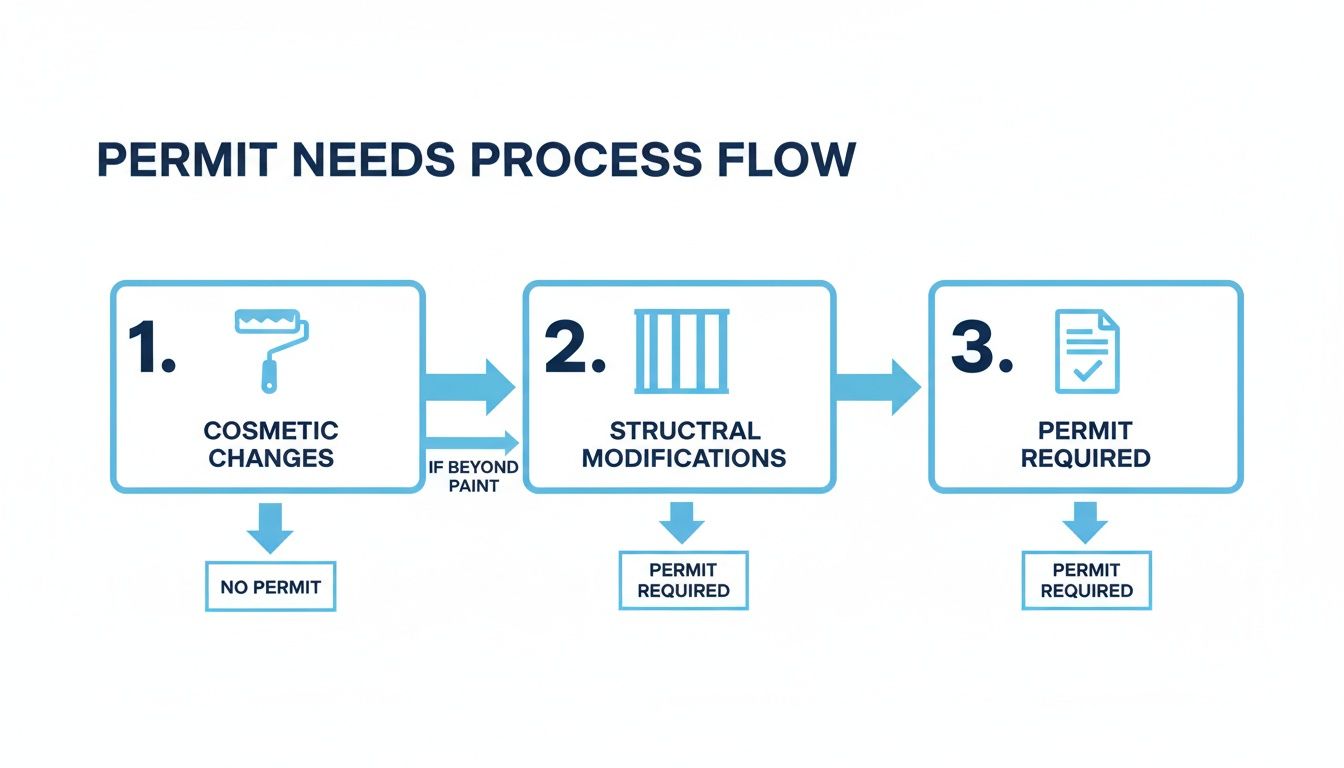
You need a permit for any project that alters a building's structural integrity or its electrical, plumbing, or mechanical systems. Simple cosmetic upgrades do not require a permit.
The city draws a clear distinction between aesthetic maintenance and substantive construction. You can paint walls, replace flooring, or install new cabinets without filing for a building permit in Phoenix, AZ. These are considered maintenance and do not impact the core safety or structure of the home.
However, once a project touches the building's "bones" or essential services, a permit is mandatory.
Projects That Require a Permit
If the work can impact safety, zoning, or property integrity, official approval is required. Phoenix enforces this strictly to protect property owners, neighbors, and future buyers.
- Structural Changes: Removing a load-bearing wall, altering a roofline, or converting a garage into a living space requires a permit.
- System Installations: Any new electrical wiring, major plumbing work (like adding a bathroom), or installing a new HVAC system requires a permit and subsequent inspections.
- Exterior Additions: Building a new fence over three feet tall, constructing a retaining wall, or installing a swimming pool requires a permit. This also applies to an Accessory Dwelling Unit (ADU) or a patio cover.
The Risks of Unpermitted Work
Attempting to bypass the permit process is a significant financial and legal gamble. The city's enforcement is aggressive, and the consequences are far more expensive than the initial permit fee.
A stop-work order is the most immediate consequence, legally freezing all construction. This is typically followed by fines that can escalate into thousands of dollars. The long-term issues are worse. You may be forced to demolish finished work, such as drywall or tile, at your own expense for an inspector to view the underlying plumbing or wiring.
Ultimately, unpermitted work can terminate a real estate transaction. Most lenders will not finance a property with known code violations, forcing a seller to either undertake a costly retroactive permitting process or sell at a significant discount.
How do I apply for a Phoenix building permit?
The application process for a building permit in Phoenix, AZ is a precise, document-intensive procedure best handled through the city's online portal. A complete and accurate application package is the most critical factor for avoiding delays.
Before submission, you must assemble a professional case for your project.
Required Application Documents
City plan reviewers require specific information to verify code compliance. Incomplete packages are the primary source of delays.
- Professional Plans: Most structural projects require blueprints stamped by an Arizona-licensed architect or engineer.
- Detailed Site Plan: This scaled drawing must show property lines, the location of the proposed work, and distances to other structures. Precise property data can be found by learning how to find county information using an address.
- Correct Application Form: Use either the Residential Construction Permit-Plan Review Application or the Commercial/Multifamily Permit/Plan Review Application. Every field must be completed.
An inaccurate or incomplete site plan is a common reason for application rejection. Verify all measurements and clearly mark elements like utility easements before submission to prevent costly revisions.
Online vs. In-Person Submission
The City of Phoenix has standardized on digital submissions for efficiency. While in-person appointments are available, the online portal is the mandatory route for most projects.
| Submission Method | Description | Best For |
|---|---|---|
| ProjectDox (Online) | The city's electronic plan review (EPR) system for digital document uploads and review. | Virtually all residential and commercial projects. It is the fastest and most efficient channel. |
| In-Person Appointment | Physical plan drop-off at the Planning & Development Dept. offices. Requires a scheduled appointment. | Simple, over-the-counter permits or for users unable to access the online system. |
The city's online system, ProjectDox, centralizes all communication and allows multiple departments to review plans concurrently. Success on this platform requires strict adherence to the city's file naming conventions and responding to reviewer comments directly within the system. Failure to do so will stall your application indefinitely.
The initial plan review for a building permit in Phoenix, AZ takes approximately 28 days. If corrections are required, the subsequent review cycle is 21 days. A clean digital submission is the best strategy to avoid these extra delays.
What are the costs and timelines for a Phoenix permit?
Permit costs are calculated based on your project's total valuation, and timelines are driven by the complexity of the plan review and inspection schedule. A building permit in Phoenix, AZ is not a single flat fee but a combination of charges that must be budgeted for upfront.

The primary fee is based on the project valuation—the total cost of all materials, labor, and overhead. For a project valued between $1,001 and $10,000, the fee starts at $150 plus $9.00 for each additional $1,000 in value. The cost scales with project size.
The Fee Structure
The plan review fee is a separate charge for the city staff's time to review your blueprints. This fee is typically 80% to 100% of the building permit fee, depending on the project's valuation. The total upfront cost is the sum of the permit fee and the plan review fee. For a $50,000 remodel, expect a base fee of $551 plus a plan review fee of another $551, totaling over $1,100 before construction begins.
Permit Cost Examples
These estimates are based on project valuation and can fluctuate.
| Project Type | Estimated Valuation | Estimated Total Permit & Plan Review Fees |
|---|---|---|
| Water Heater Replacement | $1,000 | ~$150 (often a flat fee) |
| Kitchen Remodel (No structural) | $30,000 | ~$750 – $900 |
| New Swimming Pool | $75,000 | ~$1,200 – $1,500 |
| Small Room Addition (200 sq. ft.) | $120,000 | ~$1,700 – $2,000 |
Inspection Timelines and Milestones
A standard residential permit takes approximately 60-75 days from application submission to issuance. This includes an initial 28-day review and a 21-day cycle for any necessary corrections.
Once the permit is issued, you must schedule inspections at critical construction phases. You cannot proceed to the next phase until the previous one is approved by a city inspector.
- Foundation Inspection: Occurs after trenches are dug and rebar is placed, but before concrete is poured.
- Framing/Rough-in Inspection: Scheduled after the structure is framed and all electrical, plumbing, and mechanical systems are installed but remain exposed.
- Final Inspection: The last step. The project must be 100% complete for the inspector to close out the permit.
Arizona's construction activity directly impacts these timelines. A recent seasonal peak saw 4,221 new private housing units authorized by building permits, according to the Federal Reserve's housing data. Passing inspections on the first attempt is the most effective way to avoid delays in a high-demand market.
How is permit data used by professionals?
A building permit in Phoenix, AZ is a public record that signals a significant spending event, creating a high-value data point for industry professionals. This data provides a roadmap of future economic activity and is a powerful tool for predictive analysis.
Aggregated permit data reveals market patterns that are invisible at the individual project level.
High-Intent Sales Leads
Permit data generates high-intent sales leads. A newly issued permit for a swimming pool is a direct signal for landscapers, fence installers, and pool maintenance providers. By monitoring public filings, businesses can engage homeowners at the precise moment they are actively spending money on a project.
- Roofing Contractors: Filter for permits related to storm damage or major remodels to identify immediate service needs.
- Solar Installers: Target homeowners with approved electrical panel upgrades—a prerequisite for many solar installations.
- Interior Designers: Track permits for large additions or gut renovations to find clients ready for professional design services.
This data-driven approach allows businesses, including local construction companies, to target consumers who have demonstrated a clear intent to buy.
Enriched Property Data for Investment
For real estate investors and proptech platforms, permit data provides a verified history of a property's upgrades and its true market potential. A home with recently closed-out permits for a new HVAC system and kitchen remodel is a fundamentally different asset than one without.
This data is used to:
- Improve Automated Valuation Models (AVMs): Permit history adds a layer of investment data that makes machine-learning property valuations more accurate.
- Verify Property Condition: Investors can cross-reference a seller's claims of "recent upgrades" against official city records.
- Monitor Neighborhood Trends: A surge in Accessory Dwelling Unit (ADU) permits in a specific zip code can signal a shift in zoning or housing demand, allowing investors to act on emerging trends.
Integrating permit data provides insight into the investment made in a property, a far better indicator of its market value than simple metrics like square footage. Understanding how these data points are linked to specific parcels via identifiers like an APN is crucial, a topic covered in our guide on the role of APN in real estate.
What are common questions about Phoenix building permits?
Navigating the specifics of building permits in Phoenix, AZ often raises recurring questions. Here are direct answers to the most frequent inquiries from property owners and contractors.
Do I need a new permit if a previous one existed?
Yes. A permit is tied to the specific work performed under the building codes of that era. Phoenix currently operates under the 2018 International Building Code and local amendments. A new project must comply with current standards, rendering any old permit obsolete for new work.
What if I bought a house with unpermitted work?
The current homeowner is legally responsible for any unpermitted work, regardless of who performed it. If discovered, the City of Phoenix can require you to:
- Apply for a costly and complex retroactive permit.
- Demolish finished surfaces (walls, floors) for inspection at your own expense.
- In severe cases, remove the unpermitted structure entirely.
Resolve all unpermitted work before starting any new projects to avoid compounding the problem.
How long is a Phoenix building permit valid?
A standard Phoenix building permit is valid for 180 days from the date of issuance. The permit remains active as long as work begins within this period and the project does not stall for more than 180 consecutive days between passed inspections. If the permit expires due to inactivity, you must re-apply and pay all associated fees again.
Can a homeowner pull their own permit in Phoenix?
Yes, under an "owner-builder" permit, but this comes with significant liability. You must own and occupy the property and either perform the work yourself or act as your own general contractor. By signing the owner-builder form, you assume full legal responsibility for code compliance and supervision of all workers. It is not a method to hire unlicensed labor. If you hire a professional contractor, they are legally required to pull the permit under their license.
Frequently Asked Questions
| Question | Answer |
|---|---|
| How much does a building permit cost in Phoenix? | Fees are based on project valuation. A simple electrical permit may be under $100, while a new home construction permit can cost thousands after plan review and inspection fees. |
| Can I check if a property has open permits? | Yes. The City of Phoenix's online permit search tool allows you to view a property's complete permit history by address. |
| What is the penalty for building without a permit? | Penalties include a "work without permit" fee (often double the original permit fee), a stop-work order, and potential demolition of the unpermitted work. |
| How do I schedule an inspection? | Inspections are scheduled online via the Planning & Development Department's portal or by phone. You will need your permit number and the specific inspection code. |
At BatchData, we refine public records like building permits into actionable intelligence for real estate professionals. Our platform offers access to over 155 million property records, enhanced with permit data that uncovers market trends and high-intent leads. Shift from speculation to data-driven decision-making. Explore how our comprehensive property data can give you a competitive edge.