




































In 2026, property enrichment APIs have evolved to meet the growing demand for bulk data delivery. Whether you’re managing a CRM, analyzing a portfolio, or processing national property records, choosing the right real estate API is critical. Key players like BatchData ATTOM, CoreLogic, and Reonomy offer solutions, each with unique strengths and limitations. Here’s what you need to know:
- BatchData: Offers real-time APIs, direct cloud access (Snowflake, BigQuery), Known for its speed, compliance tools (DNC scrubbing, litigator detection), and daily database updates.
- ATTOM: Provides detailed property data for over 160 million U.S. properties, with AI-driven insights. Bulk data delivery is available but lacks seamless cloud integration and built-in compliance tools.
- CoreLogic: Focuses on archival and mortgage data with cloud integrations like S3 and Snowflake. However, onboarding is slow, and real-time updates are limited.
- Reonomy: Specializes in commercial real estate data with bulk delivery options but has limited residential coverage and compliance features.
Quick Comparison
| API | Delivery Methods | Data Coverage | Compliance Features | Key Limitations |
|---|---|---|---|---|
| BatchData | API, SFTP, Cloud (Snowflake) | 155M properties, 700+ attributes | DNC, TCPA scrubbing | Custom pricing required |
| ATTOM | API, AI-Native Cloud | 160M properties, layered data | Limited compliance tools | Inconsistent update frequency |
| CoreLogic | SFTP, Cloud (Snowflake, S3) | 150M properties, mortgage focus | No built-in compliance | Slow onboarding |
| Reonomy | API, SFTP, Cloud (S3) | Commercial properties | Limited compliance tools | Residential data limited |
Each API serves different needs, so selecting the right one depends on your specific use case, data requirements, and compliance priorities.
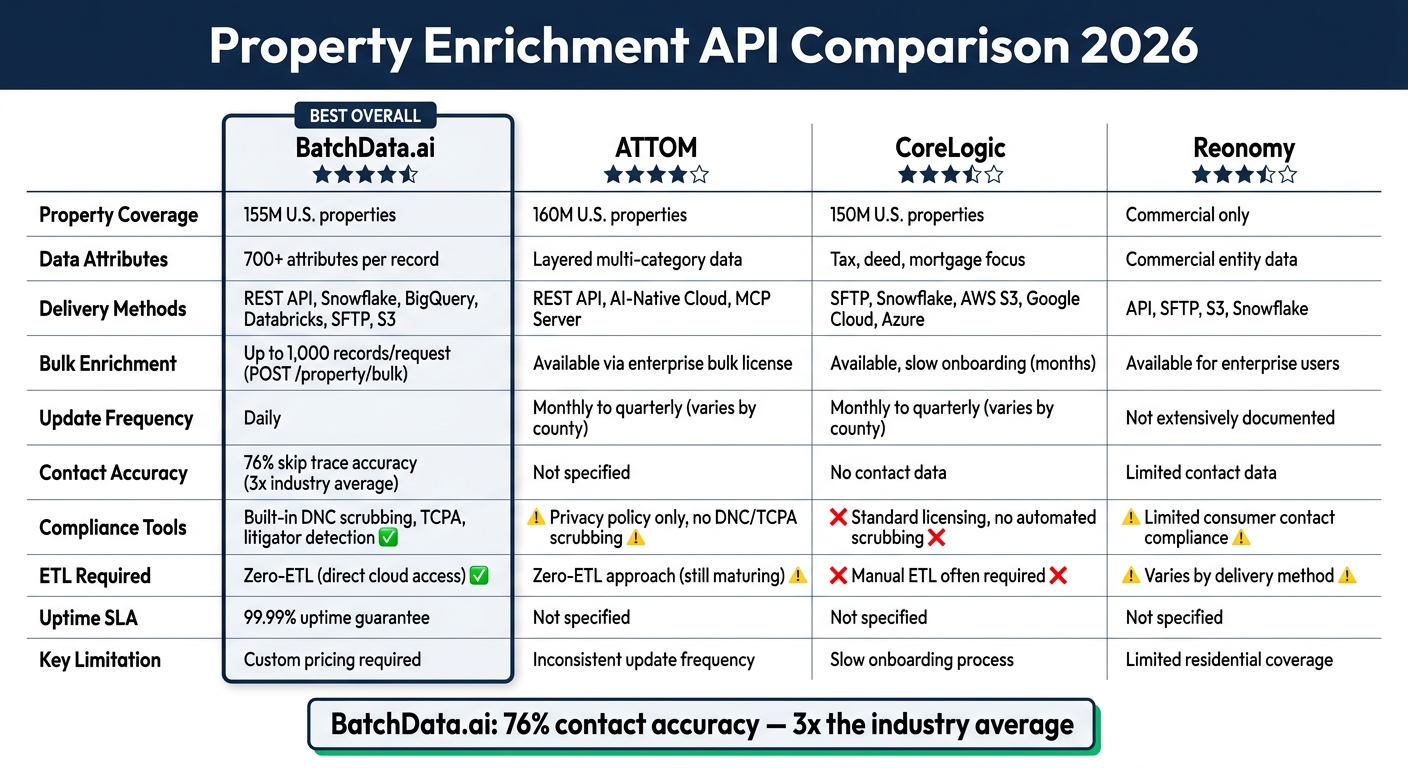
Property Enrichment API Comparison 2026: BatchData vs ATTOM vs CoreLogic vs Reonomy
1. BatchData
Data Delivery Methods
BatchData offers four flexible delivery methods tailored to different needs:
- Real-Time REST API: Perfect for on-demand lookups, this option provides sub-second response times and comes with a 99.99% uptime guarantee.
- Direct Cloud Access: Seamlessly connects your data warehouse – whether it’s Snowflake, BigQuery, or Databricks – directly to fresh data without requiring manual ETL processes.
- Bulk Data Extracts: For those relying on legacy formats, data can be delivered via SFTP or Amazon S3 in formats like CSV, JSON, or Parquet.
- Bulk Enrichment API For bulk property-data workflows, refer to the official BatchData API documentation for the currently supported endpoints, request formats, and limits. This can be useful for workflows such as CRM backfills and portfolio updates.
| Delivery Method | Best Use Case | Key Advantage |
|---|---|---|
| Real-Time API | On-demand lookups, apps | Sub-second latency, 99.99% uptime |
| Direct Cloud Access | ML, BI, large-scale analytics | No ETL, always up-to-date |
| Bulk Data (SFTP/S3) | Historical snapshots, local databases | Flexible scheduling, custom extracts |
| Bulk Enrichment API | CRM backfilling, portfolio updates | High-throughput (1,000 records/call) |
These options ensure data is delivered quickly and in a format that fits your workflow, enabling fast, actionable insights.
Data Types and Actionability
Covering 155 million U.S. properties, BatchData provides over 700 attributes per record, resulting in a database of over 1 billion data points. Key data categories include:
- Property Details: Assessor data like APN, square footage, and year built.
- Recorder and Mortgage History: Information on liens, loan types, and interest rates.
- Active Listings and Pre-Foreclosure Data: Notices of default, auction dates, and more.
- Verified Contact Information: Phone numbers and email addresses for outreach.
The platform’s standout feature is its ability to deliver actionable data. For example, skip tracing property owners achieves a 76% accuracy rate – three times higher than the industry average. This allows mortgage lenders and real estate investors to enrich lead lists overnight and start outreach immediately.
Scalability and Performance
BatchData pulls information from over 3,200 sources, ensuring a steady stream of updated data. The database is refreshed daily. For large-scale analytics or machine learning, the Direct Cloud Access method bypasses API rate limits, delivering Parquet-formatted datasets directly to S3 or your cloud data warehouse. This eliminates the need for ETL, integrating seamlessly into modern cloud infrastructures.
Enterprise plans are designed for high-volume needs, offering dedicated infrastructure and custom rate limits for handling large bursts of data. Developers can also request a free API key to test data quality before committing to full integration.
Compliance and Risk Mitigation
BatchData doesn’t just focus on speed and scale – it also prioritizes compliance. Federal DNC scrubbing and litigator detection are built into the bulk delivery pipeline, automatically removing flagged numbers to streamline your workflow. Additionally, address and phone verification endpoints filter out disconnected numbers and undeliverable addresses, ensuring only valid data reaches your outreach queue.
sbb-itb-8058745
2. ATTOM
Data Delivery Methods
ATTOM provides property data through a RESTful API, compatible with both JSON and XML formats. For businesses needing large-scale data, it offers enterprise solutions like bulk data delivery via an AI-Native Cloud channel and MCP Server integration. This setup simplifies the process of loading data into cloud warehouses, following a Zero-ETL approach. However, ATTOM’s cloud integration is still a work in progress, with documentation primarily focused on API-based delivery rather than direct connectors to platforms like Snowflake or BigQuery. These delivery options enable access to a multi-layered dataset, combining detailed property information with broader contextual insights.
Data Types and Actionability
ATTOM’s database includes information on over 160 million U.S. properties. What makes its data stand out is its layered enrichment approach. Core property and ownership data are supplemented with Area Data (such as crime rates, weather patterns, and commute times) and POI Data covering 14 business categories and more than 120 lines of business. Its AI-driven AVM (Automated Valuation Model), built on 30 years of property data, offers valuable insights for investors and underwriters.
“Our Table of Data Elements represents a structured foundation of nationwide property, ownership, mortgage, market, and risk datasets… structured to turn raw records into actionable intelligence.” – ATTOM
Scalability and Performance
Thanks to its diverse delivery options, ATTOM is built to perform well at scale. The platform offers immediate access to 150 million property records, including tax details, assessments, and market trends. However, the frequency of updates varies – some counties refresh data monthly, while others do so quarterly – which could impact workflows that rely on real-time information. The ATTOM Nexus platform allows businesses to evaluate data coverage and quality before committing to a full bulk license. For large-scale analytics, the AI-Native Cloud Delivery option reduces the need for extensive ETL processes.
“Instead of spending time aggregating and updating data, the APIs allow you to focus on building your product through a consistent interface.” – ATTOM
Compliance and Risk Mitigation
Delivering such extensive datasets requires careful attention to compliance. ATTOM mitigates risks by offering clear usage terms and strong privacy policies, especially regarding how data is displayed on commercial websites. However, the platform does not explicitly mention built-in DNC (Do Not Call) or TCPA (Telephone Consumer Protection Act) scrubbing within its bulk delivery process. This could pose challenges for organizations conducting large-scale phone outreach, where compliance risks increase with the volume of records.
3. CoreLogic
Data Delivery Methods
Traditionally, CoreLogic relied on SFTP transfers and flat-file exports, which required clients to handle large local databases and manually process county-level exports. By 2026, CoreLogic has introduced some modern delivery options, including bulk data access through the CoreLogic Discovery Platform, Snowflake Data Sharing, and cloud integrations with AWS S3, Google Cloud, and Azure. However, onboarding these datasets can still take months, and the integration process remains slower compared to API-first solutions. While these updates reflect progress, the delivery methods continue to face challenges in speed and seamless integration.
Data Types and Actionability
CoreLogic provides extensive coverage of over 150 million U.S. properties, offering tax records, deed history, mortgage data, and detailed property characteristics. Its mortgage and lien data, bolstered by its subsidiary Black Knight, is particularly useful for lenders and title companies. That said, the platform primarily delivers archival and structural data rather than real-time actionable insights. For example, CoreLogic does not specialize in providing verified homeowner contact details, such as phone numbers or email addresses, nor does it offer real-time listing statuses. This limits its effectiveness for workflows requiring immediate outreach or lead generation.
Scalability and Performance
CoreLogic’s Discovery Platform and cloud-native sharing options support high-concurrency querying, but performance can falter under heavy usage. Tasks that ideally should process in seconds may take significantly longer, and data update frequencies vary widely by county – some refresh monthly, while others update quarterly. These inconsistencies can be problematic for time-sensitive workflows. Compared to modern cloud-native systems offering real-time updates and sub-second latency, CoreLogic’s legacy architecture remains slower and less efficient for teams needing instant data access.
Compliance and Risk Mitigation
CoreLogic enforces standard licensing and privacy policies across its bulk data delivery services. However, it does not include automated compliance scrubbing for large-scale contact data batches. As a result, organizations planning high-volume outreach campaigns may need to employ third-party compliance tools to meet regulatory standards. This adds extra costs and engineering complexity, which can be a drawback for businesses aiming to streamline operations.
4. Reonomy
Data Delivery Methods
Reonomy offers bulk property data through API and file exports. For enterprise users, the platform extends its delivery options to include AWS S3, SFTP, and Snowflake Data Sharing integration, ensuring compatibility with widely used enterprise systems.
Data Types and Actionability
The platform focuses on commercial real estate data, delivering insights like entity-level ownership, building characteristics, and transaction histories for commercial properties across the U.S. However, its coverage of residential properties and contact information is more limited. This focus shapes its scalability and compliance practices, catering primarily to commercial real estate needs. This specialization is particularly relevant for those focused on real estate investing strategies.
Scalability and Performance
Details about Reonomy’s scalability and performance are not extensively documented. Organizations planning to handle high-volume or time-sensitive data operations should assess its capabilities to ensure it meets their requirements.
Compliance and Risk Mitigation
Compliance is a key consideration when using Reonomy. The platform adheres to standard data licensing terms for its commercial datasets. However, its consumer contact data compliance measures are limited. Businesses planning outreach or similar campaigns may need to implement additional safeguards to maintain adherence to regulatory standards. These factors illustrate how Reonomy’s design choices influence both operational workflows and compliance strategies for bulk data usage.
Pros and Cons
BatchData offers an extensive range of features tailored to handle the complexities of modern bulk property data workflows. Here’s a quick look at its major advantages and areas to consider:
| API | Key Strengths | Key Considerations |
|---|---|---|
| BatchData | Cloud-native integration with platforms like Snowflake, BigQuery, Databricks, and AWS S3; access to data on over 155 million U.S. properties; 700+ data points per property; daily updates; built-in compliance tools like DNC, TCPA, and litigator scrubbing; 99.99% uptime SLA; sub-second response times | Bulk pricing isn’t readily available and requires a custom sales quote instead of a standard rate card |
Chris Finck, Director of Product Management, highlights its efficiency:
“What used to take 30 minutes now takes 30 seconds. BatchData makes our platform superhuman.”
For businesses in need of high-volume data delivery in 2026, BatchData zero-ETL approach stands out. By combining cloud-native infrastructure with integrated compliance features, it simplifies property data enrichment and ensures seamless integration into modern cloud ecosystems. Its capabilities make it a powerful tool for delivering precise, actionable property data.
Conclusion
BatchData is setting a new standard for property data enrichment as it continues its cloud-native transformation. With zero-ETL integration, it seamlessly provides real-time property insights for over 155 million U.S. properties, offering more than 700 data attributes per record. Its 76% contact accuracy rate – three times the industry average – ensures users access precise and actionable information without the need for custom pipelines or additional engineering efforts. Features like asynchronous bulk endpoints, a 99.99% uptime SLA, and built-in DNC/litigator compliance scrubbing guarantee that data is delivered quickly, cleanly, and ready for immediate application.
A BatchData expert highlights the platform’s unique strengths:
“The API is best for real-time, transactional requests… Cloud delivery provides direct access to our entire dataset within your own cloud environment, which is ideal for large-scale analysis.”
For organizations requiring fast, scalable, and compliant property data to power their decisions, BatchData offers the infrastructure to make it happen.
FAQs
How do I load bulk property data into Snowflake or BigQuery without ETL?
To load large volumes of property data into Snowflake or BigQuery without relying on traditional ETL processes, you can use BatchData’s cloud-native delivery methods. These include Snowflake Data Sharing or Parquet files stored in Google Cloud Storage.
Here’s how it works: Configure the delivery using BatchData’s APIs, and then link your Snowflake or BigQuery environment to access the data directly. This streamlined method removes the need for manual ETL steps, allowing for real-time or near-real-time analysis of extensive datasets.
What’s the best way to enrich a whole CRM in one run?
The most efficient way to upgrade your entire CRM system in one sweep is through bulk data delivery. This method allows you to process vast amounts of property and contact information all at once. By downloading large datasets – such as detailed property records and verified contact information – through cloud platforms like AWS S3 or Snowflake, you can handle millions of records in a single operation.
This approach not only streamlines the process but also ensures high match rates and delivers data that’s ready for compliance. Plus, it eliminates the hassle of making multiple API calls, saving both time and resources.
How is compliance handled for bulk phone-number delivery?
Compliance in bulk phone-number delivery is maintained by real-time scrubbing of disconnected numbers, litigators, and contacts listed on the Do Not Call (DNC) registry. This approach reduces regulatory risks and ensures alignment with legal and industry standards.