






































Choosing among title companies in Phoenix affects yield, closing speed, and risk control. For an investor or lender, title is not an administrative vendor. It is the checkpoint that determines whether a file clears on schedule, whether exceptions get explained correctly, and whether recording, payoff coordination, and fraud controls hold up under pressure.
Phoenix supports both high transaction volume and a wide mix of deal types. That creates a real split in title operations. Some firms are built for fast residential resale and standard escrow files. Others are better suited to entity-heavy commercial closings, construction draws, portfolio transfers, and custom endorsement work. The right choice depends less on brand familiarity and more on how the company handles your actual workflow.
The practical questions are straightforward:
- Can the title team work cleanly with your data stack? That includes ownership research, lien review, parcel-level diligence, and location screening. If your acquisitions process already depends on geospatial analysis in automated valuation workflows, title coordination gets easier when the escrow and title team can work from structured property data instead of email chains and manual re-entry.
- Is the operation built for complexity or throughput? High-volume SFR investors need repeatable escrow execution. Commercial lenders and private capital groups need people who can handle layered entities, survey issues, endorsements, and negotiated requirements.
- How does the company operate in Phoenix day to day? Local branch coverage, recorder familiarity, payoff handling, notary coordination, and responsiveness on curative items all matter once the file is live.
That is the filter for this list. It goes beyond a directory and evaluates Phoenix title companies the way an active buyer, lender, or operator would evaluate them. The goal is simple. Match the title partner to the deal model, the diligence process, and the risk profile of the transaction.
1. Great American Title Agency GAT
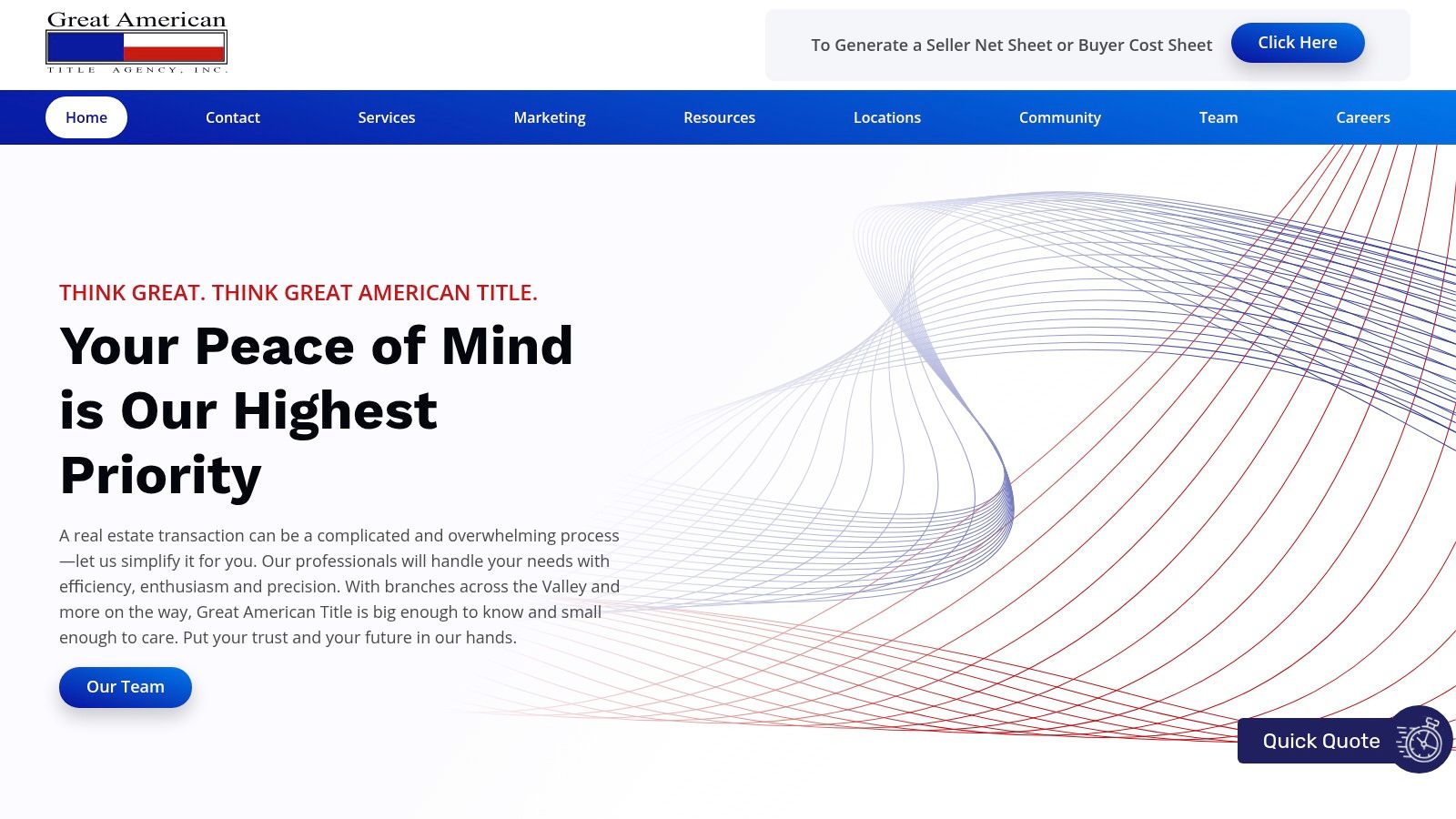
Great American Title Agency is a strong fit for Phoenix investors who want local execution from a firm built around Arizona, not a national template. Founded in 1998, GAT presents itself as a statewide title and escrow operation with multiple Arizona offices on its company website. For an investor or lender, that matters less as branding and more as workflow. Local branch coverage usually means faster payoff follow-up, better familiarity with county recording habits, and fewer surprises when a file needs curative work before close.
GAT works best in the middle of the market. It is better suited to repeat residential, small multifamily, and light investor volume than to multi-state portfolio work that needs one standardized national process. That middle position is useful. You get a local desk that understands Phoenix closing norms, but you are not relying on a single small office that can bottleneck when volume rises.
Where GAT fits in an investor workflow
The practical use case is straightforward:
- Arizona-focused acquisitions teams that close enough local volume to value responsive escrow communication.
- Residential investors and private lenders handling standard purchase, refinance, or resale files without heavy commercial structuring.
- Operators who screen deals early and want online calculators or estimate tools before opening a file.
That last point is more useful than it sounds. Quote and net-sheet tools help an acquisitions team test fees, seller proceeds, and rough close costs before legal review starts. They do not replace a title commitment, vesting review, or payoff verification. They do help kill weak deals earlier.
For teams already tying property research to location data, the handoff into title gets cleaner when parcel review starts with mapped context instead of scattered notes. This is the same logic behind geospatial analysis in automated valuation workflows, where location intelligence improves the quality of early screening before the file reaches escrow.
The trade-offs
GAT's strength is also its limit. Arizona concentration is an advantage if your buy box is local. It is less attractive if your firm closes across several states and wants one portal, one escalation chain, and one consistent underwriting relationship everywhere.
The other trade-off is file complexity. GAT can handle ordinary investor transactions well, but a lender dealing with layered entities, negotiated endorsements, survey issues, or cross-state collateral packages may prefer a larger national commercial platform. That is not a knock on execution. It is a fit issue.
Use GAT when the property is in Arizona, the closing path is clear, and the value of a local title desk outweighs the benefits of national standardization.
2. Security Title Agency
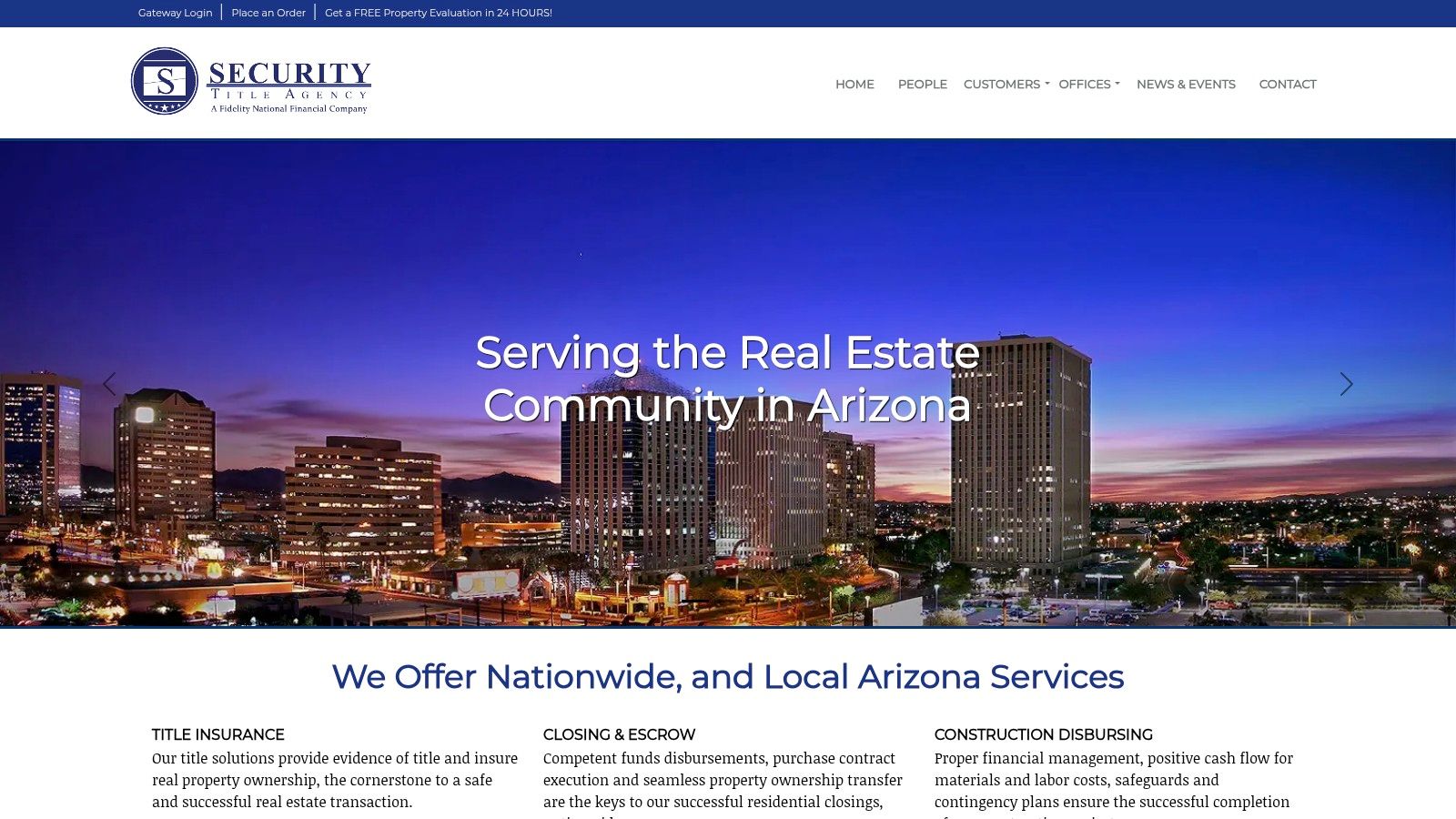
Security Title Agency is the pick when the file has moving parts beyond a plain resale. Construction disbursing, 1031 exchange support, recording coordination, and commercial-oriented services make it more useful than a standard residential-only desk.
Title companies in Phoenix start to separate. Lots of firms can issue a policy and close a house. Fewer handle construction draws, entity-heavy files, or side processes like UCC-related support without routing everything through another office.
Why lenders and repeat investors use it
Security Title is better suited to files that need process discipline:
- Construction or builder files where escrow touches staged funding and documentation.
- 1031 exchange transactions where timing and coordination mistakes get expensive fast.
- Commercial closings that need a broader service menu than a standard residential escrow desk.
The practical benefit isn't just service breadth. It's fewer handoffs. Every additional outside party creates one more place for payoff errors, missing signatures, stale vesting, or recording delays.
Security also emphasizes wire-fraud education and consumer protection resources. That's not fluff. Title fraud and payment risk are real operational concerns in Arizona, and a company that trains around them is usually easier to work with on secure closing procedures.
Ask any title company handling your funds to spell out its callback protocol, wire-change policy, and who has authority to approve revised instructions. If the answer is vague, keep looking.
Where it can frustrate you
Security is part of a larger national family structure, and large systems can feel standardized. That’s fine for institutional users. It’s less appealing if you're a smaller investor who wants direct-cell responsiveness from the same escrow officer every time.
The upside is familiarity. The downside is that some specialized functions may be concentrated in particular branches or teams, not every local office.
A practical way to use Security is to bring them in when the deal complexity is obvious from day one. Don't wait until the file gets messy. If you already know there’s exchange coordination, construction disbursing, or nonstandard collateral issues, start with the shop built for that.
Direct site: Security Title Agency
3. Pioneer Title Agency
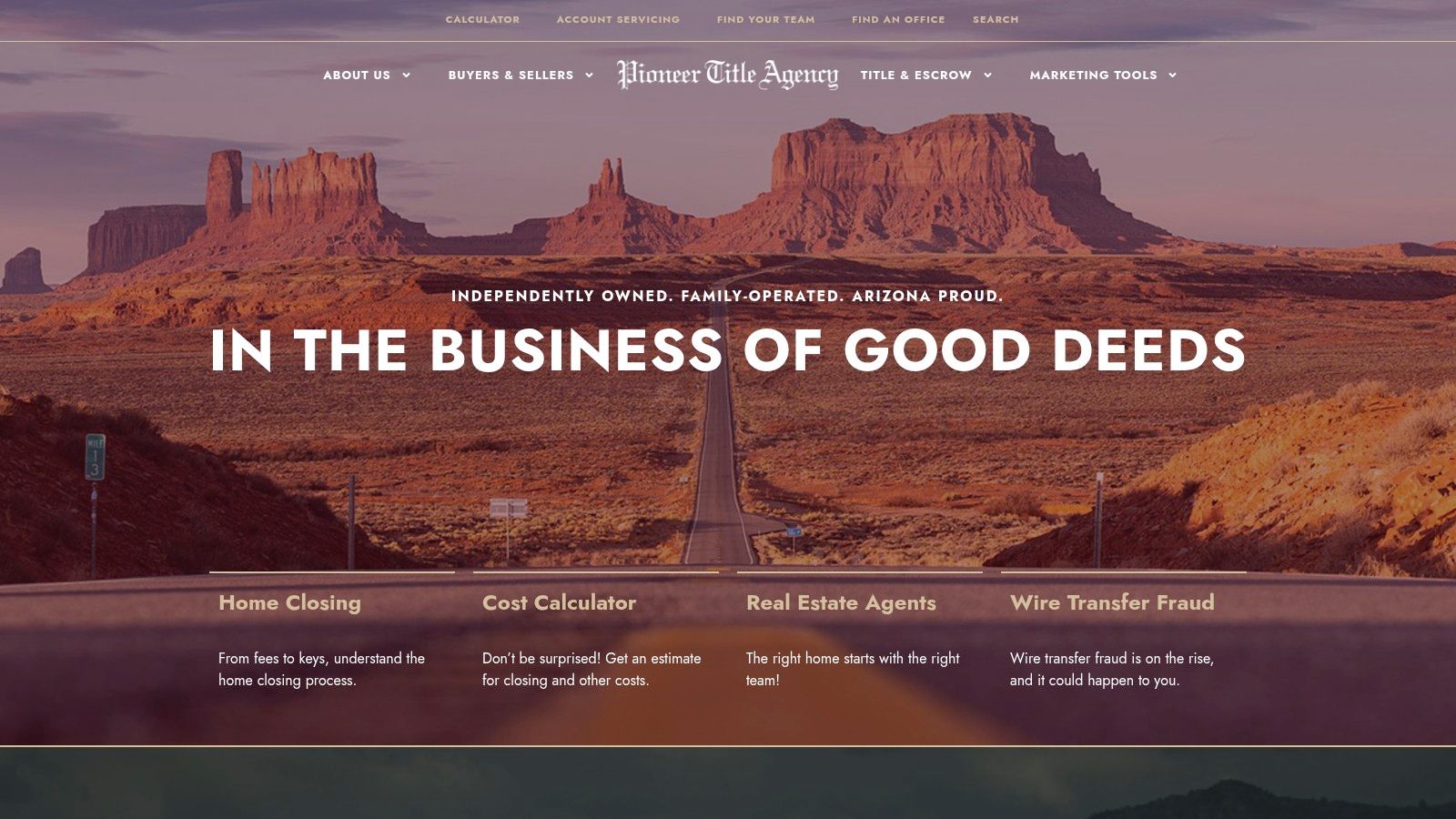
Pioneer Title Agency is the most planning-friendly option here for buyers, sellers, and smaller investor teams that want transparency up front. The differentiator isn't flashy tech. It's that Pioneer publishes useful rate and educational material, which cuts friction before a file is even opened.
That matters more than people think. A lot of title friction happens because parties don't understand costs, sequencing, or document expectations until late in escrow.
What Pioneer does well
Pioneer gives users practical self-service support:
- Published rate information for early-stage budgeting.
- Cost calculators for rough planning.
- Educational resources such as title basics, cure-sheet style guidance, and wire-fraud information.
- Office and team directory visibility so clients can identify the right local contact.
For an investor screening multiple Phoenix acquisitions, that transparency helps with triage. You can rough out the economics, identify likely closing-side costs, and decide whether a contract deserves more diligence.
Pioneer is also an Arizona-first operation, and that local orientation is useful in routine Phoenix transactions where custom often matters as much as policy language. Escrow culture varies by market. Arizona has its own habits, and local companies usually deal with those norms more skillfully.
Where Pioneer is less compelling
Pioneer isn't the obvious first choice for institutional buyers trying to standardize closings across many states. It also won't be the automatic answer for very large commercial transactions with heavy underwriting customization.
That doesn't make it weak. It makes it focused.
Best fit: local or regional operators who want clear cost visibility, practical educational support, and a direct Arizona desk.
If your file is a standard residential purchase, a refinance-adjacent investor sale, or a manageable LLC-held rental disposition, Pioneer is easy to justify. If the deal includes layered entities, national counsel, bespoke endorsements, or simultaneous multi-site coordination, another provider on this list may fit better.
Direct site: Pioneer Title Agency
4. Landmark Title Assurance Agency
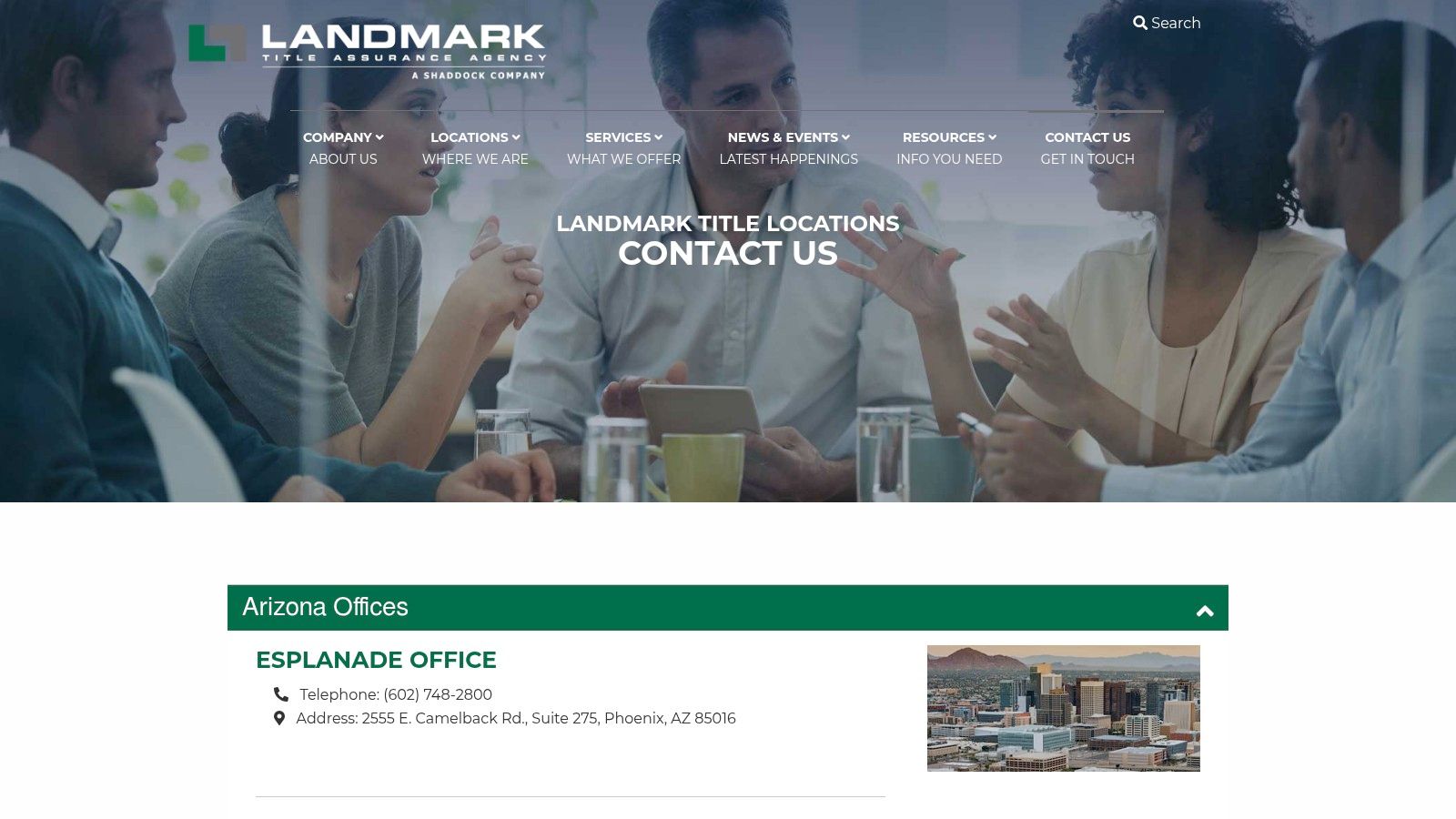
Landmark Title Assurance Agency makes the short list when a Phoenix file needs real title work before closing work can even start. That matters to investors buying with clouds on title, lenders reviewing collateral with unusual vesting, and developers who need a local team that can sort through issues instead of just pushing paper to signing.
The differentiator here is not brand size. It is service mix. Landmark publicly positions itself around residential, commercial, builder, developer, trust, and lender work, with property research included. For a real estate professional, that signals a workflow built for files that need more than a standard commitment and a clean payoff statement.
That is a practical advantage in Phoenix. Distressed acquisitions, inherited property, trust-owned assets, and builder inventory can all create extra review points before a deal is fundable. A title company with in-house research capacity can shorten the gap between spotting an exception and figuring out whether it can be cleared, insured over, or priced into the deal.
Landmark is strongest in situations like these:
- Commercial or mixed-use files that need local coordination
- Trust, builder, or lender-driven transactions with added documentation
- Acquisitions where ownership history, lien position, or recorded matters need closer review before final underwriting
- Teams that prefer direct access to a knowledgeable escrow or title contact instead of a portal-first process
The trade-off is straightforward. Landmark looks better for hands-on problem solving than for high-volume automation. If your operation is built around API-driven intake, instant rate estimates, or a highly standardized national closing stack, other providers on this list may fit more cleanly.
For Phoenix investors, that distinction matters more than marketing copy. A fix-and-flip buyer reviewing scattered-site opportunities can tolerate some manual communication if the title desk helps clarify risk early. A lender or acquisitions team processing a large pipeline may care more about uniform workflows and system integration. Broader county activity still shapes that decision, and the county-level data in our Investor Pulse reports is a useful reference point for judging whether your priority should be speed at scale or better triage on messy files.
The best local title partner for a complicated deal is usually the one that can answer a specific exception question quickly and tell you what document or curative step comes next.
Direct site: Landmark Title Assurance Agency
5. Chicago Title Maricopa Fidelity National Title Group
Chicago Title is a practical fit for investors, lenders, and brokerage operations that care more about repeatable execution than customized handling on every file. That matters in Phoenix, where deal teams often need a title partner that can absorb steady volume, support multiple offices, and keep closings inside a familiar process.
Chicago Title’s value is operational consistency. If your team runs on standardized intake, documented escrow steps, and centralized fraud controls, that consistency reduces avoidable friction. Large lending groups and acquisition shops usually benefit more from that than from a highly individualized closing experience.
Where Chicago Title fits best
Chicago Title works best for files that need scale and process discipline, not constant exception handling. Typical use cases include:
- High-volume residential purchases and refinances
- Lender-driven closings that require consistent escrow workflows
- Brokerage teams that want broad branch access across the Phoenix area
- Operations that prefer established digital tools such as inHere
The inHere platform is relevant for teams that want one portal for earnest money tracking, document status, and closing communication. That does not replace title judgment, but it does help processors and loan teams keep files moving without relying on scattered email threads.
Fraud prevention is another reason Chicago Title stays on investor and lender shortlists. Wire instructions, signer verification, and last-mile closing communication are now part of basic risk control, not a bonus feature. A provider with mature procedures in those areas can save a file from expensive avoidable errors.
For teams benchmarking Phoenix acquisition activity against title capacity, the Maricopa County data in our Investor Pulse reports gives useful county-level context. It helps investors and lenders judge whether their current title partner is built for the volume and deal mix they are seeing.
The trade-off
Chicago Title can feel process-heavy on unusual files.
This is the trade-off. A wholesaler cleaning up a broken chain of assignments, or a small investor trying to solve a probate-related title issue, may find the workflow less flexible than a smaller local operation. Escalations can also depend on getting the file to the right desk early, especially when a transaction moves outside standard residential patterns.
For professionals who need predictable service, broad coverage, and digital coordination that fits an established closing stack, Chicago Title remains one of the more dependable title companies in phoenix to evaluate.
Direct site: Chicago Title Arizona
6. First American Title National Commercial Services Arizona
First American NCS is the pick when a Phoenix deal gets complicated enough that a standard title desk becomes a bottleneck. Investors and lenders usually reach for this team when the file includes multiple parcels, layered entities, outside counsel, negotiated endorsements, or a closing structure that has to work across more than one state.
The practical distinction is workflow discipline. On a commercial file, title is not only clearing vesting and issuing a policy. It is coordinating survey review, exception management, pro forma work, payoff handling, entity documentation, and lender-specific closing requirements on a schedule that can break if one party works from the wrong checklist.
Where First American NCS fits
First American NCS makes the most sense for:
- Portfolio or multi-asset acquisitions
- Cross-state transactions with Arizona property in the stack
- Closings with heavy attorney involvement
- Lender-driven files that need formal approvals, tracked document flow, and clear audit trails
Its ClarityFirst platform matters for teams that do not manage closings through email and PDF attachments alone. Asset managers, lender counsel, and transaction coordinators can follow document status in a more controlled environment, which helps on deals where version control and approval sequencing affect closing risk.
That profile matches part of the current Arizona investment market. Teams monitoring statewide acquisition conditions can use the state-level data in our Investor Pulse reports to gauge whether their deal flow is shifting toward the larger, more structured transactions where a commercial title operation adds value.
The trade-off
First American NCS is usually too much platform and process for a simple residential investment purchase.
A lender closing a complex commercial refinance may see that as a benefit. A small investor buying one clean SFR usually will not. The extra controls that help on endorsement-heavy or counsel-led files can slow a basic closing where the primary need is local responsiveness and quick issue clearance.
That is the decision standard here. If the file could involve survey conflicts, negotiated title coverage, entity authority questions, assignment chains, or multiple funding parties, First American NCS deserves a serious look. If the transaction is straightforward, the added structure may not produce enough return.
Direct site: First American NCS Arizona
7. Old Republic Title Arizona
Old Republic Title works best for cross-market investors who want a national underwriter with Arizona-facing contacts, not a purely local operator. It sits between regional familiarity and national infrastructure.
That makes it practical for buyers, lenders, and relocation-oriented transaction teams that need Phoenix support but don't want to rebuild vendor relationships every time they enter a new market.
Where Old Republic fits
Old Republic is useful when:
- Your team invests across several states
- You want Arizona-specific guides and local pages for onboarding
- You may need national commercial resources behind the local contact
This kind of structure helps when your process starts outside Arizona. Internal asset managers or underwriting teams can rely on a known underwriter, while local desks handle state-specific execution.
That setup also aligns with broader statewide monitoring. For teams comparing Phoenix activity with wider Arizona conditions, the Arizona data in BatchData’s Investor Pulse reports adds a useful market layer before title gets involved.
The compromise you make
Old Republic’s local presence is real, but some tools and content sit on national pages rather than highly localized office pages. That means onboarding can feel less direct than with a pure Arizona-first company.
Also, if the file gets highly specialized, complex commercial work may be routed to dedicated teams. That's normal for national underwriters, but it matters if you expected one local contact to control everything from opening to recording.
A good national title relationship works when local execution and centralized underwriting actually talk to each other. Ask that question early instead of assuming they do.
Direct site: Old Republic Title Arizona
7 Phoenix Title Companies Comparison
| Provider | Process Complexity (🔄) | Resource & Speed (⚡) | Expected Outcomes (⭐ 📊) | Ideal Use Cases (💡) | Key Advantages |
|---|---|---|---|---|---|
| Great American Title Agency (GAT) | 🔄 Low, standard residential/investment workflows, online self-serve tools | ⚡ Fast for local deals; net-sheet calculators speed budgeting | ⭐⭐⭐, reliable local closings and faster pre-qualification | 💡 Local residential/investment transactions; agents needing marketing support | Local Arizona presence, self-serve estimates, agent marketing resources |
| Security Title Agency | 🔄 Moderate, supports specialized workflows (construction, 1031, commercial) | ⚡ Moderate, large branch network; 24‑hr property eval accelerates diligence | ⭐⭐⭐⭐, strong for commercial/complex deals and consumer protection | 💡 Construction disbursing, 1031 exchanges, commercial projects | Extensive offices, specialized commercial services, WireSafe education |
| Pioneer Title Agency | 🔄 Low, transparent, consumer-focused processes with published rates | ⚡ Quick for planning via calculators and published rate schedules | ⭐⭐⭐, good for budgeting, first-time buyers and agent planning | 💡 Consumers and agents seeking transparent cost planning and education | Community roots, on-site cost tools, clear educational materials |
| Landmark Title Assurance Agency | 🔄 Moderate, research- and diligence-heavy for complex transactions | ⚡ Moderate, multiple central offices but limited instant online tools | ⭐⭐⭐⭐, effective for developer/lender due diligence and commercial closings | 💡 Builders, developers, lenders and complex commercial transactions | Property research services, builder/developer/trust experience, in-person offices |
| Chicago Title – Maricopa (Fidelity) | 🔄 Moderate‑High, standardized national workflows, scalable processes | ⚡ Efficient at scale via inHere digital platform and broad branch coverage | ⭐⭐⭐⭐, predictable, scalable results for lenders and brokerages | 💡 Lenders, national brokerages, multi-branch or high-volume workflows | National backing, digital start-to-close, wide Phoenix-area coverage |
| First American Title – NCS (Arizona) | 🔄 High, enterprise commercial focus with heavier, controlled processes | ⚡ High capability for complex portfolios; ClarityFirst supports end-to-end digital closings | ⭐⭐⭐⭐⭐, best for large, multi-site or institutional commercial transactions | 💡 Institutional portfolios, multi-state commercial closings, complex deals | Depth on large deals, commercial technology (ClarityFirst), specialist NCS team |
| Old Republic Title – Arizona | 🔄 Moderate, local desks plus national routing for specialized work | ⚡ Moderate, regional offices with national underwriter resources | ⭐⭐⭐⭐, reliable for cross-market investors needing national support | 💡 Cross-market investors and clients wanting national underwriter with local service | National underwriter strength, Arizona-specific guides and local contacts |
Making the Final Decision A Phoenix Investor's Framework
A Phoenix title company should be selected the same way you underwrite a borrower or an asset. By process fit, error tolerance, and file complexity. Branding matters far less than whether the team can clear exceptions fast, control escrow risk, and work inside your operating model.
Start with the transaction type you repeat most often. An investor closing fix-and-flips across Maricopa County needs a different title partner than a lender funding construction draws or a buyer assembling land through multiple entities. The mistake is treating all title desks as interchangeable. They are not. Some teams are built for residential volume and standardized escrow steps. Others are built for layered commercial files, custom endorsements, entity document review, and problem-solving with underwriters.
For high-volume residential files, the test is operational discipline. Ask how files are opened, how payoff and vesting issues are flagged, how quickly wire changes are escalated, and whether the same escrow team stays involved through closing. A fast response time is useful, but clean intake and consistent file handling matter more. Rework kills margin on repeat transactions.
For Arizona-focused investors, local workflow knowledge still has real value. County-level recording habits, municipal quirks, and practical responsiveness often matter more than a polished national portal. If a deal goes sideways the day before close, access to a decision-maker beats a generic service channel.
Commercial and development work needs a different screen entirely. Use a title company with a dedicated commercial operation if the file includes multiple parcels, easement issues, assignment chains, entity layering, survey coordination, or 1031 timing pressure. On those deals, the key question is who can clear exceptions, coordinate counsel, and get underwriting answers without stalling the closing calendar. If your team relies on outside support for document collection and transaction prep, experienced legal assistants can help keep entity paperwork, signature packages, and closing checklists organized before title issues become funding delays.
Data compatibility is another decision point that investors and lenders often underweight. If your team reviews ownership history, open mortgages, lien exposure, permits, or valuation signals before sending out a contract, your title partner should be able to work from that file intelligence instead of recreating the process from scratch. The best title relationships reduce duplicate review. They do not add it.
Use a simple selection rule:
- Choose a local-first provider if your pipeline is concentrated in Arizona and success depends on direct access to escrow and title staff.
- Choose a national platform if your operation spans multiple states, counterparties, or branch locations and you need standardized workflows.
- Choose a commercial specialist if the file includes complex entities, development issues, large dollar exposure, or endorsement-heavy underwriting.
Before assigning the next file, send the same short set of questions to two or three title companies. Ask who handles exception review, who approves escrow changes, how digital document delivery works, and when underwriters get involved. Ask what typically slows a Phoenix closing in their shop. Their answers will tell you more than any sales presentation.
Title is only one vendor in the chain, but it often controls the pace of acquisition and refinance closings. After closing, operations teams may also need adjacent vendors such as commercial property maintenance companies to protect asset condition and tenant experience. At the front end of the deal, though, title still sets the rhythm. Pick the firm that matches your file mix, your risk tolerance, and your need for execution speed.
If your team needs cleaner diligence before title is opened, BatchData is built for that job. It gives investors, lenders, servicers, and proptech teams access to U.S. property records, ownership history, mortgage and lien details, valuations, and verified owner contacts with daily updates. Use it to screen acquisitions faster, enrich underwriting, monitor portfolios, and hand your title partner a file that is already grounded in current property intelligence.