


































Looking for the best property data APIs in 2026? Here’s everything you need to know to pick the right one for your real estate application.
Property data APIs are essential for developers creating tools like property search platforms, rental analytics, or AI-driven real estate systems. The best APIs offer:
- Extensive coverage: Data on over 155 million U.S. properties.
- Fast updates: Daily refreshes to keep data accurate.
- AI compatibility: Structured data for machine learning.
- Reliable performance: Low latency and high uptime.
- Easy integration: RESTful architecture with clear documentation.
This guide focuses on BatchData‘s suite of APIs, which includes tools for property search, skip tracing, contact verification, and bulk data delivery. Each API is tailored for specific needs, such as retrieving property details, finding owner contact information, or handling large datasets efficiently. Pricing is flexible, with pay-as-you-go and subscription options.
Quick Highlights:
- Property Search API: Access 700+ data points per property, with advanced filtering and batch processing.
- Skip Tracing API: Retrieve verified contact details, including phone numbers and emails.
- Verification API: Validate phone numbers and addresses for accuracy and compliance.
- Bulk Data Delivery: Get large-scale datasets for offline analysis.
These APIs are built for speed, accuracy, and scalability – key factors for modern real estate applications. Below, we break down each API’s features, data coverage, integration methods, and pricing.
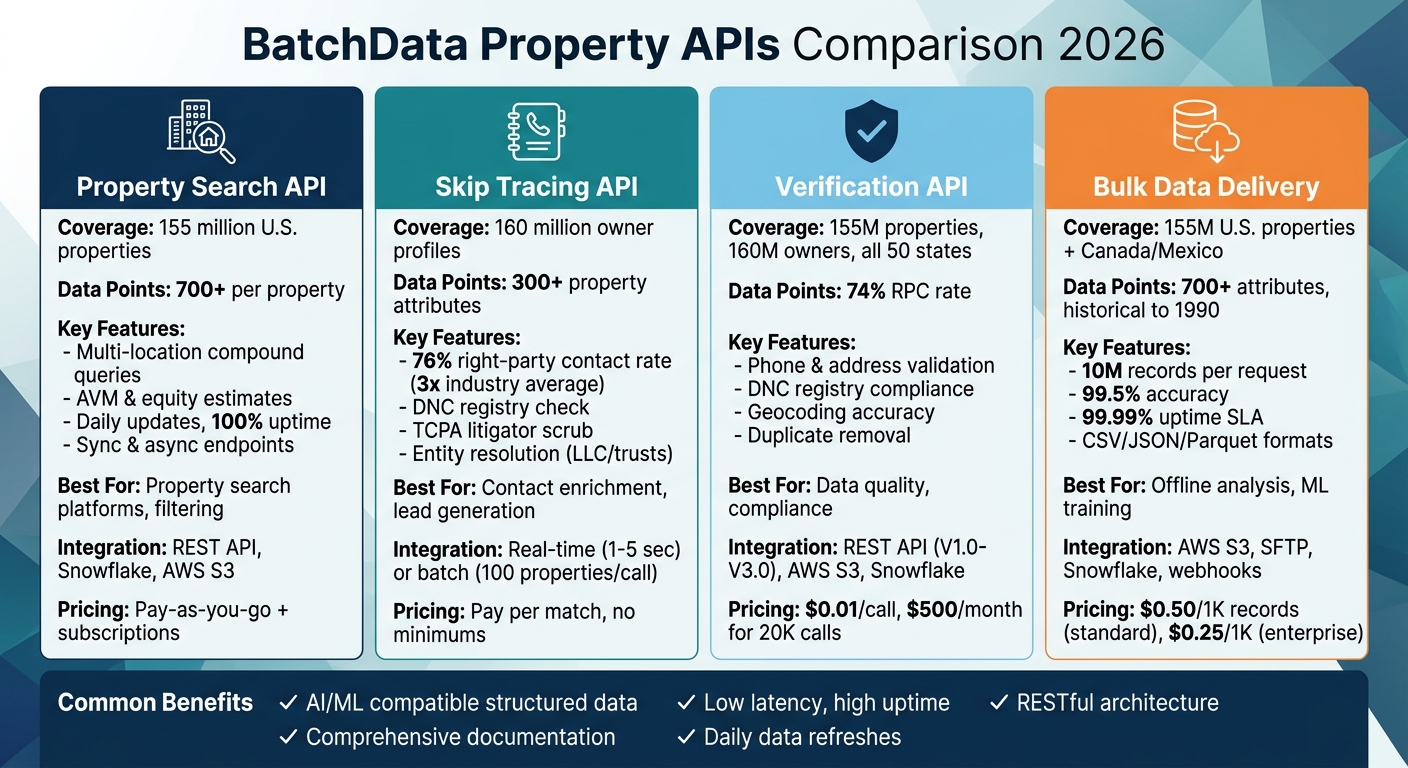
BatchData Property APIs Comparison: Features, Coverage, and Pricing 2026
Get Real Estate Property Data using Estated‘s API | Python Tutorial Part 1
sbb-itb-8058745
1. BatchData Property Search API
The Property Search API offers data on 155 million properties across the United States, with over 700 data points for each property. Designed for developers, this API delivers property insights quickly and efficiently. Chris Finck, Director of Product Management, highlights its transformative speed:
“What used to take 30 minutes now takes 30 seconds. BatchData makes our platform superhuman.”
Features
The API enables multi-location compound queries, allowing developers to search across multiple cities, counties, or ZIP codes with a single request. This reduces the number of API calls and helps lower costs. It also supports filtering based on property attributes – like size or age – as well as financial metrics such as AVM (Automated Valuation Model), equity estimates, and distress indicators like pre-foreclosure status[4,5]. Daily property profile updates and 100% uptime ensure the data remains current and reliable[4,7].
For handling large-scale requests, the API provides both synchronous and asynchronous endpoints. The “Property Search Async” option prevents delays during extensive data retrievals, making it ideal for batch processing workflows. Additionally, the platform includes detailed documentation for integrating with large language models (LLMs), enabling AI-driven search and analysis.
These features, combined with broad data coverage, make the API a powerful real estate API for property data enrichment.
Data Coverage
The API provides a wide range of data, such as core building details (e.g., bedrooms, bathrooms, lot size), ownership history with absentee status, valuation and equity metrics, and mortgage and lien information. It also includes active and sold listings, building permits, and contractor details. Developers can access ownership portfolios, demographic insights, property valuations, and other property intelligence data. The database spans over 1 billion data points, including contact details like phone numbers and email addresses for enhanced property intelligence.
Developer Integration
In addition to real-time API calls, bulk data can be delivered through platforms like Snowflake, AWS S3, or file-based methods for large-scale applications. The system enhances match rates by converting addresses to USPS standards before running searches. It also provides County FIPS codes and geocoding for precise map visualizations. For user-facing applications, the Address Autocomplete feature offers real-time suggestions based on geolocation, minimizing input errors and improving user experience.
2. BatchData Skip Tracing and Contact Enrichment API
The Skip Tracing and Contact Enrichment API transforms property records into verified contact details, delivering phone numbers, email addresses, and mailing information in real time. Unlike typical property data APIs, which focus on property characteristics, this API links property records to the actual decision-makers – even when ownership is hidden within entities like LLCs or trusts.
Features
This API performs skip tracing in milliseconds, making it easy for developers to add high-speed contact retrieval to user-facing platforms. Its entity resolution feature uncovers the individuals behind corporate registrations, providing a detailed contact profile that includes:
- Multiple verified phone numbers (labeled as mobile or landline)
- Deliverable email addresses
- Accurate mailing addresses
To ensure compliance, the API automatically checks results against the National Do Not Call (DNC) registry and identifies known TCPA litigators with a “Litigator Scrub.” It also categorizes phone types to route mobile and landline numbers appropriately, reducing legal risks for platforms that support outbound marketing. BatchData achieves an impressive 76% right-party contact (RPC) rate – nearly three times the industry average – through cross-verification across over 12 primary sources and 3,200+ independent sources. This accuracy is continuously refined through feedback from more than 20,000 active users reporting contact outcomes.
The API’s high accuracy and speed are made possible by its extensive data coverage and advanced infrastructure.
Data Coverage
The API enriches contact data with daily updates and confidence scores, helping developers focus on high-probability leads. It also enables access to an owner’s full real estate portfolio, supporting outreach strategies that target multiple properties. Additionally, the database includes over 300 data points, such as property age, lot size, construction details, and financial distress indicators, offering a well-rounded view of each record.
Developer Integration
The API integrates seamlessly into various workflows, supporting both real-time and batch processing. Real-time endpoints deliver results in 1-5 seconds for interactive applications, while batch requests can handle up to 100 properties per call and scale to process millions of records for enterprise-level demands.
Built on REST API standards, the integration uses JSON for requests and responses and is secured with API keys. Developers can choose from three main integration patterns:
- Enrich on Ingest: Automatically trigger skip tracing as leads enter a CRM.
- Batch Campaign Preparation: Process lists in bulk before outreach efforts.
- AI Agent Enrichment: Use MCP servers for autonomous lead research.
Comprehensive documentation and enterprise-grade SLAs make implementation straightforward, even for large-scale projects.
Pricing
BatchData offers a pay-as-you-go pricing model, charging only for matches received. There are no long-term contracts or minimum usage requirements, making it flexible for businesses of all sizes. Scalable subscription tiers are available for high-volume users, and custom packages can be tailored for enterprise needs.
3. BatchData Phone and Address Verification API
The Phone and Address Verification API from BatchData enhances its property search and skip tracing capabilities by ensuring the accuracy of contact information. This tool validates phone numbers and addresses in real time, reducing wasted outreach efforts and minimizing legal risks tied to non-compliant communication practices.
Features
This API goes beyond basic format checks with its multi-layered validation process. For phone numbers, it not only ensures proper formatting and active status but also cross-checks numbers against the National Do Not Call registry to support telemarketing compliance. A TCPA litigation scrub flags numbers linked to frequent lawsuits, helping users avoid high-risk contacts.
Address verification includes automatic cleansing of mailing lists, removing invalid entries and duplicates. Enhanced geocoding ensures accurate property coordinates for mapping, while contact enrichment adds valuable details like carrier information, mobile versus landline classification, and reachability scores – helping users prioritize leads effectively.
These features are supported by extensive data coverage, ensuring reliable and actionable insights.
Data Coverage
The API provides comprehensive coverage across all 50 states, offering access to 155 million property records and 160 million owner profiles. With a 74% Right Party Contact rate for property owner outreach, BatchData leverages its vast database to deliver standardized insights nationwide. Additionally, it guarantees 100% coverage of U.S. parcels by transforming raw county records into uniform, actionable data.
Developer Integration
Designed for easy integration, the API supports multiple versions (V1.0, V2.0, V3.0) and adheres to RESTful standards. Low-latency endpoints validate data in real time during data entry, while bulk data delivery options via AWS S3, Snowflake, or flat files cater to larger operations, such as database updates or machine learning model training. The self-serve deployment model ensures quick setup and immediate use. Like other BatchData APIs, this solution is built for fast and reliable real-time performance, seamlessly integrating with BatchData’s suite for continuous data enrichment.
Pricing
BatchData offers a flexible pay-as-you-go pricing model, starting at $0.01 per call. Monthly subscriptions begin at $500 for 20,000 calls, with annual pricing for custom datasets reaching up to $10,200. Free samples are available, allowing users to test data quality before committing to a purchase.
4. BatchData Bulk Data Delivery and Custom Datasets
BatchData goes beyond its real-time APIs with a bulk data service designed for large-scale property data needs. This service allows businesses to access massive datasets offline, making it ideal for enterprise platforms and machine learning projects. Instead of relying on millions of API calls, users can receive comprehensive property intelligence in one go. Delivered in formats like CSV, JSON, or Parquet through AWS S3, SFTP, or Snowflake, this solution enables cost-effective offline analysis and database management.
Features
This service handles up to 10 million records per request, with options for automated scheduling and deduplication. Users can customize datasets based on criteria like state, property value, or type, receiving data aggregated from over 3,200 sources. With more than 700 property attributes available, the data spans assessor details (e.g., square footage, lot size, year built), recorder information (e.g., sale prices, deeds, liens), listing data (e.g., on-market status, days listed), pre-foreclosure records, and demographic insights. Historical data goes back to 1990.
For businesses requiring additional support, BatchData offers professional services like custom data matching, legacy system migration, and match-and-append operations. The data is updated daily, ensuring an impressive 99.5% accuracy across 155 million U.S. properties.
These capabilities make it a reliable option for large-scale data applications.
Data Coverage
BatchData provides full coverage of U.S. parcels, representing 99% of the population, and now extends to Canada and Mexico for cross-border insights. The database includes residential, commercial, and land properties, with continuous updates from tax assessors and recorder offices. Its multi-source architecture, pulling from over 3,200 sources, ensures uninterrupted service even during county-level outages. The platform also guarantees a 99.99% uptime SLA, ensuring dependable access to data.
Developer Integration
Developers can easily integrate the service using RESTful API endpoints for tasks like placing bulk orders (/v1/bulk/order) or retrieving data (/v1/bulk/download/{id}). SDKs for Python and Node.js simplify authentication through API keys or OAuth. For instance, the code snippet batchdata.bulk_order(filters={'state': 'CA', 'min_value': 500000}, format='csv') generates a download link. Webhooks notify developers when datasets are ready, enabling asynchronous processing, while AWS S3 direct export integrates seamlessly into cloud workflows.
Pricing
Standard bulk delivery starts at $0.50 per 1,000 records, with a $99 monthly minimum. Custom datasets are priced at $1.20 per 1,000 records, plus a $500 setup fee. Discounts of 20–50% are available for high-volume users managing over 1 million records monthly, with enterprise pricing dropping to $0.25 per 1,000 records. Annual subscriptions save 15% compared to pay-as-you-go plans, and all prices are listed in USD with no hidden fees. For example, a proptech startup reduced its query costs by 80% by using bulk delivery to enrich 5 million property records.
Pros and Cons
BatchData’s property data APIs bring plenty of perks to developers working on real estate APIs, but there are a few challenges to keep in mind.
On the plus side, the platform delivers well-structured JSON data, which simplifies development by cutting out the need for manual data cleaning. It also automates data pipelines, saving time and effort. With bulk data delivery and user-friendly endpoints, integrating the APIs into large-scale projects becomes much smoother. This streamlined approach to data structuring is one of the standout benefits of BatchData’s offerings.
However, there are some trade-offs. Developers must account for rate limits, which cap how frequently requests can be made. This means handling rate limits and pagination effectively to avoid disruptions. While the platform offers nationwide coverage, some endpoints may have gaps in specific regions due to local data limitations. BatchData’s multi-source setup helps reduce these issues, but it’s still wise to verify coverage in your target areas.
The pricing model is pay-as-you-go, offering transparency and flexibility. Enterprise discounts are available, but low-volume users should keep an eye on expenses to avoid surprises. This pricing aligns well with the advanced features the platform provides.
Conclusion
BatchData’s property data APIs offer a powerful mix of property intelligence, contact verification, and data validation – key tools for real estate applications in 2026.
Choosing the right API depends on your project needs. Whether it’s property search for filtering data, skip tracing for accurate contact details, or verification to ensure data quality, each option serves a specific purpose. For larger datasets, the Bulk Data Delivery feature simplifies workflows even further. These options align with the growing demands of modern property data solutions.
The industry is shifting toward APIs that are cloud-native, low-latency, scalable, and ready for AI/ML integration. This builds on the advanced capabilities already transforming real estate applications today. Additionally, the move to sourcing data directly from county records has significantly improved accuracy and timeliness, addressing the inconsistencies seen in older systems. With APIs now capable of returning up to 100 parcels per call, developers can streamline processes and reduce costs.
BatchData’s pay-as-you-go pricing model adds transparency and flexibility, making it accessible for developers of all scales. Features like structured JSON responses and automated pipelines reduce the need for manual data processing, saving time and effort. However, developers should plan for rate limits and confirm regional data coverage before scaling up.
For real estate developers in 2026, BatchData delivers a well-rounded toolkit that combines functionality, high-quality data, and a seamless developer experience. By carefully matching the right API to your project’s needs and weighing factors like coverage, cost, and feature set, you can achieve the best results for your applications.
FAQs
Which BatchData API should I use for my app?
The BatchData Property Search API gives you access to a massive database of over 155 million U.S. properties. Designed with developers in mind, it provides advanced filtering options, real-time query capabilities, and smooth integration features. Whether you’re building a real estate app or need robust property data for your project, this API delivers the tools to elevate your application’s performance.
How do I handle rate limits and pagination?
When working with property data APIs, it’s essential to handle rate limits and pagination effectively. Here are some practical tips to keep your data retrieval smooth and efficient:
- Respect API rate limits: Keep track of how many requests you’re making. If you’re approaching the limit, adjust your request rate by pausing or slowing down to prevent disruptions.
- Use pagination wisely: Break down large datasets into smaller, manageable chunks by leveraging pagination parameters like page numbers or offsets.
- Streamline requests: Consolidate your data needs into fewer API calls whenever possible. If the API supports bulk data retrieval, take advantage of it to reduce usage.
By following these steps, you can maintain consistent and reliable access to the data you need.
When should I choose bulk delivery over real-time APIs?
Bulk delivery is a smart choice when working on large-scale offline data analysis or handling extensive volumes of property records that don’t demand real-time updates. It’s especially useful for activities like market research, forecasting, or training machine learning models. This option is most effective if your setup can handle significant storage and processing requirements, and if periodic updates, such as daily or weekly, are sufficient for your workflow. Plus, it can be a more budget-friendly solution for long-term projects.