Most U.S. foreclosure filings never become bank-owned losses. In the first half of 2026, 227,548 properties had a filing, while completed REOs remained roughly 4,700 to 4,800 properties in the monthly examples available for January and July.
That gap changes how U.S. foreclosures should be analyzed. A filing is an entry into a legal and servicing process, not proof that a lender has repossessed a home. Investors, servicers, insurers, and housing analysts need to track movement between stages, because the stage often says more about expected inventory and loss exposure than the headline filing count.
- Total filings show observed foreclosure activity.
- Foreclosure starts show newly initiated cases.
- Auction notices indicate escalation.
- REO transfers show completed lender enforcement.
The central question isn't whether filings are rising. It's how many properties progress through the pipeline, how quickly they move, and where they ultimately stop.
Why Most U.S. Foreclosure Filings Never Become Bank-Owned Losses
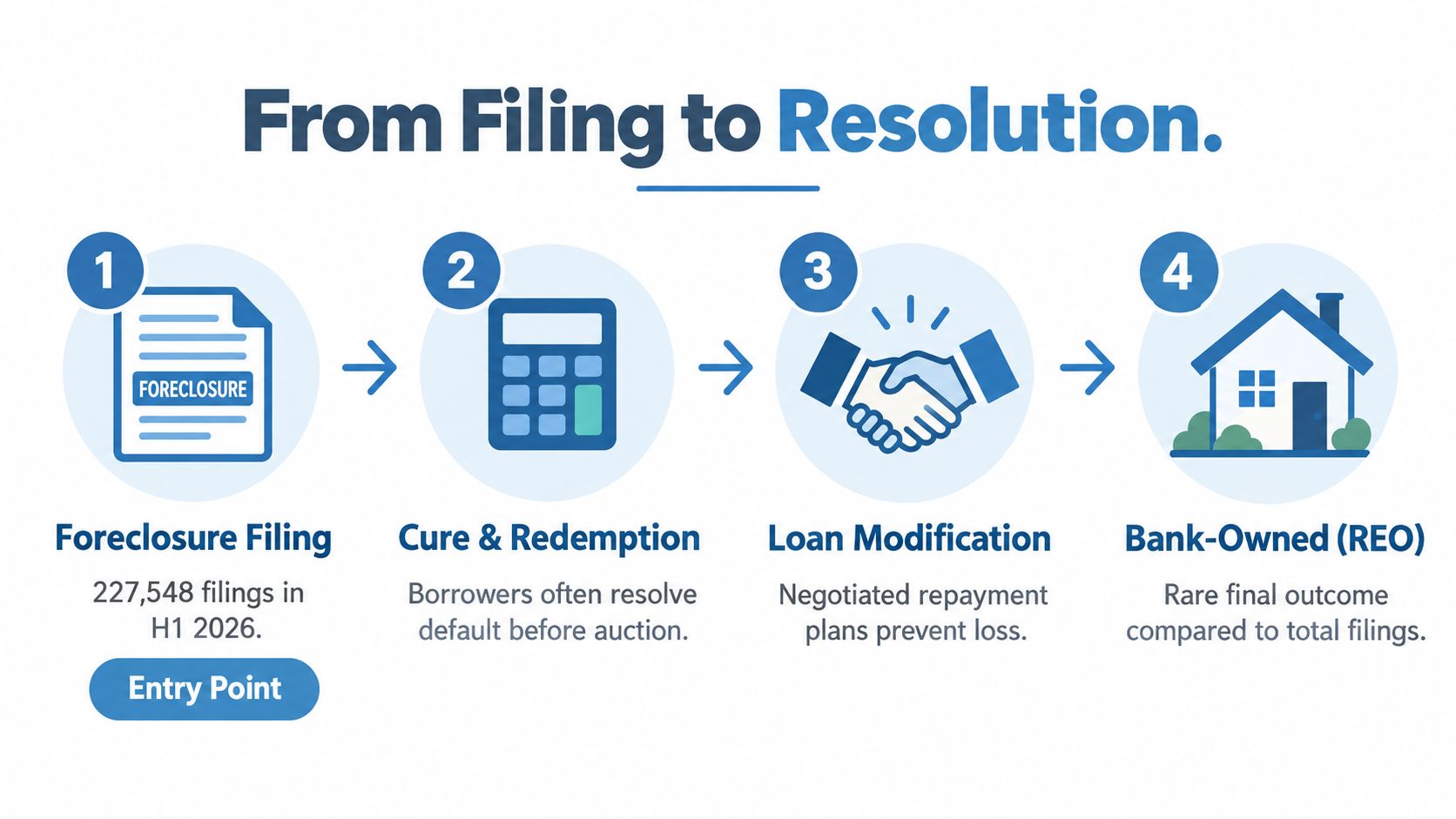
Foreclosure filings are not completed losses. In the first half of 2026, 227,548 U.S. properties had at least one foreclosure filing, but a filing can represent a default notice, an auction notice, or a bank repossession at a later stage of the process (ATTOM's 2026 mid-year foreclosure report). The number measures properties touched by foreclosure activity, not homes that lenders acquired.
A borrower can cure the default, negotiate a modification, sell the property, enter another loss-mitigation arrangement, or resolve the delinquency before an auction. The Federal Reserve reported that approximately 1.4 million U.S. homes entered foreclosure during the second half of 2009, while also noting that historically about one-half of foreclosure starts ultimately resulted in homeowners losing their homes (Federal Reserve foreclosure analysis). That distinction remains the foundation for interpreting current data.
The pipeline has four practical outcomes
A useful model separates the process into stages rather than treating every document as an independent distressed property:
- Filing: A default-stage or auction-stage document enters the public record.
- Intervention: The borrower, servicer, buyer, or another party resolves the delinquency.
- Escalation: The property advances toward a scheduled foreclosure sale.
- REO: The lender takes ownership after a completed foreclosure.
The historical benchmark reinforces why the distinction matters. Nearly 2.9 million U.S. properties recorded a foreclosure filing in 2010, equivalent to approximately 2.23% of residential properties, while annual filings had declined to about 493,066 properties by 2019. The 367,460 properties recorded in 2025 remained 25% below the 2019 level, according to ATTOM's 2025 year-end report. Current increases deserve attention, but they shouldn't automatically be interpreted as a return to crisis-era supply conditions.
The analytical mistake is simple: multiplying filing counts by an assumed completion rate. That approach overstates likely REO inventory, misprices acquisition opportunities, and may cause servicers to prioritize the wrong borrowers. A stage-aware model instead asks whether each property is still in default, approaching auction, or already lender-owned.
Practical rule: Treat a filing as a risk signal first, an inventory signal second, and a completed loss only when the record shows an REO transfer.
How State Foreclosure Rules Change the Timeline
State procedure determines how quickly a foreclosure can move from delinquency to sale. Judicial foreclosures generally require court involvement, while nonjudicial foreclosures rely on a power-of-sale process outside a full court case. The exact timeline, notice requirements, cure rights, sale procedures, and borrower protections vary by state, so a national average can't serve as a property-level forecast.
| Process Type | Typical Characteristics | Intervention Impact |
|---|---|---|
| Judicial | The lender files a court action and the borrower can respond within the litigation process. | Court milestones may create additional opportunities for defense, settlement, modification, or sale. |
| Nonjudicial | The trustee follows statutory notice and sale procedures without a traditional foreclosure lawsuit. | The process can move more directly toward auction, making accurate contact and date monitoring critical. |
| Mixed or state-specific | States may use different procedures depending on the lien, document, property, or election by the lender. | Portfolio models must use state and sometimes county rules instead of a single national clock. |
Federal servicing rules establish an important baseline. In most cases, a mortgage servicer must observe a 120-day pre-foreclosure waiting period before initiating foreclosure, and an active loss-mitigation review can restrict further action while the application remains under consideration (HUD housing counselor materials). The waiting period isn't a guaranteed recovery window, because state law, borrower responsiveness, and application completeness affect what happens next.
Time is a portfolio variable
The average foreclosed property spent 563 days in the foreclosure process during the first half of 2026, a 13% annual decline and the shortest timeline since 2013 (ATTOM's January 2026 foreclosure report). That combination, rising activity and a shorter average process, creates a more complicated risk environment. A larger pipeline doesn't necessarily give borrowers, servicers, or investors more time to act.
For underwriting, process type changes expected cash-flow timing, legal expense, property deterioration risk, and the probability that an opportunity disappears before acquisition. A lender servicing a nonjudicial state may need tighter auction-date controls. An investor evaluating judicial markets may need more patience and stronger legal review.
Teams comparing state exposure should use structured foreclosure data by state and preserve the governing jurisdiction for every record. A national rate can identify direction, but it can't determine the next operational step for a specific property.
Where U.S. Foreclosure Risk Is Actually Concentrated Right Now
National foreclosure rates conceal sharp geographic differences. During the first half of 2026, filings affected 0.16% of U.S. housing units, approximately one in every 632 homes. Florida had the highest state rate at 0.27%, while Idaho recorded the largest year-over-year increase among states with at least 500 filings, at 59% (Realtor.com's summary of the 2026 ATTOM data).
The rate changes were also significant in other states:
- Colorado: 57% year-over-year increase.
- Georgia: 52% year-over-year increase.
- North Carolina: 47% year-over-year increase.
- Mississippi: 45% year-over-year increase.
Those figures identify where movement is accelerating, but they don't explain why. A rising rate may reflect local economic pressure, insurance costs, vacancy, legal procedure, borrower composition, or a concentrated cluster of properties. Investors should resist ranking states by growth alone.
Concentration matters more than national averages
A foreclosure rate becomes actionable only after it is connected to property and neighborhood conditions. The relevant questions include:
- Is the filing still at the default stage or already scheduled for auction?
- Does the property have enough equity to support a sale or workout?
- Are senior or junior liens likely to affect recovery?
- Is the home occupied, vacant, or difficult to contact?
- Does the area have local legal or insurance conditions that alter timing?
The data also challenges the assumption that every increase produces a wave of abandoned homes. Residential vacancy stood at 1.33% nationally in the first quarter of 2026, while zombie foreclosures represented about 3.27% of homes in the foreclosure process, according to the same Realtor.com coverage. Those figures indicate that filing growth and widespread abandonment aren't interchangeable outcomes.
The stronger investment screen combines the local housing-unit denominator with filing stage, vacancy, equity, liens, insurance exposure, and owner contactability. That filter can separate a small number of high-probability auction opportunities from a broad statistical increase that produces little immediate REO supply.
What Foreclosure Filing, Start, and REO Metrics Actually Mean
A foreclosure filing, a foreclosure start, and an REO are different observations. The default stage may include a Notice of Default or Lis Pendens. The auction stage may include a Notice of Trustee Sale or Notice of Foreclosure Sale. The REO stage begins after the property is foreclosed on and repurchased by a bank (ATTOM's foreclosure-stage definitions).
A property can generate multiple documents as it advances. If a system counts every document as a separate property, it inflates the apparent size of the distressed inventory. The correct unit for underwriting and servicing is usually the property-loan relationship, with the earliest stage date retained and later transitions appended.
Read the metric according to the decision
| Metric | What it captures | Operational meaning |
|---|---|---|
| Filing | A property with at least one recorded foreclosure document during the reporting period. | Measures observed activity, but not necessarily new cases or completed losses. |
| Start | A property that newly entered the foreclosure process. | Indicates fresh pipeline creation and supports early outreach or risk monitoring. |
| REO | A property that became lender-owned after completed foreclosure. | Represents completed enforcement and potential bank-owned inventory. |
The first half of 2025 shows why the distinction matters. 187,659 properties had at least one filing, while 140,006 properties started the foreclosure process, as reported by ATTOM's October 2025 foreclosure report. The difference is not a data defect. It reflects properties already in the pipeline, properties progressing between stages, and records that require deduplication.
For a lender, a default notice supports cure outreach and loss-mitigation review. An auction notice changes the urgency and may require bid, title, occupancy, and disposition analysis. An REO transfer shifts the task to valuation, preservation, insurance, and resale planning.
Readers who need the broader meaning of what is distressed property can use that resource to distinguish financial distress from the narrower event of completed foreclosure. For operational monitoring, mortgage delinquency data adds an earlier credit signal, but delinquency still shouldn't be treated as proof that foreclosure will follow.
How Professional Platforms Monitor Foreclosure Signals
Professional monitoring turns public-record events into normalized property workflows. The core task isn't collecting more documents. It's matching records to the right property and owner, preserving stage history, validating dates, and exposing the fields that determine what action is possible.
A scalable workflow usually follows this sequence:
- Ingest records: Collect default notices, lis pendens filings, sale notices, auction details, lender information, and recording dates.
- Normalize identities: Match addresses, parcel identifiers, owners, lenders, trustees, and loan relationships across source records.
- Track transitions: Preserve the first observed stage and append later events instead of replacing the history.
- Enrich the property: Add valuation, equity, mortgage, lien, ownership, occupancy, and contactability signals.
- Score the opportunity: Separate early intervention, auction preparation, REO valuation, and low-probability records.
- Deliver the result: Push alerts, API responses, bulk files, or portfolio reports into underwriting and servicing systems.
Design for action, not just retrieval
A default-stage record should trigger a different workflow from an auction-stage record. Early records may support borrower outreach, loss mitigation, or pre-foreclosure acquisition. Auction records require date validation, title review, lien analysis, occupancy checks, and bid controls. REO records need condition, valuation, preservation, insurance, and disposition fields.
Contact enrichment, skip tracing, phone verification, and confidence scores help teams decide whether an owner can be reached before they allocate staff time. Propensity models can rank records by likely intent or response, but the score should remain a prioritization aid, not a substitute for legal status or property-level diligence.
A specialized real estate auction API can support portals and investment systems that need auction dates, locations, trustee details, or sale-related fields in an application workflow. The important architecture choice is to keep raw events, normalized entities, and derived scores separate. That makes the model auditable when a notice is corrected, a sale is postponed, or a borrower resolves the delinquency.
A Real Foreclosure Journey From Default Notice to Auction
A single property can move through several materially different risk states before a lender owns it. Consider a property record that first receives a default notice after missed mortgage payments. At that point, the record indicates serious distress, but it doesn't establish that the borrower will lose the home or that an investor can buy it.
The first data task is identity validation. The servicer, investor, or analyst should confirm the parcel, owner, lender, loan relationship, recording date, and lien position. A record with an incorrect address match or stale owner contact can send outreach to the wrong household and distort the expected recovery.
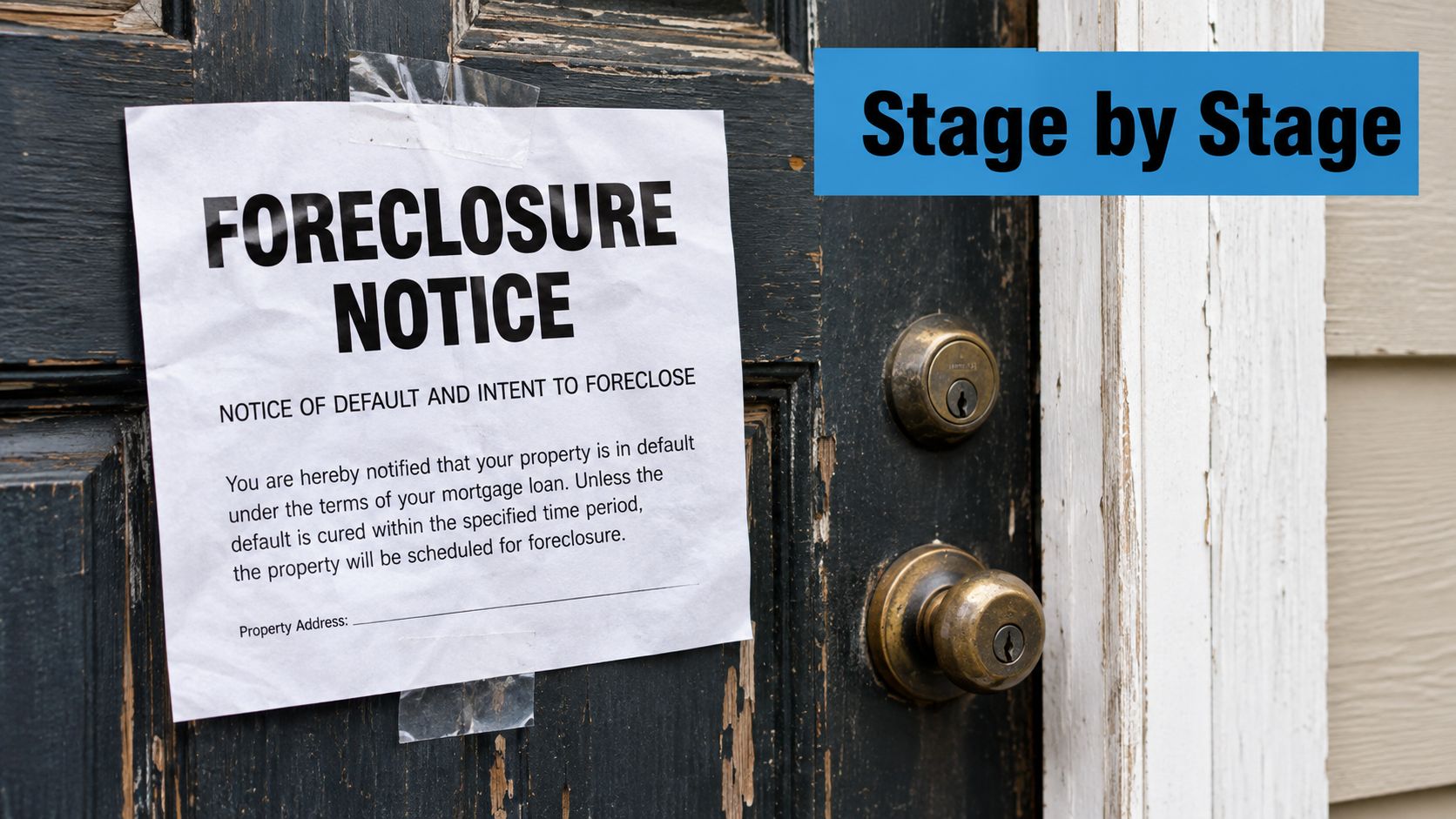
The property then enters a pre-foreclosure decision window. The borrower may cure the arrears, request a modification, sell the home, pursue another loss-mitigation route, or fail to resolve the default. A Notice of Default is therefore a trigger for triage, not a purchase contract or an ownership transfer.
The auction stage changes the operating model
If the case advances, a sale notice supplies a more urgent signal. The analyst now needs to verify the scheduled date, trustee, location or sale method, senior liens, unpaid balance, property condition, occupancy, and available equity. A postponed sale can move the record backward in practical urgency without erasing the underlying distress.
The final branch is either completed foreclosure and REO, or a resolution before the lender takes title. Investors shouldn't model the property as bank-owned until the public record confirms that transition. Servicers should preserve every event because the sequence reveals whether the case is accelerating, pausing, or resolving.
Use this media example only as a visual supplement to the event chain, not as evidence about a particular property:
The practical conclusion is narrow but important. Data quality matters most before the auction, when contactability, lien position, and legal timing can still change the decision. After REO transfer, the opportunity is no longer intervention. It becomes asset management.
Why Headline Foreclosure Numbers Mislead Investors
A rising filing count doesn't equal a proportional increase in investable REO supply. Headlines favor the largest visible number, usually total filings, because it creates a simple narrative. That narrative omits the properties that cure, modify, sell, remain in process, or fail to reach completed foreclosure.
In July 2026, 39,906 properties had a foreclosure filing, while lenders initiated foreclosure on 26,648 properties and completed foreclosures on 4,764 properties. The filing and initiation figures were each up 10% year over year, while completed foreclosures rose 23%, according to ATTOM's most recent foreclosure reporting. Each number describes a different point in the pipeline.
The denominator changes the investment conclusion
The first half of 2026 produced a 21% year-over-year increase in filings and an 18% increase in foreclosure starts, but those changes don't reveal how many properties will become available for acquisition. A filing spike can reflect more cases entering early stages while completed REO remains comparatively limited.
That creates three common underwriting errors:
- Supply inflation: Treating every notice as a future bank-owned listing.
- Timing distortion: Assuming an auction or REO event will occur on the same schedule in every state.
- Risk compression: Ignoring equity, liens, occupancy, and the probability of borrower resolution.
Investors should replace a single headline metric with a transition view. Measure how many records move from default to auction, how long they remain at each stage, and how many reach REO. If the filing queue expands but transitions slow, the market may have more unresolved risk without producing immediate inventory. If auction transitions accelerate, intervention windows and diligence periods may narrow even before REO supply grows.
A headline describes activity. A transition model describes exposure.
The correct response to rising filings isn't panic buying or dismissal. It is segmentation. Identify where new distress is appearing, determine which records have progressed, and underwrite only the properties whose legal status, ownership, liens, condition, and expected timing support the intended strategy.
Turning Foreclosure Data Into Better Investment Decisions
Better foreclosure decisions come from connecting legal stage, property economics, and operational reachability. A filing trend can tell you where to investigate, but it can't tell you whether a specific property is a viable acquisition, servicing intervention, insurance risk, or REO disposition candidate.
Use a compact decision sequence:
- Confirm the stage and date. Separate default, auction, and completed enforcement events.
- Validate the asset. Match the parcel, owner, lien position, occupancy, and current property condition.
- Model the jurisdiction. Apply the relevant judicial, nonjudicial, notice, cure, and sale rules.
- Estimate recoverability. Compare available equity and liens with the likely disposition path.
- Verify contactability. Test whether the owner, borrower, trustee, or occupant can be reached.
- Monitor transitions. Refresh the record when a sale is postponed, a notice changes, or ownership transfers.
This framework also applies beyond foreclosure acquisition. Servicers can prioritize intervention, insurers can distinguish exposure from completed loss, and portals can explain risk without presenting every filing as a repossession. Teams managing adjacent housing strategies, including hiring an investment manager for short-term rentals, still need the same discipline when evaluating property status, ownership, and marketability.
The strongest systems centralize tax, assessment, ownership, mortgage, lien, valuation, contact, and foreclosure signals. They preserve the event history instead of reducing a complex case to a yes-or-no foreclosure flag. That is how investors avoid headline-driven assumptions and build workflows that remain useful across changing market conditions.
BatchData provides normalized U.S. property, ownership, valuation, lien, mortgage, contact, and pre-foreclosure data through APIs and bulk delivery, supporting portfolio monitoring and property-level underwriting. Use BatchData to connect stage-specific foreclosure signals with the records your team needs before outreach, auction analysis, or REO valuation.