






































A Notice of Default (NOD) is a legal document filed by a mortgage lender when a borrower has failed to make payments, typically for 90 to 180 days, officially starting the foreclosure process. This is the lender’s final warning shot, a public record that signals the pre-foreclosure phase has begun. It is not an eviction notice but a critical, time-sensitive call to action.
- What it is: A formal, public declaration that you have violated your mortgage terms.
- What it triggers: The start of a legal foreclosure timeline, including a "reinstatement period" to pay the debt.
- What it means: You must act immediately to either cure the default, negotiate an alternative, or risk losing the property at auction.
This guide breaks down exactly what a Notice of Default entails, the strict timelines you must follow, and the strategic options available to both homeowners and investors.
What Is a Notice of Default?
A Notice of Default (NOD) is a public, legal document a lender or their trustee files to formally begin foreclosure proceedings against a borrower who has defaulted on their mortgage. It serves as an official alert that the borrower has a specific, limited timeframe—the reinstatement period—to repay the overdue amount before the lender escalates to auctioning the property.
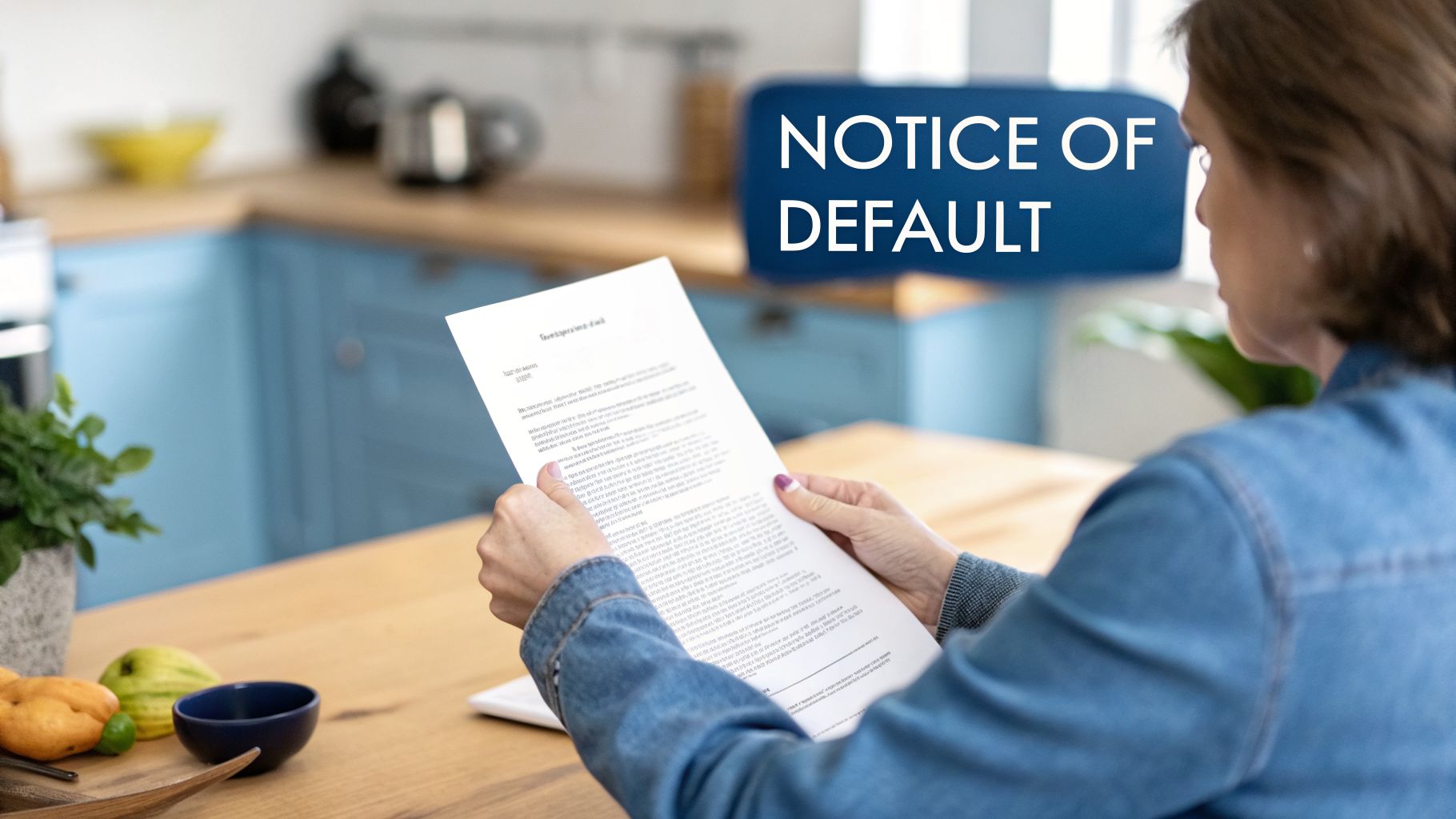
Once filed with the county recorder’s office, the NOD becomes a public record. This is a critical event. It immediately signals to the market—including real estate investors using platforms like BatchData—that the property is now in pre-foreclosure, creating a window of opportunity for off-market deals.
The Anatomy of the Notice
An NOD is designed to be unambiguous. It provides a clear roadmap of the debt and the immediate steps required to halt the foreclosure.
Every Notice of Default will specify:
- The Total Amount Owed: This is not just the missed payments. It is an itemized total including all delinquent principal and interest, late fees, and any legal or trustee costs the lender has incurred.
- The Reinstatement Period: This is your window of opportunity. The notice defines the exact timeline, often 90 days (varying by state), during which you can "cure" the default by paying the full amount specified.
- The Consequence of Inaction: The document explicitly states that if the default is not cured within the reinstatement period, the lender has the right to schedule the property for a foreclosure auction.
Notice of Default: Key Components & Implications
| Component | Definition | What It Means for You |
|---|---|---|
| Public Filing | The document is recorded with the county, making it accessible to anyone. | Your property's distressed status is now public, attracting investors and impacting your credit reputation. |
| Total Amount Due | A precise calculation of all missed payments, penalties, and associated costs. | You must pay this exact amount in full to stop the foreclosure. Partial payments will not be accepted. |
| Reinstatement Period | A legally mandated timeframe (e.g., 90 days) to cure the loan default. | This is your final, non-negotiable deadline to get current on the loan and halt the foreclosure process. |
| Auction Warning | Explicit language stating the property will be scheduled for public auction if the default isn't cured. | The clock is ticking. Failure to act guarantees the lender will proceed with selling your home. |
This document provides the hard facts and, crucially, a defined timeline. Whether you intend to cure the default, negotiate with your lender, or sell the property, your strategy starts with understanding this notice.
Why Do Lenders Issue a Notice of Default?
A lender issues a Notice of Default (NOD) because they are legally required to do so before they can foreclose on a property. This action is triggered after a borrower has significantly breached their loan agreement, almost always by missing consecutive mortgage payments for a period of 90 to 180 days. It is a mandatory step that moves the loan from "delinquent" to the formal "pre-foreclosure" stage.
Judicial vs. Non-Judicial Foreclosure States
The exact process depends entirely on state law, which follows one of two foreclosure paths.
- Non-Judicial States: In states like California, Texas, and Arizona, mortgages typically contain a "power of sale" clause. This empowers a neutral third party (a trustee) to initiate foreclosure without court involvement. In these states, the Notice of Default is the official starting gun.
- Judicial States: In states like Florida, New York, and Illinois, the lender must sue the borrower in court to foreclose. Here, the process begins with a Lis Pendens, a public notice that a lawsuit has been filed against the property. While the name is different, its function is identical to an NOD. Explore the specific differences between a Lis Pendens and a Notice of Default in our guide.
Regardless of the term used, the outcome is the same: a public record is created that flags a property as being at risk of foreclosure.
The Impact of Public Record on the Market
The moment an NOD is filed, it becomes a public document, flipping the property's status to pre-foreclosure. This filing acts as a powerful market signal.
For real estate investors and data-driven professionals, this public record is an alert for a motivated seller. It's the starting point for finding investment opportunities long before a property is ever listed for public auction. This data is also a key economic indicator. For example, a January 2023 report from ATTOM revealed that 40,534 U.S. properties had foreclosure filings, a 32% increase from the previous year. This data, also tracked by outlets like Realtor.com, demonstrates how NOD filings provide an early warning of shifting housing market dynamics.
What is the Notice of Default Timeline?
The Notice of Default (NOD) initiates a strict and rapid timeline toward a potential foreclosure auction, typically beginning after a homeowner misses three to six mortgage payments. Understanding this sequence is the first step toward regaining control of the situation.
Once the NOD is recorded with the county, a critical window called the reinstatement period opens. This is the primary opportunity for the homeowner to halt the foreclosure.
Stage 1: The Reinstatement Period
The reinstatement period is a legally mandated grace period that grants you the right to "cure" the default and restore your loan to good standing. The most common timeframe is 90 days, although this can vary by state law.
To cure the default, you must pay the full amount specified in the NOD, which includes:
- All missed mortgage payments.
- Accumulated late fees.
- Lender's legal costs, such as trustee fees.
Partial payments will not stop the process. The exact amount must be paid before the deadline expires.
The reinstatement period is a hard, non-negotiable deadline. Failure to act within this specific timeframe legally empowers the lender to escalate to the final stage before auction. While navigating this, remember other legal obligations, such as those under the Protecting Tenants Foreclosure Act if the property is rented.
Stage 2: Escalation to Notice of Trustee's Sale
If the 90-day reinstatement period expires and the default is not cured, the lender or their trustee proceeds to the next phase: issuing and recording a Notice of Trustee's Sale (NTS).
This document is far more severe than the NOD. It is an announcement, not a warning. The NTS sets a specific date, time, and location for the public auction of the home. You can learn more about this event in our guide on what is a trustee's sale. The timeline shrinks dramatically here; in states like California, the auction can be scheduled in as little as 21 days after the NTS is issued.
Notice of Default Process Timeline
| Stage | Typical Duration | Required Action |
|---|---|---|
| Missed Payments | 90 – 180 Days | Borrower falls behind on mortgage payments, triggering lender action. |
| Notice of Default (NOD) | 90 Days (Reinstatement Period) | Homeowner must pay the full overdue amount to "cure" the default. |
| Notice of Trustee's Sale (NTS) | 21+ Days | The property is officially scheduled for auction; the date is set. |
| Foreclosure Auction | 1 Day | The property is sold to the highest bidder at a public sale. |
How Should You Respond to a Notice of Default?
Receiving a Notice of Default is jarring, but inaction is the fastest path to foreclosure. Your first step is to open the notice and read it carefully. Your second step is to immediately contact your lender. Lenders are in the business of collecting payments, not owning properties, and are often willing to work with a borrower who is proactively seeking a solution.
Curing the Default and Requesting Loss Mitigation
The NOD will specify the exact amount required to "cure the default." This includes all missed payments, late fees, and legal costs. If paying this lump sum is not feasible, you must immediately ask your lender about loss mitigation options. These are foreclosure alternatives designed to help borrowers.
Common loss mitigation options include:
- Repayment Plan: Spreads the overdue amount across several future mortgage payments.
- Forbearance: Temporarily pauses or reduces payments for a set period, giving you time to recover from a short-term financial hardship.
- Loan Modification: Permanently alters your original loan terms, such as by lowering the interest rate or extending the repayment period, to create a more affordable monthly payment.
The foreclosure process moves quickly from the initial missed payments to a potential auction date.

This condensed timeline makes swift action absolutely critical.
Seeking Professional Guidance
Do not try to navigate this complex legal and financial situation alone. You need experts.
It is highly advisable to consult a qualified real estate attorney to understand your rights and options. An attorney can validate the NOD, negotiate with the lender on your behalf, and protect your legal interests. Additionally, connect with a HUD-approved housing counselor. These professionals offer free or low-cost guidance on foreclosure prevention, helping you organize your finances and communicate effectively with your lender.
What Are Your Alternatives to Foreclosure?
A Notice of Default is an urgent call to action, not a final verdict. If you cannot pay the full past-due amount to "cure the default," you still have several powerful, legally recognized alternatives. Lenders refer to these as loss mitigation options, as they are designed to avoid the costly and inefficient foreclosure process.

Your objective is to work with your lender to find a path that settles the debt without resorting to a foreclosure auction.
Options to Keep Your Home
If your primary goal is to remain in the home, you must prove to your lender that you can afford a new payment structure. Be prepared with detailed financial documentation.
- Repayment Plan: You agree to pay your normal mortgage payment plus an additional amount each month for a short period (typically 3 to 6 months) until the overdue balance is paid off.
- Forbearance: This option provides temporary relief by pausing or reducing your payments for a few months. It is designed for short-term financial crises, like a temporary job loss or medical emergency.
- Loan Modification: This is a permanent change to your loan terms. A modification could lower your interest rate, extend the loan term (e.g., from 30 to 40 years), or add the past-due amount to the principal balance to reduce your monthly payment. A loan modification is often the most sustainable solution but requires a rigorous underwriting process.
Exit Strategies to Avoid Foreclosure
If keeping the home is not financially viable, the mission shifts to exiting the property with minimal damage to your credit and financial future. A foreclosure can devastate your credit score for up to seven years. Real estate investors actively find pre-foreclosure properties using this public data, creating an opportunity for a quick sale.
Your main exit strategies are:
- Short Sale: You sell the home for less than the total mortgage balance with the lender's approval. The lender accepts the sale proceeds as settlement of the debt. Clarify whether they will pursue the remaining balance (the "deficiency").
- Deed in Lieu of Foreclosure: You voluntarily transfer ownership of the property to the lender by signing over the deed. In exchange, the lender cancels the foreclosure.
Foreclosure Alternatives Comparison
| Alternative | Description | Credit Impact | Best For Homeowners… |
|---|---|---|---|
| Loan Modification | Permanently changes loan terms to create an affordable payment. | Negative, but less severe than foreclosure. | …with a stable income who can afford a modified payment long-term. |
| Forbearance | Temporarily pauses or reduces payments for a short, defined period. | Can be neutral if payments are caught up as agreed. | …facing a temporary, solvable financial crisis. |
| Short Sale | Selling the home for less than the mortgage balance owed. | Significant negative impact, but less damaging than foreclosure. | …who can no longer afford the home and want to avoid foreclosure. |
| Deed in Lieu | Voluntarily transferring the property deed to the lender to cancel the debt. | Serious negative impact, but often better than foreclosure. | …with no other viable options who need a quick exit. |
How Can Investors Use Notice of Default Data?
For a homeowner, a Notice of Default signals a crisis. For a real estate professional, it signals an opportunity. The public filing of an NOD identifies the ultimate motivated seller—a homeowner who needs to resolve a significant debt issue quickly and is therefore likely receptive to a fast, fair cash offer.
Investors, wholesalers, and agents build their businesses by identifying these distress signals early. Instead of waiting for properties to hit the open market, they use pre-foreclosure data to find homeowners who need an immediate exit strategy.
Finding Deals with Pre-Foreclosure Data
The strategy is to act on the data the moment it becomes public. Instead of manually searching county records, successful investors use real estate data platforms to receive daily updated lists of new NOD filings.
This technology allows them to:
- Identify Opportunities Instantly: Get alerts when a property enters pre-foreclosure in a target market.
- Access Owner Information: Use integrated skip tracing to find verified phone numbers and emails for the property owner.
- Reach Out Directly: Contact the homeowner with a viable solution before competitors do and before the foreclosure timeline runs out.
This proactive approach creates a win-win scenario. The investor gains access to a potential off-market deal, while the homeowner receives an offer that could help them avoid the severe credit damage of a foreclosure auction.
A Notice of Default is the formal document that starts the foreclosure process. Historically, NODs have spiked during economic crises. During the Great Depression, an estimated 40-50% of all U.S. mortgages were in default by 1933. In the 2008 financial crisis, foreclosure starts surged by 73% as over a million mortgages entered distress. Discover more on the historical context of the foreclosure process on usfn.org.
A Notice of Default is a critical data point. For the homeowner, it is a final warning. For the investor with the right tools, it is the first sign of a potential partnership.
What Are Common Questions About a Notice of Default?
Does a Notice of Default mean I have to move out immediately?
No. A Notice of Default is not an eviction order. It is a legal notification that begins the foreclosure process. You have the right to remain in your home throughout the pre-foreclosure period, which includes the reinstatement period (often 90 days), giving you time to find a solution. An eviction can only occur after a foreclosure sale is complete and the property has a new owner.
How does a Notice of Default affect my credit score?
The Notice of Default document itself is not reported to credit bureaus. However, the underlying cause—the missed mortgage payments—has already severely damaged your credit score. If the process proceeds to a full foreclosure, that event will remain on your credit report for seven years, making it extremely difficult to obtain future loans.
Can I sell my house after receiving a Notice of Default?
Yes. Selling your home is often the most strategic move to protect your finances and avoid foreclosure. You have the right to sell the property at any time before the foreclosure auction occurs. If the sale price is sufficient to cover the mortgage balance, fees, and any other liens, you can settle your debt and potentially walk away with any remaining equity.
Is it possible to stop a Notice of Default?
No, you cannot stop the notice from being issued once you have defaulted, as the lender is legally required to send it. However, you can absolutely stop the foreclosure process that the notice initiates. The most direct method is to "cure the default" by paying the full amount specified in the notice within the given reinstatement period. This halts the foreclosure and restores your loan to good standing.
Acting on pre-foreclosure data is essential for investors seeking to help homeowners and find off-market opportunities. BatchData delivers daily-updated Notice of Default lists with integrated skip tracing tools to connect you with motivated sellers fast. Explore the platform at https://batchdata.io.