A property valuation doesn't come with a universal expiration date, and anyone who tells you it's valid for six months is giving you an answer that can fail at closing. The party relying on the value sets the clock, and that party also decides whether an update can save an aging report or a new valuation is required. If you're asking how long is a property valuation valid for, you need to identify the program, the valuation effective date, and whether the property or market has moved since that date.
- Program clock: The lender, government program, tax authority, or internal decision owner sets the maximum age.
- Evidence clock: New sales, listings, permits, damage, or a sharp index move can make a technically current report unusable.
- Update gate: Some programs allow an update inside a defined window. Others require a new report once a hard stop passes.
That's the operating model. The specific windows below show why one static valid-until field will mislead your team.
How Long Is a Property Valuation Valid For?
A valuation can be acceptable under a program's age rule and still be too stale for the decision in front of you. Its useful life runs on two clocks: the accepting program's deadline and any movement in the property or market. Store the effective date, any update date, the source, and a refresh trigger, rather than relying on one “valid until” field.
For U.S. conventional loans, the Fannie Mae Selling Guide on appraisal age and use requirements requires an appraisal completed within the 12 months before the note and mortgage date. If the appraisal is more than 4 months old but less than 12 months old at closing, the lender must obtain an update within the 4 months before the note date. The update includes an exterior inspection and a review of current market evidence to determine whether the value has declined.
If the update identifies a decline, the lender needs a new appraisal. If it finds no decline, the lender may generally proceed without additional fieldwork. Once the original appraisal is more than 12 months old, an update is insufficient and a new appraisal is required.
Property Valuation Validity by Use
| Use | Baseline window | What can extend it | Hard stop |
|---|---|---|---|
| U.S. conventional appraisal (Fannie Mae) | Effective date within 12 months before the note date; treated as current for about 4 months | Appraisal update if more than 4 and under 12 months old, with exterior inspection and no value decline | New appraisal once the original is more than 12 months old |
| VA liquidation appraisal | 180 calendar days from the issuance date | No automatic extension | Shorter period if the VA Compliance and Valuation section finds rapidly changing markets; servicers rely on the Notice of Value |
| Fannie Mae multifamily | Update required when the appraisal date is more than 6 months before commitment | Update before the 12-month mark | New appraisal when the date is more than 12 months before commitment |
| Section 184-related appraisal | 180 days | Update extends validity | Updated appraisal valid one year after the initial effective date |
| RICS market valuation | No fixed expiry; valuation date can differ from inspection and report dates | Valuer flags material market or property change between valuation and report dates | Receiving party decides whether the evidence is still relevant |
| AVM (automated valuation model) | No statutory expiry | Fresh data run with documented confidence | Confidence drop, new permit, new listing, or index move past an internal band |
| Broker price opinion | No statutory expiry | Documented comparable cutoff date | Listing, foreclosure, or servicing decision outside the opinion's comparable window |
The table separates a program's age limit from the evidence needed to keep relying on a value. A permitted update can address an aging appraisal, but it does not make the original effective date more recent. For AVMs and broker price opinions, the section gives no fixed statutory expiry, so the organization relying on them needs a refresh trigger tied to its decision.
A printed date is a timestamp, not a promise that the number still holds. Record the effective date and source, then track any update and the event that would prompt another review.
Why Is the Report Date Not the Expiry?
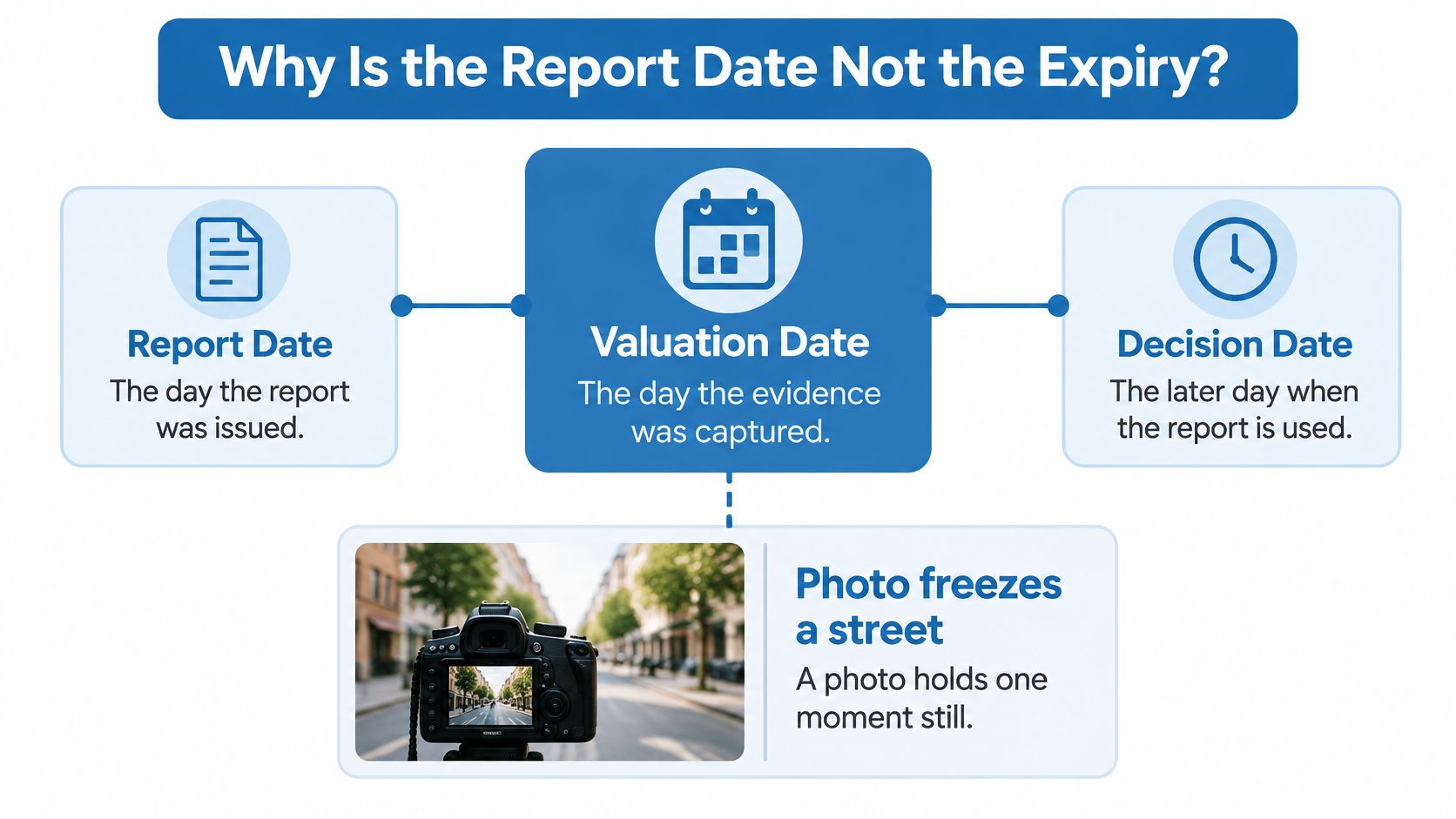
The report date is not the expiry because a valuation states an opinion of value as of a specific valuation date, and a later report issue date doesn't move that opinion forward in time.
Think of the report as a photograph of a street. The photo freezes traffic, parked cars, and construction barriers at the moment the shutter closed. Traffic an hour later doesn't rewrite the photo, and delivering the photo next week doesn't make it a picture of next week's street.
A valuation works the same way. The RICS Valuation Report Framework requires the report to identify a specific valuation date, which may differ from the inspection date and the report issue date. The framework also requires the valuer to highlight any material change in market conditions or the property's circumstances between the valuation date and the report date.
One Dated Purchase
Say an appraiser inspects a house on 2 March, sets a valuation effective date of 2 March, and issues the report on 9 March. Your investment committee doesn't meet until 20 May. You now have three different dates, and only one of them anchors the evidence.
The inspection tells you when someone observed the property. The issue date tells you when the PDF reached the file. The effective date tells you which closed sales, listings, and market conditions the value opinion reflects.
If a directly comparable house closes at a lower price on 15 April, the March report doesn't absorb that sale. If the roof suffers storm damage on 1 May, the March inspection doesn't describe the current collateral. Your May decision is relying on March evidence, so someone has to test whether that gap matters.
Tracking property valuation history helps here because a sequence of dated values shows drift that a single report hides. You can see whether values moved steadily, jumped after a renovation, or dropped after new listings reset the neighborhood.
Store Three Dates
Every file should carry the valuation effective date, the report issue date, and the latest update date as separate fields. Collapsing them into a delivery date destroys the audit trail. An underwriter who sees only the day the PDF arrived can't tell whether the evidence is a week old or was already aging when the report was signed.
Two clocks run on every file. The first is the program age limit set by the accepting party. The second is whether the property or market moved after the valuation date. A file can pass the first clock and fail the second, which is exactly where teams get caught.
What Makes a Valuation Expire Sooner
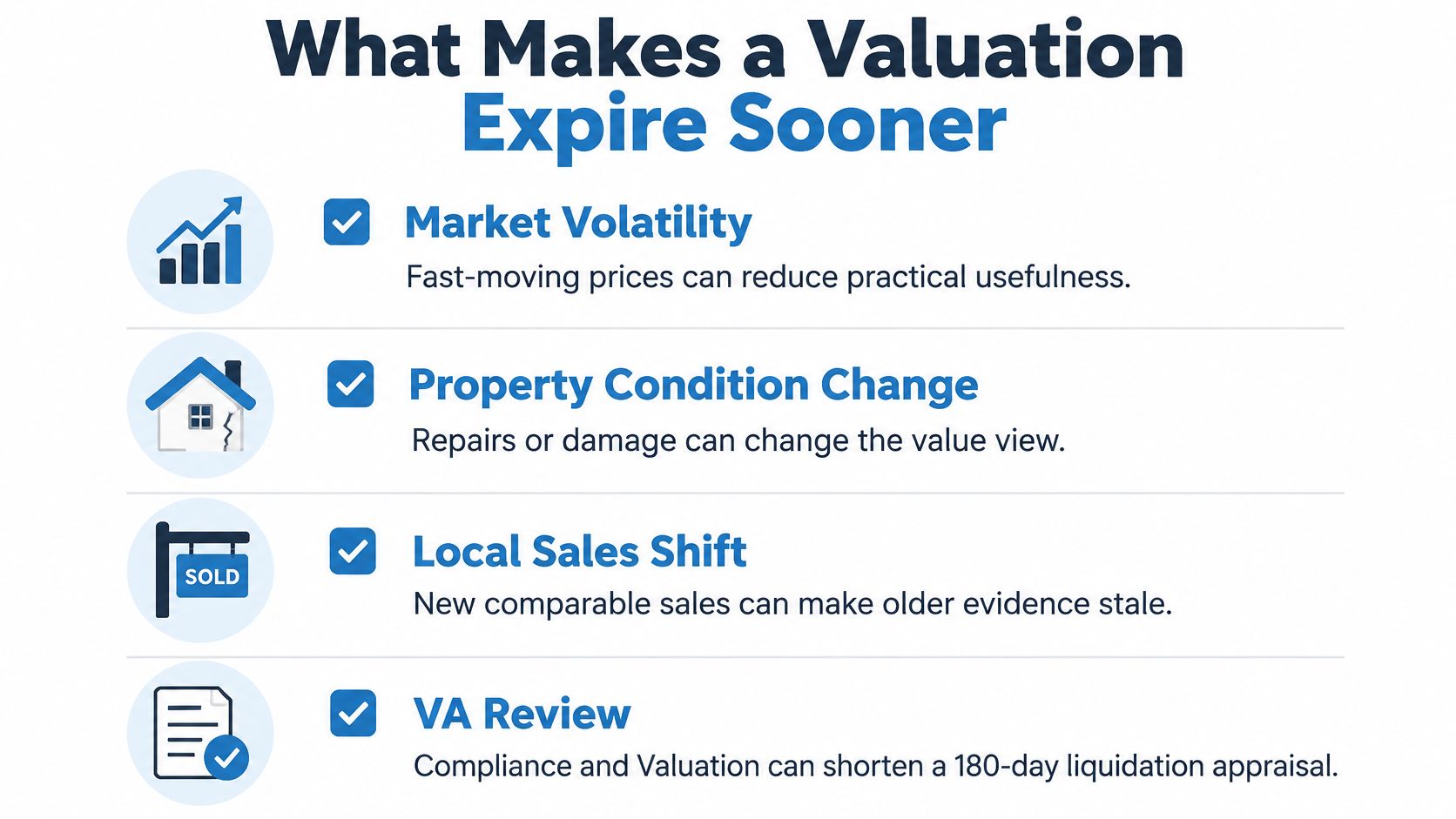
Market volatility can retire a valuation before its stated period ends because the accepting authority can shorten the window when older evidence stops describing current conditions.
The VA makes this explicit. The VA Servicers Handbook chapter on appraisals states that certain VA liquidation appraisals are valid for 180 calendar days from the issuance date, while the Compliance and Valuation section can impose a shorter period when rapidly changing market conditions exist in the area. The manual also states that servicers should rely on the Notice of Value, rather than the appraisal report alone, for net-value calculations because appraisal reports remain subject to review and possible changes.
That structure matters outside VA files too. A headline period is a ceiling, not a guarantee. If local prices gap down, inventory piles up, or financing conditions tighten enough to change what buyers can pay, the comparable set behind a recent report can lose relevance fast.
Property Change Beats Calendar Age
A permitted addition changes living area and the comparable set. Storm damage, fire, deferred repairs finally completed, or a conversion from owner-occupied to rental use can all change what the asset is. A new listing at an aggressive price tells a buyer something the old report couldn't know. A newly recorded lien doesn't change market value directly, but it changes equity and the risk decision built on top of that value.
None of those events wait for an anniversary date. A report completed last month can describe a property that no longer exists in the same condition. When your team finds a physical or legal change since inspection, treat the old number as a starting point for a refresh, not as current collateral evidence.
Evidence Drift and Local Rules
Newer closed sales are the third force. A disciplined comparable sales analysis shows whether fresh transactions support the original adjustment grid or pull value in a different direction. Active listings matter too, because they cap what a buyer needs to pay when close substitutes sit unsold.
Interest rate moves work through the same channel. They change monthly payments, buyer pools, and ultimately closed prices. The report doesn't need to mention rates for rates to make its evidence stale.
Fourth, a local or product rule can override the appraiser's own view of shelf life. An Irish mortgage desk can require a valuation dated inside its application window. A government repayment desk can impose its own submission and expiry deadlines. The valuer's professional opinion about relevance doesn't bind the receiving program.
Five Checks Before You Rely on the Number
- Effective date versus decision date: Count the gap in days and compare it with the accepting party's limit, not with a rule of thumb.
- Update on file: Confirm whether an update exists, who completed it, and whether it tested for a value decline.
- Physical change since inspection: Look for permits, damage, renovations, or a change in occupancy or use.
- Material evidence move: Check new closed sales, active listings, and a local index move against the original conclusion.
- Program remedy: Confirm whether the accepting program allows an update or demands a new report at this age.
Elapsed time is only one input. A fast market can retire a young appraisal, while a quiet market may leave an older report directionally useful for internal screening, even if a lender still won't accept it.
Which Transactions Use a Different Clock?
A valuation has two clocks: the accepting program's age rule and the property or market's movement. The first determines whether a desk will accept the report. The second determines whether its conclusion still reflects current conditions. Track the effective date, any update date, the source, and the refresh trigger rather than relying on one “valid until” field.
Conventional Purchase Closing in August
Consider a conventional purchase with an appraisal effective 1 March 2026 and closing set for 20 August 2026. The report is more than four months old by closing, so the lender cannot carry it to the note date without addressing its age.
The lender may order an update that reviews current market evidence and includes an exterior inspection. If the update finds no decline, the original appraisal may still support the note. If it finds a decline, the file needs a new appraisal before closing, and the loan amount may need to change.
Help to Buy Repayment in the UK
For a UK Help to Buy repayment, the program sets its own appraisal submission and validity deadlines. The accepting desk applies those rules, so the owner must confirm the applicable dates before relying on a valuation or scheduling repayment.
If repayment is delayed, the program's rules determine whether an extension or desktop valuation is available, and what steps the owner must take. The operational point is to track the program deadline as a separate clock from the report's effective date.
Multifamily Commitment and Section 184
Multifamily files may run against the commitment date rather than the closing date. The Fannie Mae Multifamily Selling and Servicing Guide requires an appraisal update when the appraisal date is more than six months before commitment, and a new appraisal when it is more than 12 months before commitment.
Federal programs, including Section 184-related programs, set their own appraisal validity and update rules. The accepting desk determines which rule applies and whether an update can keep an appraisal in use. Commitment is a distinct milestone: an appraisal ordered early in a long negotiation can reach an update trigger before the lender commits. Tracking only expected closing can miss that change in the program clock.
The relevant date can differ outside lending, too. A court dividing a professional practice and its real estate in a divorce may require a medical practice divorce valuation tied to the court's valuation date. A mortgage appraisal prepared for another date and purpose may not answer that legal question.
Desk test: Name the accepting party first. If you can't name it, you can't state the applicable validity period.
Refinance, commercial lending, government-backed loans, tax appeals, insurance, and investment analysis can each apply a different clock. The same report may pass one desk and fail another on the same day.
How AVMs and Broker Opinions Age
AVMs and broker opinions age through data freshness and documented judgment, not through a statutory expiration date that kills them on a fixed day.
An automated valuation model is a model run against a data vintage. That vintage can include tax rolls, recorded sales, active listings, property characteristics, and equity signals. When any of those inputs refresh, the model can produce a different point estimate and a different confidence score.
A fast market exposes the limit quickly. A run that's only days old can still misstate collateral risk if a new listing undercuts the subject, a permit changes the property, or the model has thin comparable support in that neighborhood. The run date alone doesn't tell you whether the estimate is decision-grade.

A broker price opinion is different again. It's one person's read of comparable properties on the day it was written, often prepared for a listing decision, a short sale, or a servicing action. Its usefulness is tied to the comparable cutoff date inside the opinion and to the purpose the broker was asked to address.
Don't treat a broker opinion as a lighter version of a regulated appraisal. The scope, inspection standard, licensing framework, and intended use differ. The comparison in AVMs vs traditional appraisals and their key differences is useful because it separates model speed and coverage from the inspection and certification work behind an appraisal.
Four Fields That Replace a Fake Expiry
- Source type: Record whether the value came from an appraisal, an update, an AVM, a broker opinion, a desktop review, or an internal index adjustment.
- Run or opinion date: Store the date the value was produced and, for an appraisal, the separate effective date.
- Confidence or comparable support: Keep the AVM confidence score or the opinion's comparable count and cutoff date next to the number.
- Refresh trigger: Define the event that forces a rerun, such as a confidence drop, a new permit, a new listing, a pre-foreclosure filing, or an index move past your internal band.
Don't invent a universal 30-day or 90-day AVM law. No such statute does the work for you. Your credit, servicing, or investment policy has to state how fresh a model run must be for each decision and which events override the calendar.
Batch rules should apply a different expiry logic per product. A marketing screen can tolerate an older, lower-confidence estimate that a draw decision or loss-mitigation offer shouldn't. The question isn't whether the model run has legally expired. It's whether it's fresh enough, and supported enough, for the decision in front of you.
Which Refresh Cadence Fits Each Decision?
The right refresh cadence matches the decision being made, with lending files checked against program milestones and portfolio books screened continuously for value drift.
Refresh Cadence by Decision
| Decision | When to refresh | What to check | If it is stale |
|---|---|---|---|
| Conventional origination | At application and again before the 4-month mark | Effective date versus expected note date | Order an update or a new appraisal |
| FHA or VA file | Before day 180 and again before disbursement | Effective or issuance date, plus any market shortening | Update only if the program allows it, otherwise a new report |
| Commitment underwriting | At commitment and at clear-to-close | Decline test and property condition since inspection | Stop and revalue if value fell |
| Portfolio, servicing, or insurance book | Monthly screen and quarterly review of outliers | AVM move, permits, listings, liens, ownership change | Revalue the outlier instead of waiting for maturity |
| Tax or assessment work | On the statutory cycle or at the triggering event | Assessment date, sale, or new construction | Use the assessment event, not the mortgage clock |
Lending and Underwriting Checks
Origination teams should calculate appraisal age at application using the expected note date, not the application date. A file that looks comfortable at intake can cross the four-month mark during processing, underwriting conditions, and closing delays. Checking again before that mark leaves time to order an update inside the allowed window.
Underwriting should retest collateral at commitment and again at clear-to-close. The second check isn't redundant. It catches a value decline identified by an update, visible property deterioration, or a new listing that changes the exit assumption. Treat a decline finding as a hard stop until a new value supports the loan terms.
Government files need their own calendar alerts. A team that applies conventional timing to an FHA or VA file will order the wrong remedy at the wrong time. Build the alert from the program's own start date, whether that's an effective date or an issuance date, and confirm whether an update is even available for that product.
Portfolio and Insurance Monitoring
Portfolio, servicing, and insurance teams aren't working toward a note date. They're watching collateral and exposure drift between transactions. A monthly AVM or index screen gives them a low-cost first pass across the book. A quarterly review of outliers then focuses human attention on properties where the model moved sharply or confidence fell.
Event triggers should override the monthly rhythm. A new permit can signal an addition or a major repair. A new listing reveals an owner's exit intent and a market test of price. An ownership change, a new lien, or a pre-foreclosure filing changes the risk picture immediately. Revalue those properties when the event fires instead of waiting for the next scheduled screen.
A property-data platform can feed that screen with dated valuation signals, property records, permits, listings, and ownership changes. The feed's job is surveillance between loan events. It flags where a full appraisal, desktop review, or broker opinion is worth ordering, rather than pretending a model estimate replaces every regulated valuation.
Waiting for a 12-month appraisal cycle to discover collateral movement is a choice, and in a volatile market it's an expensive one.
Tax and assessment work sits outside this monitoring logic. Follow the statutory reassessment cycle or the triggering event, such as a sale or completed construction. Borrowing a mortgage clock for a tax question produces a precise-looking answer to the wrong problem.
How Do You Lock a Refresh Rule Before Relying on a Value?
You lock a refresh rule by mapping each product to its accepting party, storing five control fields, and refusing to rely on the value when either the program clock or a property trigger has fired.
Four Setup Steps
Step 1. Name the accepting party for each product. List conventional, FHA, VA, multifamily, government repayment, tax, insurance, and internal investment screening as separate rows. Map each row to its baseline window, update gate, and hard stop.
Step 2. Store five fields before the value enters a decision. Capture the valuation effective date, the update date if one exists, the source type, the confidence score or comparable support, and the trigger that forces a refresh. A value without those fields shouldn't reach underwriting or a portfolio memo.
Step 3. Reject a single valid-until field. One date can't express a four-month update gate inside a twelve-month outer limit. It also can't express a confidence drop or a new permit. Your system needs the program deadline and the event triggers side by side.
Step 4. Monitor between transactions. Run a recurring feed against the book instead of waiting for the next closing, claim, or default to reveal drift. BatchData is one option for dated property records and valuation signals that teams can screen for listings, permits, ownership changes, and value movement.
Go or No-Go
If the program clock has run out, order the update or new valuation the program requires. If a property or evidence trigger has fired inside the window, refresh anyway and document why. If neither clock has fired and the support still holds, the existing value stands for that decision.
Write that rule down before the next file arrives. A team improvising validity at clear-to-close will either delay closings with late orders or, worse, fund against evidence nobody retested.
Stop guessing whether an old value still holds by screening your book with dated valuation signals, permits, listings, and ownership changes from BatchData. Build refresh triggers around each property's effective date and confidence score, flag outliers before they reach underwriting or servicing, and order full revaluations only where the evidence moved.