
Public does not mean machine-ready, and treating a free property search as a national database is how bad joins enter production. A usable set of data universe property records has to identify a parcel, attach ownership, transactions, liens and valuation to it, and preserve where each fact came from and when it took effect. If you can't test those three things on your own addresses, you don't have coverage. You have a headline count.
- Identity first: Parcel numbers work only inside their jurisdiction scope.
- Provenance over freshness: A recent file can still carry an old, conflicting fact.
- Missing is a diagnosis: A miss can mean delay, redaction, a different identifier, or a different office.
Those distinctions decide whether underwriting, monitoring and marketing queries return evidence or noise.
What Is a Property Data Universe?
A property data universe is the set of properties and associated records a system can retrieve. The phrase can refer to a public search tool or a commercial data platform, but those serve different purposes. Neither label alone establishes that records are complete or ready for use.
DataUniverse is a free public records search. The APP.com description of DataUniverse says it is operated by APP.com and the Asbury Park Press, includes more than two dozen searchable databases, launched in 2006, and generated approximately 1 million page views per week. It provides an interface to jurisdiction-specific government information, rather than a nationwide commercial property dataset.
A commercial national platform combines records from county, state and federal sources. Those files were not designed to join cleanly, so a usable platform must reconcile identifiers and preserve the source and timing of each fact. Its practical value lies in making records queryable across sources, not just collecting them.
Three Tests for a Usable Universe
- Parcel identification: Can each record be tied to a parcel or unit, with the relevant jurisdiction clear?
- Attached facts: Can ownership, transactions, liens and valuations be connected to that property through a documented key?
- Source and date: Does each fact retain its source, publication date and effective date as distinct information?
| Meaning | Source | Coverage | Use it for |
|---|---|---|---|
| Public records search | APP.com DataUniverse | Jurisdiction-specific, with New Jersey sales searchable back to 2000 | Single-state history and lookups |
| Commercial national platform | Aggregated county, state and federal sources | National aggregation assembled county by county, with gaps by source and attribute | Underwriting, portfolio monitoring and marketing at scale |
| Census benchmark | U.S. Census Bureau | Housing-unit count for a defined census date | A scale reference, not a test of record-level coverage |
A national label does not mean every jurisdiction or attribute is present. Before relying on a dataset, compare its records with addresses in the areas and property types relevant to your use case. Check whether a match resolves to the intended parcel, whether key fields are populated, and whether the available history supports the decision. A large total can describe the dataset's scale, but it cannot show where coverage breaks or whether records can be joined reliably.
Which Record Types and Attributes Does It Hold?
A property data universe is defined by the facts it connects to a property, not by the number of fields in its catalog. Public records can describe the same asset through separate assessor, recorder, mortgage, permit and geographic files. A machine-ready record needs those facts tied to a usable identifier, with enough provenance to distinguish the source and meaning of each field.
| Record type | What it holds | Example fields |
|---|---|---|
| Core characteristics | Building, lot and construction specs | Beds, baths, square footage, lot size, zoning, roof, HVAC, APN |
| Ownership | Owner identity and holdings | Owner type (person, company, trust or LLC), mailing address, owned properties |
| Sales and title | Transfer history | Last sale, prior sale, chain of title |
| Mortgages and liens | Debt and encumbrances | Open liens, mortgage terms, lender |
| Pre-foreclosure | Distress filings | Filing date, default status |
| Valuation | Modeled and estimated values | Automated valuation, equity estimate, valuation date |
| Permits | Construction and improvement activity | Permit type, issue date, status |
| Geography | Location and jurisdiction | Latitude, longitude, ZIP code, county, school district |
Core characteristics describe both the physical asset and its legal parcel. Building specifications, lot characteristics, zoning, parking, construction details, legal description and assessor parcel number (APN) answer different questions. The APN is an identifier, not proof that a record matches across jurisdictions or source files. For tax-related fields, property tax basics can help distinguish assessed value from market value before either enters a model.
Ownership and transaction records show who holds an interest and how it changed. Owner type affects how an owner should be represented and matched: a person, company, trust and LLC are different record types, not interchangeable labels. Sales history and chain of title establish transfer sequence. Mortgages, liens and pre-foreclosure filings describe debt, claims or distress associated with a parcel, but their presence and fields depend on the underlying records.
Permits and valuations add another layer. Permit records can indicate construction or improvement activity, while valuation fields may be modeled estimates rather than recorded sale prices. Preserve that distinction in the schema. A single value without its type, source and date can be misleading even when the field is populated.
Why Occupancy Belongs in the Schema
The Census Bureau's 2020 housing counts distinguish occupied from vacant housing units and owner-occupied from renter-occupied units. Those categories show why occupancy and tenure matter, but they are not interchangeable with parcel-level owner records. A property's owner mailing address alone does not establish whether the home is occupied by its owner or rented.
For outreach, rental analysis and vacancy segmentation, check whether occupancy and tenure are available for the properties and jurisdictions you need. Then test the match key, source and field completeness on your own addresses. A field defined in a schema but blank for a county is not usable coverage. Public data may exist, yet still require normalization and matching before it can support repeatable analysis.
How Often Each Property Source Refreshes
A national property file does not have one refresh clock. Each source publishes on its own schedule, while a vendor may ingest and reload those records more frequently. A nightly reload cannot make an annual assessment current. Track both the source's publication timing and the date the record entered the source.
County assessor rolls, recorder deed indexes, state sales files and federal housing counts are published independently. Transaction dates also mark different events: a sale becomes effective, is recorded, indexed, compiled into a state file and then loaded by an aggregator. Keep those dates distinct. Otherwise, a delay in publication can look like a period with no market activity.
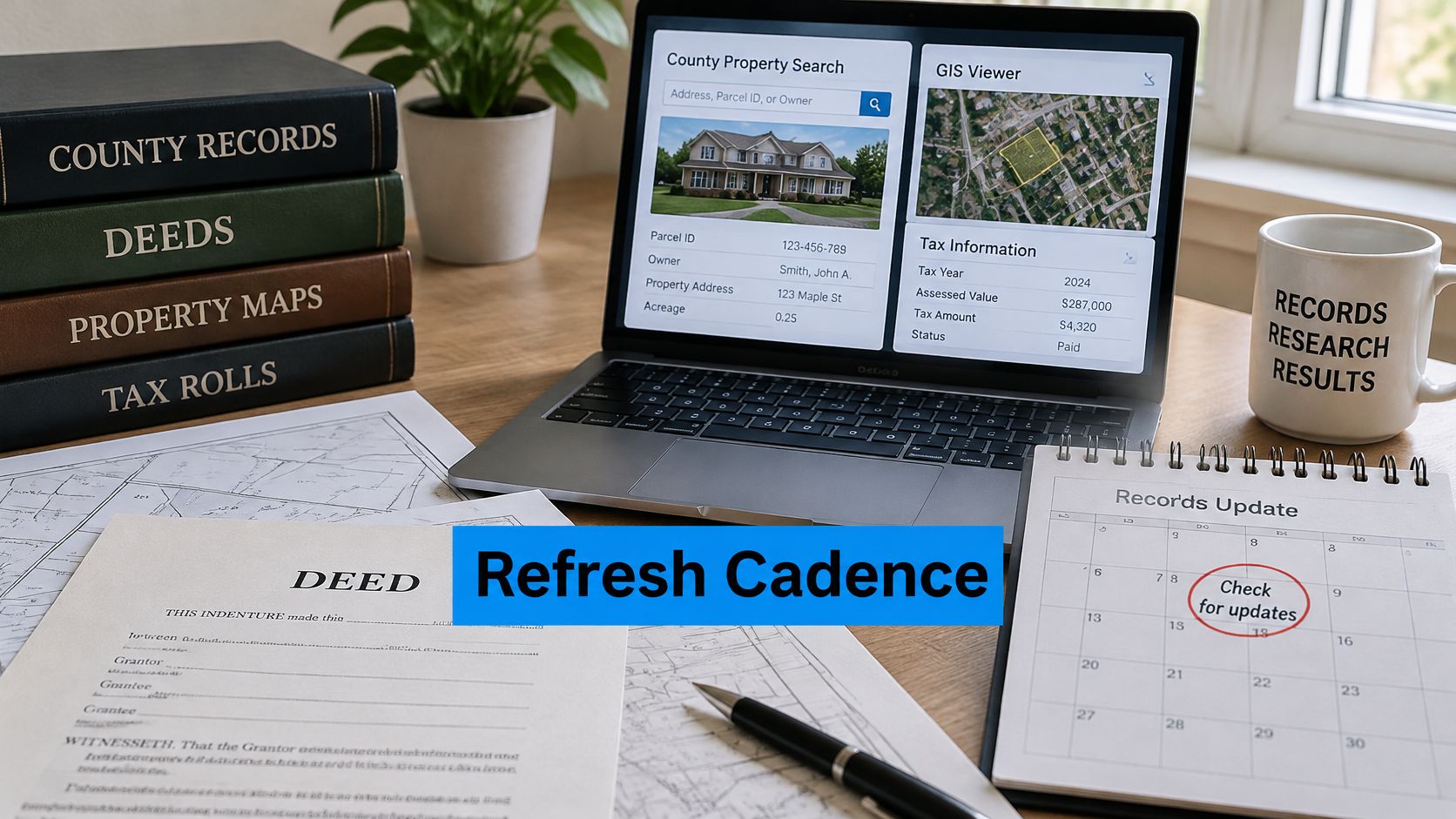
New Jersey illustrates how separate files can describe different points in a property's history. The state publishes annual Property Assessment List files and SR1A sales files separately, rather than as one unified record. A property can therefore have an assessment from one cycle and a sale from another without either file being wrong. Some counties also require in-person or mailed requests instead of offering searchable portals.
| Source type | Typical cycle | Limitation to check |
|---|---|---|
| County assessor roll | Annual assessment list | Values update at reassessment, not at sale |
| New Jersey SR1A sales files | Separate sales file, distinct from assessment list | Sale can appear before or after the matching assessment |
| County recorder deed index | County-controlled recording and indexing schedule | Some offices require an in-person or mailed request |
| Federal housing census | Decennial, last count April 1, 2020 | Counts units, not current ownership |
How to Diagnose a Missing Record
Treat a failed lookup as a question about the source path, not immediate evidence that the property has no record.
- Compare dates: Set the source publication date beside the transaction's effective date. A deed may exist but fall outside the file's published period.
- Search by parcel first: Address formatting can fail even when a jurisdiction-scoped parcel key is available.
- Check access level: Determine whether the file contains summary records or document-level detail, and whether another office holds the underlying document.
- Check identifier history: Splits, mergers or renumbering may place the same land under a new key.
Operating rule: A missing record is evidence about your source path before it is evidence about the property.
For national models, coverage gaps matter as much as refresh timing. If thin counties are treated as empty markets, sparsity can bias valuations, ownership matching, monitoring alerts and lead generation in the same direction each cycle. Before relying on a source, record its publication cadence, identifier scope and access limits, then test whether the records you need appear in the jurisdictions you serve.
How to Match a Property Record Across Sources
Matching is a key problem, not an address lookup. A parcel identifier is valid inside its issuing jurisdiction, and it isn't a stable national key by itself.
The OGC discussion paper on land and property data exchange specifies that a cadastralParcelID is unique across an entire jurisdiction, or globally unique only when combined with an ID.scope, with a similar scope requirement for propertyUnitID. Build your matching process around that constraint from the start.
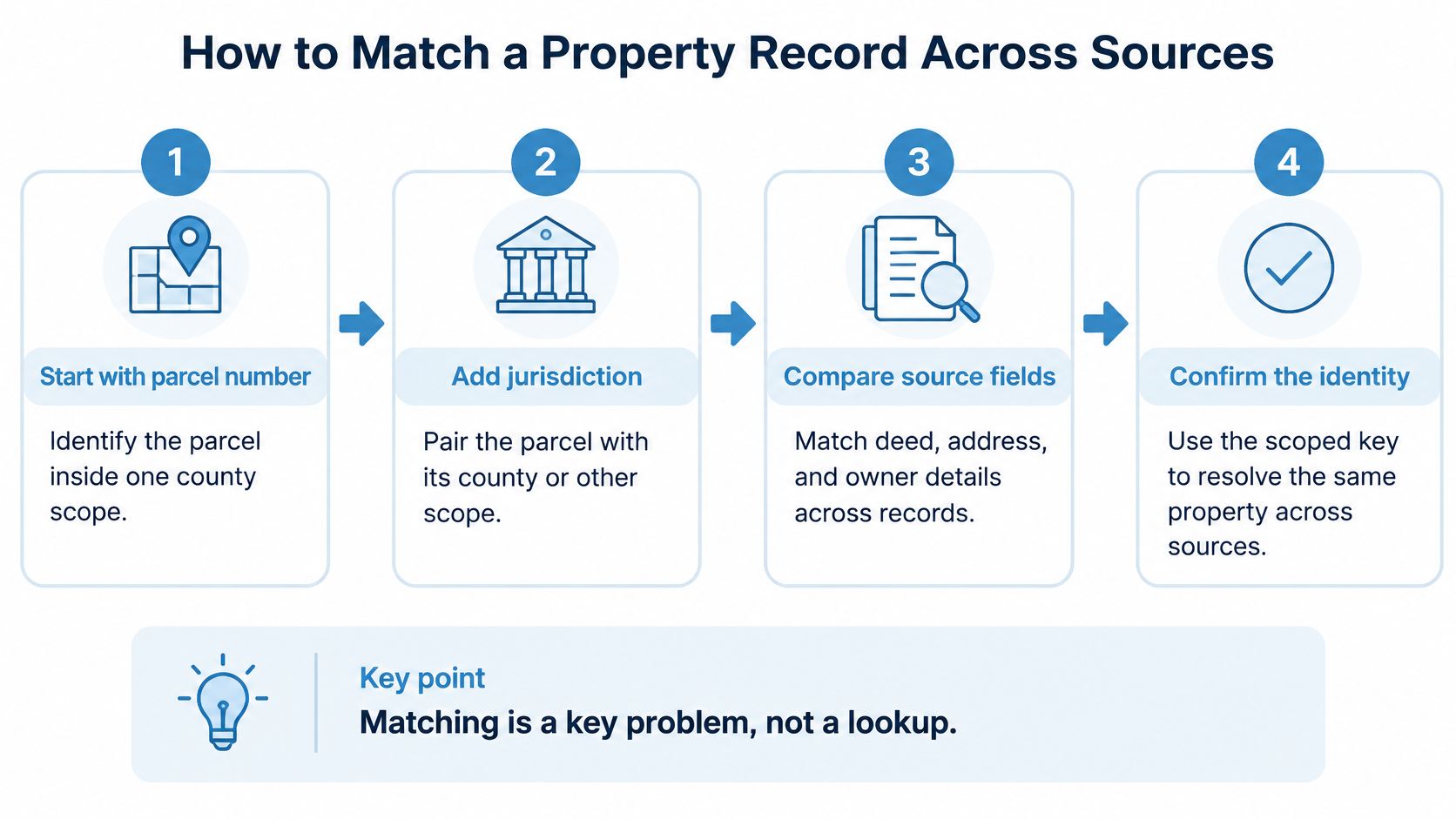
Matching Sequence
- Normalize the input address: Standardize abbreviations, unit numbers, ZIP format and punctuation before you match. Keep the original string so reviewers can audit the change.
- Match to a parcel, then confirm location: Use the normalized address to find candidate parcels, then compare coordinates to rule out neighboring lots, split parcels and multi-unit structures. Address similarity alone can't resolve those cases.
- Attach records through crosswalks: Build explicit parcel-to-address, parcel-to-building, parcel-to-deed and parcel-to-tax-account tables. Allow one-to-many and many-to-one relationships, because condominiums, mixed-use buildings and merged lots break one-to-one assumptions.
- Run referential integrity checks: Every deed, lien and ownership event must resolve to a valid parcel key. If it doesn't, you have an unresolved event, not a record you can safely drop.
- Quarantine unresolved records: Send failures to a quarantine table with the source payload, attempted keys and failure reason. That table becomes your county-level work queue and your evidence in vendor discussions.
- Preserve the source identifier: Store it as immutable, with jurisdiction, issuing agency, identifier type, validity interval and geometry version. Never overwrite it when a parcel is split, merged, renumbered or reassessed. Create a new version and link the history.
- Record the match path: Store which crosswalk produced each join and which fields agreed. A reviewer should be able to reconstruct why two records were treated as the same property months later.
Matching by owner name alone is the weakest path, especially when title sits in an LLC or trust with a mailing address outside the property county.
Expect two outputs, not one blended score. You need a match rate by county and a quarantine list by reason. The first tells you where automation is viable. The second tells you whether the problem is addressing, parcel history, source delay or missing document access. A national average hides all four.
Quality Metrics to Check Before Relying on Records
Accuracy is a provenance and identity-resolution problem, not a freshness problem. A newly loaded record can still join the wrong owner to the wrong parcel, overwrite a better source, or present a modeled value as if a county official recorded it.
The CountyOffice disclosure on public record limitations reflects the warning users need to operationalize, that records may be incomplete, inaccurate or outdated and not independently verified, while privacy programs can restrict public display of name-plus-address combinations for protected individuals. Your quality system has to handle missing identifiers without inventing certainty.
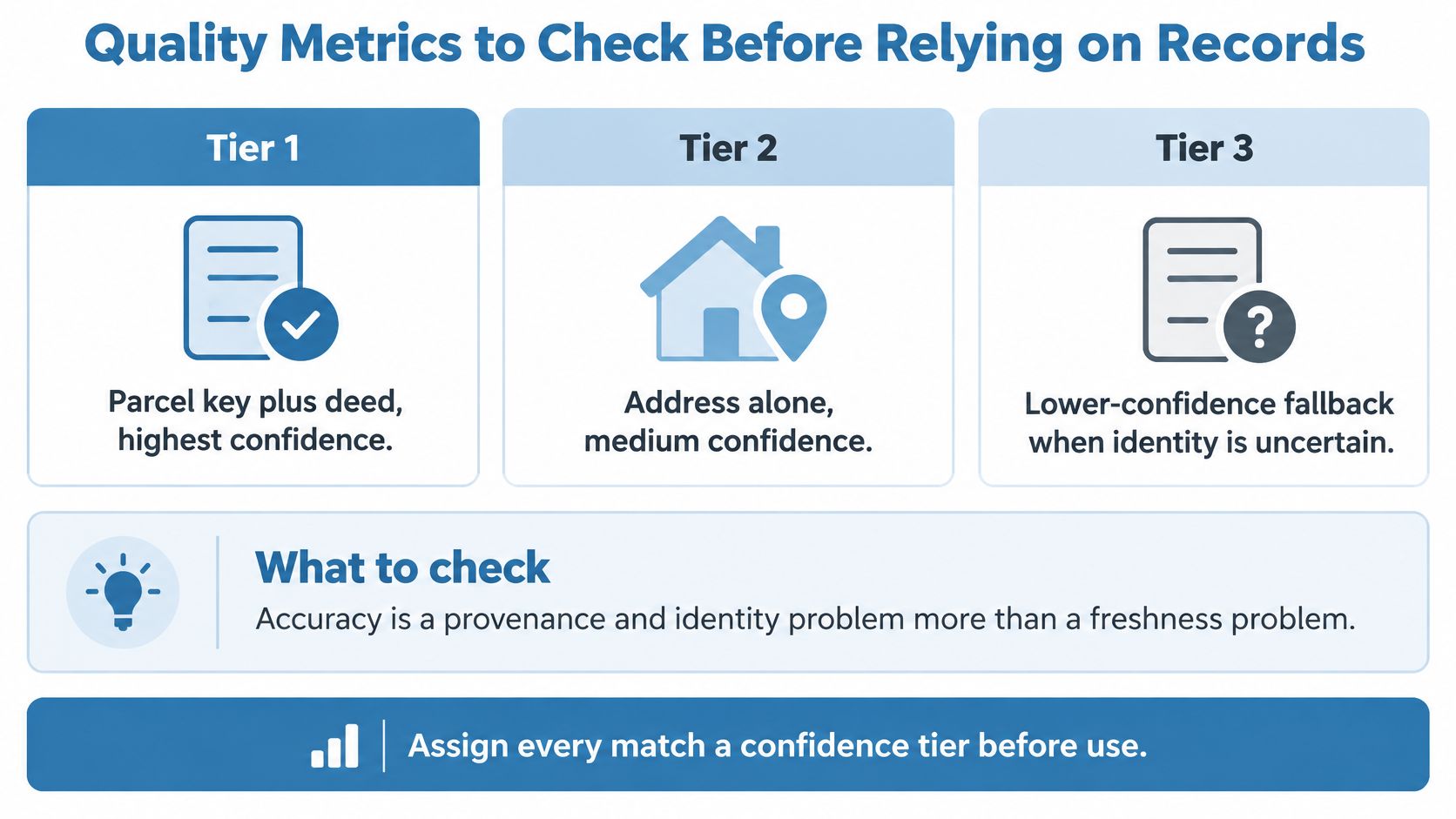
Confidence Tiers That Control Action
- Tier 1, parcel key plus deed: Act directly when the scoped parcel key resolves and the deed supports the ownership or transfer claim.
- Tier 2, address alone: Route the record to a second source check, such as the recorder index or tax account, before pricing, servicing or outreach.
- Tier 3, owner name alone: Send it to human review or original-document retrieval. Don't let a name match create a property relationship by itself.
Apply the same skepticism to values and ratios. A short review of real estate numbers worth questioning is useful context for marketing teams that reuse modeled figures without checking what produced them. Inside your pipeline, that skepticism becomes a rule, separate publication date, effective date, source authority and confidence on every fact.
Conflicts need a named source of record. If the newest assessment and the deed disagree, or one parcel carries multiple legal descriptions, pick the governing source for that field, log the choice and queue the parcel for review. Don't average legal facts. Don't let ingestion order decide ownership.
Flag LLC and trust owners in every output, because entity ownership changes how name matching, mailing address matching and contact suppression should work. Flag redactions separately from blanks. A redacted owner field is intentionally withheld. A blank field may mean the source never carried it. Treating either one as verified creates compliance and underwriting risk.
Our own guidance on data quality assurance controls follows the same principle, measure lineage and match confidence before you measure speed. Both a missing field and a conflicting field should block automated action until the record earns a higher tier.
How Underwriting, Monitoring and Marketing Query the Data
Every team starts with the same pattern, resolve an address or parcel key, pull attached facts, then apply a decision rule. What changes is the filter, the refresh rhythm and the cost of acting on a weak match.
A simple public example shows the mechanics. The APP.com report on the DataUniverse New Jersey property sales update describes searches by owner or buyer name, municipality, street and sale amount, with a reported search range extending back to 2000, using official records compiled by the New Jersey State Treasury Department. A national system uses the same logic, but it joins on a scoped parcel key instead of relying on a name search in one state file.
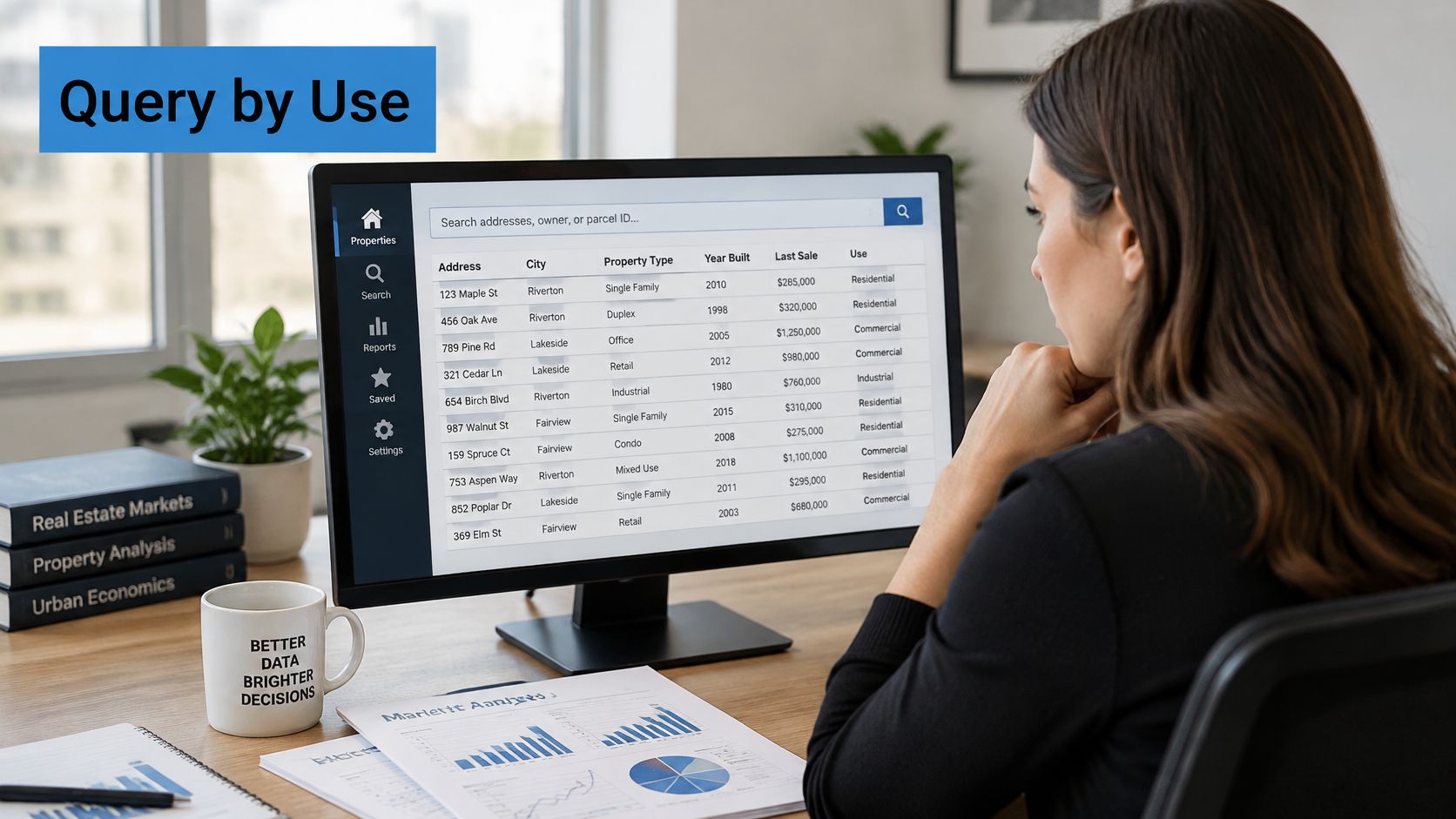
Underwriting Query
Underwriters pull the last sale, open liens, pre-foreclosure status, property characteristics and a valuation for each address in a pipeline. They price only after the parcel resolves cleanly. A record that matches by address alone should be flagged for a second check, because the wrong lot can carry a plausible value and still be the wrong collateral.
Portfolio Monitoring Query
Monitoring teams store parcel keys once, then re-query those same keys on a fixed schedule. Useful alerts are changes, not snapshots. A new lien, a transfer, an owner type changing from person to LLC, a new permit or a distress filing should trigger review with the prior value preserved. If your system overwrites history, you can't prove when the risk changed.
Marketing Query
Marketing teams filter by owner type, property characteristics, geography, equity signals and distress indicators, then suppress records that fail contact, consent or confidence checks. That last step isn't optional cleanup. A high-scoring property with a redacted owner, an entity mailing address or a tier-three match isn't a ready lead.
A pseudo-query for the New Jersey pattern would read, municipality equals the target town, sale date is on or after January 1, 2000, and sale amount falls inside the target range, sorted by sale date descending. In production, add jurisdiction scope and parcel key to that logic. Then treat a zero-result search as a coverage question before you treat it as a market answer.
Which Delivery Method Fits Your Stack
Choose delivery by query pattern, not by price tier. Interactive decisions, warehouse joins and full-universe model training place different demands on latency, schema control and replay.
| Delivery method | Best for | Typical workflow |
|---|---|---|
| REST API | Single-property lookups and filtered searches | Underwriting check at application time |
| S3 bulk files | Full-universe loads | Nightly portfolio scan or model training |
| Snowflake delivery | Joins with internal tables in a warehouse | Portfolio analytics and lead scoring in SQL |
| Flat files | Legacy systems and custom ingestion | Scheduled ETL with a fixed schema |
Use a REST API when a person's decision waits on one property answer. It keeps the request narrow, returns the current assembled record and fits application-time checks. You'll still need pagination discipline for filtered searches, retry handling and a local log of request keys, response versions and match confidence.
Use S3 bulk files when you need the full universe locally. Bulk delivery supports model training, nightly scans and reproducible backtests because your team controls the snapshot. It also makes source lag visible. You can diff two loads and see exactly which parcels, liens or valuations changed.
Choose Snowflake delivery when analysts already join loan, policy, listing or lead tables in the warehouse. Parcel keys, transactions and liens can sit next to internal records in SQL, which reduces file movement but doesn't remove the need for scoped keys. Choose flat files for legacy ingestion or custom ETL where a fixed schema and controlled parsing matter more than interactive access.
Our comparison of API and bulk delivery methods for real estate data goes deeper on that trade-off. Whichever channel you pick, confirm four things in writing, the parcel and source identifiers arrive unchanged, schema changes are versioned, large results paginate predictably, and each channel states when it reflects upstream source publication.
Many teams combine channels. They use the API for interactive lookups, bulk files for the full universe and one shared parcel key across both. That reconciliation key is what prevents two delivery paths from becoming two versions of the truth.
Test Coverage on Your Own Addresses Before Committing
Commit only after a sample test on addresses you already know. A provider's national count can't tell you whether your counties, property types and required attributes are usable. Your own list can.
Export addresses covering every county and property type you'll score. Include condominiums, multi-unit buildings, rural parcels, entity-owned properties and records with unit numbers, because clean suburban single-family addresses overstate performance. Run the identical file through each provider and score the output the same way.
- Measure match rate by county: Record matched, ambiguous and unmatched results separately. A strong national average can hide a failed county.
- Classify every miss: Use address not found, parcel key conflict, source not yet published, identifier changed, or record held by another office. Don't accept an unexplained no-hit bucket.
- Compare dates: Check each returned publication date against the transaction or assessment date your decision depends on.
- Audit populated fields: Confirm owner type, open liens, sale history, valuation, permits and other scored attributes contain values, not only field names.
- Repeat the pull: Run the file again and confirm source identifiers and parcel keys stay identical unless a documented parcel event explains the change.
- Score confidence tiers: Count parcel-plus-deed matches separately from address-only and name-only matches.
On budget, request the price per matched record, per miss and per refresh. Then calculate cost per usable record, meaning a matched record with your required fields populated at an acceptable confidence tier. Cost per listed record rewards empty coverage.
For scale, BatchData's catalog covers over 1,000 data points across 131M+ properties, its national property, owner and contact data is refreshed daily, and its match service matches a list of addresses to property records while adding owner, deed and contact details. Include BatchData in the same sample test as every other provider and judge all of them on match rate, miss reasons and populated-field rate. Don't buy the headline count.
Put your own address file through a scoped parcel match and inspect the misses, confidence tiers and populated fields before you sign anything. BatchData can match that list to property records and add owner, deed and contact details, giving you a concrete coverage result for underwriting, monitoring or marketing instead of a national promise.