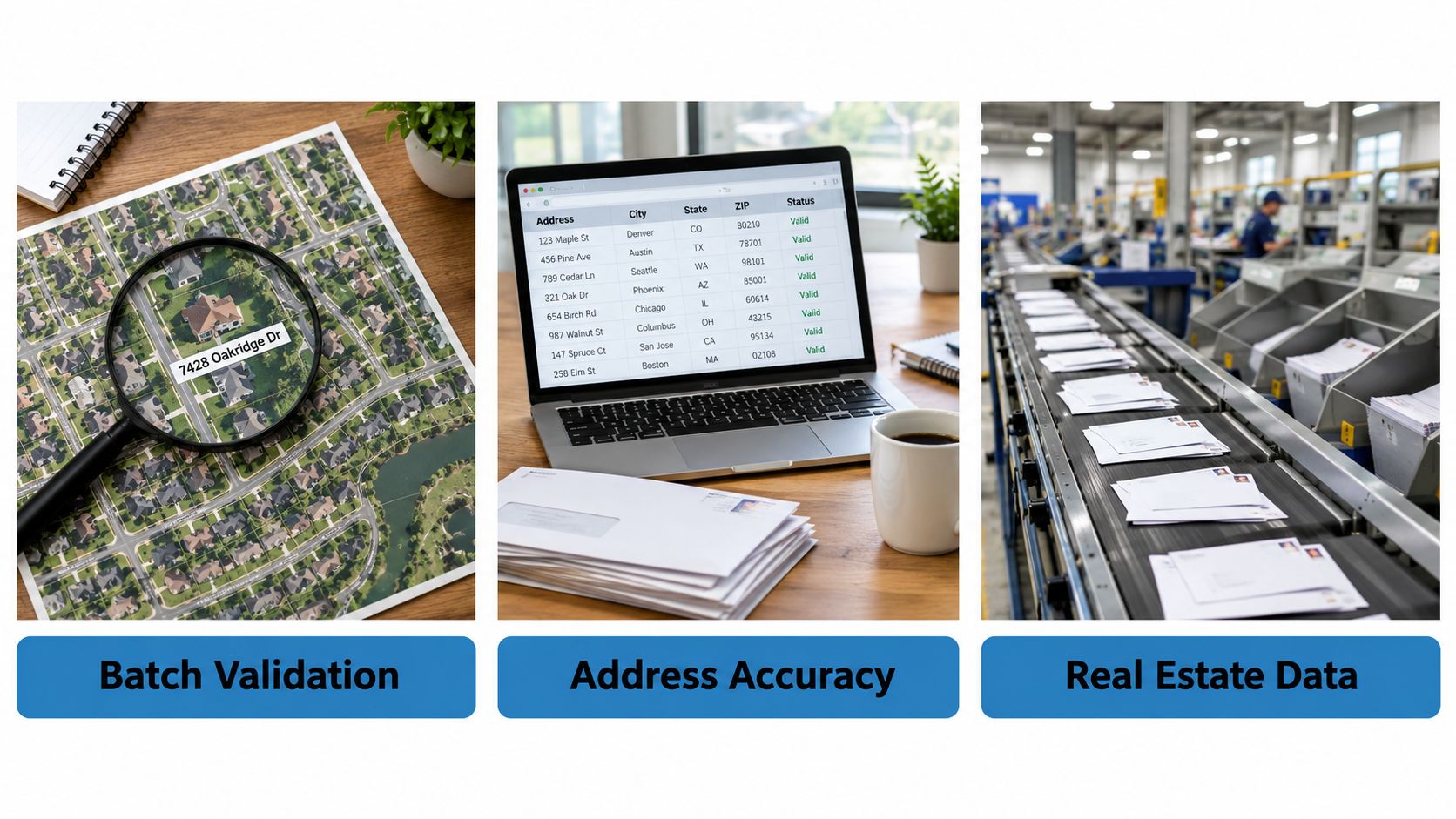
6.6 billion mailpieces, or 4.3% of 155 billion, were undeliverable as addressed in the United States Postal Service's FY2014 data. That failure generated roughly $1.5 billion in handling costs, making batch address validation a necessary control for any real-estate or lending operation that relies on physical addresses.
A production workflow shouldn't treat an address as merely valid or invalid. It should separate syntactic validity, postal deliverability, physical existence, and operational usability, then preserve the evidence behind every decision.
- Validate before downstream work: Stop bad records before underwriting, appraisals, notices, marketing, or fulfillment.
- Use layered outcomes: Store parsing, standardization, ZIP+4, primary delivery-point, secondary-unit, and exception statuses separately.
- Choose the right processing mode: Use synchronous API checks for critical user actions and bulk jobs for portfolio-scale cleansing.
- Measure operational results: Returned mail, first-attempt delivery, contactability, and completed inspections matter more than one aggregate match rate.
Why Batch Address Validation Matters for Real Estate and Lending
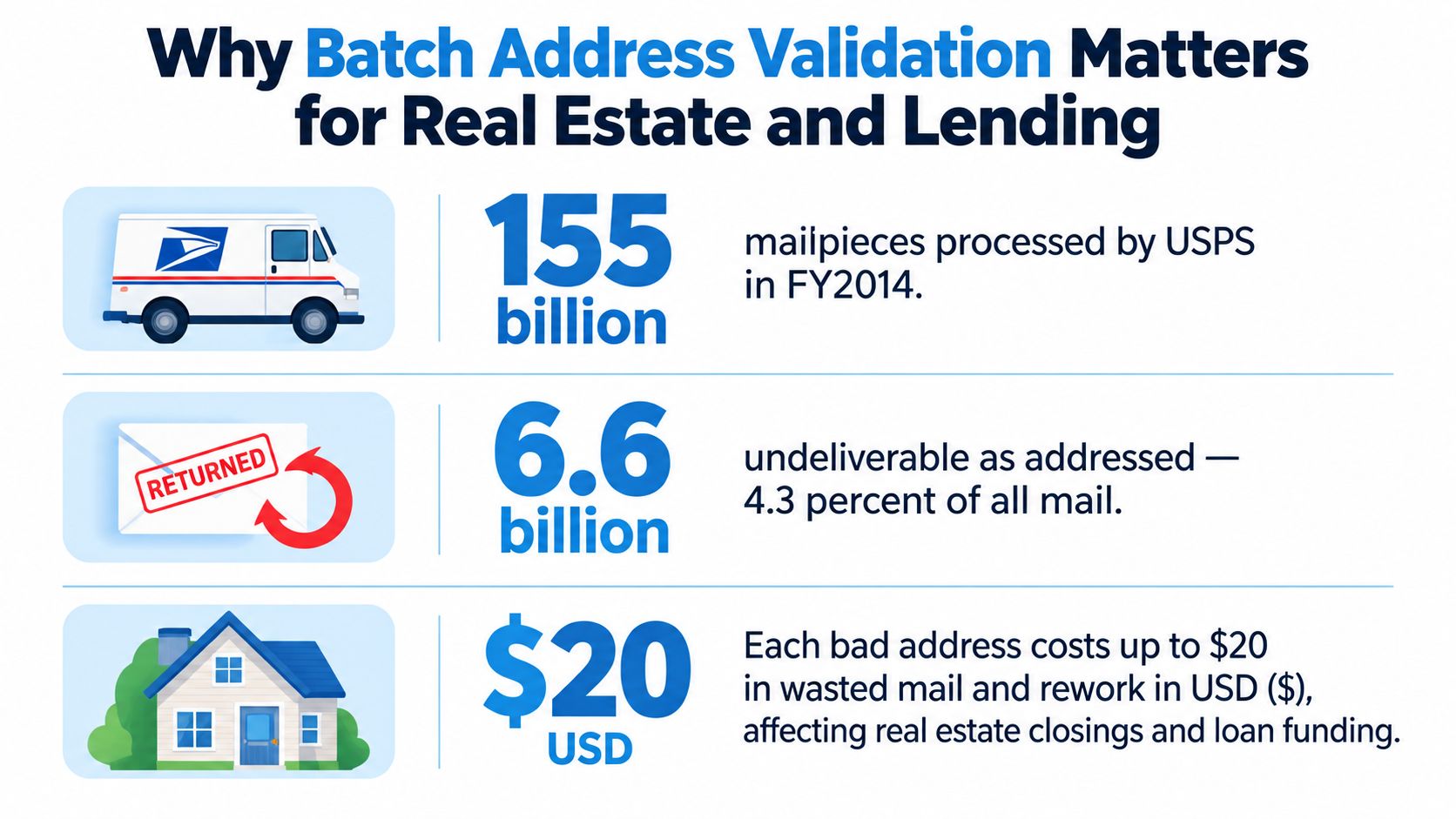
Batch address validation is a production data-quality control that tests and enriches many address records before they reach costly operational workflows. The business case is visible in USPS data. The Postal Service processed more than 155 billion mailpieces in FY2014, and 6.6 billion, or 4.3%, were classified as “undeliverable as addressed” by the USPS Office of Inspector General.
The cost wasn't limited to postage. The Inspector General estimated approximately $1.5 billion in UAA handling costs in FY2013, including forwarded mail, returned mail, waste, and administrative work related to address correction and change-of-address processing in the same USPS OIG analysis. For a lender, insurer, investor, or property platform, the equivalent failure appears as returned notices, stalled servicing, failed document delivery, wasted marketing spend, and unreliable property-to-person relationships.
Why one-time cleansing fails
A one-time cleanup creates a snapshot, not a durable control. The USPS OIG reported that UAA volume increased 2.1% over the four fiscal years from FY2011 through FY2014 in its address-quality analysis. Records change, units are added, businesses relocate, rural routes evolve, and source systems continue introducing malformed data.
A lender portfolio may combine borrower-submitted addresses, tax records, servicing exports, appraisal files, and contact-enrichment results. Each source has different conventions for apartment identifiers, directional prefixes, street suffixes, and postal codes. Without a controlled validation stage, those differences spread into every downstream table.
Practical rule: Don't overwrite the source address. Store the raw value, the normalized representation, the validation result, and the reason for any unresolved status.
For teams evaluating broader automation across underwriting, servicing, and finance operations, resources on AI-driven finance solutions can provide useful context. Address validation still needs its own auditable controls, because a clean-looking string doesn't prove that mail can reach the intended location.
How USPS Batch Validation Works
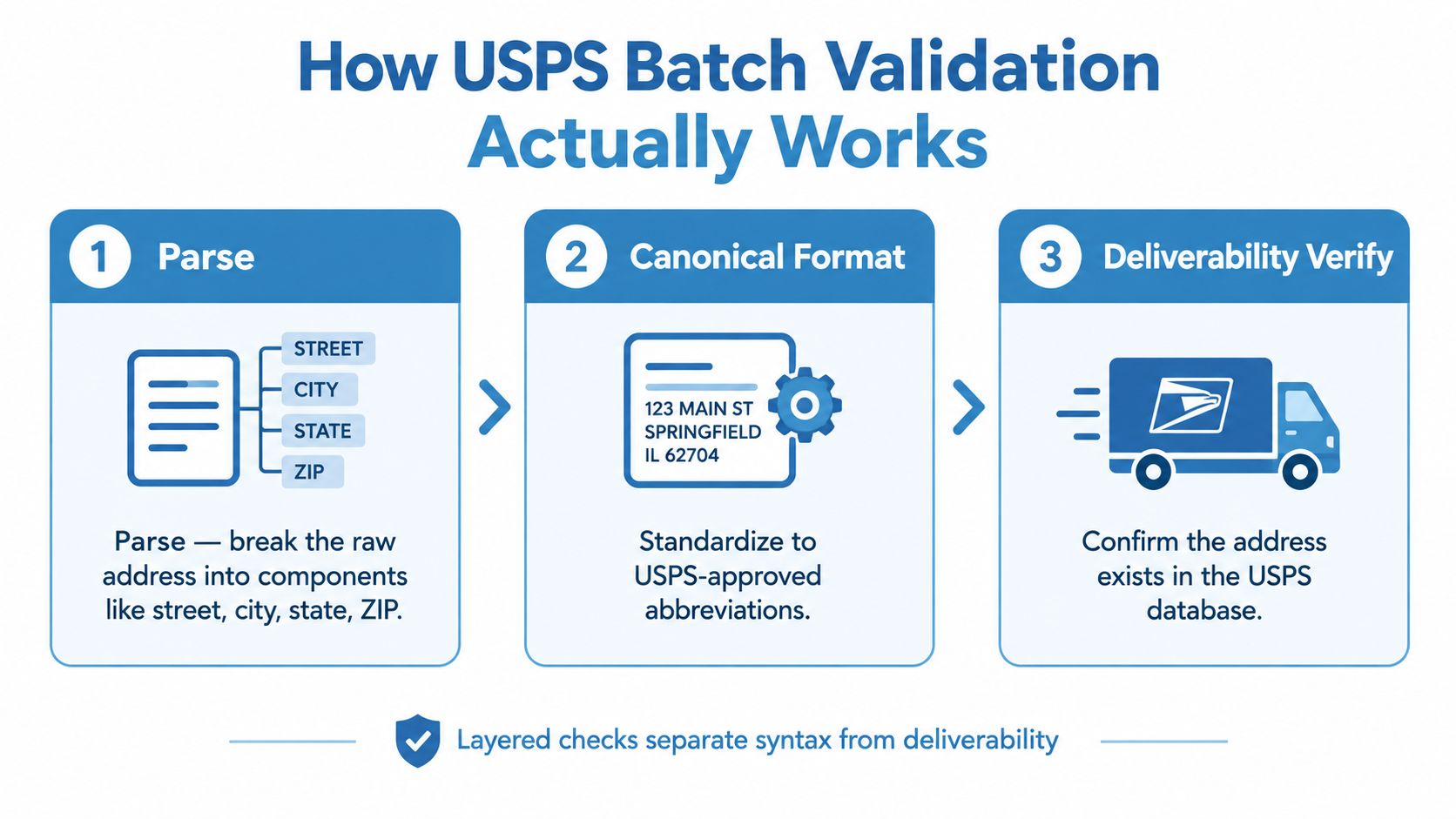
USPS batch validation works as a sequence of parsing, standardization, coding, and delivery-point checks. In production, that sequence is best treated as a confidence model. One layer tells you whether the string is well formed. Another tells you whether it maps to postal reference data. A later layer tells you whether USPS recognizes it as deliverable. Those are different questions, and collapsing them into one pass is how teams end up with false positives.
The validation layers
Parse the raw string. Split the input into house number, predirectional, street name, suffix, postdirectional, secondary unit, city, state, and ZIP. Good systems surface parsing failures rather than guessing, because a guessed component can produce a clean-looking standardized address that still points nowhere useful.
Create a canonical format. Apply USPS abbreviations, normalize punctuation and casing, and standardize unit designators. USPS defines a complete address as one containing the elements needed for an exact match against current ZIP+4 and City State files in Publication 28. This step improves consistency, but consistency alone does not prove deliverability.
Apply CASS coding. CASS evaluates whether an address-matching engine can assign ZIP+4, carrier-route, and five-digit codes using USPS reference data. That matters because CASS is often treated as the finish line in legacy workflows. It is not. A CASS-coded record may be syntactically standardized and postal-coded while still leaving operational questions unresolved, especially around secondary units and ambiguous matches.
Check delivery points with DPV. DPV tests whether the coded address is represented as an active delivery point and whether the secondary information is confirmed, missing, or invalid under USPS delivery-point standards. For lending and real-estate teams, the confidence model becomes useful. ZIP+4 match, primary delivery confirmation, and secondary-unit confirmation should be stored as separate outcomes.
Run correction and enrichment processes. USPS tools such as LACSLink, NCOALink, DSF2, and Z4CHANGE can improve records that do not resolve cleanly in the first pass. USPS also reported that AEC processed more than 12.5 million addresses and resolved 3.9 million, an average resolution rate of 31% for records ordinary CASS-certified matching could not resolve according to USPS. Modern enrichment stacks extend this idea further by preserving postal outputs while adding operational signals your downstream systems can query.
The output schema should make those layers queryable:
| Field | Operational meaning |
|---|---|
original_address |
Exact source value retained for audit and comparison |
normalized_address |
Canonical postal representation |
zip4_match_status |
Whether the record reached a ZIP+4 match |
primary_delivery_status |
Whether the primary address is confirmed |
secondary_unit_status |
Whether the apartment, suite, or unit is confirmed |
exception_reason |
Missing, invalid, ambiguous, or unresolved condition |
USPS also benchmarks delivery-point coding at the digit level, so a single aggregate match rate hides too much. Teams replacing CASS-only workflows usually need a schema that separates postal validity, physical existence, and operational usability. A focused guide to USPS address validation is useful when mapping provider outputs into that audit model.
API Validation vs Bulk Processing, Which Pipeline Fits Your Team
API validation fits low-latency decisions, while bulk processing fits portfolio cleansing, recurring refreshes, and large-scale enrichment. Mature real-estate platforms usually need both. A synchronous check protects the point of entry, and an asynchronous batch job corrects older records and detects drift.
| Pattern | Best For | Latency | Typical Volume | Integration Complexity |
|---|---|---|---|---|
| Real-time API | Loan origination, address entry, checkout, immediate eligibility decisions | Synchronous | Individual records or small request groups | Moderate application integration |
| Bulk file processing | Portfolio cleanup, CRM migration, historical property records | Asynchronous | Large files and recurring datasets | Moderate data-engineering integration |
| Hybrid pipeline | Real-time safeguards plus portfolio-wide revalidation | Mixed | Critical records immediately, full books on schedule | Highest, because two paths need consistent rules |
Where API-first works
Use an API when an incorrect address should block or pause the user action. A borrower entering a mailing address during origination may need immediate correction. A property portal may want to reject malformed input before it becomes a canonical record. The API response should still return structured statuses, not just a replacement string.
API validation has trade-offs. It can add latency to a user flow, create dependency on provider availability, and become expensive or operationally awkward when a team tries to push an entire portfolio through synchronous requests. Keep the request path narrow and send uncertain records to an enrichment queue.
Where bulk wins
Bulk processing is better for nightly or weekly portfolio refreshes, CSV imports, S3 objects, Snowflake tables, and historical cleanup. It allows the data team to preserve full input and output files, compare status transitions, quarantine exceptions, and rerun a deterministic job with versioned reference data.
Engineering rule: Use synchronous verification for decisions that cannot wait. Use asynchronous enrichment for completeness, remediation, and recurring maintenance.
The same architecture applies to other high-volume monitoring tasks, including competitor price monitoring, where scheduled collection and exception review often make more sense than blocking every individual event.
A practical design uses a shared validation contract. The API and bulk job should emit the same normalized fields, status vocabulary, diagnostic codes, and provenance metadata. Otherwise, the address accepted during origination may later fail portfolio reconciliation because each path interprets “valid” differently. Teams comparing delivery methods can also review API versus bulk data delivery for real estate.
Real-World Workflows for Lenders and Investors Using BatchData
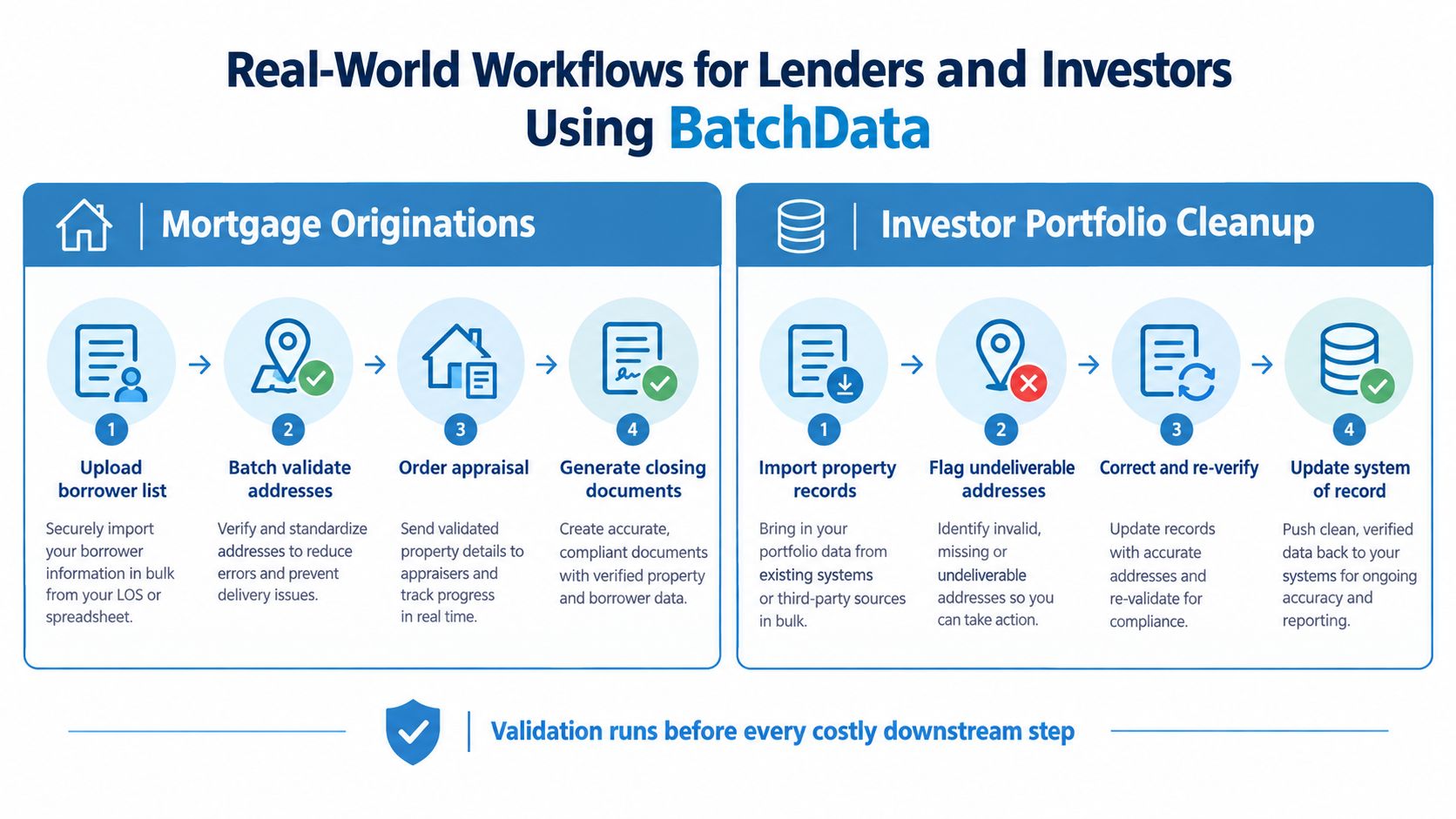
The strongest real-estate workflows place validation immediately before a costly action and use the result to decide whether to proceed, enrich, or review. The workflow shouldn't stop at a corrected street line. It should connect address confidence to the next operational step.
Mortgage origination pipeline
A lender can start with borrower addresses from an application system, servicing export, or partner file. Before ordering an appraisal or mailing disclosures, the pipeline should preserve the submitted value, parse the components, standardize the address, and evaluate primary and secondary delivery status.
The decision logic should be explicit:
- Primary confirmed, secondary confirmed: Continue to appraisal ordering and document generation.
- Primary confirmed, secondary missing: Request the apartment or unit number before mailing time-sensitive documents.
- Primary confirmed, secondary invalid: Preserve the street-level match, but pause delivery and route the record to correction.
- Unresolved or ambiguous: Send the record to human review rather than forcing a false match.
After the postal stage, a lender can add verified owner contacts and AVMs where the use case and permissions support it. The address result remains separate from contact identity. A deliverable address doesn't prove that a person owns or occupies the property.
Investor lead-enrichment pipeline
An investor platform may begin with property records, tax exports, list-provider files, or acquisition targets. Batch validation first identifies malformed and potentially non-deliverable records, then the system can run skip tracing, phone verification, and BatchRank propensity scoring on records that meet the project's quality and privacy rules.
That order matters. Enriching every malformed record increases review volume and can contaminate joins between properties, owners, tenants, and contact details. Use the validation status to determine whether the system should enrich, suppress, or request a correction.
A useful downstream report tracks:
| Signal | What it tells the team |
|---|---|
| Returned-mail rate | Whether mailing records remain operationally usable |
| First-attempt delivery | Whether corrected addresses work in practice |
| Contact rate | Whether enrichment reaches the intended party |
| Review queue size | Whether source systems are producing unresolved records |
| Status transitions | Whether records are degrading between refreshes |
For teams collecting property information from web sources before enrichment, a technical resource on how to scrape rendered HTML can help with acquisition architecture. It doesn't replace validation. It only improves the quality of the input arriving at the address pipeline.
Timeliness Rules, Privacy Expectations, and Secondary-Unit Handling
A validated address has a time context, a mailing purpose, and a privacy boundary. USPS checking periods differ by mailing type, and address validation must remain distinct from claims about occupancy, identity, or ownership.
USPS specifies these verification windows:
| Mailing type | Verification requirement |
|---|---|
| Presorted mail | ZIP Code verified within 12 months of mailing |
| Automation mail | Complete address verified within 95 days |
| Carrier-route mail | Carrier-route information verified within 90 days |
These requirements are described in USPS guidance for checking mailing addresses. Store the processing timestamp and the mailing class with every batch result. A record that passed a prior job may need revalidation before a later campaign or notice cycle.
Secondary information is delivery data
An apartment, suite, or unit isn't optional decoration in a multi-unit property. USPS Publication 28 requires a secondary unit designator such as APT, STE, or UNIT when the location contains a secondary unit, with the designator placed at the end of the delivery-address line under USPS secondary-address standards.
A pound sign shouldn't replace a known designator. If it is used instead, USPS requires a space between the sign and the secondary number. A pipeline should therefore preserve both the parsed unit value and the source representation, then flag missing or conflicting unit information instead of collapsing it into the street address.
Teams working on field definitions can use this explanation of address line 1 to keep primary and secondary components separate.
Privacy changes the output model
Address validation isn't proof of identity, ownership, lawful possession, or occupancy. NIST's digital-identity guidance includes checks for virtual post-office boxes and other high-risk address characteristics, but an address signal still doesn't establish who controls or lives at the location in its identity-proofing guidance.
Use purpose-limited fields:
- Deliverable: Can the postal system recognize and serve the address?
- Occupancy-associated: Is there an authorized, current basis for associating a person with it?
- Ownership-associated: Is there a separate source supporting an ownership relationship?
- Suppression status: Should the record be excluded from a particular use?
That separation reduces the risk of turning a postal match into an unsupported identity inference.
Why ZIP+4 Matches Are Not Enough and How to Avoid False Positives
A ZIP+4 match confirms an important postal relationship, but it doesn't automatically prove that a record is usable for delivery, inspection, contact, or identity workflows. The four layers must remain separate: syntactic validity, postal deliverability, physical existence, and operational usability.
The Universal Postal Union's 2025 analysis found that improving address accuracy can raise successful first-delivery attempts by up to 23%, with a median improvement of 5.4%, while poor address quality can reduce delivery success by as much as 14% in its 2025 delivery-address analysis. The same analysis distinguishes invalid addresses, addresses not found, and insufficient detail as different failure categories.

The multi-unit false positive
A multi-unit property can produce a plausible street-level or ZIP+4 result while still lacking the apartment number needed for successful delivery. Treating that result as fully deliverable creates a false positive. The safer outcome is primary confirmed, secondary unresolved, which preserves the verified street information and creates a targeted remediation task.
The schema should expose confidence as a set of statuses:
| Layer | Passing result | Failure or uncertainty |
|---|---|---|
| Syntax | Components can be parsed | Unstructured or malformed input |
| Postal match | Address maps to postal reference data | No current match |
| Primary delivery | Primary number is confirmed | Invalid or unrecognized primary |
| Secondary delivery | Unit is confirmed where required | Missing or invalid unit |
| Operational use | Record supports the intended workflow | Access, detail, privacy, or purpose limitation |
Measure outcomes, not just matches
A high match percentage can conceal returned mail, failed inspections, and incorrect person-property joins. Measure whether the address supported the actual task:
- Did the notice arrive on the first attempt?
- Did the field inspection reach the property?
- Did the investor contact the intended party?
- Did the record require manual correction?
- Did a previously confirmed record degrade during revalidation?
LACSLink and DPV can improve postal interpretation, but neither should be treated as proof of occupancy or ownership. The strongest pipeline keeps postal evidence, enrichment evidence, and business-use authorization in separate fields.
Batch Address Validation Implementation Checklist
A production implementation needs repeatable inputs, versioned processing, granular outputs, and feedback from downstream operations. Use this checklist before moving from pilot to scheduled jobs.
- Source and preserve: Keep the original address string, source system, record identifier, and ingestion timestamp.
- Choose a qualified engine: Use CASS-certified processing for U.S. postal coding, and document the reference-data version.
- Normalize without overwriting: Standardize fields, suffixes, directionals, and secondary-unit labels while retaining the raw input.
- Model confidence: Store ZIP+4, primary, secondary, exception, and operational-use statuses separately.
- Quarantine uncertainty: Route ambiguous, missing-unit, and unresolved records to review or enrichment queues.
- Apply privacy controls: Track purpose, provenance, retention, suppression, and any required consent separately from deliverability.
- Schedule revalidation: Align processing frequency with mailing type and the rate at which source records change.
- Monitor drift: Compare status transitions by geography and source system, not only in aggregate.
- Measure results: Track returned-mail rates, first-attempt delivery, contact rates, review volume, and downstream throughput.
BatchData describes a platform with 169 million-plus U.S. property records, 1,000-plus attributes, and daily updates, with APIs and bulk delivery through S3, Snowflake, or flat files. Teams can evaluate sandbox access, white-glove onboarding, and custom matching as part of a broader property-data stack, while keeping postal validation outcomes auditable and separate from ownership or contact inferences.
BatchData supports bulk address verification alongside property, ownership, valuation, contact, and enrichment data, so real-estate teams can place validation before underwriting, outreach, and servicing actions. Visit BatchData to request access, test your records in a sandbox, and design a batch pipeline around the statuses and downstream outcomes that matter to your operation.