



Title problems do not kill deals by themselves. Slow escrow teams, sloppy payoff coordination, missed recording windows, and weak communication do. In Las Vegas, the title company often controls all four, which makes your choice an operating decision, not a branding decision.
Here is the investor view. Local firms usually handle file friction faster, especially when the deal has assignment questions, entity vesting changes, seller trust issues, mail-away signatures, or last-minute payoff corrections. National groups usually perform better when the file is lender-driven, commercial, multi-state, or part of a higher-volume process that depends on standardized systems and broader underwriting reach.
That distinction matters more than the logo on the wire instructions.
This guide compares Las Vegas title companies the way active buyers, flippers, wholesalers, and brokers use them. Can they close volume without constant babysitting? Will the escrow officer work through a messy file, or just quote policy? Can the office handle digital signing, remote coordination, and investor-specific structures without turning every exception into a week of delay? Those are the questions worth asking. Before you pick a company, understand the title company fees that affect your closing costs.
My short list is simple:
- Best for local investor execution: Nevada Title Company
- Best for lender-heavy and institutional closings: Chicago Title
- Best for commercial transactions with direct underwriter depth: Stewart Title
- Best for hands-on branch access and title cleanup: Old Republic Title
- Best for commercial-oriented deal structure: WFG National Title
- Best for national systems and large commercial coordination: First American Title
- Best for scalable volume inside a major national platform: Ticor Title
Use a local specialist when the file needs judgment calls and fast problem-solving. Use a national powerhouse when the deal needs process depth, lender alignment, or multi-state support. That is the frame for the rest of this guide.
1. Nevada Title Company
If you're an investor closing in Clark County and you want people who understand local file friction without routing everything through a national machine, Nevada Title Company is a smart pick. It fits buyers, flippers, wholesalers, landlords, and agents who need escrow staff that can move with the deal instead of forcing the deal into a rigid process.
Nevada title workflows matter more here because, in Las Vegas, title companies often handle both the title search and escrow as the neutral third party. That means the operational controls that matter are chain-of-title verification, document custody, and conditioned fund disbursement, not just issuing a policy (Las Vegas title and escrow functions). Nevada Title Company benefits when your priority is getting all of those moving parts handled by a team that knows the local terrain.
Where it fits
This is the kind of office you use when the file needs conversation. Resale. Refinance. Entity vesting. Mail-away signing. Assignment-sensitive investor deals. The advantage is less about flashy tools and more about whether the escrow team can spot a problem early and keep recording from slipping.
What stands out
- Investor-friendly file handling: Entity purchases, non-owner-occupant deals, and more custom closing structures are typically easier when the office is used to them.
- Broad escrow coverage: Residential, commercial, lender, and builder activity under one umbrella makes handoffs simpler.
- Local operating knowledge: That matters when curative items or recording logistics get messy.
Practical rule: If your deal has unusual signatures, layered entities, payoff timing issues, or assignment sensitivity, choose the office that will answer the phone and solve it.
The downside is simple. You usually won't get posted pricing online because Nevada runs on a regulated rate structure and quote-based workflows, so you need an actual file or scenario for precision. If you want a primer on what title charges usually include, review this breakdown of title company fees.
Use the official site here: Nevada Title Company
2. Chicago Title (Fidelity National Title Group) Nevada
Chicago Title works best when your closing volume is high enough that process matters more than personality. In Las Vegas, that usually means lender-driven purchases, builder contracts, repeat brokerage files, and multi-state transactions where nobody wants to explain the same escrow structure twice.
From an investor perspective, Chicago Title is the pick when you want a branch plugged into a national operating system. That matters if you buy across markets, close through LLCs, or need cleaner coordination with outside lenders and agent teams. The upside is consistency. The downside is simple. You need to confirm early who is handling the file, because execution still depends on the local escrow officer, not the logo on the wire instructions.
Where it fits
Choose Chicago Title when repeatability is the priority.
If your team is working through a steady acquisition pipeline, standard purchase contracts, or financed deals with tighter compliance requirements, Chicago Title usually makes the handoff easier. Large underwriter infrastructure helps keep document flow, lender communication, and closing procedures familiar across files. For operators tracking acquisition activity across the valley, the Clark County data in our Investor Pulse reports gives useful context for how active that pipeline can get.
Best-fit scenarios
- Financed acquisitions: Lenders like predictable title and escrow workflows.
- Repeat investor volume: Better fit for buyers who want the same process every time.
- Multi-state ownership groups: Easier coordination when your team already works with national title brands elsewhere.
- Builder and brokerage pipelines: Standard files move faster when everyone knows the order of operations.
Practical rule: If the deal is ordinary but the volume is heavy, choose the office with systems your lender and agents already use.
Chicago Title is weaker on the margins where deals get odd. Double closes, assignment-sensitive contracts, unusual vesting questions, or files that need judgment calls can feel slower if the branch is rigid. That does not make it a bad option. It means you should ask direct questions before opening escrow: Who clears title? Who handles investor files? Have they closed your exact structure before?
If you need a quick refresher before comparing brands, read this explanation of what a title insurance policy is.
Use the official site here: Chicago Title Nevada
3. Stewart Title Las Vegas
Stewart Title earns its spot because it sits in the middle of two things investors care about. National underwriter strength and local execution. In Las Vegas, that matters more than brand polish. If you are buying at volume, handling commercial property, or trying to close a file with assignment language, entity vesting, or a tight lender timeline, you need a title company that can make decisions without sending your file through three layers of bureaucracy.
Stewart is a practical choice for investors who have outgrown purely retail-style escrow but do not want a giant branch system that treats every deal the same. The advantage is straightforward. You can often get the stability of a national platform while still dealing with people in-market who understand how local escrow moves.
Where Stewart fits best
Stewart makes the most sense for buyers and operators who need more than a basic purchase closing.
Good reasons to choose it
- Direct underwriter setup: Better fit when title questions need real underwriting review, not canned answers from a sales desk.
- Commercial capability: Useful for land, mixed-use, builder, and larger investment transactions where title, escrow, and document coordination all need to stay aligned.
- Digital workflow access: Online ordering and quote tools help if your acquisitions team opens multiple files and wants less back-and-forth.
- Local accountability: You can usually identify the actual office and team handling the transaction, which is a real advantage when deadlines start slipping.
The investor angle is simple. Stewart is stronger than a small local shop when the deal size grows or lender scrutiny increases. It is often more flexible than a process-heavy national branch when the contract structure is not perfectly standard.
That does not mean you should assume every Stewart office handles investor files the same way. Ask direct questions before you send earnest money. Have they closed assignments? Will they insure a double close? Who clears title issues locally? How are mobile signings, remote notarization, and document updates handled if your buyer, seller, or funding partner is out of state?
If you are actively buying in the valley, review Clark County investor activity in our Investor Pulse reports before choosing an escrow partner. Volume changes the service level you need.
Use the official site here: Stewart Title Las Vegas
4. Old Republic Title Las Vegas (Fort Apache branch)
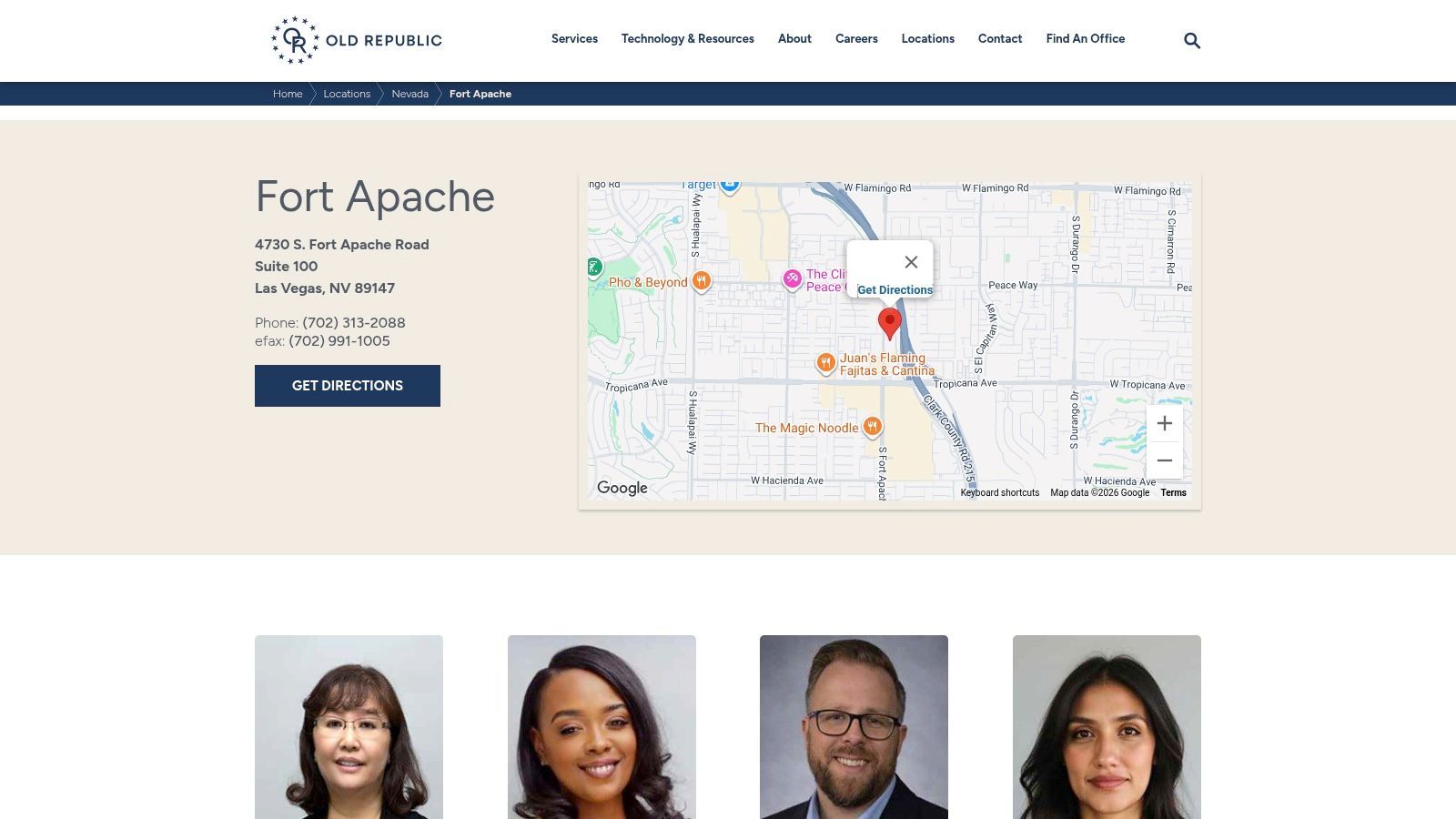
Old Republic Title is the pick when you care more about officer quality than front-end polish. That's not a criticism. That's usually where experienced investors make money. The Fort Apache branch stands out because branch-level staffing and officer visibility matter when the file needs real curative work, not just status updates.
This is a practical fit for residential closings that may have title noise attached, along with mid-market commercial transactions that need clean coordination between title, escrow, payoff handling, and recording. If you're dealing with lien cleanup, vesting corrections, old conveyance issues, or servicer-sensitive timelines, that branch-level structure matters.
Where Old Republic is strongest
Old Republic makes sense when your question is, “Who is touching this file?” not “How pretty is the portal?”
Good reasons to choose it
- Experienced title and escrow officers: You can often identify the actual team more easily.
- Curative orientation: Better fit for defects, exceptions, or clean-up work.
- Direct underwriter stability: Useful for lender and servicing confidence.
The weak spot is self-service. If you like clicking through online tools, calculators, and consumer-facing workflows, some competitors are more polished. Old Republic is better when human review is the value.
Field advice: On any file with title defects, ask for the officer's plan to clear exceptions before you ask about closing date. The date is meaningless if the defect is still sitting there.
Use the official site here: Old Republic Title Fort Apache
5. WFG National Title Las Vegas (Arroyo Crossing Commercial Office)
Commercial files fail at the handoff. The buyer, lender, title team, and escrow team all think someone else is driving. WFG National Title at Arroyo Crossing is worth your time if you want a Las Vegas office built around commercial coordination instead of retail closing volume.
From an investor's perspective, WFG sits in a useful middle lane. It has more process and platform support than a small local shop, but it can still feel more reachable than the biggest national brands. That matters on deals with assignments, entity-heavy buyers, layered seller documents, or repeat closings that need the same setup every time.
Why investors use this office
The main advantage is specialization. A commercial-focused office usually handles operating agreements, authority documents, vesting review, payoff coordination, and recording logistics with fewer slowdowns than a general residential branch. That saves time on the files that make money.
Best-fit scenarios
- Commercial acquisitions and sales: Better fit for purchase contracts, due diligence timelines, and lender-driven closing conditions.
- Repeat investor business: Useful when you want one team handling LLC documents, signing protocols, and wire procedures the same way each time.
- Structured deals: Better candidate for assignments, entity changes, or closings that need extra underwriting review before signing.
WFG also publishes Nevada rate information and office details on its site, which is a practical plus. Serious operators want to review the fee framework, digital options, and office contacts before they send over a contract, not after the file is already drifting.
The limitation is simple. If you are closing a basic owner-occupant deal with no complexity, this office is probably more specialization than you need. Use WFG Arroyo Crossing when the file has moving parts and you want a team that handles commercial work all day.
Use the official site here: WFG National Title Arroyo Crossing
6. First American Title Nevada (including Las Vegas National Commercial Services)
Large files break at the handoff points. First American makes sense when your deal has enough parties, approvals, and document layers that a small local office starts to feel cramped.
From an investor's perspective, this is one of the clearer national-versus-local decisions in Las Vegas. If you are closing a straightforward SFR purchase, First American can feel heavier than necessary. If you are handling portfolio sales, lender-controlled timelines, cross-state entities, or commercial assets that need National Commercial Services involvement, the extra structure helps.
Where First American fits best
Use First American when process control matters more than personality. Their Nevada operation, paired with National Commercial Services, is better suited to files that require tighter coordination between escrow, underwriting, lenders, and outside counsel.
Best-fit scenarios
- Multi-state or portfolio transactions: Better choice when ownership, vesting, or collateral touches more than one jurisdiction.
- Commercial deals with layered approvals: Useful for assets that need entity review, formal signing authority checks, and lender conditions cleared in order.
- Assignment-heavy or entity-based investor closings: Stronger fit when the buyer is an LLC, the contract changed hands, or underwriting needs to bless the structure before signing.
- Digital-first closings: Good option for operators who want online order entry, centralized communication, and fewer branch-specific workarounds.
A key advantage is consistency. National platforms usually give repeat investors a more predictable file setup, wire procedure, and document review path across different transaction types. That matters when you are trying to scale closings instead of babysitting each one.
The tradeoff is friction at the front end. First American's tools and contacts can sit across consumer, local, and commercial channels, so your team needs to start in the right lane. If you send a complex file into the wrong office first, you lose time.
My recommendation is simple. Use First American for commercial property, institutional counterparties, portfolio activity, and investor deals where underwriting discipline matters more than speed-to-hello. For routine local closings, a smaller office can be faster.
Use the official site here: First American Nevada Commercial Locations
7. Ticor Title of Nevada (Fidelity National Title Group)
Ticor Title of Nevada fits teams that close a lot of files and want fewer surprises. If you run repeat residential volume, work with lender-driven timelines, or need a title partner your counterparties already recognize, Ticor deserves a hard look.
The investor angle is simple. Brand familiarity helps, but throughput matters more. Ticor sits inside the Fidelity National network, which gives it a practical advantage on files that need standardized process, predictable underwriting channels, and offices that know how to work inside a larger production system. For flippers, broker teams, and buy-and-hold operators closing again and again, that can save real time.
Who should use Ticor
Ticor is a strong fit for teams that care about repeatability more than hand-holding on every file. If your operation depends on getting contracts opened fast, moving escrow with fewer custom workarounds, and keeping agents, lenders, and transaction staff on familiar rails, this is the kind of platform that holds up better under volume.
Best fit scenarios
- Brokerage and team volume: Good choice for offices that need a title partner built for recurring closings, not one-off exceptions.
- Lender-aligned transactions: Useful when the lender, agent, and escrow sides all benefit from familiar forms, procedures, and approval paths.
- Builder-adjacent and repeat investor work: Better fit for operators who want consistency across multiple files instead of reinventing process each time.
- Digital workflow users: A reasonable option if your team wants online access and centralized coordination without depending entirely on one branch's manual habits.
The main risk is simple. Execution still depends on the escrow officer, not the parent company. Large networks can process a lot of business, but service quality still varies by branch and by team. If you are an investor doing assignments, entity purchases, or fast-turn deals, ask direct questions before you send the file over.
Ask who handles repeat investor closings. Ask how they deal with entity documents, assignment documentation, and last-minute lender conditions. Ask how wires, seller payoffs, and signing updates are communicated. If the answers are vague, move on.
My recommendation is straightforward. Use Ticor when you want scale, familiar process, and a platform that can support an ongoing closing pipeline. For highly customized investor files, choose the specific escrow officer first, then decide whether the Ticor office is the right fit.
Use the official site here: Ticor Title of Nevada
Top 7 Las Vegas Title Companies Comparison
| Provider | Implementation Complexity 🔄 | Resource Requirements ⚡ | Expected Outcomes 📊 | Ideal Use Cases 💡 | Key Advantages ⭐ |
|---|---|---|---|---|---|
| Nevada Title Company | Low–Moderate, local processes and investor workflows; quotes required for rates | Local branches and responsive escrow teams; partner 1031 coordination | Reliable, timely Las Vegas closings with investor support | High‑volume Las Vegas residential, investor assignments, refinances | Deep local underwriting knowledge and broad escrow capabilities |
| Chicago Title (Fidelity National) – Nevada | Moderate, integrates national systems which can add steps | Access to FNF infrastructure and national commercial services | Scalable, enterprise‑grade processing for multi‑site portfolios | Enterprise lenders, multi‑state portfolios, complex commercial deals | Strong capacity for enterprise transactions and recognized workflows |
| Stewart Title – Las Vegas | Moderate, direct underwriter workflows with online portals; some services deal‑dependent | Quote/order portals, local commercial support, visible team contacts | Clear quoting/tracking and solid commercial support for larger deals | Commercial deals, builders, users who want online order/quote access | Direct underwriter strength and accessible online tools |
| Old Republic Title – Las Vegas (Fort Apache) | Low–Moderate, branch‑centric; often requires direct contact for specifics | Experienced local escrow/title officers and curative resources | Effective curative/recording resolution and stable underwriting | Mid‑market commercial, curative matters, lender/servicer needs | Strong curative capabilities and well‑documented local team |
| WFG National Title – Las Vegas (Arroyo Crossing) | Moderate–High, commercial‑first processes for complex structuring | Dedicated commercial team, enterprise network and digital toolset | Tailored solutions for complex commercial and portfolio deals | Commercial and enterprise asset transactions | Enterprise‑friendly processes and direct commercial structuring |
| First American Title – Nevada | Moderate, multiple portals (consumer vs NCS) can require navigation | National systems, NCS team, enterprise documentation and security | Robust support for lenders/servicers and multi‑state specialty assets | Lenders, servicers, large commercial portfolios and specialty assets | Strong national systems and National Commercial Services depth |
| Ticor Title of Nevada (FNF) | Moderate, leverages FNF systems; branch variation possible | Local leadership with national resources and online rate tools | Scales well for volume closings and investor pipelines | High‑volume investor closings, builders, lender workflows | Familiar to local brokers and scalable for pipeline volume |
Executing Your Closing Strategy
The best title company in Las Vegas is the one built for your exact file. That's the whole game. If you're buying a straightforward house with a clean chain and normal financing, local execution and responsive escrow may matter most. If you're handling commercial property, a portfolio acquisition, or a multi-state transaction, national underwriting infrastructure stops being optional.
Here's the blunt version. Nevada Title Company is a strong choice for local investor work and hands-on file management. Chicago Title and Ticor make sense when lender familiarity and scalable FNF workflows matter. Stewart is a strong middle ground if you want direct-underwriter credibility with visible Las Vegas commercial support. Old Republic is worth calling when the file has defects, exceptions, or branch-level officer quality is the deciding factor. WFG is best treated as a commercial-first option. First American is the institutional pick for large, structured, and multi-jurisdictional closings.
Before you open escrow, get clear on five things:
- Deal structure: Individual, LLC, trust, assignment, or portfolio purchase.
- Asset type: Residential resale isn't the same as land, mixed-use, or commercial.
- Counterparty demands: Lender, servicer, builder, fund, or private seller.
- Signing logistics: Local, remote, mail-away, or multiple signers.
- Title complexity: Clean file, payoff issue, lien cleanup, vesting problem, or curative work.
That due diligence starts before title. It starts when you identify the asset and decide whether it's worth pursuing. If you need a transaction-side document after the acquisition path is set, this guide to create a property bill of sale is a useful complement.
If you're sourcing, screening, or validating opportunities before the file ever reaches escrow, BatchData can fit earlier in the workflow. Its recorder and mortgage data can support property research, chain-of-title review, and encumbrance checks before you hand the deal to a title officer. That won't replace title insurance or escrow. It helps you show up with better information.
If you want cleaner acquisitions before you ever choose a title company, use BatchData to pull property, ownership, mortgage, and recorder data at scale. It's a practical fit for investors, lenders, and proptech teams that want faster due diligence and better deal screening upstream of closing.