






































MCP servers are transforming how real estate professionals access and use data. These servers connect natural language queries to real estate APIs, enabling instant access to structured data without manual coding. For example, you can simply ask, "Find distressed properties in Atlanta under $300,000", and the server handles the complex backend processes.
Key highlights:
- Event-Driven Model: Sends real-time updates (e.g., new property listings) using webhooks, eliminating manual polling.
- Request-Response Model: Provides precise, on-demand data retrieval for tasks like property valuations or lead prospecting.
- Hybrid Model: Combines real-time updates with detailed analysis, ideal for managing large property portfolios.
These models speed up workflows, improve data accuracy, and simplify complex tasks, making them essential tools in the competitive real estate market.
This AI-Powered Server Just Made Real Estate Marketing INSANELY Easy! 🏡
sbb-itb-8058745
1. Event-Driven Streaming MCP Model
The event-driven streaming model changes how real estate data is delivered. Instead of constantly asking, "Is there anything new?" – a method known as polling – the data is sent to you as soon as it updates. This push-based approach uses webhooks and direct integrations to provide immediate updates on property matches, deed recordings, or status changes. By eliminating repetitive polling and manual querying, this system speeds up decision-making, a critical advantage in real estate.
Latency and Scalability
Speed is the standout feature of this model. Without the delays caused by polling, notifications are delivered the moment a property event occurs. Investors can perform multiple Smart Searches simultaneously without needing to manually monitor updates. BatchData‘s database, which includes over 600 million records spanning addresses, properties, and phone numbers, ensures that the system continuously scans a massive data pool around the clock. This allows for instant notifications and guarantees access to the most up-to-date information.
Data Freshness
This model guarantees that deed recordings and property statuses are updated daily, keeping the data fresh. As Victor Lund from WAV Group explains:
"Static datasets do not work. MCP servers deliver live connectivity."
By relying on real-time updates, the model minimizes the risk of errors caused by outdated or unverified data, a common issue in AI systems.
Operational Complexity
Despite its benefits, the event-driven model comes with challenges. Rate limits on certain endpoints can slow down operations; for instance, BatchData’s address geocoding endpoint allows a maximum of 90 requests, so using a batch size of 75 helps maintain reliability. Security is another concern. Manual token management increases vulnerability, but switching to OAuth authentication resolves this by automating token handling and streamlining access control for teams.
Real Estate Use Cases
This model powers automated lead generation pipelines directly into CRMs, enabling immediate action when a distressed property or new deed recording matches specific criteria. For investors, this means acting on opportunities before competitors even notice – a critical advantage in fast-paced markets.
| Feature | Traditional Pull API | Event-Driven MCP Model |
|---|---|---|
| Mechanism | Manual polling/querying | Automated webhooks/streaming |
| Speed | Delayed by polling interval | Instant, real-time delivery |
| Data State | Often outdated | Updated daily at recording |
| User Effort | High – repetitive manual searches | Low – set criteria once |
| Scalability | Limited by manual workload | Supports multiple markets at once |
2. Request-Response Orchestration MCP Model
The request-response orchestration model stands apart from the push-based event-driven approach by delivering precise, on-demand data. Here, an AI agent sends a query to the MCP server, which retrieves structured, up-to-date information from trusted sources. This setup is especially useful in industries like real estate, where accurate valuations and timely insights are essential.
Latency and Scalability
To keep latency low and resource use efficient, techniques like field projection (e.g., querying ?fields=zpid,price) and in-process memoization (which avoids repeating API calls) are employed. For enterprises, scalability is addressed by deploying hosted MCP servers using HTTP alongside Server-Sent Events (SSE). This allows a single integration to serve multiple users simultaneously, eliminating the need for individual local setups.
Another key to scalability is intelligent task routing. Simple queries are handled by lightweight Small Language Models (SLMs), while more demanding tasks are escalated to larger models only when necessary. This keeps compute costs predictable and ensures efficient handling of diverse property-related queries. Together, these strategies maintain consistent performance and ensure access to the most current data.
Data Freshness
On-demand queries connect directly to live data sources, ensuring that information like listing prices, market trends, and property details is always current. Victor Lund of WAV Group highlights the importance of this approach:
"MCP servers are not simply integration tools. They are a mechanism for maintaining digital sovereignty in an AI-driven marketplace."
For real estate professionals, this means immediate access to accurate valuations, flood risk assessments, and loan-to-value (LTV) details – all reflecting the latest market conditions rather than outdated information. While data precision is critical, operational details also play a role in optimizing performance.
Operational Complexity
Implementing this model requires careful attention to operational details. For instance, API calls should have a 60-second timeout limit to prevent false failures when accessing cold data caches. Errors should be returned in plain text – { error: "not_found" } – to avoid disrupting the AI agent’s workflow. Additionally, exposing too many endpoints can lead to confusion and incorrect tool usage. A focused toolset of 3–4 well-defined tools, such as lookup_property or search_listings, improves reliability. For batch processing, BatchData recommends limiting requests to 1,000 per batch (though up to 5,000 are supported) for optimal performance.
Real Estate Use Cases
The request-response model is a natural fit for workflows that rely on structured, on-demand data retrieval rather than continuous updates.
| Real Estate Use Case | How the MCP Model Helps | Key Tools Used |
|---|---|---|
| Investment Analysis | Compares market fundamentals and distress indicators across cities | search_properties, lookup_property |
| Lead Prospecting | Instantly identifies owners and verifies contact reliability | skip_trace_property, verify_phone |
| Due Diligence | Automates collection of tax history, liens, and demographics | lookup_property, verify_address |
| Underwriting | Retrieves valuations, flood risks, and LTV details in one query | Property + risk data tools |
| Agent Prospecting | Finds expired or withdrawn listings using natural language queries | search_properties |
BatchData sums it up well: "If you can write a sentence, you can access our data.". This model simplifies access to reliable, real-time answers, even for those without technical expertise.
3. Hybrid Streaming and Orchestration MCP Model
The hybrid model blends continuous streaming for quick updates with request-response orchestration for precise queries. By combining the strengths of event-driven streaming and traditional orchestration, this model is tailored for dynamic real estate operations. It ensures tasks are routed to the most efficient method, making it ideal for workflows requiring both real-time monitoring and detailed analysis.
Latency and Scalability
In this setup, task routing becomes more sophisticated. Instead of choosing one approach, it coordinates between two active layers. For example, straightforward queries – like checking a property’s listing price – are handled by lightweight Small Language Models (SLMs) for fast, cost-effective responses. On the other hand, complex tasks, such as comparing investment opportunities across multiple cities, are escalated to larger models only when necessary. Victor Lund of WAV Group highlights this efficiency:
"MCP-enabled workflows let organizations route tasks intelligently. Simple queries use lightweight SLM models; complex analysis escalates only when necessary. That keeps costs predictable."
For handling large datasets, tools like search_properties_page and comparable_property_page use both offset and cursor-based pagination. This ensures smooth processing of thousands of records without overwhelming the system. Additionally, multi-client deployments are supported through Streamable HTTP, allowing a single integration to serve entire teams simultaneously. This layered approach ensures consistent performance and up-to-date data.
Data Freshness
The hybrid model maintains a live connection to MLS records and property databases, ensuring AI outputs are always informed by the latest listings, price changes, and market trends. This real-time access minimizes reliance on outdated data and reduces the risk of AI "hallucinations" by grounding outputs in authoritative, current sources.
Operational Complexity
Running streaming and orchestration simultaneously does come with challenges. For instance, timeout mismatches can occur, as AI clients often operate within 10-second limits, while more complex queries might take longer. A practical solution is the Job ID pattern, where the system immediately returns a Job ID, allowing the AI to poll a separate resource for the result.
Another issue is tool name collisions. For example, when integrating multiple MCP servers – such as one for MLS data and another for tax records – each might have a tool named search. To avoid confusion, tools can be namespaced by provider, such as batchdata_search_properties. Additionally, OAuth 2.1 is preferred over static API tokens in team environments. OAuth 2.1 enables automatic token refreshing and centralized access management, reducing manual effort and improving security. These strategies help balance the hybrid model’s complexity while ensuring its reliability.
Real Estate Use Cases
The hybrid model shines in workflows that demand both real-time updates and deep, structured analysis within the same session.
| Use Case | Streaming Layer | Orchestration Layer |
|---|---|---|
| Portfolio Monitoring | Flags price drops or new listings in real time | Initiates detailed property lookups on flagged assets |
| Bulk Skip Tracing | Streams batch job status updates | Retrieves verified contact data upon completion |
| Market Intelligence | Pushes alerts on distressed property signals | Runs comparable analysis |
| Lead Enrichment | Monitors new listing events | Enriches owner records with phone verification |
This hybrid approach is particularly effective for enterprise teams managing large property portfolios or conducting high-frequency prospecting. It strikes a balance between speed and in-depth analysis, making it a powerful tool for modern real estate operations.
Pros and Cons of Each MCP Model
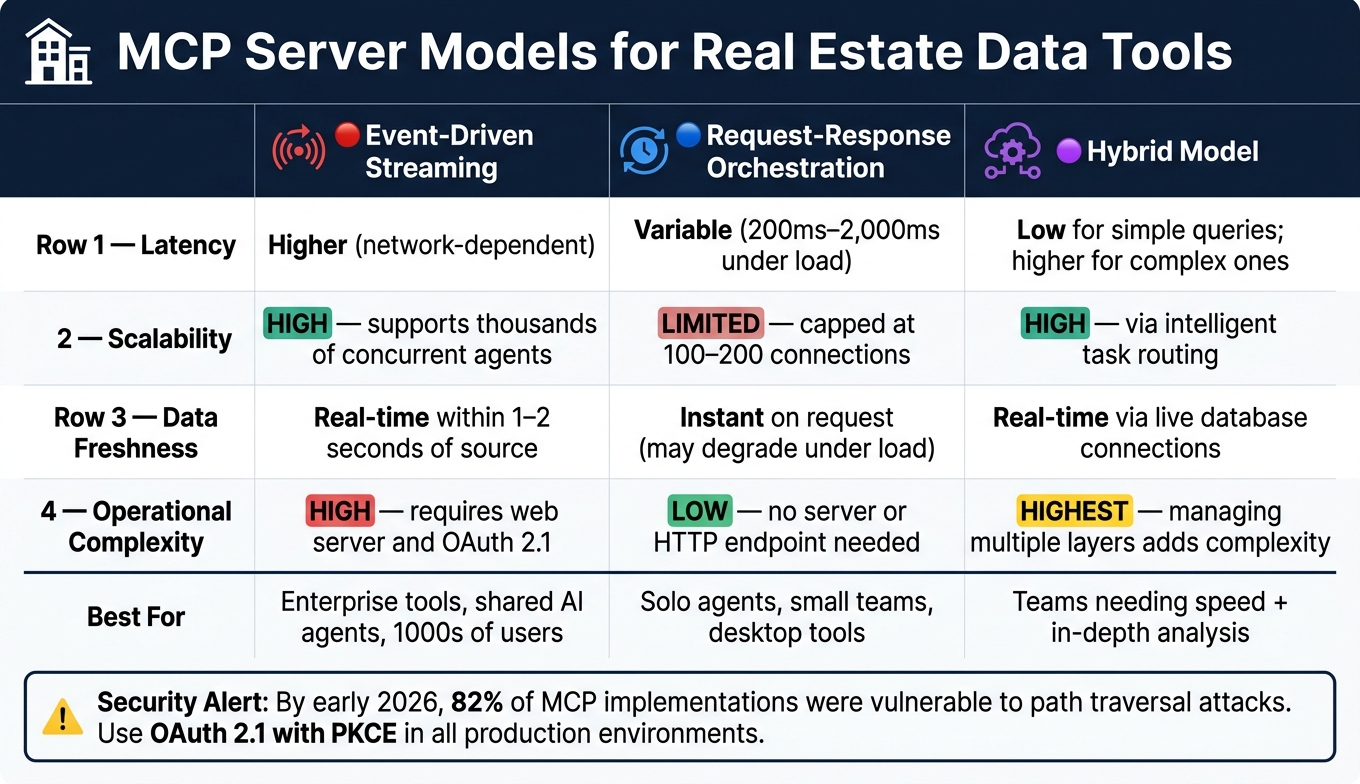
MCP Server Models for Real Estate: Event-Driven vs Request-Response vs Hybrid
When it comes to real estate data tools, picking the right MCP model can make or break your workflow. Each model has its own strengths and weaknesses, and understanding these trade-offs is key to making the best choice for your needs.
The Event-Driven Streaming model, which uses Streamable HTTP, is designed for scalability. As Greg Low points out:
"Streamable HTTP… is far more suitable for remote access, shared services, and multi-client scenarios."
However, this model comes with some challenges. Network latency is higher compared to local setups, and it requires robust server management and security measures. It’s a great fit for enterprise-level tools and shared AI agents but might be overkill for individual developers.
The Request-Response Orchestration model focuses on simplicity. Greg Low highlights:
"The main advantage of stdio is its simplicity. There is no separate web server to publish, no HTTP endpoint to configure, and no network path to secure."
But simplicity has its downsides. Under heavy workloads, query latency can spike – from around 200 ms to as much as 2,000 ms. Performance also tends to degrade when multiple queries are issued per request.
The Hybrid model strikes a balance by routing tasks through different layers, combining speed with analytical depth. However, this approach introduces additional operational complexity that teams must account for.
Here’s a quick comparison of the three models:
| Dimension | Event-Driven Streaming | Request-Response Orchestration | Hybrid |
|---|---|---|---|
| Latency | Higher (network-dependent) | Variable (200 ms–2,000 ms under load) | Low for simple queries; higher for complex ones |
| Scalability | High – supports thousands of concurrent agents | Limited by connection pool (100–200 connections) | High, via intelligent task routing |
| Data Freshness | Real-time; within 1–2 seconds of source | Instant on request, though performance may suffer under load | Real-time via live database connections |
| Operational Complexity | High – requires web server and OAuth 2.1 | Low – no server or HTTP endpoint needed | Highest – managing multiple layers adds complexity |
Security is a key concern across all models. By early 2026, 82% of MCP implementations were found to be vulnerable to path traversal attacks due to insecure file operations. To mitigate these risks, it’s critical to follow strict MCP security practices, including origin validation and using OAuth 2.1 with PKCE, especially in production environments handling real estate data solutions.
Conclusion
Choosing the right MCP model depends on factors like scale, budget, and how fresh the data needs to be. Each model has its strengths tailored to specific use cases. For solo agents or small teams creating desktop tools, the Request-Response Orchestration model (stdio) is a budget-friendly option that skips the need for a dedicated server or extra network security. On the other hand, if you’re supporting thousands of users at once, the Event-Driven Streaming model using Streamable HTTP is better suited, though it requires more resources to manage. For teams that need both fast performance and in-depth analysis, the Hybrid model strikes a balance – if they can handle the extra engineering challenges. These options underline the trade-offs between simplicity, scalability, and operational demands.
Data integration continues to advance rapidly. As Victor Lund of WAV Group explains:
"MCP servers empower real-world data grounding in an AI-driven marketplace."
For U.S. real estate businesses dealing with property and contact data, platforms like BatchData offer AI tools powered by up-to-date, reliable data to reduce inaccuracies in AI outputs.
Abhas Ricky, Chief Strategy Officer at Cloudera, adds:
"The next era will reward specialization, efficiency, and real-world grounding in data owned by companies."
For the real estate sector, MCP servers provide a clear advantage in staying competitive.
FAQs
Which MCP model fits my real estate workflow?
The BatchData MCP server is a game-changer for real estate professionals who want to integrate property data effortlessly – no coding required. Powered by AI, it transforms natural language requests into structured data queries, making it incredibly user-friendly for those without technical expertise.
With just a few simple prompts, you can automate tasks like property research, investment analysis, and marketing. Forget about the hassle of manual API integration – this tool is all about speed, simplicity, and smart automation to streamline your workflow.
How do MCP servers keep data accurate and up to date?
MCP servers excel at ensuring data stays accurate and up-to-date by linking AI tools to real-time sources like BatchData. To keep data properly formatted and ensure type safety, they rely on validation tools like Zod and TypeScript.
What sets them apart is their ability to process updates quickly. Property listings, status changes, and ownership records are refreshed within just 24 hours, achieving a 99% accuracy rate. On top of that, real estate-focused models are used to interpret the industry’s often complex data, delivering trustworthy insights tailored specifically for this field.
What security steps matter most for MCP in production?
When it comes to protecting MCP servers in a live environment, a few key practices can make a big difference:
- Encrypt Data Transmissions: Always ensure that data being transmitted is encrypted to safeguard it from interception. This is non-negotiable in production settings.
- Use OAuth for Authentication: OAuth offers strong security and efficient token management, making it an ideal choice for handling authentication.
- Handle API Tokens with Care: If you need to use API tokens, treat them like sensitive credentials. Store them securely, such as in environment variables, to reduce the risk of exposure.
- Review Tool Permissions Regularly: Use the MCP approval prompt to frequently review and adjust tool permissions, ensuring they align with current needs.
- Monitor API Usage: Keep an eye on API activity through the BatchData dashboard. This helps you catch unauthorized access or unexpected usage spikes early.
By sticking to these practices, you can strengthen the security of your MCP servers and reduce potential vulnerabilities.