


































Machine learning is transforming real estate forecasting by delivering precise 6 months property sales predictions. Unlike traditional methods that rely on intuition and limited data, AI analyzes thousands of variables – like property details, owner behavior, and market trends – in real time. Tools like BatchRank™ assign each property a sale likelihood score, helping professionals focus on leads most likely to sell.
Key takeaways:
- AI models achieve up to 82% accuracy in predicting property sales within 6 months.
- Properties priced using AI sell 40% faster, and lead generation tools boost conversion rates by 33%.
- AI processes over 1 billion data points daily, covering 155 million U.S. properties. Developers and data scientists can access this scale of information through a real estate API to build custom predictive models.
While AI offers unmatched scale and precision, human intuition still plays a role in handling disruptions or unique market conditions. Combining AI’s data-driven insights with human expertise creates a more effective approach to real estate forecasting.
How Machine Learning Predicts Property Sales with 6 months Accuracy
Machine learning has made predicting property sales within a 6 months window incredibly precise by analyzing over 5,000 variables simultaneously – something traditional methods just can’t handle. These models process a wide range of data, including property details, ownership history, economic indicators, and local market trends. Plus, they adapt in real time as new information becomes available.
Regression Models, Time-Series Analysis, and Neural Networks
Gradient Boosting, especially XGBoost, has proven to be a standout tool for real estate forecasting. It uses decision trees to uncover nonlinear connections between factors like interest rates, demographics, and property age. According to research from the University of Florida’s Warrington College of Business (updated through Q2 2024), XGBoost reduced forecasting errors by 68% compared to basic linear regression and 26% compared to multivariate regression models.
Neural networks excel at analyzing historical pricing trends and geographic data to refine property valuations. Meanwhile, random forests process massive datasets to find patterns between property features – like location or proximity to amenities – and price changes. Time-series and rolling-window analysis further enhance these models by continuously updating them with fresh data, ensuring they reflect current market conditions rather than relying on outdated snapshots.
Advanced systems also assign a sale propensity score to properties, predicting the likelihood of a listing within a specific timeframe. For instance, BatchRank uses this method to pinpoint homes likely to hit the market within 6 months. Some models even integrate Natural Language Processing (NLP) to analyze market sentiment from news and social media, while Computer Vision assesses property images for condition and style.
“Machine learning is a branch of AI that enables computers to learn patterns from data and make predictions without being explicitly programmed. Unlike traditional regression, ML algorithms can process massive datasets, identify nonlinear relationships and adapt as new data becomes available.”
– Anh Tran, UF Warrington College of Business
These algorithms thrive on diverse, real-time data inputs to deliver precise forecasts.
Data Inputs for AI Predictions
Accurate 6 months predictions rely on a wide range of data sources. Property-specific data includes details like age, size, condition, and square footage. Owner behavior signals, such as life events like marriage, divorce, or job changes, add another layer of insight. Economic indicators, including interest rates, consumer sentiment, and local employment trends, complete the picture.
BatchData’s models pull from an enormous dataset that includes 155 million properties, 361 million owners, and over 1,000 key attributes. This data spans equity positions, ownership duration, tax delinquency, vacancy status, and lien records. With over 3,200 data sources updated daily, the platform ensures predictions are based on the most current information available.
The quality and timeliness of the data are critical. Models trained on outdated or incomplete data produce unreliable results, while those using comprehensive and up-to-date information can pinpoint high-propensity sellers with precision. BatchData boasts 99.25% coverage for single-family homes and 99.02% for condos and townhouses, ensuring a statistically sound foundation for predictions.
How BatchData Improves AI Predictions
BatchData refines its predictions with proprietary tools like BatchRank™, which assigns properties a sale propensity score (High, Medium, Low) based on their likelihood of selling within 6 months. By blending statistical techniques, rule-based logic, and machine learning, the platform handles both standard and unique property types effectively.
“BatchRank’s proprietary AI analyzes millions of data points to identify properties most likely to sell in the next 6 months, turning speculation into precision.”
– BatchData
The platform also features a Model Context Protocol (MCP) Server, an AI-native gateway that enables large language models to perform property searches, valuations, and skip-tracing autonomously. For developers and data scientists, BatchData provides bulk data delivery via Amazon S3 or FTP, offering historical datasets for training machine learning models. Real-time APIs then score new properties against updated data, creating a system that balances depth with speed.
All predictions undergo rigorous back-testing using historical sales data to ensure they outperform traditional methods. With daily data updates and continuous validation, BatchData enables real estate professionals to focus their marketing efforts on homeowners statistically most likely to sell, avoiding wasted resources on unmotivated leads.
sbb-itb-8058745
AI Accuracy vs. Human Intuition in Property Sales Forecasting
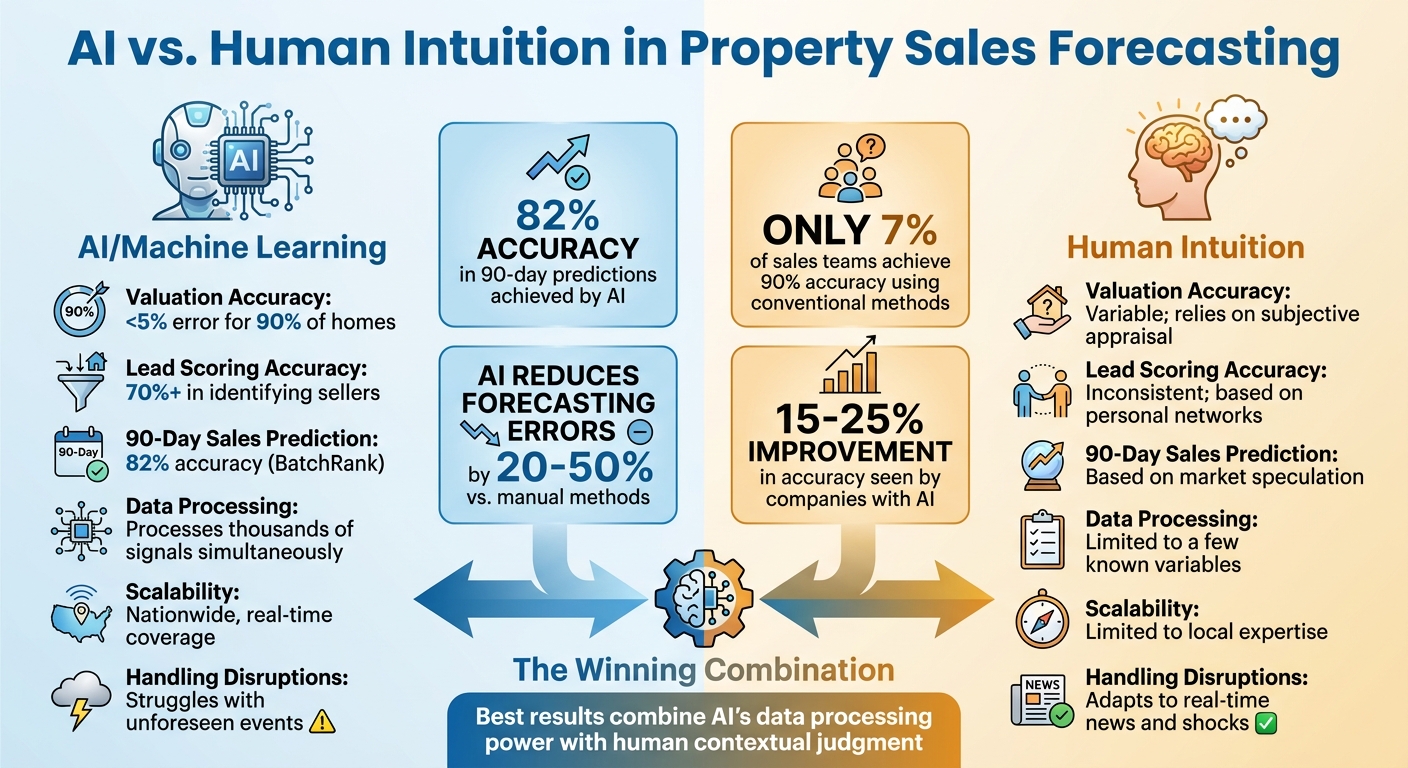
AI vs Human Intuition in Real Estate Forecasting: Performance Metrics Comparison
When it comes to predicting property sales within a 6 months window, machine learning models consistently outperform human intuition. AI can process millions of data points at once, while human forecasts are often limited by local knowledge and personal experience.
AI Performance Metrics
Recent tests highlight the power of AI in real estate forecasting. For example, BatchData’s BatchRank AI achieved an 82% accuracy rate in predicting property sales during Q3 2025. Real estate professionals leveraging AI tools have reported 76% more closed deals and 76% more homeowner reach compared to traditional methods.
Zillow‘s Zestimate tool estimates sale prices with an error margin of less than 5% for over 90% of homes in various U.S. metro areas. Similarly, SmartZip identifies potential sellers with over 70% accuracy. Some enterprise AI platforms even claim prediction accuracy levels as high as 98%.
AI models have been shown to reduce forecasting errors by 20% to 50% compared to manual methods. Companies with disciplined data practices see an additional 15–25% improvement in accuracy over traditional pipeline forecasting. By contrast, only 7% of sales teams achieve a 90% forecasting accuracy using conventional methods.
Despite these impressive numbers, human intuition still holds value in certain scenarios, offering a complementary perspective to AI’s efficiency.
Human Intuition: Strengths and Limitations
Human intuition shines in situations where historical data falls short. For example, regulatory changes or market rumors – factors that AI struggles to process – are areas where human expertise can adapt more effectively. Experienced professionals often rely on “tribal knowledge” to fill in gaps, especially in markets with limited or unstructured data.
Humans also play a critical role in challenging AI predictions that seem extreme or based on flawed data. In negotiations or culturally sensitive situations, human judgment often provides context and nuance that algorithms can’t replicate.
“Humans have common sense that they use to evaluate intuitive assumptions… AI lacks such a ‘safety net,’ and will simply output the result.”
– Alexander Gritsay, CEO, Forecast NOW!
However, intuition has its shortcomings. It’s hard to scale and often inconsistent, as it depends on individual experience and available time. Unlike AI, which can evaluate thousands of properties simultaneously, human forecasting is limited in scope.
These strengths and weaknesses highlight the importance of pairing AI’s scalability with the situational insight of human judgment.
Comparison Table: AI vs. Intuition
| Metric | AI/Machine Learning | Human Intuition |
|---|---|---|
| Valuation Accuracy | <5% error for 90% of homes | Variable; relies on subjective appraisal |
| Lead Scoring | 70%+ accuracy in identifying sellers | Inconsistent; based on personal networks |
| 6-Months Sales Prediction | 82% accuracy (BatchRank) | Based on market speculation |
| Handling Disruptions | Struggles with unforeseen events | Adapts to real-time news and shocks |
| Scalability | Nationwide, real-time coverage | Limited to local expertise |
| Data Processing | Processes thousands of signals | Limited to a few known variables |
The best results come from combining AI’s ability to process massive amounts of data with the nuanced decision-making that only human experience can provide.
Machine Learning Applications in Real Estate Forecasting
Machine learning is reshaping how real estate professionals – investors, agents, and service providers – identify opportunities and close deals. BatchData’s AI-powered tools showcase how predictive models can drive results in areas like property valuation, lead generation, and forecasting. Here’s a closer look at how these tools turn raw data into actionable insights.
Case Study: Property Valuation Updates with BatchData
BatchData’s Automated Valuation Model (AVM) combines statistical techniques, rule-based logic, and AI to evaluate over 150 million properties across the U.S., covering 99.25% of single-family homes and 99.02% of condos and townhouses. Updated monthly, the AVM delivers real-time valuations by analyzing property details, ownership history, market trends, and economic data – going beyond traditional appraisals that rely only on comparable sales. This approach is especially effective for unique or non-homogenous properties that lack sufficient comparables.
Real estate investors can access these valuations via RESTful APIs for single-record lookups or through Bulk Data Delivery (via Amazon S3 or FTP) for analyzing large portfolios.
Skip Tracing and Contact Enrichment for Lead Conversion
BatchData’s skip tracing service enhances lead conversion by enriching contact information. With access to 350 million phone numbers and 260 million email addresses, the service achieves a 76% right-party contact rate. It also includes compliance features like DNC and litigation tags.
In 2025, a national landscaping company partnered with BatchData to target new homeowners during the moving process. Using real-time ownership updates and enriched contact data, they reached 76% more homeowners compared to traditional methods.
“We prioritize the ability to help clients do it all in one place… You do not need five or six different data vendors to power your go-to-market stack anymore.”
– Matt Shephard, Chief Revenue Officer, BatchData
This enriched contact data works seamlessly with BatchRank’s sale propensity scores, allowing investors to focus on the top 50 high-propensity sellers in their target area rather than cold-calling thousands of properties. This targeted approach complements BatchData’s property forecasts, enabling more precise and effective outreach.
Custom Datasets for 6 months Sales Predictions
BatchData’s custom datasets are the foundation of its 6 months sales prediction model. The BatchRank™ AI Engine evaluates thousands of data points – such as property characteristics, ownership history, market trends, and lien data – to assign a propensity score to each property. With an 82% accuracy rate, the system predicts which properties are likely to sell within 6 months. It processes over 1 billion data points daily, covering 155 million properties and 221 million homeowners, ensuring that predictions remain up-to-date with recent sales and market changes.
Each property is assigned a clear indicator – High, Medium, or Low Propensity – or a numerical score, helping users prioritize leads with precision. For businesses developing their own machine learning models, BatchData offers Bulk Data Delivery through platforms like Amazon S3, Snowflake, or SFTP. These enriched datasets enable data scientists to train custom models and populate feature stores.
Looking ahead, the upcoming Model Context Protocol (MCP) server, launching in 2026, will allow non-technical users to query property intelligence using natural language, making predictive analytics more accessible.
“Our goal for BatchRank is more deals and less marketing spend.”
– Ivo Draginov, President, BatchData
Data-Driven Decisions vs. Intuition: Pros and Cons
Advantages of AI in Real Estate Forecasting
AI takes much of the uncertainty out of real estate investing. Take BatchData’s BatchRank AI, for example – it processes over 1 billion data points daily from 155 million U.S. properties, factoring in more than 800 attributes to deliver insights. In testing, it achieved an impressive 82% accuracy in predicting 6 months sales. This level of precision allows investors to zero in on high-propensity leads, saving time and resources.
Another big plus? Scalability. AI models apply consistent logic across the entire country, avoiding the subjective biases that often creep into traditional methods. Plus, with real-time updates, decisions are always informed by the latest market conditions instead of outdated information.
“Data without intelligence is just noise.”
– BatchData
Still, no matter how advanced AI becomes, there are times when human judgment is irreplaceable.
When Intuition Still Matters
AI excels at crunching numbers, but some situations call for the nuanced understanding only human professionals can provide. For instance, while AI depends on historical patterns, it can struggle when sudden market changes – like new regulations, geopolitical tensions, or unexpected events – disrupt those patterns. That’s where experienced professionals step in, bringing a level of contextual awareness that algorithms simply can’t replicate. Think about factors like a neighborhood’s evolving reputation, a developer’s past performance, or even the curb appeal of a property – these are things that data alone can’t fully capture.
Human expertise becomes even more critical when data is limited. Seasoned agents often rely on what’s sometimes called “tribal knowledge” – informal but invaluable insights into things like seller motivations, emotional readiness, or community dynamics. The best results often come from blending both approaches: using AI to narrow the field to high-potential leads and then applying human judgment to tailor outreach to each seller’s unique circumstances.
Pros and Cons Table: AI vs. Intuition
| Feature | AI-Driven Analysis | Human Intuition |
|---|---|---|
| Accuracy | 82% predictive accuracy for 6 months sales | Based on speculation and subjective judgment |
| Data Volume | Processes 1B+ data points and 800+ attributes | Limited to manual review of fragmented lists |
| Update Frequency | Real-time, continuous updates | Periodic; often relies on outdated data |
| Scalability | Nationwide coverage (155M+ properties) | Limited to specific local markets |
| Lead Focus | Surgical precision (top 50 high-propensity leads) | Broad targeting of thousands of properties |
| Contextual Awareness | Limited to programmed parameters | Shaped by cultural, social, and emotional factors |
| Adaptability | Struggles with novel, high-stakes scenarios | Thrives in uncertainty and “gray areas” |
Implementing BatchData for 6 months Sales Accuracy
Getting Started with BatchData APIs and Custom Solutions
BatchData can be integrated in three key ways: MCP-first for direct connections to large language models, API-driven microservices for high-throughput tasks like CRM enrichment and real-time property searches, and a Bulk + API hybrid approach for teams that need both large datasets and real-time scoring capabilities. These integration options are tailored to provide actionable insights, particularly for predicting property sales within a 6 months window.
Want to get started quickly? Open a free account to explore API endpoints and test BatchRank scores before scaling your operations. With usage-based pricing and no long-term commitments, BatchData offers flexibility. Thanks to interactive documentation and SDKs, most teams complete the integration process in just a few days instead of weeks. This efficient setup paves the way for more advanced data enrichment workflows.
Best Practices for Data Enrichment and Verification
To improve the accuracy of 6 months sales predictions, it’s essential to leverage BatchData’s 800+ property attributes. These include key metrics like equity position, ownership length, tax delinquency, and vacancy status. The BatchRank “sale propensity score” uses these attributes to classify properties into High, Medium, or Low sale likelihood categories, making it easier to prioritize leads.
“The better the data, the more money you know you will be able to extract from that information and insight.” – Matt Shephard, Chief Revenue Officer, BatchData
For compliance, BatchData offers DNC and TCPA tags, ensuring your contact enrichment process adheres to regulations. Set up automated alerts for critical events – such as liens, ownership changes, or foreclosures – to act on opportunities as they arise. Additionally, BatchData’s daily database updates ensure your models rely on up-to-date information rather than outdated quarterly data. This focus on data quality keeps your 6 months prediction models both accurate and dependable.
Achieving Scalability and Precision with BatchData
With enriched data and compliance measures in place, BatchData enables scalable and precise forecasting across the United States. The platform covers 99.8% of U.S. property parcels (155M) and tracks over 1 billion data points, including 350 million phone numbers and 260 million email addresses. This extensive reach allows users to scale operations without compromising accuracy. In fact, users report connecting with 76% more homeowners compared to traditional methods.
“Technology should simplify, not complicate. Today, we provide data to a lot of very sophisticated investors using complicated strategies, and they could not be successful if they were getting stale or fragmented data.” – Ivo Draginov, President, BatchData
When implementing BatchData, ensure your provider meets P95 and P99 latency benchmarks to maintain seamless performance in real-time applications. BatchData’s modern REST APIs and bulk cloud delivery eliminate the need for outdated systems like FTP drops and SOAP APIs, streamlining your workflow.
The Future of Property Sales Forecasting
Key Takeaways
Machine learning is now achieving an impressive 82% accuracy in predicting property sales within a 6 months window, surpassing the 60-70% accuracy typically associated with human intuition. BatchData plays a pivotal role here, processing over 1 billion data points from 155 million U.S. properties. This data feeds into their BatchRank system, which categorizes properties into High, Medium, or Low likelihood of sale.
“We envision transitioning from simply being a data provider to becoming an intelligence partner that can tell you both a property’s history and predict its future.” – Ivo Draginov, President, BatchData
The impact of these tools is clear: integrating enriched data has cut prediction errors by 28% in property valuation studies. Daily updates ensure the models remain accurate, even in fluctuating markets. By combining the scalability of AI with the nuanced insights of human expertise, real estate professionals can adopt hybrid strategies that balance precision with local knowledge.
Looking ahead, the future of property sales forecasting will likely see even deeper integration of real-time, multimodal data sources.
What’s Next: AI’s Role in Shaping Real Estate
As machine learning models continue to set new benchmarks, upcoming innovations promise to make property intelligence more accessible. One notable development is the introduction of Model Context Protocol (MCP) servers, which aim to simplify complex analytics. These servers allow users to interact with datasets using natural language interfaces, similar to tools like ChatGPT or Gemini. This means autonomous AI agents could handle tasks like property searches, deal analysis, skip tracing, and outreach with minimal human intervention.
The future also points to the rise of multimodal AI, which combines satellite imagery, IoT sensor data, and economic indicators. This approach could push accuracy rates to 95% by 2030. Moreover, AI adoption is expanding beyond real estate into industries like mortgage lending, home services (HVAC, roofing, solar), and insurance. In these sectors, sale-propensity scores are being used to identify key events that trigger targeted marketing. By shifting from reactive to predictive intelligence, professionals can identify potential sellers 6 months before they list, opening doors to off-market opportunities in competitive, low-inventory markets.
“Technology should simplify, not complicate. Data freshness means daily updates and real-time checks for content accuracy. It is what separates productive deal-making from wasted effort.” – Ivo Draginov, President, BatchData
BatchData’s pay-as-you-go pricing and RESTful API architecture remove traditional barriers, making these forecasting tools accessible to businesses of all sizes. As predictive insights become the norm, organizations that invest in robust property data systems today will shape the future of real estate technology.
FAQs
What data signals matter most for 6 months sale predictions?
Predicting whether a property will sell within 6 months relies on analyzing several key data signals. These include property-specific factors such as:
- Location: Is the property in a desirable area? Proximity to schools, public transit, or amenities can play a big role.
- Market trends: Current real estate trends, like rising or falling prices, can impact the likelihood of a quick sale.
- Neighborhood quality: The overall appeal of the neighborhood, including safety and community features, matters.
- Property size and age: Larger or newer homes may attract more buyers, depending on the market.
- Supply-demand ratios: A low inventory of homes in the area can create urgency among buyers.
Beyond these, behavioral data also comes into play. For example, a homeowner’s intent to sell and their online activity – like researching home values or engaging with real estate platforms – can provide additional insights.
To make sense of all this data, machine learning models such as neural networks and random forests are used. These advanced tools help crunch the numbers and deliver forecasts that are both detailed and accurate.
How should I use a sale propensity score in my outreach?
Zero in on homeowners with the highest propensity scores – these scores suggest they’re more likely to sell within a certain timeframe, such as 6–12 months. Tools like BatchRank can help you sift through property data and pinpoint the most promising leads, typically those with scores in the 80–100 range.
Once you’ve identified these top prospects, craft messaging specifically designed to resonate with them. Stay agile by using real-time updates to refine your approach, ensuring your outreach stays relevant and boosts your chances of converting these leads into successful sales.
When can human judgment override an AI forecast?
In certain situations, human judgment takes precedence over AI forecasts – especially when the stakes are high, compliance is critical, or complex interpretations are involved. These scenarios often demand professional expertise to navigate uncertainties in AI-generated outputs and ensure they are applied correctly.