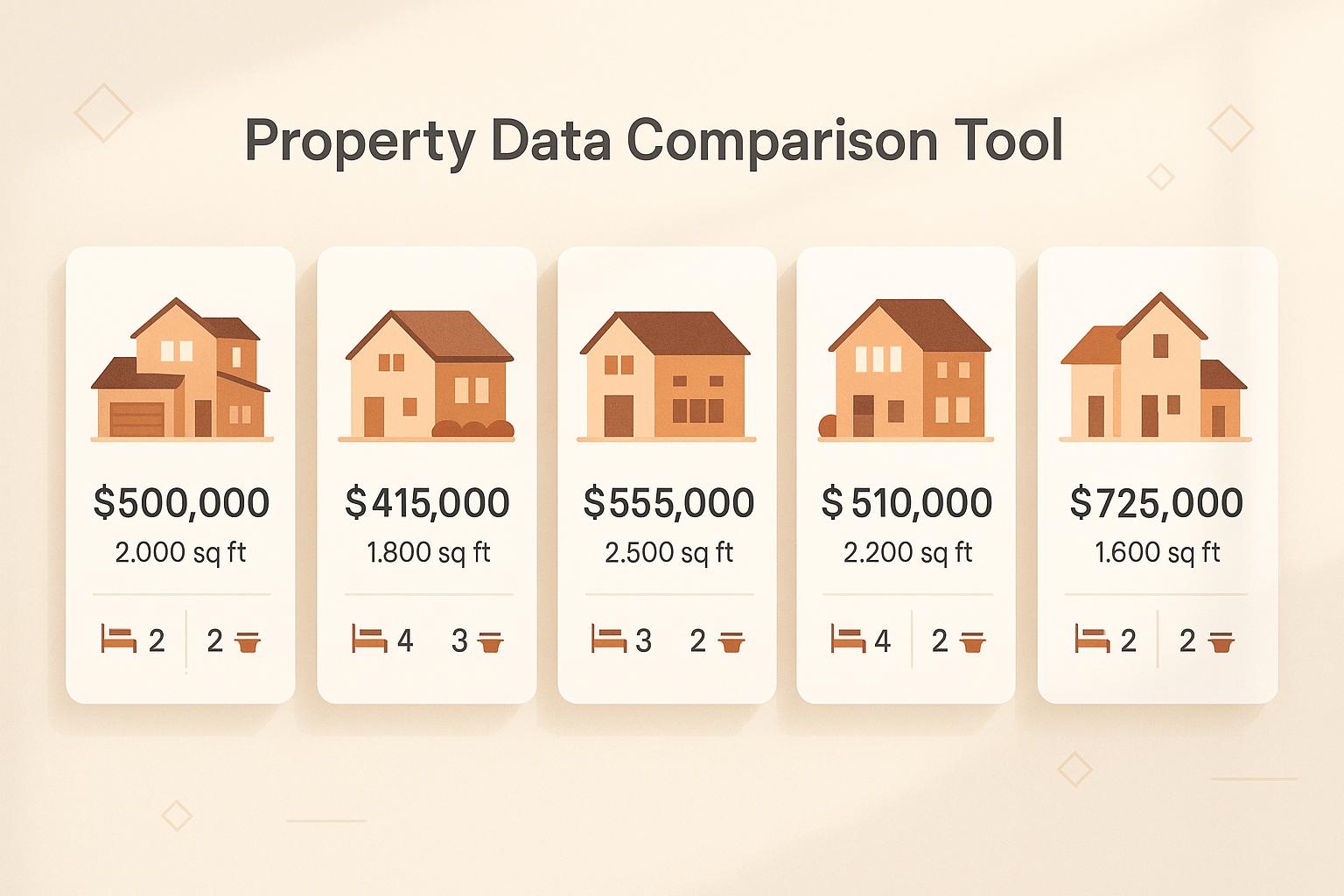





































Machine learning transforms fragmented real estate data into actionable insights by automating processes like valuation, risk assessment, and lead targeting. Here’s a quick breakdown:
- What It Does: Combines basic property records with external data (e.g., ownership history, market trends, geospatial info) to create detailed profiles.
- Why It Matters: Improves accuracy in property valuations, forecasts, and decision-making by leveraging advanced models like XGBoost and Random Forest.
- Challenges: Real estate data often suffers from missing details, inconsistencies, and errors that can skew predictions.
- How It Works: Tools like anomaly detection, natural language processing (NLP), and geospatial AI clean, standardize, and enrich data.
- Tools: APIs like BatchData provide access to massive datasets and automate data validation for real-time updates.
Machine learning bridges gaps in real estate data, making it more reliable for professionals like agents, investors, and lenders.
AI in Real Estate Systems: Machine Learning for Valuation, Risk, and Smart Assets | Uplatz

sbb-itb-8058745
Machine Learning Techniques for Real Estate Data Enrichment
Machine learning takes raw property data and turns it into structured, reliable information using specialized tools and methods. These techniques handle common issues in real estate datasets – like missing details, inconsistent formats, and unstructured text – by automating tasks that would otherwise require significant manual effort.
Anomaly Detection for Data Accuracy
Anomaly detection pinpoints data points that deviate from expected patterns, often signaling errors in the dataset. Imagine a high-value neighborhood property listed for just $5,000, or a 3,000-sq-ft home mistakenly recorded as 50,000 sq ft. Anomaly detection tools, such as Isolation Forest, flag these inconsistencies quickly. These methods work well in real estate, where factors like property age, location, and condition interact in complex ways to define what’s normal versus erroneous. By identifying these errors early, anomaly detection prevents inaccuracies in property prices, square footage, and sales data from skewing analysis or valuation models.
Natural Language Processing for Unstructured Data
Natural Language Processing (NLP) converts unstructured text – like property descriptions, contracts, and public records – into structured, machine-readable formats. Techniques like Named Entity Recognition (NER) extract specific details such as property types (e.g., condo or single-family), locations, and features (like pools or hardwood floors) from listings. Custom lemmatization helps standardize industry abbreviations, turning "br" into "bedroom", "apt" into "apartment", and "st" into "street."
"NLP transforms unstructured text into structured data. This means better search results, smarter customer support, and more accurate data insights." – Tezeract.ai
Take Zillow, for instance. They use AI-driven natural language search to let users input conversational queries like "3-bedroom house with a big backyard near schools" and receive personalized results. NLP also speeds up legal document review by extracting key terms, drastically reducing manual review time. A real-world example is a project with Tokyo Airbnb data, where data cleaning removed duplicates and HTML artifacts, cutting the dataset size by nearly 50% before analysis. Beyond text, ensuring spatial accuracy is equally important – this is where geospatial AI steps in.
Geospatial AI for Address Standardization
After addressing text and anomalies, geospatial AI fine-tunes location data to ensure accuracy. These techniques clean and standardize address information based on official guidelines like USPS Publication 28. They correct spelling errors, standardize abbreviations, and fill in missing details such as ZIP codes or directional prefixes. Reverse geocoding transforms street addresses into precise latitude and longitude coordinates, while parcel-level geometry ensures these coordinates match official property boundaries – not just postal zones. This level of precision is critical for identifying the legal "situs" county, especially for properties that span jurisdictional lines. Each property gets a unique five-digit FIPS code to eliminate confusion between areas with similar names. Such detailed accuracy is essential for tasks like mortgage underwriting and tax assessments.
Tools and APIs for Scalable Machine Learning in Real Estate
Setting up machine learning for real estate data enrichment demands a robust infrastructure capable of handling vast amounts of property records in real time. To train models effectively, you need tools that deliver detailed property attributes while simplifying the data enrichment process.
BatchData Property Search API and Bulk Data Services

BatchData’s Property Search API is a powerhouse, offering access to over 160 million properties across the U.S., each with more than 700 unique data attributes. These include essentials like property characteristics, valuations, tax details, sales history, demographics, and mortgage data – everything needed to train models like Automated Valuation Models (AVMs) or algorithms predicting the likelihood of a sale. The platform’s database is massive, boasting over 1 billion data points, including 64 million phone numbers and 26 million email addresses.
The API’s ability to handle compound and nested queries adds efficiency, allowing users to pull multiple datasets with a single request. With the capacity to retrieve up to 203 items per call, it’s perfect for building large-scale training datasets.
"What used to take 30 minutes now takes 30 seconds. BatchData makes our platform superhuman." – Chris Finck, Director of Product Management
To ensure data quality, BatchData includes built-in verification tools like address normalization, geocoding, and phone/email validation. The platform boasts a 76% right-party contact accuracy rate, which is about three times the industry standard. It also excels in entity resolution, revealing true ownership details – key for relationship mapping and portfolio analysis. With daily updates and real-time access, models stay aligned with the latest market trends. Plus, BatchData reports 100% uptime for its Property Search API.
For even deeper insights, combining MLS data and geocoding services with BatchData’s offerings can significantly enhance property profiles.
Integrating MLS Data Feeds and Geocoding Services
While BatchData provides a strong foundation, incorporating additional data sources like MLS feeds takes enrichment to the next level. MLS feeds supply real-time updates on active listings, pending sales, and price changes. Pairing this with BatchData’s validated geocodes ensures precise location-based services, whether for neighborhood trend analysis or optimizing routes.
Cross-referencing data sources strengthens accuracy. For example, using BatchData’s geocoding API alongside MLS data and tax records helps verify property boundaries and ownership details before integration. This approach reduces duplication and ensures spatial coordinates match official property boundaries – not just postal zones. This level of precision is essential for applications like mortgage underwriting and tax assessments.
Building Scalable Data Enrichment Workflows
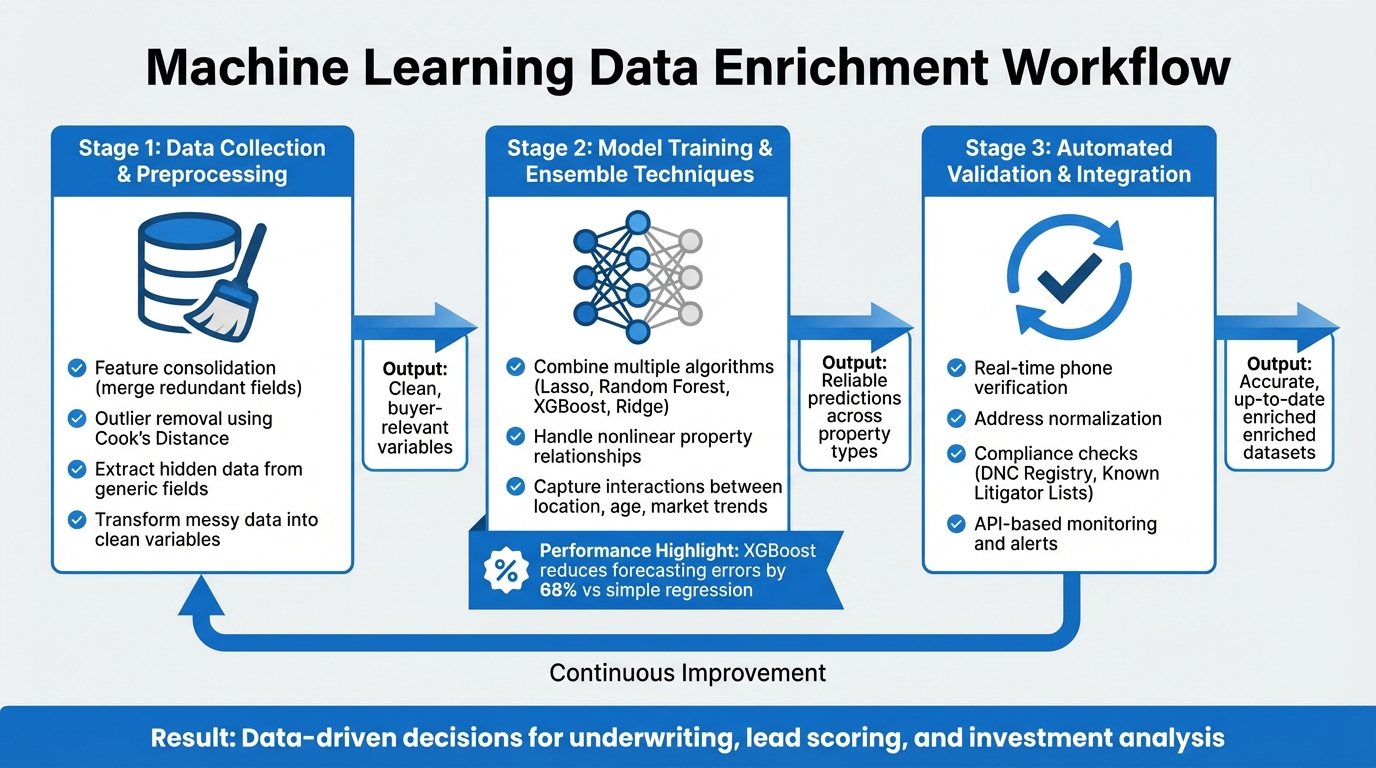
Machine Learning Data Enrichment Workflow for Real Estate
Designing a machine learning workflow to enrich real estate data requires a methodical approach that balances precision and computational efficiency. This process typically involves three main stages: preparing raw data, training models to handle intricate property relationships, and automating validation to ensure consistent quality at scale.
Data Collection and Preprocessing
Raw property data sourced from county assessors, MLS feeds, and tax databases often comes with a host of issues. Duplicate entries, inconsistent formats, and overlapping information can confuse machine learning models. To tackle this, feature consolidation merges redundant fields into meaningful variables. For instance, combining ‘BldgType’ and ‘MSSubClass’ into a binary ‘ClassDuplex’ variable or unifying scattered bathroom counts into a single ‘total bathrooms’ metric ensures clarity and usability for the models.
Another critical step is outlier removal. Techniques like Cook’s Distance help identify and eliminate extreme values that could distort predictions, ensuring only reliable property records are used. Additionally, hidden data within generic fields like ‘MiscFeature’ often requires extraction and reorganization. For example, details about sheds might need to be pulled from ‘MiscFeature’ and combined with square footage values from ‘MiscVal’ to create a new ‘Shed’ feature. The aim here is clear: transform messy, fragmented data into clean, buyer-relevant variables that models can interpret effectively. With properly prepared data, models can better capture the nuanced relationships within real estate markets.
Model Training and Ensemble Techniques
Real estate data is notoriously nonlinear, with complex interactions between variables such as location, property age, and market trends. Single machine learning models often fall short in addressing these complexities. Ensemble techniques come to the rescue by combining multiple algorithms to improve prediction accuracy. For example, an ensemble of seven models – Lasso, Random Forest, XGBoost, Ridge, and others – achieved top 15% performance even without hyperparameter tuning, offering more reliable results.
XGBoost (Extreme Gradient Boosting) is particularly effective for real estate applications. In a study forecasting private real estate excess returns from 1990 through Q2 2024, XGBoost reduced forecasting errors by 68% compared to simple regression and 26% versus multivariate regression. Its ability to handle intricate interactions between property features, demographics, and market conditions gives it a clear edge over simpler models. Moreover, ensemble methods help mitigate overfitting, ensuring predictions are reliable across diverse property types and market cycles. These advanced modeling techniques lay the groundwork for automated validation processes, which ensure enriched data remains both accurate and up-to-date.
Automated Validation and Integration
Clean, enriched data is only as good as its accuracy and timeliness. This is where automated validation plays a crucial role, embedding verification directly into the workflow. For example, phone verification APIs can confirm contact details in real time, while address normalization ensures geocodes align with official property boundaries rather than just postal zones. BatchData takes this further by incorporating compliance checks, such as filtering outreach lists against the Do Not Call (DNC) Registry and Known Litigator Lists, to preempt potential legal issues.
API-based delivery systems enable real-time monitoring at scale. These systems can trigger alerts when property values change, new liens are filed, or pre-foreclosure statuses emerge. This allows risk teams to respond immediately, avoiding the delays associated with manual reviews. By maintaining a continuous validation loop, enriched datasets stay aligned with current market conditions, meeting the high standards required for underwriting, lead scoring, and informed investment decisions.
BatchData Professional Services for Data Enrichment
BatchData takes real estate data operations to the next level with services designed to refine and streamline data enrichment workflows.
Custom Datasets and Skip Tracing
BatchData’s custom dataset services bring together thousands of property variables using advanced techniques like gradient boosting to achieve hyper-local precision. These datasets are built around four key data categories:
- Physical property details
- Owner and occupant demographics
- Financial records (e.g., liens, equity, mortgages)
- Market and neighborhood trends
This comprehensive approach creates detailed property profiles, enabling accurate lead scoring and better-informed investment decisions.
When it comes to skip tracing, BatchData employs machine learning to detect irregularities in owner data and predict potential relocations triggered by life events. For instance, the BatchRank model analyzes hundreds of data points to assess the likelihood of a property being sold. It identifies highly motivated sellers based on factors like high equity, long-term ownership, and life-stage changes. This targeted strategy helps real estate professionals focus their marketing efforts on prospects most likely to act, boosting ROI and ensuring efficient outreach. Beyond enriched property profiles, BatchData also ensures seamless data integration and continuous updates for smoother operations.
Data Pipeline Optimization and Consulting
BatchData doesn’t stop at creating datasets – it also offers consulting services to fine-tune data pipelines for maximum efficiency. Their five-stage workflow includes:
- Ingestion
- Cleaning
- Feature engineering
- Modeling
- Validation
This structured process shifts businesses from making reactive decisions to strategic, data-driven ones.
Professional services also include portfolio monitoring with automated alerts for critical property changes, such as new liens, pre-foreclosures, or shifts in equity. With support for real-time API integration and bulk data delivery, BatchData allows businesses to scale operations seamlessly while maintaining compliance with regulations.
Implementation Best Practices and Success Metrics
Roadmap for Machine Learning Data Enrichment
Having a clear roadmap can turn machine learning data enrichment into a practical advantage rather than just an abstract idea. Start by evaluating your current data quality and identifying issues like missing information, inconsistent formats (e.g., addresses), or duplicate entries.
From there, prioritize data collection and preprocessing. Pull data from sources such as CRMs or MLS feeds, then clean it through deduplication and normalization. Feature engineering is key here – combine similar variables and eliminate outliers using techniques like Cook’s Distance.
To improve accuracy, use ensemble methods like Lasso, Random Forest, or XGBoost, which are known for delivering better results, as seen in reduced RMSE scores. Deploy these models with automated validation systems to monitor data shifts and maintain quality. Tools such as BatchData’s Property Search API can further streamline scalable data processing. Make sure to retrain your models regularly with updated market data to keep them relevant.
Once the roadmap is in place, the focus should shift to measuring the success of your enrichment strategies.
Measuring Success with Enrichment Metrics
Tracking the right metrics can turn data enrichment from a backend task into a clear business advantage. Start by evaluating accuracy improvements using statistical benchmarks like reductions in Root Mean Squared Error (RMSE). For example, XGBoost models have been shown to cut forecasting errors by 68% compared to simple regression and 26% compared to multivariate regression when predicting commercial real estate excess returns. Comparing model performance before and after enrichment on holdout datasets offers a tangible way to measure progress.
Metrics like data coverage and completeness are also critical. These measure how many records include full property profiles, which can enhance lead matching and improve risk scoring. Real-time APIs contribute by speeding up processing and adapting to changing market conditions. Beyond technical metrics, consider business-focused KPIs like marketing ROI, which can be assessed through better response rates and reduced cost-per-acquisition. Additionally, metrics like default rates in lending portfolios can reflect the broader impact of your efforts.
| Key Enrichment Metric | What It Measures | Business Benefit |
|---|---|---|
| Accuracy (RMSE) | Reduction in prediction errors | More reliable property valuations and risk assessments |
| Data Coverage | Percentage of complete property profiles | Improved lead matching and targeting |
| Processing Speed | Time from data ingestion to enrichment | Quicker response to market opportunities |
| Marketing ROI | Response rates and cost-per-acquisition | Lower costs and higher conversion rates |
These metrics help paint a clear picture of whether your machine learning investments are delivering meaningful results.
Conclusion
Machine learning has become a game-changer for improving real estate data. The methods explored here – like anomaly detection, predictive modeling, geospatial AI, and ensemble techniques – tackle long-standing issues with data quality in the industry. Studies show that advanced models, such as XGBoost, excel at capturing complex patterns, often outperforming older, more traditional methods.
Today, the industry views data as a critical asset. Enhanced datasets enable real-time lead scoring, automated data checks, and accurate risk evaluations. As tools like gradient boosting, deep learning, and geospatial analytics continue to advance, real estate professionals who adopt ongoing data enrichment processes will stay ahead in fast-moving markets.
Success hinges on a thoughtful, systematic approach and reliable automated validation. Companies like BatchData, led by Ivo Draginov, offer scalable solutions that make these processes more efficient. The trick lies in smoothly integrating these tools into existing CRM systems through APIs and automated workflows.
The real advantage belongs to businesses that combine technical expertise with a clear focus on their goals. Organizations that measure their progress often see clear benefits, using these insights to guide strategic decisions. By merging machine learning with enriched real estate data, businesses can create actionable intelligence that supports market leadership. As AI-powered search tools and conversational platforms change how people find properties, enriched data becomes the backbone of better visibility and engagement.
Looking ahead, machine learning will continue to push innovation in real estate data. Those who take bold steps – by building strong workflows, ensuring consistent data quality, and using advanced techniques – will transform scattered data into actionable insights, securing their place in an ever-evolving market.
FAQs
What data sources should I enrich property records with?
To build more detailed property records, it’s essential to tap into various sources to ensure the data is accurate and well-rounded. Start with public records – these can provide valuable insights like ownership histories, tax liens, and transaction details. Additionally, APIs that supply property-specific information, such as physical characteristics and market trends, are incredibly useful.
To take it a step further, include demographic, neighborhood, and geographic data. These layers of information allow for deeper analysis and a clearer understanding of the property’s context.
For lead generation, having verified contact details is crucial. Using skip tracing APIs to gather accurate phone numbers, email addresses, and mailing addresses not only improves the precision of your records but also supports better decision-making, risk assessment, and targeted marketing efforts.
How do I handle missing or incorrect property data before modeling?
To fix missing or incorrect property data, begin with data validation. This means checking for completeness to confirm that critical details – like addresses or ownership records – are present and accurate. Next, cross-check the data with reliable sources, such as county records or MLS databases, to identify and resolve inconsistencies.
Once validated, focus on data cleaning. Remove duplicates, standardize formats (like aligning addresses with USPS standards), and correct any errors. To address gaps in the dataset, consider using data enrichment services. These tools can help fill in missing information, ensuring your dataset is reliable and ready for further analysis or modeling.
What is the best ML model for an AVM or seller-likelihood scoring?
Supervised learning algorithms, such as regression models, random forests, and neural networks, are among the most effective tools for tasks like AVMs (Automated Valuation Models) or seller-likelihood scoring. These models work by examining a mix of property data, market trends, and homeowner behaviors to generate precise predictions.