




































Email verification APIs are game-changers for real estate professionals. They ensure email addresses are valid, reducing wasted outreach, protecting sender reputation, and improving lead quality. Here’s why they matter:
- Accuracy Matters: Invalid emails lead to hard bounces, wasted marketing budgets, and broken workflows.
- How It Works: APIs use syntax checks, server communication, and risk scoring to verify emails in under 200ms.
- Fraud Prevention: These tools block fake or disposable emails, keeping CRMs clean and actionable.
- Batch and Real-Time Verification: Real-time checks validate leads during capture, while batch processing cleans large lists efficiently.
- Data Enrichment: Services like BatchData pair verified emails with property and owner details, turning leads into actionable opportunities.
Core Features of Email Verification APIs
Key Verification Checks for Real Estate Use Cases
A modern email verification API doesn’t just perform one type of check. Instead, it uses three distinct validation layers, each designed to catch different types of invalid emails:
| Validation Layer | Latency | Accuracy | Best Use Case |
|---|---|---|---|
| Syntax Only | <5ms | ~15% | Initial entry |
| Syntax + MX | 50–200ms | ~60% | Real-time lead capture |
| Full 3-Layer (SMTP) | 500ms–3,000ms | 97–99% | Batch CRM cleaning |
In the real estate space, these layers are complemented by specialized checks. For example, disposable email detection identifies temporary addresses from over 180,000 known providers, which are often used only once. Role-based address flagging spots generic inboxes like info@ or sales@, which are less effective for building personal connections with clients. Another challenge is catch-all detection: about 15–28% of B2B domains accept all emails, even if the specific mailbox doesn’t exist, leading to wasted outreach efforts.
These checks ensure that your campaigns target valid, actionable leads. However, technical accuracy alone isn’t enough – data security is equally critical.
Data Security and Compliance
Handling email data in real estate comes with strict regulatory requirements. The CAN-SPAM Act mandates that every commercial email must include a clear opt-out option, a valid physical address, and accurate sender details. Non-compliance can result in hefty fines. For teams using SMS or phone outreach alongside email, TCPA compliance adds another layer of complexity. This law requires prior express written consent and regular scrubbing of Do Not Call (DNC) lists, with penalties ranging from $500 to $1,500 per violation.
To protect sensitive data, all email verification requests should route through your backend, not directly from the browser. This keeps your API credentials secure . Google’s bulk sender guidelines, enforced since late 2025, impose strict thresholds: a 2.8% bounce rate and 0.3% spam complaint rate. Exceeding these limits can result in your messages being throttled or rejected, which could damage your domain’s reputation.
Security and compliance aren’t optional – they’re essential for protecting your operations and maintaining trust.
Running High-Volume Verification Campaigns
For real estate teams managing large lead lists – such as 50,000+ contacts from a direct mail campaign or skip-traced investor data – batch processing is the go-to method. Unlike real-time checks, which prioritize speed (under 200ms), batch jobs can handle the slower 1–3 second SMTP verification process because they run in the background. This makes batch processing perfect for cleaning up CRM exports before launching a campaign rather than during live lead collection.
When working with APIs, rate limits can be a challenge. If you receive an HTTP 429 Too Many Requests response, using exponential backoff with jitter helps prevent server overload. Many APIs offer tiered plans to accommodate different campaign sizes. For real-time scenarios, if a verification call times out during a signup form, it’s best to accept the email and verify it asynchronously later. This ensures you don’t lose a potential lead due to a temporary delay.
Efficient, secure, and compliant verification processes are the backbone of successful high-volume campaigns in real estate.
sbb-itb-8058745
Real-time Email Verification Using Iterable Journeys

Integrating Email Verification into Real Estate Workflows
Email Verification & Enrichment Workflow for Real Estate Leads
Real-Time Verification for Lead Capture Forms
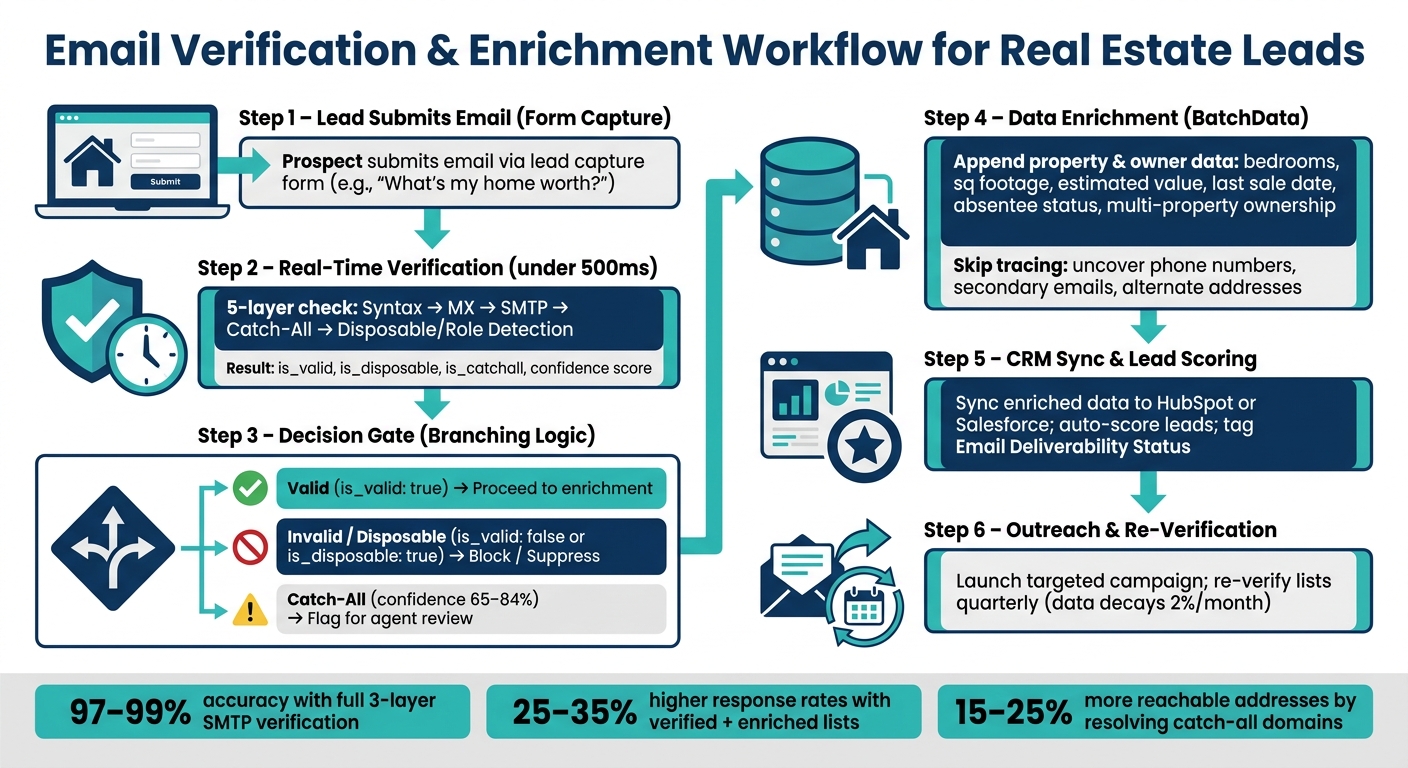
When prospects submit their contact details on a property search page, ensuring accurate data from the start is critical. Real-time APIs can validate emails in under 500 milliseconds by performing a five-step check: syntax, MX, SMTP, catch-all, and disposable/role detection.
On the technical side, forms should block submissions outright if the API returns is_valid: false or is_disposable: true. Catch-all addresses, however, shouldn’t be rejected automatically. Instead, flag them for agent follow-up to avoid losing potential leads.
"Syntax validation catches maybe 3% of bad emails. The other 97% of problems – inactive mailboxes, catch-all traps, disposable addresses, role accounts – require actually talking to the mail server." – Jesse Ouellette, LeadMagic
While real-time checks are ideal for new leads, batch verification becomes essential for maintaining the quality of your existing CRM and marketing lists.
Batch Verification for CRM and Marketing Lists
Batch verification is where you can significantly improve efficiency for existing databases. Modern APIs can process 50–100 emails per second, meaning a 10,000-contact list can be cleaned in just a few minutes. Given that B2B contact data decays at a rate of around 2% per month, a list that seemed accurate six months ago could already contain hundreds of outdated addresses. Setting up an automated quarterly re-verification process – integrated with platforms like HubSpot or Salesforce – keeps your database accurate with minimal manual effort.
For catch-all domains, which account for 30–40% of B2B domains, avoid a one-size-fits-all rejection approach. Instead, use the API’s confidence score. Addresses scoring above 85% are generally safe to send to, while those below 65% should be suppressed.
Once verification results are in, the next step is to integrate them effectively into your workflow.
Acting on Verification Results
To maximize the benefits of email verification, it’s essential to act on the results. Record the API’s output in a CRM field (e.g., "Email Deliverability Status") so sales teams can quickly identify which leads are actionable. Here’s a practical decision matrix to guide actions based on verification results:
| API Result | Condition | Recommended Action |
|---|---|---|
is_valid: true |
Mailbox confirmed | Approve for all outreach |
is_disposable: true |
Temporary email service | Block at form; request a work email |
is_role: true |
Generic inbox (e.g., info@, admin@) | Omit from personalized outreach |
is_catchall: true, confidence >85% |
High-confidence catch-all | Send normally |
is_catchall: true, confidence 65–84% |
Medium-confidence catch-all | Send with engagement monitoring |
is_valid: false or confidence <65% |
Invalid or low confidence | Suppress; protect sender reputation |
Teams that implement structured handling of catch-all addresses report 15–25% more reachable addresses compared to those who either ignore catch-alls entirely or send to them indiscriminately.
Combining Email Verification with Data Enrichment
Why Data Enrichment Matters in Real Estate
Verifying an email ensures it’s deliverable, but it doesn’t provide the deeper insights needed to turn a lead into an opportunity. Details like property type, value, equity, or occupancy status are critical for making leads actionable. Without this extra layer of information, even a perfectly verified email list is just a collection of names. To address this gap, BatchData extends email verification by adding property data enrichment, giving real estate professionals the insights they need to act.
BatchData‘s Enrichment and Skip Tracing Tools
BatchData is tailored for real estate professionals, offering tools that go beyond basic email verification. Once an email passes verification, BatchData matches it with property and owner records to deliver detailed insights, including:
- Number of bedrooms and bathrooms
- Square footage
- Estimated property value
- Last sale date
- Absentee status
It can even flag multi-property ownership, which is especially valuable for targeting real estate investors.
When contact information is incomplete, BatchData’s skip tracing tools come into play. Starting with just a verified email, these tools can uncover:
- Associated phone numbers (distinguishing between mobile and landline)
- Secondary email addresses
- Alternate mailing addresses
This is particularly helpful when dealing with LLC-owned properties, where the email might belong to a registered agent rather than the decision-maker. BatchData’s advanced linking logic identifies the person behind the corporate entity, ensuring outreach efforts reach the right individual.
Building a Unified Verification and Enrichment Workflow
Integrating email verification with data enrichment creates a streamlined, efficient process. The ideal workflow looks like this:
- A prospect submits their email through a "What’s my home worth?" form.
- The verification API confirms deliverability in under 500 milliseconds.
- Verified emails trigger an enrichment call, appending property and owner data.
- The enriched data is synced to a CRM, where automated lead scoring helps prioritize follow-ups.
This approach ensures that only verified, enriched leads make it into the CRM, maximizing conversion potential.
To maintain long-term accuracy, it’s important to schedule regular re-verification and enrichment updates. Running these processes periodically ensures your database reflects current ownership data, keeping your outreach efforts relevant and effective.
Measuring the Impact of Email Verification in Real Estate
Key Metrics to Track
When assessing the effectiveness of email verification, certain metrics stand out as essential indicators of success. Start with your hard bounce rate – a critical measure of how many emails fail to reach their destination. A healthy bounce rate typically ranges between 3% and 5%. Staying within this range helps protect your sender reputation and prevents blacklisting. If your bounce rate climbs higher, it’s a clear signal that your email list needs attention.
Another important metric is your right-party contact rate. This measures how often your outreach connects with the intended recipient, such as property owners or decision-makers. For real estate acquisitions, this is often a more telling metric than open rates. Verified and enriched email lists can boost response rates by 25–35% compared to unverified lists. Additionally, keep an eye on your API match rate, which reflects the percentage of records matched during verification. High-quality tools generally achieve match rates between 80% and 90%. With a median response time of 142ms and 99.9% uptime, API performance ensures smooth and efficient lead capture.
By tracking these metrics, you can maintain high data quality and better understand the return on investment (ROI) from email verification.
Keeping Data Quality High Over Time
Even the cleanest email lists degrade over time – at a rate of more than 2% per month. For most real estate teams, quarterly re-verification is the minimum standard to maintain data quality. However, teams operating at a faster pace may find monthly re-verification more beneficial.
"The true cost of bad data is not the price of the list; it’s the wasted payroll on fruitless outreach, the opportunity cost of missed deals, and the reputational damage from bounced emails." – BatchData
For catch-all domains, aim for a confidence threshold of 70–80%. Below 70%, the risk of bounces outweighs the potential value of the lead. Above 80%, the address is far more likely to be valid and reachable. Applying this threshold consistently keeps your list streamlined and ensures stable deliverability. Additionally, suppress contacts who haven’t engaged with your emails in six months by either re-verifying their information or removing them from your list entirely.
Once you’ve established a process for maintaining data quality, you can begin to measure the financial impact of email verification.
Calculating ROI with BatchData
The ROI of email verification comes down to comparing the cost of verification with the gains from improved lead accuracy and deliverability. Services like BatchData make this calculation straightforward by combining email verification with property and owner data enrichment in a single workflow. This approach allows you to assess both email deliverability and the overall quality of your lead records.
With BatchData’s pay-as-you-go pricing model, you only pay for what you use – no fixed fees or wasted credits. This makes it easier to calculate the cost-per-verified-lead and compare it to your average deal value. For example, resolving catch-all domains effectively can increase the number of reachable email addresses by 15–25%. When you factor in these improvements, the case for investing in email verification becomes clear. By quantifying these benefits, real estate teams can see how streamlined verification directly impacts deal conversions.
Conclusion
Email verification APIs have become indispensable for real estate teams striving to maintain accurate and actionable contact lists. With B2B contact data decaying at over 2% per month, static lists quickly lose their value. These APIs provide real-time SMTP verification, resolve catch-all domains, and automate lead tagging – all in under 200ms.
While basic syntax checks only identify about 3% of invalid emails, a full SMTP connection is essential to spot inactive, disposable, and catch-all addresses. This makes comprehensive verification a critical step in turning leads into closed deals.
Taking things further, enriched insights can transform verified data into powerful lead records. Platforms like BatchData integrate email verification with property and homeowner data, combining verification, skip tracing, and enrichment into a single, actionable resource.
The results speak for themselves: verified and enriched lists can increase response rates by over 25%, and resolving catch-all domains can uncover up to 25% more reachable addresses. With BatchData’s pay-as-you-go model, every dollar invested in verification ties directly to a measurable cost-per-verified lead, much like comparing skip tracing tools to ensure maximum ROI, ensuring a clear return on investment.
For real estate teams focused on data-driven success, the path forward is clear: automate email verification during lead capture, re-verify lists quarterly, and pair validation with property-level enrichment to make the most of every outreach effort.
FAQs
Should I verify emails in real time or in batches?
Verifying emails as they come in is a smart way to keep your contact information accurate and up-to-date. This method works especially well in fast-paced real estate workflows, where staying on top of details is crucial. It also helps with compliance and boosts success rates. While batch verification is helpful for processing large datasets, it might not catch the latest changes or updates in email information.
How should I handle catch-all email domains?
Catch-all email domains require cautious handling. To manage them effectively, integrate real-time SMTP and carrier lookups with email verification APIs. These tools work together to identify such addresses, helping you avoid invalid or potentially risky contacts. The result? Cleaner, more dependable data – essential for keeping your real estate operations running smoothly.
How often should I re-verify my CRM email list?
To keep your email data accurate and deliverable, it’s a good idea to re-verify your CRM email list every 3 to 6 months. Doing so ensures your contact information remains current and enhances the efficiency of your communication efforts.