
Chasing outdated leads is costing real estate agents time, money, and opportunities. Here’s why:
- Low conversion rates: Agents often see less than 1% success with old lead lists, wasting thousands of dollars annually.
- Data decay: Contact lists become unreliable within 6–18 months, with accuracy dropping to 20–40%.
- Missed opportunities: 78% of buyers choose the first agent who responds, yet most agents take over 15 hours to reply.
- Lost income: Abandoned leads cost agents an average of $127,000 in annual commissions.
- Legal risks: Outdated lists increase compliance issues under TCPA regulations, leading to potential lawsuits.
Modern, data-driven tools solve these problems by using real-time updates, intent-based targeting, and automation. These methods improve accuracy to 85–95% and boost conversion rates to 2–5%, saving time and increasing revenue. If you’re still relying on outdated methods, it’s time to rethink your approach.
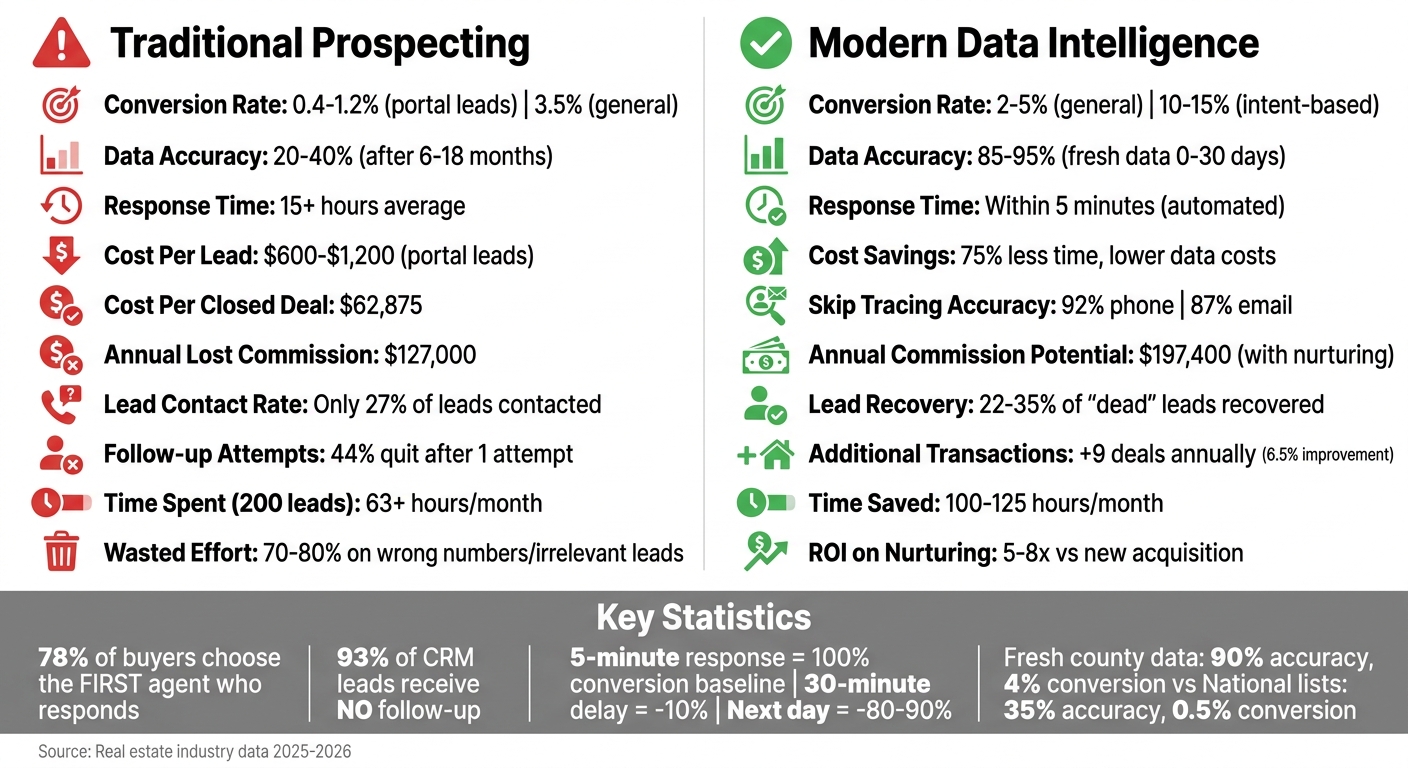
Traditional vs Modern Real Estate Prospecting: Cost and Performance Comparison
The Hidden Costs of Traditional Prospecting Methods
Low Conversion Rates and Financial Losses
Traditional prospecting methods come with hefty financial consequences. For instance, abandoned leads cost agents nearly $127,000 annually, showing just how much potential income slips through the cracks. This gap between what could be earned and what actually is earned is staggering.
Take portal leads from platforms like Zillow and Redfin as an example. These leads cost between $600–$1,200 each, yet they convert at a dismal 0.4–1.2%. When you crunch the numbers, that means the cost per closed deal skyrockets to roughly $62,875. For most agents, this is simply unsustainable. Even more troubling, 93% of leads in the average agent’s CRM receive no follow-up at all, leaving enormous potential revenue untapped.
“Real estate leads often result in double costs: initial acquisition and subsequent opportunity loss.” – US Tech Automations
The difference in conversion rates is eye-opening. Traditional methods yield a 3.5% conversion rate, but systems that focus on consistent nurturing can achieve 10%. That extra 6.5% could mean 9 additional closed transactions annually, boosting annual commissions from $70,500 to $197,400. Yet, despite the potential, 80% of sales require five or more follow-ups, while 44% of agents give up after just one attempt.
Timing and responsiveness are just as crucial as conversion rates when it comes to seizing opportunities.
Missed Opportunities in a Fast-Moving Market
Speed matters – big time. 78% of buyers go with the first agent who responds to their inquiry. But the reality? The average agent takes over 15 hours to respond to inbound leads. That delay is costly, especially when only 27% of real estate leads ever get contacted.
The numbers don’t lie. A lead contacted within 5 minutes has a 100% baseline conversion probability. Wait just 30 minutes, and that probability drops by 10%. If you wait until the next day, it plummets by 80–90%. Unfortunately, traditional manual processes – like checking voicemails or logging into multiple systems – make it nearly impossible to respond within that crucial 5-minute window.
On top of that, outdated data adds another layer of inefficiency. Traditional “motivated seller” lists are often 6–18 months old, with accuracy rates sinking to 30–50%. By the time an agent makes contact, the property may already be sold, the issue resolved, or the owner inundated with calls from other investors. In contrast, fresh data (0–30 days old) retains 85–95% accuracy – a clear advantage that traditional methods fail to leverage.
Compliance and Legal Risks
Beyond financial losses, traditional approaches also come with legal risks. For example, cold calling can land agents in hot water due to strict regulations under the Telephone Consumer Protection Act (TCPA). This law governs automated dialers and unsolicited text messages to mobile phones. Additionally, the Federal Communications Commission (FCC) restricts telemarketing calls to 8 a.m. to 9 p.m. local time – and it’s the recipient’s local time that counts.
Using outdated lists only amplifies these risks. Contact data decays at a rate of 2–3% per month, which increases the chances of calling numbers recently added to Do Not Call (DNC) registries. Manual DNC checks are prone to errors, and stale lists often include “known litigators” who actively look for compliance violations to file lawsuits.
Another issue is spam detection. High-frequency or short-duration calls trigger algorithms that label numbers as “Spam Likely”, which destroys answer rates and tarnishes an agent’s reputation. These challenges highlight the need for updated strategies that prioritize accuracy and compliance to avoid these costly pitfalls.
Why Traditional Real Estate Prospecting Fails
Reliance on Outdated Tactics
Managing even a modest list of 200 leads manually can eat up over 63 hours a month – time that could be spent actually closing deals. This inefficiency leaves agents stretched thin, unable to effectively engage with most of their prospects, which leads to a noticeable loss in potential revenue.
On top of that, outdated data makes things worse. Contact information on traditional lists deteriorates quickly as people move, change phone numbers, or resolve their issues. By the time an agent reaches out, the property might already be sold, the tax debt cleared, or the foreclosure avoided. The result? 70–80% of an agent’s effort goes to waste on wrong numbers, irrelevant leads, or problems that no longer exist.
Another challenge is “lead fatigue.” Homeowners on these outdated lists are often overwhelmed by calls from other investors. By the time you reach them, they’re already frustrated, making them far less likely to respond positively. This kind of intrusive outreach not only damages your reputation but also burns through any goodwill before you’ve even had a chance to connect.
But the problem isn’t just outdated tactics – there’s also a glaring lack of precise targeting.
The Lack of Intent-Based Targeting
Traditional prospecting often relies on a scattershot approach, where agents are flooded with massive lists and rely on generic autodialer campaigns. This method simply doesn’t work anymore in 2026. Why? Because it ignores key behavioral data and predictive signals that show when someone is actually ready to sell.
Timing is everything in real estate. Without tools to identify high-intent signals – like ARM resets, equity milestones, or recent permit filings – agents miss the critical “window of motivation”. Instead, they end up contacting the wrong people at the wrong time with generic pitches that don’t resonate. Meanwhile, fresh, targeted data could pinpoint those high-intent opportunities that traditional methods consistently overlook.
“If you’re still buying year-old ‘motivated seller’ lists and wondering why your conversion rates are under 1%… the days of spray and pray are over.” – Tracerfy Team
The competitive gap is hard to ignore. With 78% of buyers choosing the first agent who responds, slow, manual approaches leave agents scrambling for leftovers. Meanwhile, competitors equipped with automated, intent-driven systems are locking in the best opportunities within minutes. These weaknesses in traditional prospecting highlight why modern tools like real estate data solutions are reshaping the industry.
Top 10 Real Estate Lead Generation Ideas Ranked (Worst To Best)
How Real Estate Data Intelligence Transforms Prospecting
Modern real estate prospecting has shifted its focus to intent rather than sheer volume. Instead of cold-calling thousands of generic contacts, data intelligence tools now help create a “lead stack” that combines public records, MLS data, and specialized datasets. This approach identifies high-intent sellers – those likely to list their properties soon – allowing agents to concentrate their efforts on prospects who are genuinely ready to sell. This shift from quantity to quality underscores the transformative impact of data intelligence in today’s prospecting strategies.
The Role of Data Enrichment
Data enrichment takes a simple property address and turns it into a detailed, actionable lead profile. Through skip tracing and how it works, agents gain access to verified phone numbers, emails, and even confidence scores. These tools also screen leads against DNC registries, ensuring compliance. Plus, with county data updated as frequently as every 0–30 days, accuracy rates remain high, ranging from 85–95%.
Take Phoenix wholesaler Mike, for example. In January 2026, he switched from a list of 5,000 outdated national leads to 1,000 fresh leads focused on Maricopa County. This change boosted his data accuracy from 40% to 92% and increased his conversion rate from 0.6% to 3.8%. While he still closed 2–3 deals per month, he saved over 100 hours of calling time and cut his monthly data costs from $250 to $100.
“I was skeptical about paying more per lead, but the math is undeniable. I’m closing the same number of deals from 1/5 the list size and spending 75% less time on the phone with wrong numbers.” – Mike, Phoenix Wholesaler
Using APIs for Scalable Solutions
Real-time APIs take data enrichment to the next level by automating and scaling these insights. These APIs deliver a property’s entire history in milliseconds, eliminating the need for time-consuming manual research. When integrated into CRMs, they automatically enrich new leads with crucial property intelligence and quickly assign them to the right team members. This ensures no opportunity is missed. For example, integrating property data APIs can cut underwriting labor costs by over 50%, freeing up agents to focus on relationship-building.
Fresh, accurate data also reduces wasted time. Investors can save roughly 125 hours per month by avoiding wrong numbers and outdated leads. On top of that, tools like propensity modeling use hundreds of variables to score prospects, helping agents direct their marketing budgets toward the leads most likely to convert.
High-Intent Triggers for Smarter Targeting
High-intent triggers are game-changers when it comes to identifying motivated sellers at the right time. These triggers include equity milestones (like a loan-to-value ratio dropping below 80%), ARM resets, pre-foreclosure notices, probate filings, and tax delinquencies. By layering filters such as absentee ownership, tax issues, and significant equity, agents can refine their Ideal Customer Profile, leading to higher conversion rates.
Dallas investor Sarah provides a great example. In early 2026, she shifted her focus from competitive pre-foreclosures to fresh probate filings, updated every two weeks. This change led to a 6.2% conversion rate, compared to just 2.1% for pre-foreclosures. In just 90 days, she closed 4 deals from a list of only 500 leads. The key? Speed. With alerts notifying her of filings within 24–48 hours, she was able to reach out before her competitors even knew about the opportunity.
Zillow has also embraced this data-driven approach. Between 2022 and early 2025, its “Enhanced Markets” strategy in cities like Phoenix and Atlanta used real-time data triggers alongside a suite of services. This resulted in an 80% increase in customer transaction share in those markets. By early 2025, the program accounted for 21% of Zillow’s total connections.
BatchData‘s Automated Tools for Modern Prospecting
BatchData takes the guesswork out of prospecting by automating processes with data-driven insights. Moving away from outdated methods like spreadsheets and cold calling, BatchData consolidates information on 150+ million U.S. properties into one searchable database. Agents can instantly access real-time property details, owner information, and verified contact data via real estate APIs that integrate seamlessly with their CRM systems, enabling faster and more informed decisions.
Property Search and Data Enrichment
The Property Search API provides instant access to property intelligence sourced from public records, MLS data, and lien filings. Instead of juggling multiple data sources, agents get everything they need in one place. Filters like equity percentage, ownership length, and distress indicators allow users to create highly specific lists. For instance, you could target “out-of-state owners with 50%+ equity and delinquent property taxes.”
BatchData’s Smart Search API takes it a step further by using an event-driven “push” system. Through webhooks, it notifies agents as soon as a property meets their criteria, giving them a head start on new opportunities. This streamlined approach ensures agents work with accurate, actionable data right from the start.
“We want to supplement your work and make you superhuman so you can do things in seconds not hours. That’s where BatchData comes in. What used to take 30 minutes now takes 30 seconds.” – Chris Finck, Director of Product Management
Skip Tracing and Contact Verification
BatchData pairs enriched property information with verified contact details, creating a foundation for scalable prospecting. Their skip tracing tools achieve 95%+ accuracy in locating phone numbers and emails, with success rates of 92% for phone appends and 87% for email retrievals. Each contact is assigned a confidence score, helping agents focus on the most promising leads.
To ensure compliance, the system automatically screens against DNC registries and verifies phone types (mobile or landline) to meet TCPA standards. These features significantly boost conversion rates, increasing the typical 1–2% from cold calling to a much higher 10–15%.
Proven Strategies to Maximize Efficiency and Conversion Rates
Building Data-Driven Workflows
Cold calls are quickly becoming a thing of the past, thanks to predictive prospecting. This method shifts the focus from intuition-based lead generation to workflows driven by data. Tools like BatchData’s BatchRank use propensity modeling to score leads based on their likelihood of converting. This allows teams to prioritize high-intent leads for personalized outreach while automating nurture campaigns for those less likely to act.
Portfolio monitoring is another game-changer. It transforms static data into actionable, real-time alerts. For instance, if a property crosses the 50% equity threshold or a renovation permit is filed, automated workflows can trigger outreach within 24–48 hours. This approach captures leads at the perfect moment, replacing the inefficient “spray and pray” tactics with targeted precision.
To further enhance engagement, rotate area-code–matched phone numbers to avoid spam flags. Combine this with dialing mode optimization – using predictive dialing for high-volume lists and preview dialing for more delicate situations – to ensure every conversation begins on the right note.
These refined workflows create a focused, efficient system that zeroes in on leads with the highest potential.
Focusing on Verified, Intent-Matched Prospects
When workflows are powered by real-time behavioral triggers, conversion rates can soar. Instead of relying on outdated demographic assumptions, targeting based on actual events – like a Notice of Default filing or a tax lien – can increase conversion rates from the typical 1–2% to as high as 10–15%. These signals indicate immediate intent, making swift, coordinated outreach essential. BatchData’s webhook-driven Smart Search API alerts agents to these triggers, enabling timely multi-channel outreach.
Successful campaigns combine skip-traced data with a mix of communication methods. A sequence of texts, calls, emails, or even direct mail ensures the message reaches prospects through their preferred channels. By focusing on high-intent prospects showing real-time indicators – such as equity milestones, permit filings, or distress events – agents can eliminate the inefficiencies of traditional prospecting and significantly improve their results.
Conclusion
Traditional prospecting methods are draining agents both financially and emotionally. When abandoned leads translate to an average loss of $127,000 in annual commission, it’s clear that outdated strategies like cold calling and manual follow-ups are more than just inefficient – they’re costly. On average, agents stop after just 2.4 follow-up attempts over 11 days, even though 35% of those leads will go on to transact within two years.
The move to data-driven prospecting isn’t just a trend – it’s a necessity. Fresh county data offers 90% accuracy and a 4% conversion rate, far outperforming national lists, which struggle with only 35% accuracy and a dismal 0.5% conversion rate. By leveraging real-time behavioral triggers like equity milestones, permit filings, or distress events, and pairing them with automated workflows, agents can achieve far better results. This shift highlights the urgency of replacing outdated cold-calling techniques with precision targeting.
BatchData’s tools make this transition seamless. Features like property search APIs, skip tracing with verified contact data, and BatchRank’s propensity scoring enable agents to focus on verified, high-intent prospects at the perfect time. Instead of wasting time and resources on generic lists, these tools ensure targeted engagement. Additionally, nurturing existing leads can deliver 5–8x the ROI compared to acquiring new ones, while automated systems can recover 22–35% of “dead” leads by maintaining consistent follow-up over an 18-month cycle.
The bottom line: sticking to outdated tactics gives your competitors the upper hand. The real question isn’t whether to modernize your approach, but how quickly you can adopt BatchData’s automated, intent-based solutions – before others in your market do.
FAQs
How do I know if a lead is still accurate?
To ensure a lead is reliable, start by confirming that the data is both recent and verified. High-accuracy skip tracing can help update critical contact details, such as phone numbers and email addresses. It’s also important to work with up-to-date property data and steer clear of older lists, as outdated information tends to deliver poor results. By verifying lead accuracy, you can save time, minimize wasted effort, and connect more effectively with motivated sellers.
What intent signals predict someone will sell soon?
Intent signals that suggest someone might be ready to sell include pre-foreclosures, absentee ownership, and recent county data updates. These indicators, identified through detailed data analysis and specialized datasets, make it easier to pinpoint potential sellers with greater accuracy.
How can I respond to new leads within 5 minutes?
Responding to leads within 5 minutes can dramatically increase your chances of converting them. Research consistently shows that leads contacted promptly are far more likely to engage compared to those reached after a delay.
By using tools like BatchData, you can automate follow-up processes, enrich contact details, and launch outreach campaigns almost instantly. This approach cuts response times from hours to mere minutes, allowing you to take full advantage of that crucial early window when conversions are most likely.