
Cross-platform APIs have transformed how real estate businesses handle property data, making processes faster, more efficient, and accurate. Instead of building costly in-house systems, companies can now integrate pre-built APIs to access and sync data in real time. For as little as $599/month, APIs provide access to property details, ownership records, financial data, and market trends – helping professionals make smarter decisions.
Key Takeaways:
- Save Time: Tasks like property validation that once took hours can now be completed in seconds.
- Cost-Effective: API partnerships eliminate the need for expensive internal systems with a pay-as-you-go model.
- Real-Time Updates: Sync property listings, market trends, and analytics instantly.
- Improved Accuracy: APIs pull data from reliable sources, reducing errors and manual entry.
- Better Insights: Centralized data views simplify decision-making and uncover opportunities.
By automating workflows and consolidating fragmented data, APIs are reshaping real estate operations. Tools like BatchData offer tailored solutions to streamline data access and improve efficiency.
What Cross-Platform APIs Are and How They Work in Real Estate
What Are Cross-Platform APIs?
Cross-platform APIs simplify how real estate professionals manage and integrate data from various sources. These APIs act as standardized tools that pull information from places like MLS databases, public records, and property marketplaces, then format it into structured datasets that are easy to work with.
For example, the Real Estate Standards Organization (RESO) ensures that key data fields – like "bedroom count" – are consistent across platforms. This eliminates the need for manual data matching and provides access to over 700 property attributes per listing. High-quality APIs go even further, offering property intelligence that includes everything from square footage to lien histories.
Technically, these APIs rely on Web formats like JSON and XML. When your CRM sends a request, the API gathers and organizes data from sources such as nonprofits, public records, and listing services.
Why Real Estate Businesses Need API Integration
APIs are crucial for tackling the fragmented nature of real estate data.
In real estate, information is often scattered across different systems. Property details might be in one database, while ownership records and financial data are stored elsewhere. This disorganization leads to costly manual data entry, frequent errors, and outdated information.
APIs solve this by delivering real-time, structured data. They provide instant insights into property details (like size and layout), financial history (including AVMs, equity, and liens), and ownership information (such as contact details). By automating the flow of data from large property repositories, APIs allow businesses to react faster to market opportunities. Tasks that used to take hours can now be completed in seconds, improving overall efficiency.
One example is BatchData (https://batchdata.io), which offers tailored API solutions to enhance data enrichment and help real estate professionals make better decisions.
sbb-itb-8058745
Benefits of Cross-Platform API Integration for Real Estate Data
Better Data Accuracy and Consistency
Cross-platform APIs take the guesswork out of managing real estate data by pulling from reliable sources and standardizing it into consistent formats. Instead of manually entering or combining data from different platforms – which often leads to errors – APIs automate the process. They validate and format details like square footage, ownership records, or tax assessments, ensuring everything is accurate and aligned. This automation guarantees that all connected systems stay updated and consistent, reducing the risk of discrepancies.
Real-Time Data Access and Synchronization
With real-time APIs, property information is instantly accessible, cutting out delays that could impact decisions. When market conditions shift or a property’s status changes – like a new listing or price adjustment – every connected platform updates automatically. This ensures that real estate professionals always have the latest information at their fingertips. The ability to act on live data helps professionals respond quickly and confidently, whether they’re negotiating deals or adjusting strategies.
Better Decision-Making and Business Insights
Accurate and up-to-date data is only part of the equation – cross-platform APIs also help transform that data into actionable insights. By integrating property, financial, and market data into one centralized view, professionals can skip the tedious work of piecing together information from multiple sources. This unified perspective makes it easier to spot trends, evaluate opportunities, and refine strategies. Tools like BatchData take this a step further by offering features like property enrichment and skip tracing, providing verified owner contact details for more targeted outreach and smarter decisions.
Homesage.ai Real Estate APIs: Complete Real Estate Data Integration and Getting Started Guide
How to Implement Cross-Platform APIs in Real Estate Workflows
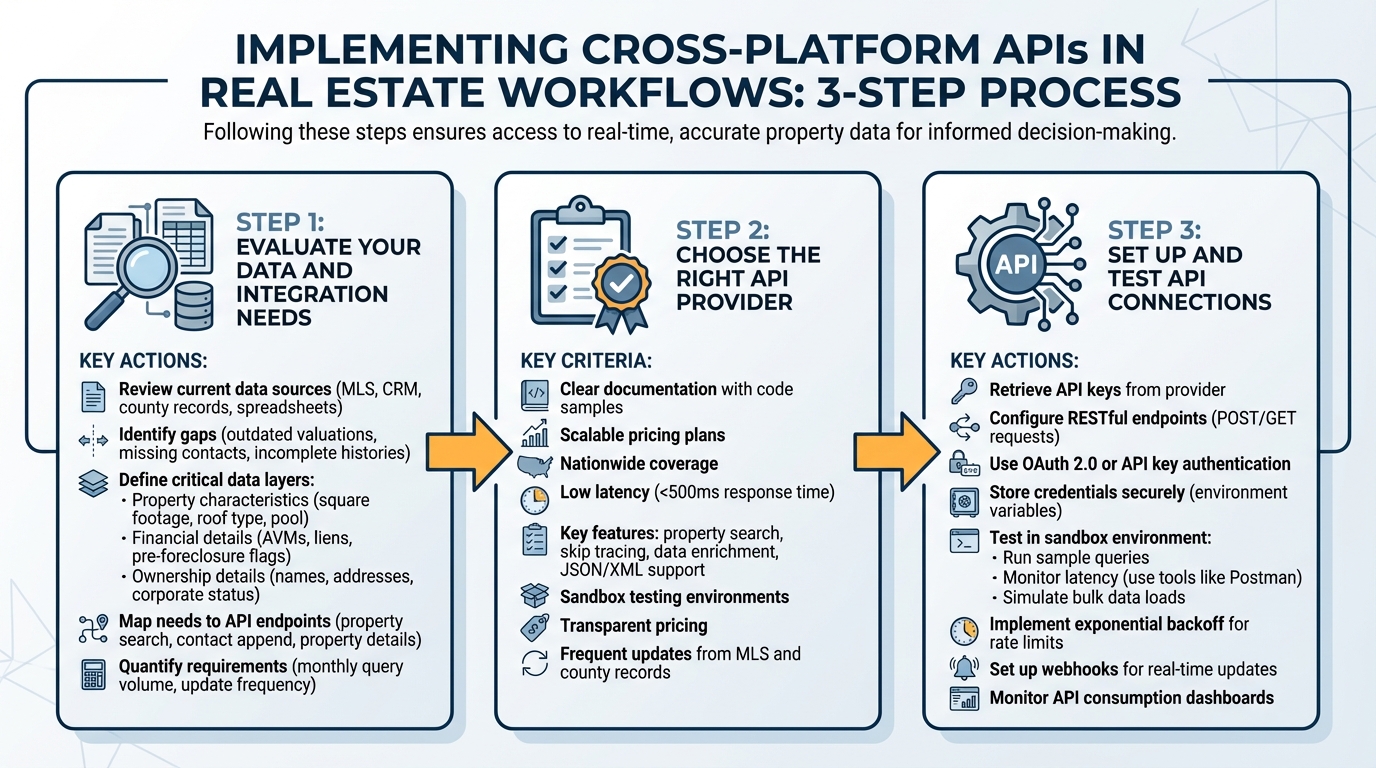
3-Step Process for Implementing Cross-Platform APIs in Real Estate Workflows
Following these steps ensures you have access to real-time, accurate property data, which is essential for making informed decisions in the real estate industry.
Step 1: Evaluate Your Data and Integration Needs
Start by taking a close look at your current data sources – such as MLS listings, CRM records, county assessor files, and any spreadsheets your team uses regularly. Identify where gaps exist. Are you dealing with outdated valuations? Missing contact information? Incomplete property histories? Or perhaps siloed data is causing mismatches and duplicates. These issues can slow down your workflow and lead to inconsistencies.
Next, decide which data layers are most important for your goals. For example, property characteristics like square footage, roof type, or pool presence might be crucial for one use case, while financial details such as AVMs, liens, or pre-foreclosure flags could be essential for another. Ownership details – like names, corporate status, or mailing addresses – might be necessary for tasks like skip tracing. Map these needs to specific API endpoints. For instance:
- Use a property search API for filtering by criteria.
- Use a contact append API to skip trace property owners.
- Use property details APIs for building complete property profiles.
It’s also important to quantify your needs. How many properties will you query monthly? How often does the data need to be updated – real-time for active listings or daily for analytics? Pinpointing these requirements will help you focus on the use cases that matter most, whether it’s calculating ROI for investments or running targeted marketing campaigns.
Once you’ve outlined your data needs, you’re ready to find a provider that matches your criteria.
Step 2: Choose the Right API Provider
When evaluating API providers, prioritize those with clear documentation, code samples, and searchable guides. Scalability is another key factor – your provider should offer flexible pricing plans that grow with your business. Look for nationwide coverage and low-latency responses (ideally under 500ms) to ensure a smooth user experience. The most useful features often include property search, skip tracing, data enrichment, and support for JSON or XML data formats.
Take BatchData as an example. They offer APIs specifically designed for real estate professionals, covering property search, contact enrichment, skip tracing, phone verification, and bulk data delivery. Their services also include custom data pipelines to address gaps in accuracy and accessibility. Whether you’re a startup needing a quick launch or a larger firm managing high-volume queries, focus on providers that offer sandbox testing environments, transparent pricing, and frequent updates from reliable sources like MLS feeds and county records.
Once you’ve selected a provider, the next step is to set up and test your API connections for smooth integration.
Step 3: Set Up and Test API Connections
Start by retrieving your API keys from the provider. Configure the endpoints using RESTful calls, such as POST or GET requests to /properties/{address}. For authentication, use OAuth 2.0 or API key methods, and make sure to store credentials securely (e.g., in environment variables). Avoid hardcoding sensitive information directly into your source code. Many providers offer SDKs to make it easier to manage requests and handle responses.
Before going live, test your setup in the provider’s sandbox environment. Run sample queries to validate responses, monitor latency (tools like Postman can help), and simulate bulk data loads to confirm everything syncs properly. To handle rate limit errors, implement exponential backoff logic. Additionally, consider using webhooks for instant updates on property status changes, so you don’t need to rely on constant polling. Keep an eye on your API consumption dashboards to spot inefficient queries and avoid unexpected costs as your usage grows.
Practical Applications: Using APIs for Real Estate Solutions
When APIs are integrated into real estate processes, they simplify operations, enhance accuracy, and keep updates flowing in real time. These tools are reshaping how the industry approaches data, making tasks faster and more efficient.
Simplifying Property Data Enrichment
Gone are the days of manually hunting down property information. APIs now deliver instant access to detailed property data, such as square footage, roof type, financial history (like mortgages and liens), and ownership details. This wealth of information eliminates tedious research and provides a clearer picture of each property.
Take BatchData’s property search API, for example. It allows users to filter properties with pinpoint accuracy using criteria like equity percentages, property age, or signs of financial distress. Imagine targeting single-family homes built before 1980 with more than 60% equity – this level of precision can help identify potential sellers in seconds.
"What used to take 30 minutes now takes 30 seconds. BatchData makes our platform superhuman." – Chris Finck, Director of Product Management
Improving Marketing Campaigns with Contact Enrichment
APIs also transform marketing efforts by turning basic property lists into powerful outreach tools. Contact enrichment APIs append verified phone numbers and email addresses to property records, ensuring your marketing dollars aren’t wasted on dead ends. With data sourced from over 20 providers, these APIs boast an accuracy rate of around 76%, which is nearly three times the industry norm.
Before launching a campaign, tools like phone and address verification endpoints can clean up your contact lists. For example, one client saw a 50% drop in invalid phone numbers after using a Phone Validation API, which significantly boosted their outbound call efficiency. This approach not only reduces compliance risks (like contacting numbers on Do Not Call lists) but also ensures your outreach focuses on verified, reachable prospects. With enriched contact data, businesses can create more tailored and effective marketing campaigns.
Building Custom Datasets for Business Insights
APIs also unlock the ability to create custom datasets tailored to your specific needs, offering insights far beyond generic market reports. For instance, you could analyze hyperlocal trends by pulling data on property characteristics, sales history, and automated valuation models (AVMs) for a particular neighborhood or ZIP code. If you’re looking for signs of property distress, APIs can combine data like pre-foreclosure flags, liens, and tax delinquencies into a single, regularly updated dataset.
These custom datasets serve various industries in unique ways. Proptech platforms, for example, use metrics like cap rates and equity to build tools for investors. Lenders can automate underwriting by incorporating lien and tax assessment data, while home services companies identify high-intent homeowners by filtering for specifics like roof age or square footage, then enriching those records with owner contact details. By turning raw property data into actionable insights, APIs empower businesses to make smarter, data-driven decisions.
Conclusion
Cross-platform APIs have reshaped how real estate businesses manage and utilize data. Instead of spending hours manually collecting property details, verifying contact information, or relying on guesswork, APIs provide faster, smarter, and more reliable solutions. Whether it’s enriching property records with over 700 attributes, ensuring compliance through quick phone list validation, or creating custom datasets for precise market analysis, APIs simplify these once time-consuming tasks.
The benefits aren’t just theoretical – they’re backed by real-world results. For instance, BatchData’s contact enrichment achieves a 76% right-party accuracy rate, which is three times the industry average. Its property search API covers more than 155 million properties, updated daily to ensure the freshest data. These metrics underscore the earlier points about eliminating manual processes and highlight how APIs deliver measurable improvements in accuracy and access to real-time information.
But this shift isn’t just about speed. It’s about opening up new revenue opportunities, cutting costs, and enabling smarter, data-driven decisions. PropTech platforms are using APIs to build AI-powered forecasting tools, lenders are automating underwriting processes, and home services companies are identifying high-intent homeowners – all thanks to seamless API integration.
FAQs
Which real estate data sources can cross-platform APIs connect to?
Cross-platform APIs serve as a bridge to various real estate data sources, granting access to a wealth of information such as property details, ownership records, market trends, and contact data. These APIs link to large property databases, delivering features like daily updates, neighborhood analytics, and in-depth property attributes.
By simplifying workflows, these tools improve both the accuracy and accessibility of data for real estate professionals. This makes tasks like verifying ownership, conducting market analyses, and enriching contact information more efficient and reliable.
How do I keep API data accurate and compliant in my CRM?
To maintain a reliable and compliant CRM, start by implementing data standards like RESO’s Web API. This API supports open formats like JSON and OAuth, making it easier to work with data consistently.
By integrating APIs linked to live data sources, you can ensure access to up-to-date property and contact information. Real-time validation is another crucial step – it minimizes errors and helps you adhere to privacy laws such as DNC (Do Not Call) and TCPA (Telephone Consumer Protection Act). Using verified data for outreach ensures you’re staying on the right side of these regulations.
Additionally, automated updates play a key role in preserving data integrity over time, reducing manual effort while keeping your CRM accurate and trustworthy.
What should I check before scaling to high-volume API queries?
Before you scale, make sure your API architecture is ready to handle horizontal scaling. Use load balancing to distribute traffic efficiently, and fine-tune your database by implementing caching, sharding, and indexing to minimize latency. Keep a close eye on response times, request limits, and critical security measures like OAuth 2.0 and TLS encryption to safeguard user data. Also, run detailed load tests to uncover and fix performance bottlenecks before they impact your users.