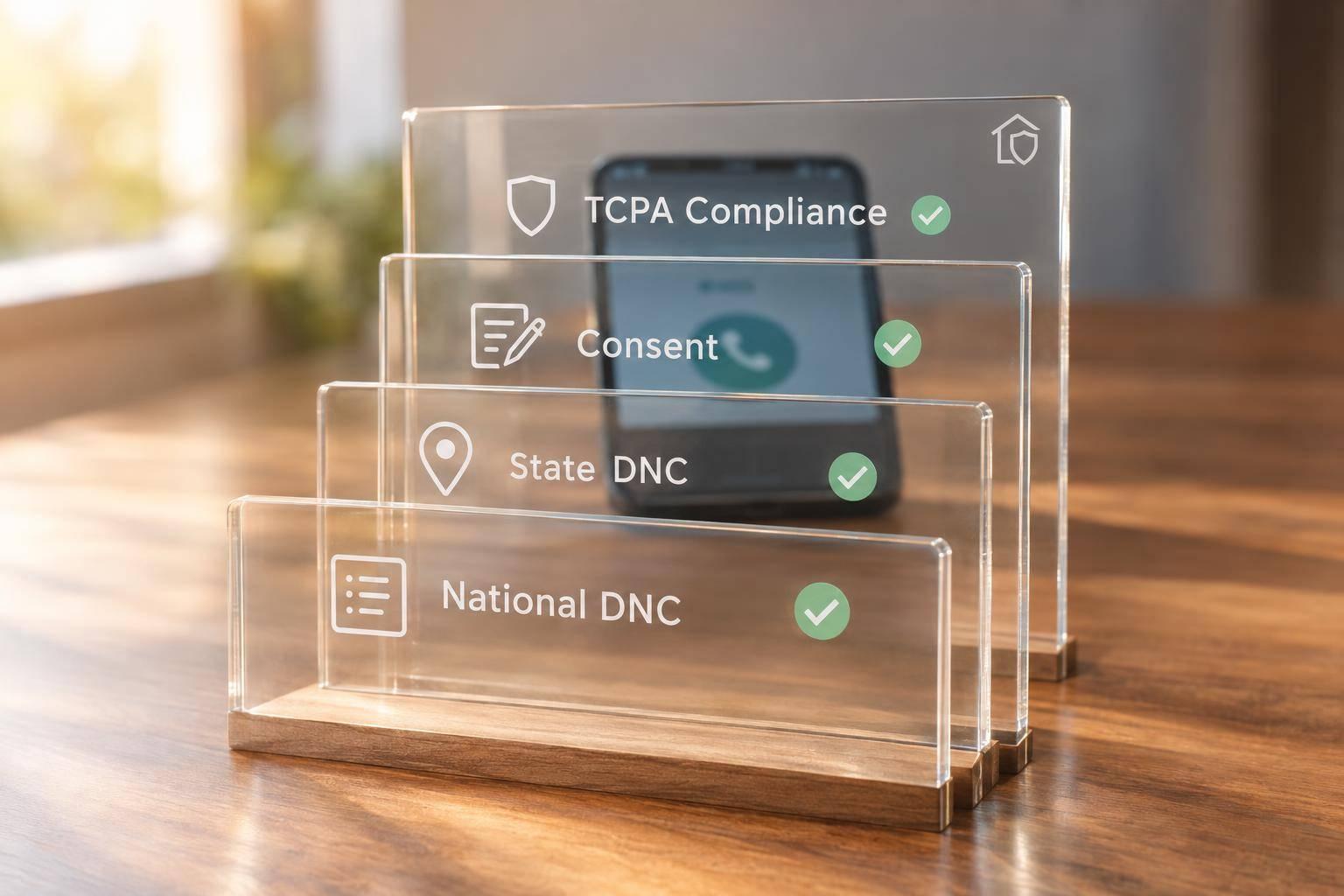
A clean DNC check is not permission to call. Home security teams must check federal, state, and internal do-not-call lists, then confirm that any required consent covers the seller and planned call or text. National Registry screening must use data no more than 31 days old.
Before a lead enters the queue, teams should:
- Confirm the recipient, phone number, seller, and outreach method.
- Check consent records, later opt-outs, and state calling rules.
- Mark the lead Callable, Hold, or Suppress - and keep unresolved or blocked records out of the dialer.
- Recheck permission and local calling time before dialing, then save the supporting records.
Phone verification helps check a number. It does not create consent.
Home Security Pre-Call DNC and TCPA Checklist
Check DNC Lists and Consent Records
Screen Federal, State, and Internal DNC Lists
Check each normalized number against the National Do Not Call Registry, applicable state lists, and internal suppression records. Combine opt-outs from web forms, calls, texts, email replies, service tickets, dealer systems, and prior campaigns. The FTC requires Registry screening at least every 31 days. Save the lookup timestamp, list version, seller, campaign, and result.
Apply the most restrictive applicable result. Route exception claims through a documented review - never override a result automatically. An established business relationship may permit certain live-agent calls for 18 months after a transaction or 3 months after an inquiry. But it generally does not permit robocalls or override a later internal opt-out.
Use the screening result to move the lead forward or keep it on Hold.
Match Consent to the Planned Outreach
Verify the number, timestamp, source, disclosure text, affirmative action, and stored consent artifact. That evidence must match the seller, marketing purpose, and planned call, text, or prerecorded voice. Obtain prior express written consent where required for autodialed or artificial- or prerecorded-voice telemarketing. Permission for a live call does not establish permission for those methods.
Put incomplete, mismatched, or stale records on Hold, with an owner and a review deadline. Resolve missing disclosure text, an uncertain recipient match, or consent naming a different dealer before releasing the lead. Review each record’s age, scope, and validity rather than applying one blanket expiration date. Keep the lead on Hold until the record matches the planned outreach.
Check Opt-Outs and State Calling Rules
Search connected systems for consent revocations received after consent was given. Block affected queued and scheduled outreach, then send suppression updates to the CRM, dialer, messaging system, dealer systems, and campaign exports.
Separately, check the recipient’s location - not just the area code - against current state consent, registration, calling-hour, frequency, and alarm-sales rules. Confirm the applicable requirements using current FTC, FCC, and state guidance. Federal clearance or an exception does not settle state compliance.
Write the final Callable, Hold, or Suppress status back to the CRM flags before the lead enters the call queue.
Use CRM Flags to Control Call Queues
After screening, CRM flags determine whether a lead enters the dialer, stays on hold, or is suppressed. Enrichment and phone verification are inputs - not permission to call. Keep them separate from seller-maintained consent, revocation, and suppression records.
Standardize Numbers and Keep Flags Separate
Normalize U.S. numbers to E.164 format (+1 plus the 10-digit number). Save the original value, remove punctuation and extensions from the match key, and use the normalized number to find duplicates.
Keep separate fields for federal, state, and internal DNC status; consent status, source, timestamp, and scope; revocation status; phone type; verification status; recipient-match confidence; and last screening date. Record a source and timestamp for every field, along with seller and campaign scope where relevant.
An active number doesn't tell you who will answer. Flag uncertain phone types, possible recipient mismatches, and conflicts between enrichment data and seller records. Use any litigator flag only as an input for risk review - not as proof that a call is prohibited or permitted.
Set Call, Hold, and Suppress Rules
Build queue rules around seller, campaign, and calling method, rather than giving a contact one permanent “callable” label. Release a record only when every required check passes. Agents must not be able to bypass suppression.
| Flag | Meaning | Required action |
|---|---|---|
| DNC block applies | A relevant restriction prevents the planned call | Suppress from the applicable campaign; do not place the call |
| Consent revoked | Permission was withdrawn | Suppress the affected calling category and update all relevant queues |
| Required consent missing | Permission for the planned method is unproven | Hold until qualifying consent is verified |
| Uncertain phone type or recipient | Classification or recipient match is unresolved | Hold for review |
| Conflicting records | Sources disagree | Hold; use the more restrictive outcome pending review |
| Disconnected or invalid | Number cannot support a reliable call | Suppress or remove from active queues |
| DNC clear | No match appeared in the checked source | Continue the remaining consent, identity, method, time, and internal-list checks |
Recheck Flags Before Dialing
Recheck flags after any import, number change, consent update, revocation, enrichment data update, campaign change, or DNC-list update. Enforce suppression through a shared record across agents, campaigns, and vendor feeds, within the documented scope.
Block dialing when required checks are missing, unavailable, or outdated, including National Registry data older than 31 days. Revalidate status immediately before dialing. Before releasing a hold, record the reviewer’s identity, decision time, reason, evidence, and rule version.
Save Records and Complete the Pre-Call Checklist
Keep a Pre-Call Audit Record
Once a lead is cleared for review, document the compliance basis before dialing. Save a timestamped compliance record - not just the lead’s status. Include:
- Lead ID, normalized number, recipient, seller, campaign, offer, channel, and caller ID.
- Federal, state, and internal DNC results, including lookup timestamps and source versions.
- Consent wording, scope, and proof; opt-out and revocation history; verification results; and the reviewer or automated rule supporting the status.
- The reason, owner, time, and next step for each disposition.
Link this record to approved scripts, prerecorded messages, caller ID authorization, and service-provider records. If the call goes out, log the calling and called numbers, seller, purpose, date, time, duration, script or message used, outcome, and transfers. Record call time and duration to the second.
The current TSR generally requires covered records to be kept for five years. Follow a written retention schedule. Confirm the retention period, storage format, access controls, state duties, and litigation holds with counsel. Assign seller and telemarketer recordkeeping duties in writing; without an agreement, both can remain responsible.
Confirm Permission and Local Calling Time
Before a call leaves the queue, verify that the record still supports the outreach. Right before dialing, confirm the recipient match, required flags, seller, purpose, channel, and technology. Check for later revocations, applicable DNC blocks, state restrictions, and caller ID authorization.
A clean DNC result alone does not authorize the call. Keep the lead out of the queue if evidence is missing or conflicts remain unresolved.
For outbound residential telemarketing calls, use 8:00 a.m.–9:00 p.m. in the called person’s local time as the federal TSR baseline, unless prior consent permits otherwise. Apply any narrower state, campaign, or consent-based limits. Determine local time using a reliable location source, account for daylight-saving changes, and hold leads whose time zones are uncertain. Save the final permission and local-time check in the call record.
Conclusion: Call Only After Every Check Passes
Use one pre-call gate to decide whether a lead can be called.
Enrichment and phone verification help with screening. They do not create consent.
Mark leads Callable only after every required check passes. Place unresolved records on Hold, and Suppress outreach that cannot proceed. Keep both Hold and Suppress records out of the dialing queue until an authorized review changes their status.
FAQs
How can I verify consent for purchased leads?
Store consent records in your CRM by status, channel, purpose, source, and timestamp. Update those records whenever someone revokes consent.
Before calling, check national, state, and internal DNC lists, along with internal opt-outs. Then confirm the TCPA requirements for your call type and verify that the consent covers that call.
BatchData flags DNC and TCPA status, but your team must verify consent. A “verified number,” a clear DNC result, or passing verification alone doesn’t mean you have permission to call.
What if a lead’s phone number has been reassigned?
When a phone number is reassigned, it no longer belongs to the person who gave consent. That breaks the chain of permission. Phone data decays by about 15% to 20% each year, so contact details and consent records that were once valid may be out of date.
Check consent and suppression lists before every campaign cycle. Update your data each time rather than relying on a one-time check.
Who is responsible if my dealer calls a suppressed lead?
Your organization is responsible for compliance when calling leads. Do Not Call (DNC) and TCPA flags help you screen leads, but they don’t give you legal permission to call.
The entity placing the call must follow the Telemarketing Sales Rule and Telephone Consumer Protection Act. Before dialing, maintain internal suppression lists, document any required consent, and check that your outreach follows federal, state, and local regulations.