If you need permit data across many U.S. counties, I’d pick an API for production and scraping for small tests.
Here’s the short version:
- A permit API gives me one integration, a standard JSON format, and more predictable monthly cost
- County scraping gives me direct access to local portals, but each county adds more parsing, more fixes, and more risk
- APIs are a better fit when I need scale, stable joins, and permit + property data in one flow
- Scraping is a better fit for 1–2 counties, one-time pulls, or a short pilot
- The article compares the paths on coverage, format, upkeep, latency, cost, and error risk
A few numbers stand out right away:
- BatchData says it covers 150 million+ and later 169 million+ U.S. property records
- The sample API price starts at $3,000/month for up to 100,000 matched records
- Scraping may look lower-cost at first, but labor grows with each new county and each portal change
Building Permit API vs County Scraping: Side-by-Side Comparison
API or Web Scraping? Which One Should You Use?
Quick Comparison
| Criteria | Building Permit API | County Scraping |
|---|---|---|
| Coverage | Many jurisdictions through one source | One portal at a time |
| Data format | Standardized JSON | Mixed files, tables, PDFs, and portal layouts |
| Setup | One connection | Custom work for each county |
| Upkeep | Vendor handles site changes | My team handles fixes |
| Latency | On-demand access | Depends on portal speed and batch jobs |
| Cost | More predictable fees | Low license cost, but labor can climb |
| Error risk | Lower due to multi-source feeds | Higher risk of silent gaps |
| Best fit | Production pipelines and multi-county use | Small pilots and narrow geographic work |
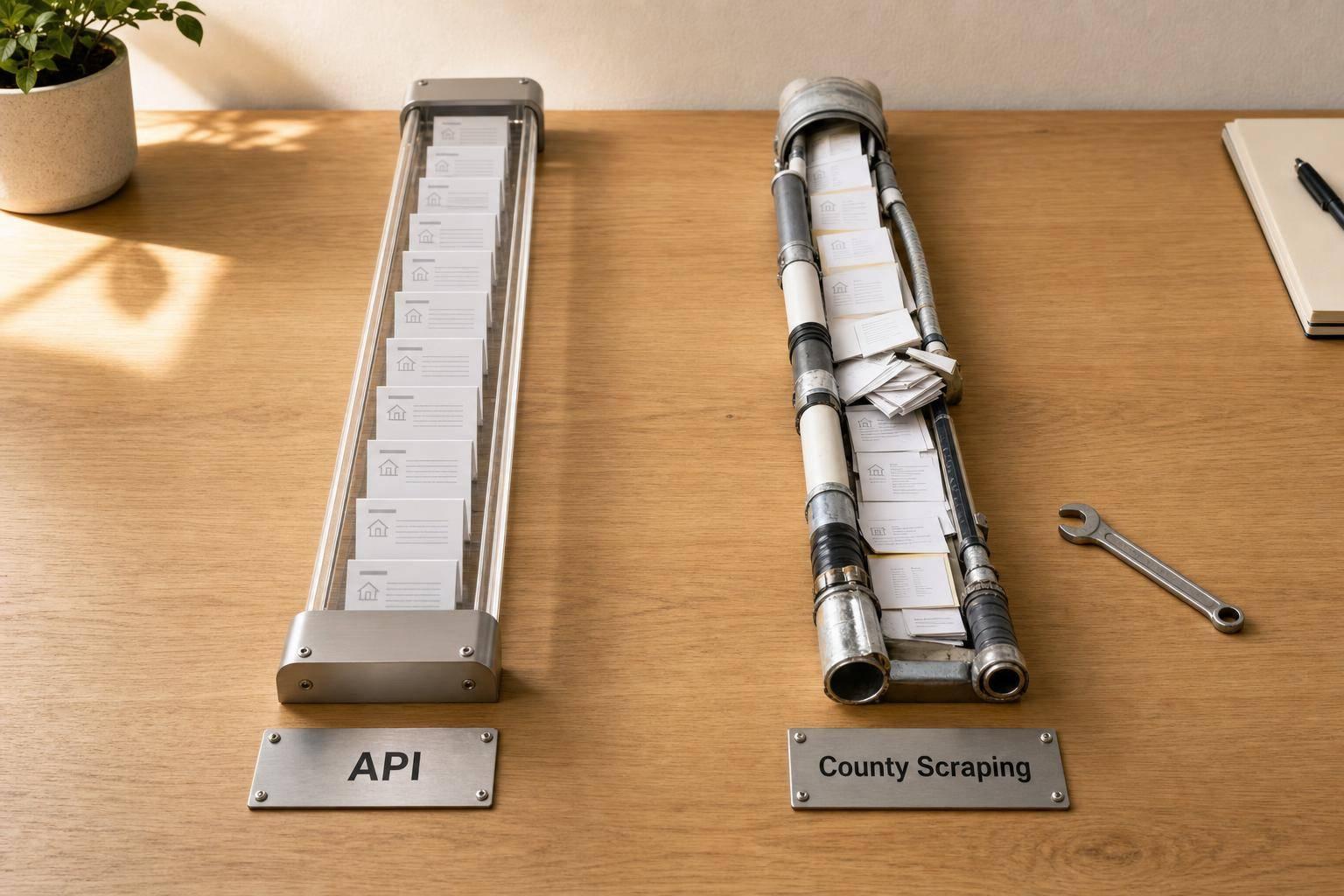
If I boil the article down to one point, it’s this: the choice is less about getting data and more about who owns the mess after launch.
Building Permit APIs: Strengths and Tradeoffs
A permit API pulls structured records into one place across thousands of U.S. jurisdictions. The upside is clear: you get cleaner, more consistent data. The downside is that you give up some source-level control, which stands out more when you compare it with county scraping.
Coverage, Schema, and Integration
The biggest day-to-day win with a permit API is schema consistency. Each record comes back in the same normalized JSON format, so teams don't have to keep remapping fields from one county site to the next. That makes downstream joins easier to manage and helps model inputs stay steady even when source formats shift.
BatchData covers more than 169 million U.S. property records. That scale helps keep permit joins more stable. If your team already uses BatchData, you can join permit records directly with ownership and identity data in the same system. That cuts out a lot of integration work.
Freshness, Maintenance, and Reliability
When a county portal changes its layout, the API provider deals with the fix instead of your engineering team. That's a big deal once this moves into production. And when one source slows down or stops updating, multiple upstream feeds can help reduce data gaps.
Cost and Error Profile
Pricing is usually monthly or usage-based, with billing tied to matched records. Standardized ingestion also cuts down on parsing mistakes that often show up when teams process inconsistent county formats at scale.
The tradeoff is simple: you get less source-level control than you would with direct scraping.
These advantages matter most for production pipelines that need stable data rather than county-by-county tailoring.
| Feature | API Advantage | Tradeoff to Consider |
|---|---|---|
| Coverage | Access to 150M+ U.S. property records across many jurisdictions | Possible gaps in very rural or non-digital counties |
| Data Format | Normalized JSON with a consistent schema | Higher upfront cost than free public scraping |
| Maintenance | Vendor handles break-fix when portals change | Dependence on the vendor's update timing |
| Reliability | Multi-source redundancy helps keep coverage steady | Requires integration into your software stack |
| Cost Profile | Predictable monthly or usage-based billing | Subscription minimums may not fit very small volumes |
County-by-county scraping comes with a different set of tradeoffs around coverage, upkeep, and error risk.
County-by-County Scraping: Strengths and Tradeoffs
Scraping can reach public permit portals, including counties that still aren't covered by an API. That's the big upside. You can go straight to the source.
The catch? The data is all over the place.
Coverage Flexibility and Data Fragmentation
With scraping, you can target county or city portals one by one. If a jurisdiction posts permit data in public, you can usually pull it.
But each portal tends to speak its own language. Field names change. Status labels don't match. Permit codes differ. Even address formats can shift from one jurisdiction to the next. So every new source adds another normalization problem your team has to handle in-house.
Refresh timing is messy too. Some portals update often. Others lag. That makes latency hard to predict, and just as uneven as the data itself. As you add more counties, that cleanup work keeps piling up.
Engineering Overhead and Data Quality Risk
The engineering load can grow fast. Direct sources need constant parsing, testing, and monitoring. And when a county changes a layout or updates an access rule, a working pipeline can break with no warning.
That's why a consistent payload matters so much. It's faster to request, easier to parse, and simpler to model.
The bigger issue is silent data loss. If a county portal changes its layout or goes offline, a scraper might return empty or partial results without throwing a clear error. Your pipeline still runs, but the data starts disappearing in the background. Unlike aggregated sources that pull records from multiple independent sources, a single-portal scraper has no fallback when one site lags or goes dark.
Once that happens, the cost story changes. What looked like savings on licensing starts turning into engineering hours.
When Scraping Makes Financial Sense
Scraping can still make sense in a few cases:
- A narrow pilot
- A one-time historical pull
- A project limited to a small set of jurisdictions
If your engineering cost stays below an API subscription that starts at $3,000/month for up to 100,000 matched records, scraping can work in the short term.
But that math can flip fast. More jurisdictions mean more scrapers to build, more break-fix work, and more normalization on your side. That's where scraping starts to strain.
| County-by-County Scraping | |
|---|---|
| Best for | Narrow pilots, one-off historical pulls, a small number of jurisdictions |
| Coverage | Any public portal, but fragmented by jurisdiction and format |
| Maintenance | High; layouts and access rules require ongoing upkeep |
| Data quality | Inconsistent; normalization falls entirely on your internal team |
| Failure mode | Silent; layout or access-rule changes can create data gaps without obvious alerts |
| Cost structure | Low licensing cost, but high engineering labor as scope grows |
Scraping looks cheap at first. But once you need dependable, production-grade coverage across many counties, the time spent on engineering, infra, and quiet failures often eats up the savings.
API vs. Scraping: Side-by-Side Comparison
The real question is which tradeoffs your team can live with in production. This isn't just about getting access. It's about how much of the day-to-day burden your team wants to carry.
Coverage, Latency, and Scale
APIs pull coverage into one place. Scraping grows one county at a time, only when each new build is finished.
APIs also return results on demand. Scraping is tied to portal response time, batch schedules, and a very basic problem: sometimes the target portal is down. For nationwide monitoring, that kind of uncertainty adds up fast.
Scale is where the gap gets much bigger. APIs support both single-address lookups using a property search API and bulk delivery in formats like CSV, JSON, or Parquet. That means the same platform can handle a one-off search and a pipeline moving millions of records. Scraping doesn't grow as neatly. More counties usually mean more scrapers, more monitoring, and more oddball cases your team has to fix on its own.
Format, Upkeep, Cost, and Error Risk
The biggest hidden source of downstream work is often the payload format.
When the payload stays consistent, it's faster to request, easier to parse, and simpler to model. Scraped data changes from county to county. Field names shift. Status labels vary. Address formats don't match. So every new source adds more normalization work.
Here is the practical split across the factors that matter most.
| Feature | Building Permit API | County-by-County Scraping |
|---|---|---|
| Coverage | Nationwide (150M+ records) | Limited to specific scraped jurisdictions |
| Data Format | Normalized, predictable JSON | Heterogeneous; requires custom parsing |
| Upkeep | Vendor-managed | High; portals change and break parsers |
| Latency | On-demand | High; dependent on portal response time and batching |
| Cost | Predictable subscription/usage fees | Variable; rises with every new county and fix |
| Error Risk | Low; redundant upstream feeds absorb gaps | High; a single-portal scraper has no backup source |
Error risk is different in a pretty basic way. API providers pull records from multiple independent sources, so if one upstream county feed lags or goes dark, coverage can still hold up. Pricing is also easier to plan for because it follows subscription or usage tiers. Scraping costs climb with every new county, every layout change, and every fix.
Those differences set up the choice framework in the next section.
How to Choose the Right Path for Your Data Pipeline
Choose based on coverage, refresh cadence, schema stability, and maintenance budget. In plain English, this is mostly about operating fit, not access.
Choose an API for Production-Ready Coverage
If your product touches more than a few counties - or you think it will soon - an API is usually the more practical choice. One integration gives you a normalized, predictable payload across jurisdictions. That means you don't have to build and maintain a separate scraper for each county.
BatchData's property API covers more than 169 million U.S. property records from comprehensive datasets, which helps coverage stay steadier when one county feed fails. Permit data also becomes more useful when you pair it with ownership context. BatchData supports that kind of enrichment through a single integration, combining permit feeds with ownership records without adding inconsistency across vendors. That's why APIs tend to work best when permit data needs to join cleanly with other property data.
Choose Scraping for Narrow or Short-Term Needs
Scraping makes sense in a pretty specific case: you need data from one or two counties, your requirements are tightly tied to that geography, and you're testing the use case before building broader infrastructure. In that situation, scraping can be a fine starting point.
Outside that window, the upkeep tends to outpace the savings fast. County sites change, fields shift, and fixes pile up. So scraping is usually a short-term fit, not the default path for production.
Conclusion: The Short Version
APIs fit production-grade scale and stability. Scraping fits narrow pilots or short-term gaps.
FAQs
When does scraping stop being cost-effective?
Scraping stops making financial sense when upkeep, infrastructure headaches, and messy data cost more than the data is worth.
That’s usually where custom scrapers start to fall apart. They can leave you with fragmented datasets and a steady stream of engineering work just to parse, normalize, and repair things when source sites change their layout or disappear altogether.
A standardized, ready-to-use option gives you data in a more consistent, structured format. It also cuts down the load on technical teams, so they can spend less time fixing pipelines and more time on work that moves the business forward.
How do I decide if my team needs an API or a pilot scraper?
Choose based on your team’s tolerance for day-to-day upkeep versus fast integration.
An API gives you standardized data, more reliable coverage, and less upkeep with a lower risk of errors. A custom scraper, on the other hand, needs steady attention to site changes, rate limits, and data normalization. That extra work can push costs and overhead up as your needs grow.
What should I check before choosing a permit data source?
Check whether the provider pulls data from more than one independent source. That way, if one feed goes down, your coverage doesn’t fall apart with it.
You’ll also want records to arrive in a consistent, predictable format. That cuts down on parsing problems and helps your models stay steady instead of breaking on small input changes.
Beyond the data itself, make sure the platform is well documented and fits into your existing workflows. It should also give you the flexibility and real-time accuracy you need to keep your data pipeline dependable on a set schedule.