



Collection skip tracing is not debt recovery. It's the identity-resolution workflow that gives a recovery team a credible way to contact the right person after addresses, phone numbers, and employment records have gone stale. Experian reports that the average age of debt in collections is about 3.5 years, while average recovery on delinquent accounts is only about 20%. Experian's skip-tracing analysis connects that aging problem with the need for refreshed contact and employment data.
A workable program does three things well: prioritizes accounts by actionable signals, verifies identity across multiple identifiers, and records enough evidence to defend every contact decision. It also separates the locate from the recovery conversation that follows.
- Why it matters: Old debt carries weaker contact data, and updated records are essential to keeping viable accounts in the queue.
- How it works: Triage failed contact attempts, resolve identity, layer data sources, verify channels, then hand a defensible lead to collections.
- Where teams fail: Single-source matches, uncontrolled dialing, weak audit logs, and treating a phone number as proof of identity.
- What compliance requires: Third-party location inquiries have a narrow purpose, and a successful locate doesn't remove FDCPA, TCPA, privacy, or state-law obligations.
Why Collection Skip Tracing Matters More Than Ever
Debt becomes harder to recover as contact data ages. Experian places the average age of accounts in collections at about 3.5 years and average recovery on delinquent accounts at about 20%. Its industry analysis also reports that U.S. household debt surpassed $18 trillion in Q3 2025. For operations teams, the implication is practical: the original application file cannot remain the only basis for contact decisions.
Collection skip tracing addresses that decay through a controlled identity-resolution workflow. It brings current addresses, phone numbers, and employment information into the account record, then gives the collector a defensible reason to use a particular channel. That work supports recovery, but it does not create recovery by itself.
A locate and a recovery outcome are separate milestones. The locate identifies a credible person and contact path. Recovery still depends on a compliant conversation, account handling, and the consumer's willingness and ability to resolve the balance.
Debt age changes the economics
The balance should not determine tracing priority by itself. A smaller account with a verified current address may offer a cleaner recovery path than a larger balance supported only by an old phone number and an unconfirmed name. Paid-search capacity belongs on accounts with evidence that supports a productive next action.
The relationship between aging debt and tracing triggers is operational, not a universal benchmark. Internal teams should measure right-party contact rates from their own portfolio rather than assume that an outside rate applies to every placement.
| Debt Age | Right-Party Contact Rate | Typical Trigger for Skip Tracing |
|---|---|---|
| Early delinquency | Measure internally | Failed first-touch outreach or returned correspondence |
| Mature placement | Measure internally | Disconnected phone, repeated unanswered outreach, address mismatch |
| Aged collection account | Measure internally | Stale address history, obsolete employment record, multiple failed channels |
First-party portfolios usually contain richer relationship data because the creditor owns the account history, application records, payment behavior, and prior interactions. Third-party agencies inherit the placement file, often with less context and less tolerance for wrong-party calls. That difference should shape the workflow and its evidence requirements, not only the vendor decision. Teams managing placement technology can also review how collection company software supports account staging, contact history, and operational controls.
The source record matters as much as the new lead. Preserve the original identifiers, record when enrichment occurred, and show which evidence supported the match. A phone number by itself is not proof of identity, and a successful locate does not authorize unrestricted outreach.
Operational boundary: A locate creates an option to recover. The collector still has to establish a compliant conversation, validate the account where required, obtain a payment commitment, and manage the promised arrangement.
Auditability determines whether the process can withstand review. The file should show which identifiers supported the match, which source returned the information, when it was checked, and why the collector selected that channel. Regulators and plaintiffs' attorneys can examine the path from raw data to contact attempt. Skip tracing therefore belongs in workflow design, with evidence attached to each decision rather than treated as a one-time data lookup.
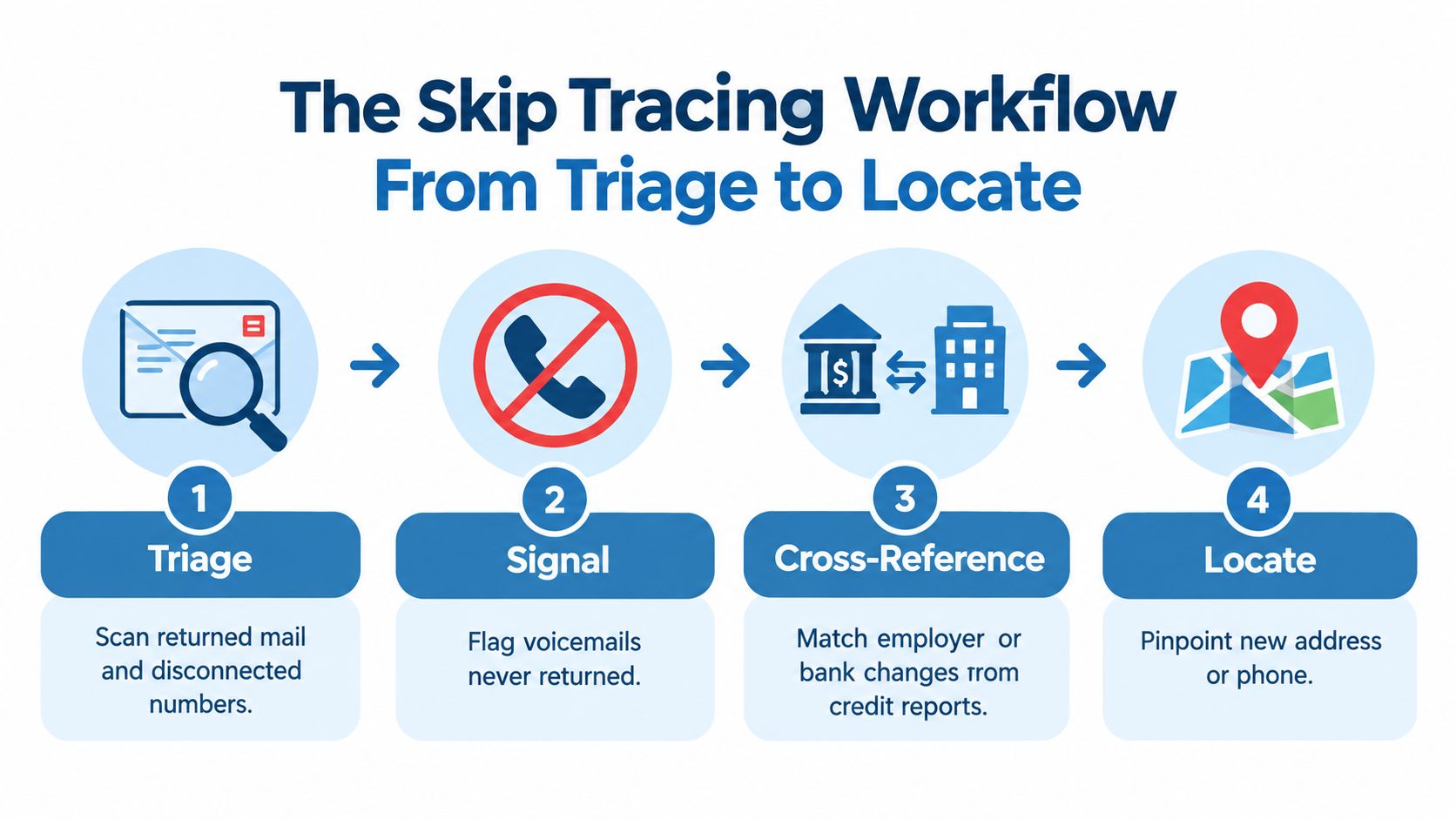
The Skip Tracing Workflow From Triage to Locate
The strongest workflow starts with account signals, not a blind batch search. Returned mail, disconnected numbers, unreturned voicemails, and employer or bank changes reported by the original creditor should determine which accounts enter tracing and how urgently they move.
Triage before you spend
Start with a queue that records the failed signal and its date. A returned envelope says something different from a disconnected number, and a creditor-reported job change can be more useful than either. Preserve the original data before enrichment so the team can later distinguish an old record from a newly discovered one.
Prioritize by recoverable signal, not balance. A $400 charged-off account with a confirmed new address may deserve attention before a $9,000 account with no credible lead. The point isn't to ignore balance. It's to avoid spending paid-search capacity on accounts where the available evidence doesn't support a productive next step.
A practical sequence looks like this:
- Flag the failure: Record returned mail, disconnected service, failed email, silent voicemail history, or reported location change.
- Normalize the file: Standardize names, addresses, phone formatting, emails, dates, and account identifiers before searching.
- Resolve identity: Use multiple identifiers, including name, prior address, DOB, SSN where permitted, phone, and email.
- Narrow candidates: Use existing records to eliminate same-name people and conflicting locations before querying paid sources.
- Escalate selectively: Add carrier, property, public-record, employment, or other permitted data only for surviving candidates.
- Verify the channel: Confirm that the proposed phone, email, or address belongs to the matched consumer and is suitable for the next action.
- Hand off with evidence: Return the result, confidence rationale, source dates, restrictions, and recommended contact path to the collector.
Identity resolution sits in the middle because raw location data is not actionable by itself. A current address attached to the wrong person is a liability, not a lead.
Make the handoff explicit
The skip-trace desk and collector need written handoff rules. The organization should define its own minimum confidence score and minimum verified-channel count before dialing, based on validation results, complaint history, jurisdiction, and channel risk. Don't let an agent infer those thresholds from a vendor's green checkmark.
A useful handoff record identifies the matched consumer, supporting identifiers, verified channels, source timestamps, suppressed channels, and the reason the result passed review. Teams that also need outbound support can evaluate specialized resources such as hire cold callers, but calling capacity won't repair weak identity matching. More phone minutes only amplify bad data.
Core Data Sources and How to Layer Them
No single source deserves automatic trust. Credit headers can be useful for names and address history, utility signals may help confirm occupancy, carrier data can clarify whether a number is active, and public records can connect people to properties or businesses. Each source answers a different question, arrives on a different timetable, and carries a different compliance burden.
Experian describes location models that combine credit headers, change-of-address records, utility setup data, property records, and social footprints in its small-business skip-tracing overview. That layered approach is more reliable than treating one database result as a final answer.
| Data Source | Best Signal | Latency | Cost per Hit | Compliance Friction |
|---|---|---|---|---|
| Credit-header data | Name and address history | Often delayed | Usually low to moderate | High, because permissible purpose and access controls matter |
| Utility and address history | Possible occupancy or move signal | Can lag a move | Moderate | High, because sensitive location data needs strict controls |
| Phone and carrier records | Number activity and line type | Often faster | Moderate | High, especially for cell outreach and consent |
| Public records | Property, court, filing, or business connections | Varies by jurisdiction | Low to moderate | Moderate to high, depending on use and jurisdiction |
| Digital footprint signals | Employment, business, or geographic clues | Unpredictable | Low to moderate | High if collection involves deception or sensitive profiling |
| Proprietary networks | Cross-source contact enrichment | Varies by provider | Moderate to high | High, requiring contracts, permissible-use review, and monitoring |
Escalate only when the candidate survives
Begin with the cheapest signal that can confirm or eliminate a candidate. A prior address can disambiguate a common name before the team buys a phone search. A DOB conflict should suppress a result before a collector sees it. A property connection may strengthen identity, but ownership alone doesn't prove that the person currently answers a particular phone.
Property data can be especially useful when a location history needs additional context. The property-data approach to skip tracing shows why ownership, mailing address, and related property signals should be treated as enrichment inputs rather than standalone identity proof.
Single-source workflows fail in predictable ways:
- Credit-header dependence: Strong historical address context can coexist with an obsolete phone.
- Utility dependence: A residence signal may be useful but can arrive after the consumer has already moved.
- Phone-only matching: A recycled, shared, or wrong-party number can produce an apparently successful locate.
- Public-record overreach: A record can establish an association without establishing current possession or contact permission.
- Digital-footprint shortcuts: A social profile can suggest a location but shouldn't replace deterministic identity checks.
The layer should end with a decision, not a data dump. Pass a verified lead, route it to manual review, or suppress it with a documented reason.
Identity Matching and Verification Best Practices
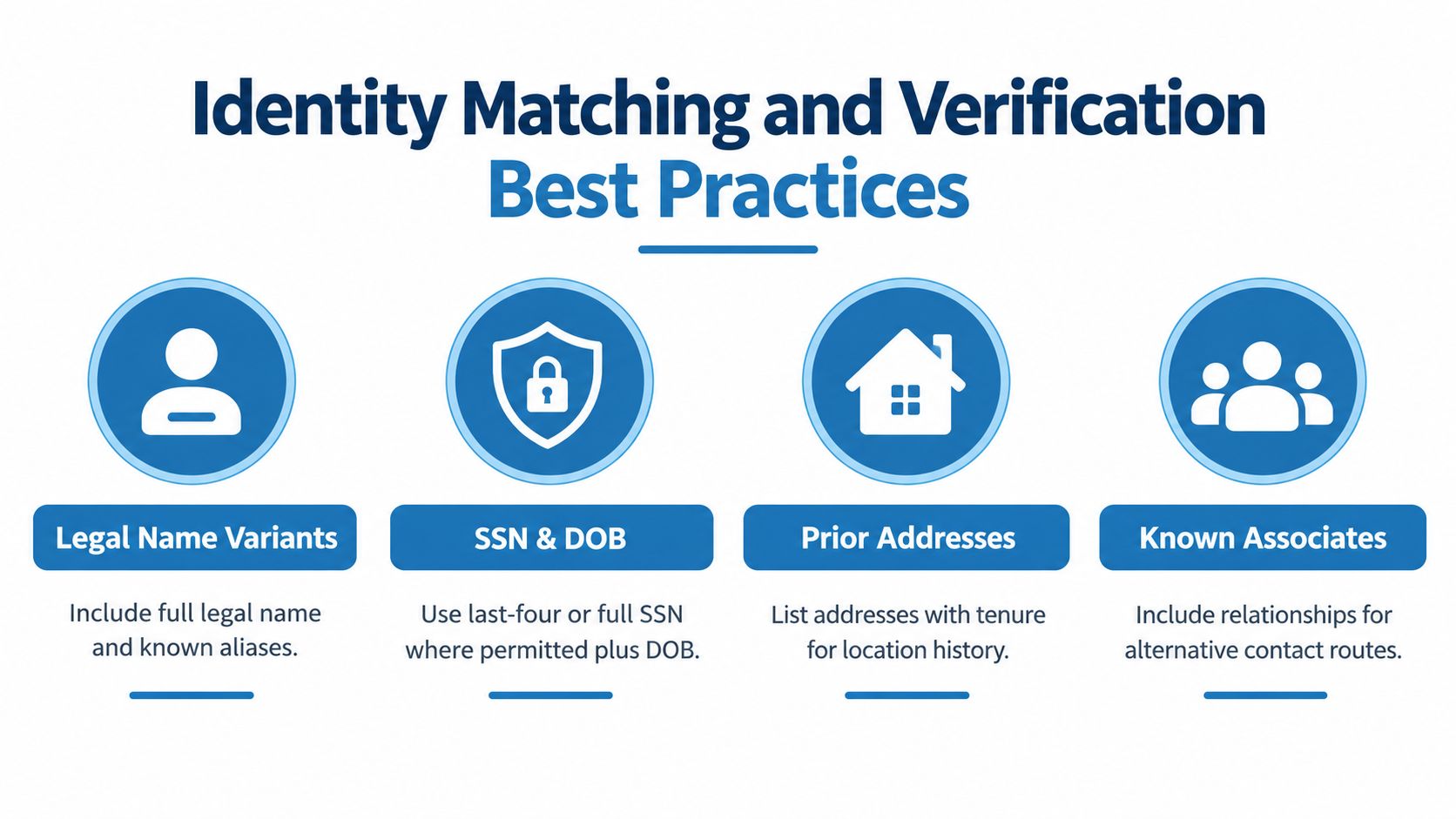
A contact becomes usable only when the record identifies the right person with enough confidence to support the proposed action. Identity matching should combine full legal name variants, SSN last-four or full SSN where permitted, DOB, prior addresses with tenure, phone, email, and known associates.
Deterministic matching looks for exact agreement on strong fields. Probabilistic matching scores partial agreement, such as a name variant paired with a prior address and a related contact. Production teams often use a 0 to 100 confidence scale, but the thresholds should be set through internal validation and legal review rather than copied from a vendor.
Separate automatic action from review
A workable policy can define three bands:
- 85 and above: Eligible for automatic workflow treatment only when the channel itself passes verification and the account has no conflicting restriction.
- 70 to 84: Manual review, with an analyst checking conflicting names, dates, addresses, and relationships.
- Below 70: Suppression until new evidence appears.
Those bands are operational guardrails, not universal legal standards. A score doesn't legalize a call, prove consent, or establish that a third party is safe to contact.
Phone and email checks should answer practical questions:
- Is the phone number active or disconnected?
- Is it mobile, landline, VoIP, prepaid, or recently ported?
- Does the number appear consistently with the matched identity?
- Has the email domain, mailbox, or prior interaction history changed?
- Is there a risk flag that requires manual handling?
Here's the kind of rejection logic that prevents avoidable wrong-party contact. A same-name result with a different DOB and no matching prior address should be rejected, even if the phone is active. A maiden-name variation that aligns with the known DOB, prior address, and co-applicant relationship can pass to review because multiple independent identifiers support the same identity.
Preserve the reasoning
Every result should carry an audit trail containing input fields, returned candidates, matching fields, confidence score, verification checks, analyst decision, and contact disposition. If a collector later receives a dispute, the organization should be able to reconstruct what was known before the call, not merely display the current CRM record.
Legal and Compliance Boundaries After a Locate
A successful locate doesn't give a collector unlimited permission to call, text, email, or contact relatives. Under the FDCPA, a collector may contact third parties only to obtain location information and may not disclose that the consumer owes a debt. The permitted purpose is limited to confirming or correcting an address, phone number, or workplace, as summarized in this overview of third-party location contacts.
A collector can generally contact a given third party only once for location information unless that person asks to be contacted again or the collector reasonably believes the earlier information was wrong or incomplete. The Mayfield Law Firm's explanation describes that limitation. That rule should be enforced in the workflow, not left to an agent's memory.
| Compliance Trigger | Source Rule | Operational Control |
|---|---|---|
| Third-party location inquiry | FDCPA limits purpose and prohibits debt disclosure | Use a restricted script, one-contact rule, and third-party disposition code |
| Consumer communication | FDCPA validation obligations can apply | Route required notices, disclosures, and dispute status into the contact workflow |
| Cell number found through tracing | TCPA consent requirements may apply to automated or prerecorded calls | Check consent and calling method before dialing |
| Dispute or cease-communication request | Applicable collection rules restrict continued outreach | Suppress or route the account immediately |
| Employer or social signal | Pretexting and unnecessary disclosure create risk | Require identity confirmation and prohibit deceptive acquisition methods |
Section 809(b) of the FDCPA requires validation handling, including the five-day notice window and the required disclosure framework commonly known as the mini-Miranda in consumer communications. The exact control should be reviewed with counsel because state rules, licensing requirements, and account circumstances can add obligations. Teams that need a practical explanation of prohibited conduct can consult what unfair collection practices are.
Cell channels deserve separate treatment
If tracing produces a cell number, the TCPA raises the stakes. Calls made with an automatic telephone dialing system or prerecorded or artificial voice generally require prior express consent, and statutory damages can range from $500 to $1,500 per call under the collection skip-tracing TCPA discussion. Don't infer consent from possession of a number.
Leaving a voicemail can also create disclosure and consent concerns, particularly when the message reaches a shared device or third party. A located phone number is a candidate channel, not a clearance signal. Public-record phone data, including resources such as public-record phone numbers, still requires permissible-use controls, suppression logic, and channel-specific review.
Choosing the Right Tooling and API Integration
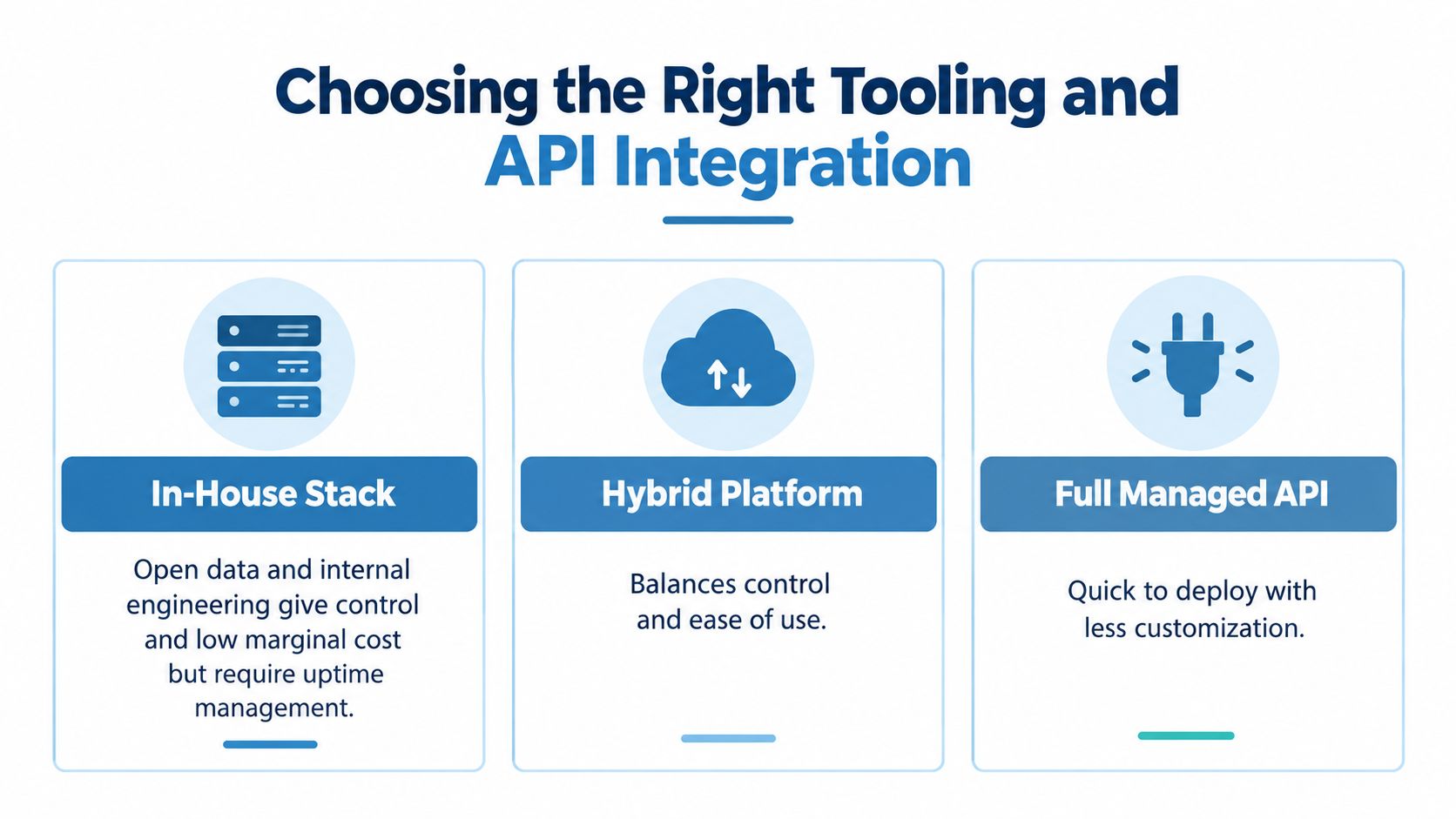
The right deployment model depends on portfolio behavior, engineering capacity, data requirements, and the speed of the next collection action. An in-house stack offers control but makes the organization responsible for data sourcing, uptime, scrubbing, monitoring, and compliance operations. A managed batch service reduces integration work and fits queued portfolios, while a real-time API makes more sense when the system must resolve identity during an active interaction.
| Deployment Path | Strength | Trade-Off | Best Fit |
|---|---|---|---|
| In-house stack | Maximum control over schemas, rules, and routing | Engineering and data-pipeline ownership remain internal | Large teams with mature infrastructure |
| Third-party batch service | Fast deployment and per-record processing | Less control over source behavior and refresh timing | Queued portfolios and scheduled enrichment |
| Real-time API | Immediate response for active workflows | Latency, failure handling, and usage costs need close monitoring | Dialers, inbound recovery, and live servicing |
A provider comparison should go beyond hit-rate language. Ask how the system exposes source-level results, confidence scores, match explanations, latency, suppression handling, audit logs, retry behavior, and vendor drift. A result that can't be explained is difficult to defend and difficult to improve.
Use a canonical integration pattern
A practical architecture has five controls:
- Protect inputs: Hash or tokenize sensitive identifiers client-side where the design and vendor contract support it.
- Make requests repeatable: Send a REST request with an idempotency key so retries don't create duplicate work or ambiguous audit records.
- Normalize outputs: Convert addresses, phone records, emails, source dates, confidence values, and restrictions into a canonical contact schema.
- Write immutable logs: Preserve the request, response, timestamp, vendor, rule version, and downstream disposition.
- Feed outcomes back: Compare verified contact outcomes with the original confidence and source mix to benchmark vendors and adjust thresholds.
A property-focused platform such as BatchData offers property skip-trace workflows and a /property/skip-trace API endpoint for enriching property records with owner phone numbers, email addresses, and mailing addresses. That capability is relevant when property ownership or mailing data forms part of the identity-resolution path, but it should still sit inside the same consent, suppression, and audit framework as every other source.
A short visual comparison of these deployment choices is useful before an engineering project begins.
Troubleshooting, Auditing, and Your First 30 Days
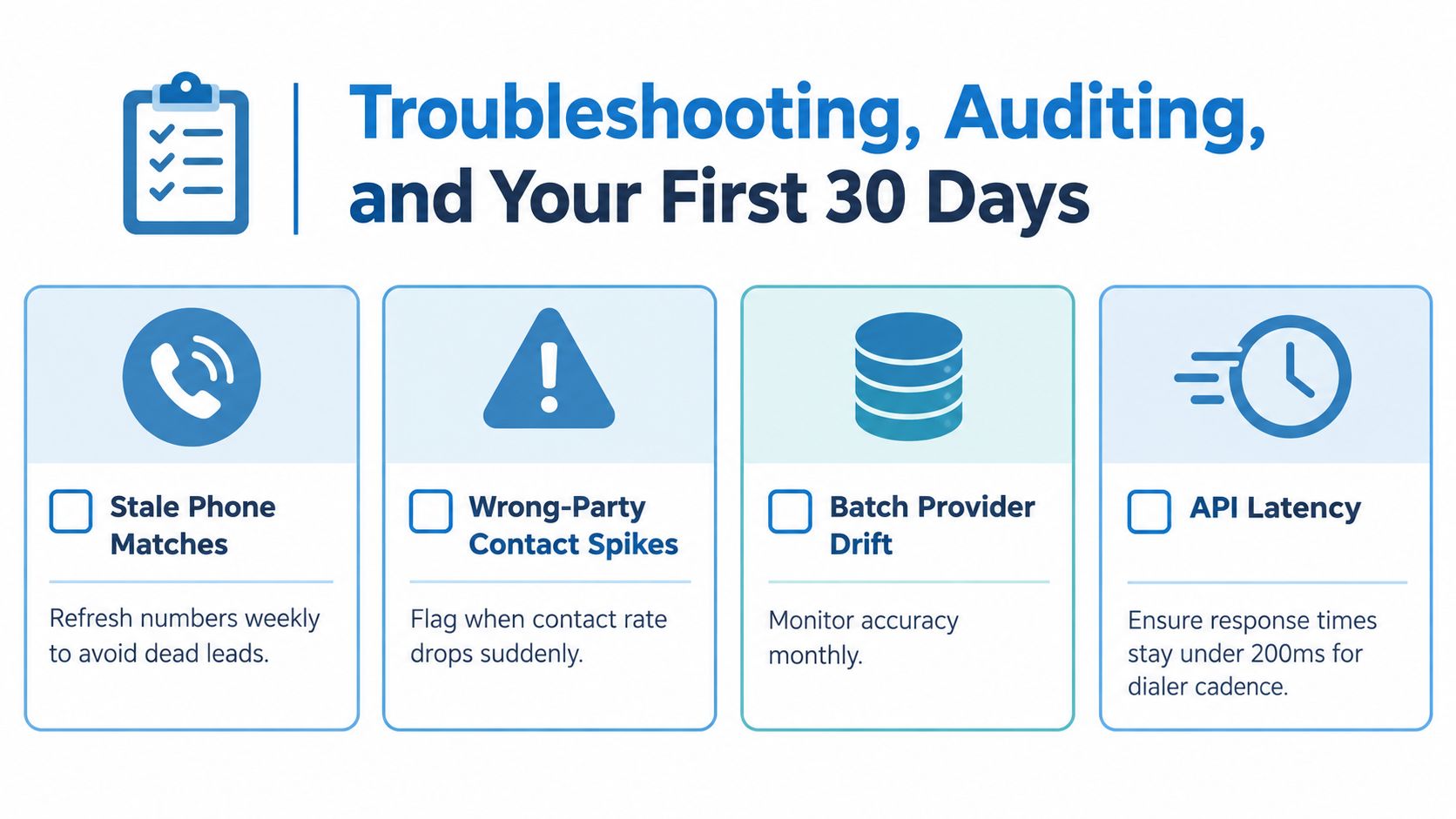
Most skip-tracing failures originate upstream. Stale phone matches usually point to weak refresh logic or excessive reliance on one source. Wrong-party contacts often trace back to identity resolution, not collector performance. Provider drift appears when source coverage or matching behavior changes without a corresponding monitoring process. API latency becomes an operations problem when the dialer can't maintain its intended cadence.
Independent industry commentary places overall skip-tracing accuracy anywhere from about 35% to 90%, while phone-number accuracy is often cited between 70% and 98%, depending on service tier and sourcing, as summarized by SmartSkip's accuracy discussion. Those broad ranges are a warning against accepting a single vendor-wide accuracy figure. Measure the outcome that matters to your operation, such as verified right-party contact and usable channel rate.
Build the minimum useful log
At a minimum, record:
- Input fields: Original name, address, phone, email, DOB, permitted SSN fields, account age, and failed-contact signals.
- Returned records: Every candidate address, phone, email, employer, source, and source timestamp.
- Decision data: Confidence score, matching identifiers, contradictions, analyst disposition, and suppression reason.
- Agent outcome: Wrong party, no answer, verified consumer, dispute, promise to pay, payment, or escalation.
- System events: Request ID, retry status, response time, provider version, and error code.
That structure separates provider performance from collector behavior. It also gives compliance and operations teams a defensible record when a consumer challenges the basis for contact.
Run a disciplined first month
Days one through five: Select vendors against data depth, confidence transparency, source dates, suppression features, integration method, and audit logging. Complete legal and compliance review before production access.
Days six through ten: Run a dry test on a 10,000-account sample, as a controlled implementation exercise rather than a claimed industry benchmark. Segment the sample by debt age, original data completeness, account type, and failed-contact signal.
Days eleven through twenty: Lock identity rules, review borderline matches manually, test opt-outs and disputes, confirm third-party contact suppression, and validate channel-specific dialing controls.
Days twenty-one through thirty: Compare results by source and segment. Report weekly right-party contact rate, average locates per account, cost per locate, wrong-party rate, dispute rate, and time from lookup to collector handoff. The goal is not to maximize raw matches. It's to maximize defensible, usable contacts that lead to compliant recovery activity.
A skip-tracing program should be judged by what happens after the locate, not by how many records a vendor returns.
Teams should also set alert thresholds for sudden wrong-party spikes, provider accuracy changes, failed API requests, and abnormal latency. If the operation can't connect an outcome to the lookup that produced it, it can't reliably troubleshoot, benchmark, or defend the workflow.
BatchData can support property-based contact enrichment through bulk workflows and API requests that return owner contact information such as phone numbers, emails, and mailing addresses. Visit BatchData to evaluate how its property skip-trace capability could fit into your identity-resolution, verification, and audit process.