


































Skip tracing in real estate is the process of finding accurate contact details for property owners, especially for off-market opportunities. By leveraging property data like ownership records, transaction histories, and tax liens, professionals can locate motivated sellers quickly and efficiently. Traditional manual searches are often slow and outdated, but enriched data sources streamline the process, achieving up to 76% right-party contact rates – three times the industry average. This article explores how property data transforms skip tracing into a faster, more precise tool for real estate success.
Key Highlights:
- Property Data Insights: Ownership history, transaction records, tax liens, and mailing addresses improve accuracy.
- Public Records vs. Enriched Data: Enriched data combines public records with private sources, offering higher accuracy (80-95%) and faster results.
- Efficient Workflow: Use tools like BatchData to enrich leads, verify contact details, and stay compliant with DNC and TCPA regulations.
- Targeting Motivated Sellers: Identify distressed properties and track ownership changes, even for LLCs or trusts.
BatchData simplifies skip tracing with APIs and bulk data options, providing fast, reliable, and compliant results for real estate professionals. Whether you’re focusing on absentee owners, pre-foreclosures, or vacant properties, property data is the key to staying ahead in competitive markets.
Skip Trace PROPERTY OWNERS/OCCUPANTS with this 3 tools
How Property Data Supports Skip Tracing
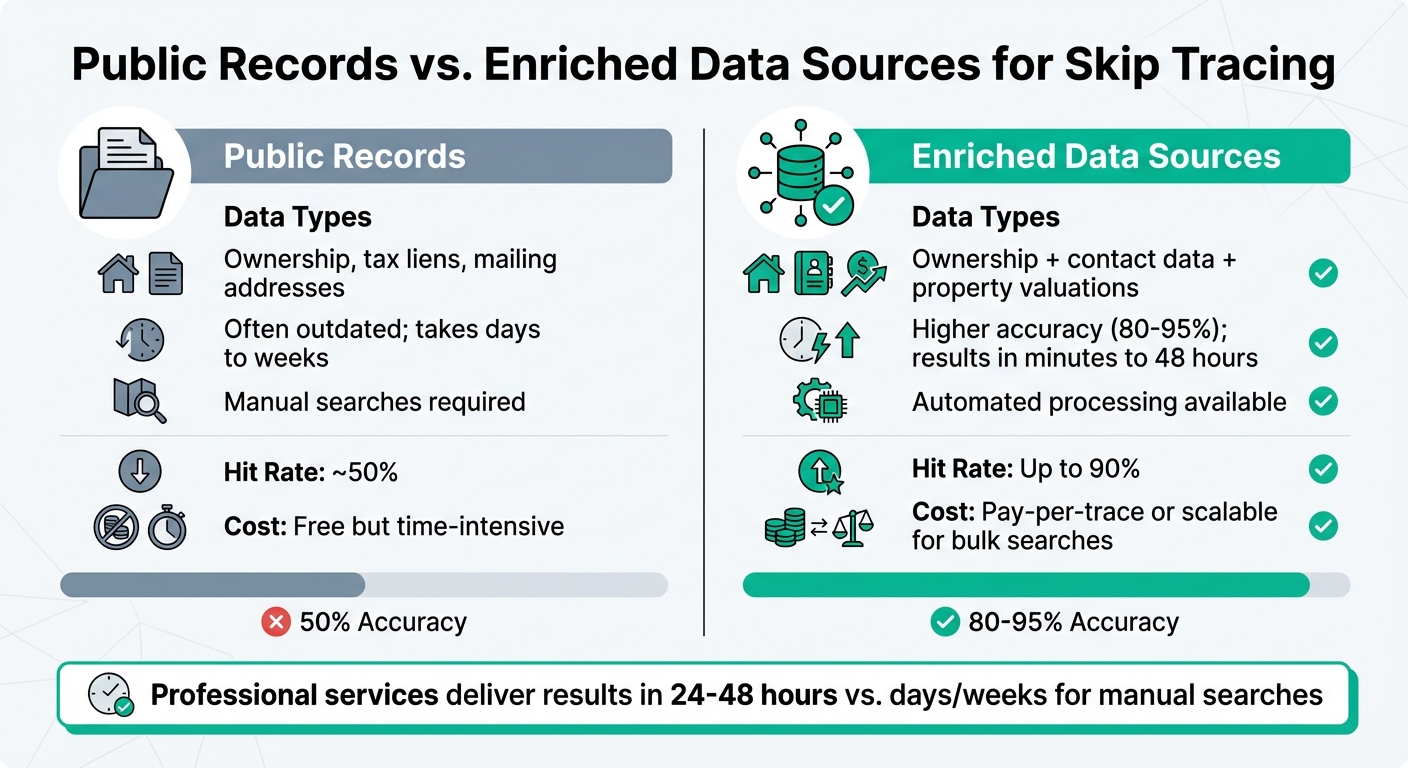
Public Records vs Enriched Data Sources for Skip Tracing Comparison
Property data plays a key role in making skip tracing more precise. Instead of relying on outdated addresses or calling random numbers, professionals can use verified ownership records, transaction histories, and financial insights to pinpoint the right person. Let’s break down how specific data points refine this process.
Property Data Points Used in Skip Tracing
- Ownership history: This reveals current and past owners, helping trace individuals even if they’ve moved. For example, if a vacant property was transferred in 2023 from an individual to an LLC, linked transaction records might reveal the original owner’s new address in another state.
- Transaction records: These show sale dates, prices, and parties involved, helping verify identities and uncover trends. For instance, a $150,000 cash sale during pre-foreclosure could lead directly to the seller’s contact details, enabling direct outreach for off-market deals.
- Tax liens: Unpaid property taxes often signal distressed owners. Tax lien records include owner names, parcel numbers, and mailing addresses, which can reveal a forwarding address for direct communication.
- Mailing addresses: Property tax records often list forwarding addresses. Cross-referencing these with tax lien data increases accuracy. For example, platforms like BatchData analyze over 1,000 data points across 155 million properties, including corporate and trust ownership data. This helps identify LLCs and connect them to the actual decision-makers .
These detailed data points offer a significant advantage over basic public records.
Public Records vs. Enriched Data Sources
Public records from county assessors provide foundational information – like ownership names, tax addresses, and lien details – but they’re often outdated and require time-consuming manual searches. At best, you might uncover a name, but not the verified contact details needed to move forward.
Enriched data sources, on the other hand, combine public records with proprietary information from credit headers, utility databases, and even social media. This approach delivers comprehensive contact profiles with accuracy rates between 80% and 95%, cutting search times from weeks to hours. While public records alone may achieve hit rates of around 50%, enriched datasets push that number closer to 90% .
| Aspect | Public Records | Enriched Data Sources |
|---|---|---|
| Data Types | Ownership, tax liens, mailing addresses | Ownership plus contact data and property valuations |
| Accuracy & Speed | Often outdated; takes days to weeks | Higher accuracy; results in minutes to 48 hours |
| Cost | Free but time-intensive | Pay-per-trace or scalable for bulk searches |
Professional services can deliver results in as little as 24–48 hours, compared to the days or weeks required for manual public record searches. They can also handle bulk lists, verifying thousands of leads overnight for campaigns focused on distressed properties. For instance, BatchData’s API provides real-time enrichment and includes DNC scrubbing to ensure compliance with TCPA regulations .
Using Property Data to Improve Skip Tracing Results
Refining skip tracing techniques with property data can turn a guessing game into a structured and effective process. By examining ownership patterns, financial distress signals, and connections to related parties, you can uncover hard-to-find property owners and potential opportunities. Here’s how you can apply these methods.
Tracking Ownership History and Transactions
Ownership records, especially deed transfers, provide a clear view of a property’s ownership history – even when the owner uses an LLC or trust. Comparing the property address with the tax billing address can often reveal the owner’s true location or even a frequently checked P.O. Box. If the property is held by an LLC or trust, reviewing the "Statement of Information" in state business filings can help identify key individuals, like managing members or registered agents. In cases where ownership trails end with a death, probate records and obituaries can pinpoint surviving relatives or executors managing the property.
"Professional investors know that the owners you can’t find easily are the best opportunities – and are worth five times as much time and effort as the ones where you can easily find the phone and email information."
– Jacob Camhi, PropertyRadar
A methodical approach works best: start with the County Tax Assessor for property records, check the County Recorder for deed history, and cross-reference with voter registrations or court records. High-quality skip tracing services often achieve hit rates of 70% to 90%, and skip-traced lists typically convert two to three times better than generic mailing lists.
Once you’ve mapped out ownership, the next step is to analyze financial clues that signal distress or motivation to sell.
Finding Distressed Properties and Motivated Sellers
Financial distress is often a key indicator of motivated sellers. Look for properties with tax liens, pre-foreclosure filings, or long-standing delinquencies. Keep in mind, lenders generally cannot foreclose until a borrower has been delinquent for at least 120 days. Ownership duration can also provide insights – long-term landlords, often referred to as "tired landlords", might be looking to downsize or retire. For properties owned by LLCs or trusts, state business filings can help identify the individuals behind these entities.
Prioritize properties with significant equity, as these owners are more likely to act quickly to protect their investment. Skip tracing services that include confidence scores can help you zero in on the most reliable contact leads. Combining financial analysis with ownership tracking creates a comprehensive profile for each property.
Locating Relatives and Neighbors
If the property owner is unavailable, property data can help you find alternative contacts through relatives or neighbors. Advanced skip tracing tools often identify spouses and up to three additional family members, offering backup options. For inherited properties, linking property data with probate records or obituaries can uncover surviving heirs who might be open to selling. Some property data platforms also provide contact details for nearby residences, giving you insights from locals who may know the owner’s situation. Keep in mind, only about 6% of general web contact information is reliable.
sbb-itb-8058745
Adding Property Data to Your Skip Tracing Process
You can seamlessly include property data into your skip tracing workflow without disrupting your current system. The trick is to establish a clear, step-by-step approach: start with identifying properties, move on to verifying contact details, and ensure compliance at every stage.
Skip Tracing Workflow Steps
Begin by pinpointing the properties you want to target. Use tools like pre-foreclosure lists, tax lien records, or even active property scouting to locate distressed properties. Once identified, build detailed property profiles by pulling information from public records, deeds, and titles. For properties held under LLCs or trusts, entity resolution tools can help you uncover the actual decision-makers instead of just the registered agents.
After compiling these profiles, enhance them with verified and prioritized contact details. For example, BatchData boasts an impressive 76% right-party contact (RPC) rate, which is about three times higher than the industry standard. This step involves cleansing your mailing lists to eliminate duplicates and ranking contacts based on confidence scores that reflect the accuracy and recency of the data.
For those managing high volumes, consider integrating a skip tracing API. This allows you to enrich thousands of records in mere milliseconds, eliminating the need for manual searches. When multiple phone numbers are available, focus on mobile numbers with high reachability scores to boost your connection rates. Before sending any direct mail, always verify addresses to avoid wasting resources on undeliverable mail. Once you’ve established detailed, verified profiles, the next challenge is to keep your data up-to-date and compliant.
Keeping Data Current and Compliant
Accurate and compliant data is critical for effective outreach. Property and contact information can change frequently – owners move, phone numbers are disconnected, and properties are sold. To stay ahead, work with a provider that refreshes datasets daily, ensuring your outreach relies on up-to-date information. On average, only 6% of contact information available online is accurate, but top-tier data providers can hit a 99.9% accuracy rate using multi-source validation.
Compliance is equally important. Before reaching out, scrub all contact data against the National Do Not Call (DNC) Registry and TCPA litigator lists. These databases should be updated every 24 hours to ensure real-time accuracy. Skipping this step can expose your business to lawsuits and hefty fines. BatchData simplifies this process by automatically handling compliance checks, saving you from manual work and reducing potential risks.
BatchData‘s Skip Tracing Tools and Services

Property Data Enrichment and Contact Information
BatchData takes property data to the next level by combining detailed property records with precise contact information. Using data from over 50 sources – including public records, telecom databases, and proprietary research – the platform provides verified mobile and landline numbers, accurate email addresses, and correct mailing addresses. This multi-source strategy ensures users get reliable and actionable information.
What sets BatchData apart is its ability to navigate complex ownership structures. Through proprietary linking logic, the platform connects LLCs and trusts to the real individuals behind them, bypassing intermediaries like registered agents. With a database of over 155 million properties and 360 million property owners, BatchData enriches records with more than 700 attributes, such as valuations, tax details, and sales histories.
Next, let’s look at how BatchData’s APIs and bulk data solutions simplify skip tracing for professionals.
APIs and Bulk Data Options
For real estate professionals handling large-scale operations, BatchData offers a RESTful JSON API that delivers skip tracing results in milliseconds. With 99.99% uptime and integration possible in under 30 minutes, the API is designed for efficiency and reliability.
For bulk operations, data can be delivered through platforms like Amazon S3, Snowflake, or via flat files (CSV, JSON, Parquet) through FTP/SFTP. This setup is perfect for large campaigns, such as direct mail targeting tens of thousands of properties, with savings of $0.05–$0.10 per lead. The datasets are refreshed daily and maintain a 99.9% accuracy rate, thanks to multi-source validation and real-time feedback from over 20,000 users.
These tools provide a strong foundation for customized solutions tailored to specific needs.
Custom Solutions for Real Estate Professionals
BatchData offers solutions designed to fit the unique needs of real estate professionals. Tailored datasets are available for niche markets, including distressed property lists with enriched contact details, probate records, and lien resolution data. The platform also provides professional consultation services to assist with data integration, creating custom dashboards for tracking property owners and handling legacy migrations seamlessly.
For PropTech platforms, BatchData offers white-label solutions, enabling the integration of skip tracing and ownership details directly into your interface. Compliance is also a priority – contact data is automatically scrubbed against the National Do Not Call Registry and TCPA litigator lists, with updates every 24 hours.
BatchData’s pricing is straightforward, following a pay-as-you-go model where you only pay for the matches you receive. Scalable tiers are available for high-volume users, making it a flexible option for businesses of all sizes.
Conclusion
Property data transforms skip tracing into a precise and scalable process, making it easier to locate motivated sellers and secure off-market deals. By leveraging ownership histories, transaction records, and financial distress indicators – combined with enriched contact details – real estate professionals can bypass outdated public records and connect directly with decision-makers, even when properties are held under LLCs or trusts.
The process starts with gathering property records and cross-referencing them with multi-source data to verify phone numbers and emails. Staying compliant with TCPA and DNC regulations is crucial. This method has helped investors secure off-market properties at 20–30% below market value by targeting absentee owners of distressed homes.
BatchData plays a key role in this approach. With access to data on 155 million properties and over 700 attributes per record, the platform provides the depth needed to quickly identify high-potential leads. As Chris Finck, Director of Product Management, put it:
"What used to take 30 minutes now takes 30 seconds. BatchData makes our platform superhuman".
Whether you’re running bulk skip tracing campaigns via the API or uploading CSV files for one-time enrichment, BatchData’s pay-as-you-go model and built-in compliance tools simplify scaling while reducing legal risks. The platform’s 99.99% uptime and fast response times ensure you can process leads in real time, turning raw property data into actionable opportunities. This efficiency not only speeds up contact efforts but also strengthens your competitive edge.
For real estate professionals looking to streamline their processes and uncover hidden opportunities, BatchData delivers the accuracy, speed, and compliance needed to thrive in today’s fast-paced market.
FAQs
How does accurate property data enhance skip tracing in real estate?
Accurate and detailed property data is a game-changer for skip tracing, especially when it comes to finding up-to-date and verified contact information like phone numbers, addresses, and ownership records. This kind of precision minimizes mistakes, improves the likelihood of reaching the right person, and saves time by eliminating outdated or incorrect leads.
Enriched data also plays a critical role in staying compliant with privacy regulations, such as avoiding contact with numbers listed on the Do Not Call registry. By relying on trustworthy data sources, skip tracers can efficiently handle large datasets, streamlining the process of connecting with property owners and uncovering potential investment opportunities. Using advanced tools for data enrichment not only boosts accuracy but also significantly improves the success rate in real estate skip tracing.
What’s the difference between public records and enriched data in real estate skip tracing?
Public records are a treasure trove of legally accessible documents, including property deeds, tax records, and court filings. They offer essential details like ownership history, property specifics, and legal status. However, they often fall short when it comes to providing accurate or complete contact information, and they may not always reflect the most current data.
This is where enriched data steps in. By integrating verified contact details – like phone numbers, email addresses, and other crucial identifiers – and leveraging advanced technology with real-time validation, enriched data delivers a higher level of precision. For skip tracing, this means you can locate property owners and motivated sellers much more effectively. The result? Less time spent chasing leads and better outcomes for your real estate research.
How does property data help find motivated sellers in real estate?
Property data serves as an invaluable resource for pinpointing motivated sellers by shedding light on details like ownership history, transaction records, and the current status of a property. For instance, it can highlight absentee owners, homes in pre-foreclosure, or properties with overdue taxes – common signs that the owner might be inclined to sell.
Using skip tracing methods, real estate professionals can track down and connect with property owners more efficiently. Access to verified contact information and updated property records allows for precise outreach, enabling investors to target owners who may be motivated to sell due to challenges like financial strain, inherited properties, or other significant life changes.