



SEO Title: Hennepin County MN Property Tax Guide: Rates, Deadlines & Appeals
Meta Description: A complete guide to property taxes in Hennepin County, MN. Learn how taxes are calculated, key payment deadlines, how to appeal your valuation, and available tax relief programs.
Meta Keywords: property taxes in hennepin county mn, hennepin county property tax, minnesota property tax refund, hennepin county tax appeal, property tax deadlines mn, pay hennepin county property tax, hennepin county tax estimator
Your Hennepin County property tax bill is the direct result of a formula, not a mystery. It all comes down to your property's value, its use classification, and the budgets set by your local government. Understanding this calculation is the first step to managing—and potentially lowering—your annual tax liability.
- Core Calculation: Your tax is your property's market value, multiplied by a classification rate, multiplied by local tax rates.
- Key Deadlines: Payments are due May 15 and October 15. Missing them triggers immediate, escalating penalties.
- Your Primary Recourse: You cannot appeal tax rates, but you can appeal your property's assessed value if you have evidence it's too high.
This guide provides the critical information you need to navigate the Hennepin County property tax system.
How are Hennepin County property taxes calculated?
The final tax amount on your bill is the direct result of a three-step process that links your property's value to the financial needs of your city, school district, and the county. The calculation begins with your property's market value, which is then adjusted based on its use, and finally multiplied by the local tax rates set by governing bodies to meet their approved budgets.
This flowchart illustrates how your property's initial valuation flows through the system to become the final tax bill you receive.
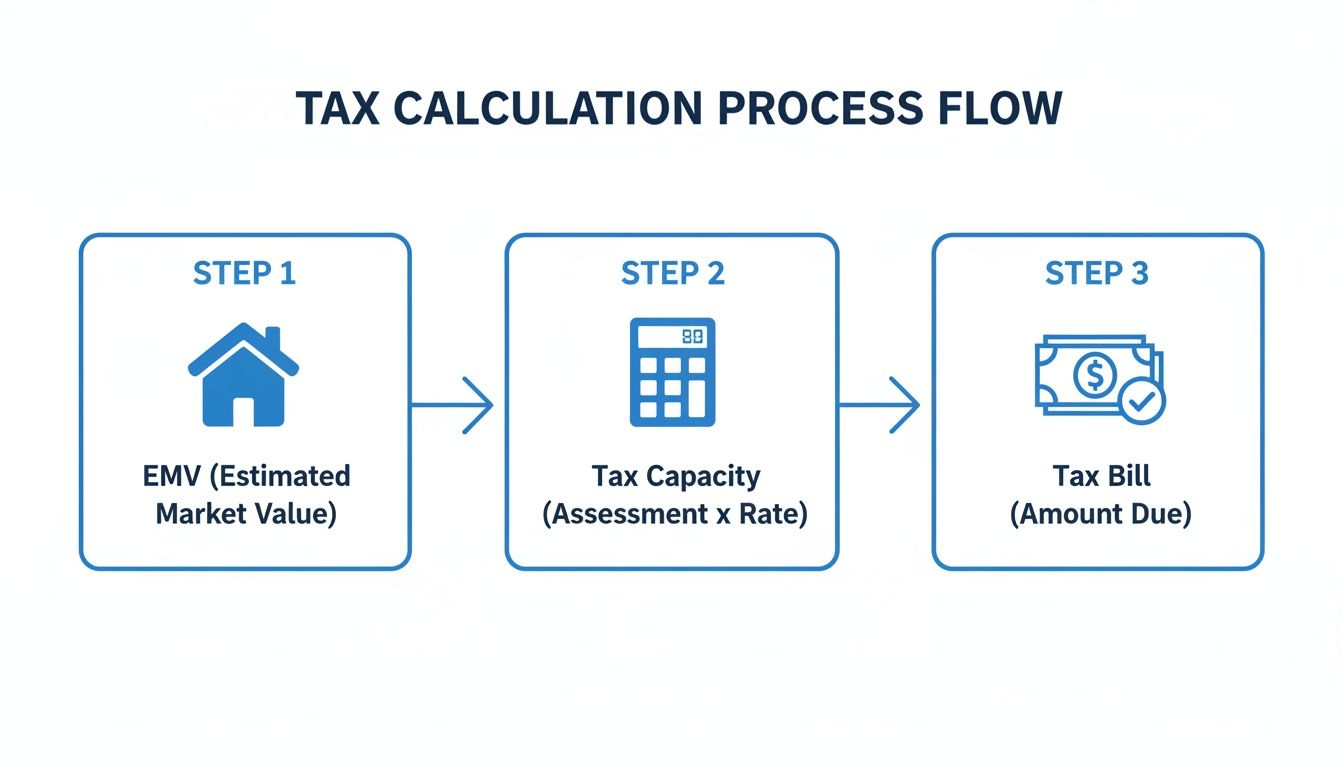
Each step directly impacts the next, making it essential to understand all three components.
The Three Pillars of Your Tax Bill
The entire system rests on three core pillars; a change to any one of them will directly affect what you owe.
- Estimated Market Value (EMV): This is the starting point. Every year, county assessors determine the EMV for each property as of January 2. This is the assessor's professional opinion of what your property would likely sell for on the open market, based on sales of similar properties in your area.
- Property Classification: Each parcel is classified based on its use—residential, commercial, agricultural, etc. This classification is critical because it determines the percentage of your EMV that is subject to tax.
- Local Tax Rates: Every year, your city, county, school district, and other local entities determine their budget needs. They set a tax rate based on these budgets, and all these individual rates combine to create your total tax rate.
A commercial building and a single-family home with the exact same market value in Hennepin County will not have the same tax bill. Minnesota law mandates that commercial properties are taxed at a substantially higher rate, a critical data point for any real estate investor.
Core Components of Your Tax Bill
This table summarizes the key factors in your property's final tax calculation.
| Component | Definition | Impact on Your Bill |
|---|---|---|
| Estimated Market Value (EMV) | The assessor's opinion of your property's sale price as of January 2. | This is the starting point; a higher EMV generally leads to a higher tax bill. |
| Property Classification | The category based on property use (e.g., residential, commercial). | Determines the "classification rate" applied to your EMV, which varies significantly by use type. |
| Tax Capacity | A transitional value calculated by multiplying your EMV by the Classification Rate. | This is the taxable figure that local tax rates are actually applied against. |
| Local Tax Rates | The combined rates set by your city, county, school district, and other taxing authorities. | This is the final multiplier. Higher local budget needs result in higher tax rates. |
From Value to Taxable Value
Before the final tax rate is applied, your property's EMV is converted into its "tax capacity," a crucial middle step.
- Tax Capacity Formula: Estimated Market Value (EMV) x Classification Rate = Tax Capacity
- Example: A residential homestead valued at $400,000 receives a lower classification rate (1.00%) on the first $500,000 of its value. This results in a lower tax capacity compared to a non-homestead or commercial property, leading to a smaller tax bill.
This tax capacity figure is what the combined local tax rates are multiplied by to calculate your final tax liability. For a more in-depth look at how assessors arrive at these valuations, review our complete guide on what is property tax assessment.
What are the key tax deadlines and payment methods?
The two non-negotiable property tax deadlines in Hennepin County are May 15 for the first-half payment and October 15 for the second-half payment. Missing these dates triggers immediate financial penalties that escalate monthly. For any property owner or investor, timely payment is a fundamental component of asset management.

The county offers several payment methods, each with a trade-off between convenience, speed, and cost.
Payment Options
| Method | Fee | Processing Time | Notes |
|---|---|---|---|
| Online (eCheck) | None | 1-3 business days | Requires bank routing and account numbers. |
| Online (Card) | 2-3% service fee | Immediate | Fee is paid to a third-party processor. |
| By Mail | None | Varies by mail delivery | Must be postmarked by the deadline. |
| In Person | None | Immediate | Pay at any Hennepin County service center. |
| By Phone | 2-3% service fee | Immediate | Same fees as online card payments. |
All details for paying your property taxes in Hennepin County MN are available on the official property tax payment portal. A key exception exists for agricultural properties, whose second-half deadline is extended to November 15.
The High Cost of Late Payments
Hennepin County enforces steep, escalating penalties for late payments. The penalty is a percentage of the unpaid tax that compounds over time, making it critical to pay on schedule.
| Postmark Date of Late Payment | Penalty Rate on Unpaid Tax |
|---|---|
| May 16 – May 31 | 2% |
| June 1 – June 30 | 4% |
| July 1 – July 31 | 5% |
| August 1 – September 30 | 6% |
| October 1 – October 15 | 7% |
| After October 15 | 8% |
These percentages apply directly to the delinquent amount for that specific half-year payment. If both halves become delinquent, penalties accrue on each unpaid portion separately.
How can I appeal my property assessment?
You have the right to challenge your property's assessed value if you believe the county's figure is inaccurate, but you cannot appeal the tax rates themselves. The entire appeal process hinges on providing concrete evidence that the county's assessed market value is wrong. The process begins when you receive your valuation notice, typically around March.
The burden of proof is on you, the property owner, to present sufficient evidence to overcome the legal presumption that the assessor's valuation is correct.
The First Step: Informal Assessor Meetings
Your first and most effective option is to schedule an informal meeting with your local or county assessor. This is a direct conversation to present your evidence. Contact information and deadlines are printed on your valuation notice, but the window for this informal review is brief, typically only March through April.
To make your case, you need hard data:
- Comparable Sales Data: This is your strongest evidence. Gather recent sales data (prior to the January 2 assessment date) for properties nearly identical to yours in size, age, condition, and location.
- A Recent Appraisal: An independent appraisal from a licensed professional provides an expert, third-party opinion of your property's value.
- Documentation of Issues: If your property has major defects like a failing roof or foundation cracks, provide photos, repair estimates, and inspection reports.
- Incorrect Property Data: Check your property record on the county website for factual errors. If the assessor's data on square footage, bedroom count, or other features is wrong, this is an objective and easily corrected issue. For a deeper look at these records, see our guide on what an APN number is in real estate.
Formal Appeal Escalation
If the informal meeting is unsuccessful, you can escalate your appeal. While you can file directly with the Minnesota Tax Court, these board hearings are also an option.
- Local Board of Appeal and Equalization: Your city or township board holds a hearing where both you and the assessor present your cases. Meeting dates are on your valuation notice.
- County Board of Appeal and Equalization: If the local board denies your appeal, the Hennepin County board is your next stop for a more formal proceeding.
- Minnesota Tax Court: This is the final step. You must file a petition by the strict deadline of April 30 of the year the tax is payable. This is a formal legal proceeding where a judge makes a binding decision.
Are there tax reduction and refund programs available?
Yes, both Hennepin County and the state of Minnesota offer multiple programs that can significantly reduce your tax bill or provide a direct refund. These are established relief measures, not loopholes. The Homestead Market Value Exclusion is the most common, but several other valuable credits exist.

The Homestead Market Value Exclusion
This is the single most important tax reduction for owner-occupants in Hennepin County. It is an automatic discount that lowers your home's taxable value before tax rates are applied.
To qualify, you must own the property, live in it as your primary residence by December 1 of the assessment year, be a Minnesota resident, and not claim the credit on any other property. The exclusion works on a sliding scale, providing the largest benefit to lower-valued homes. It excludes 40% of market value for homes valued at $76,000 or less and phases out completely for properties valued above approximately $414,000.
State-Level Property Tax Refunds
Even after paying your taxes, you may be due a refund from the state. The Department of Revenue runs two key refund programs based on your income and your tax bill's year-over-year change.
- The Regular Refund: This is an income-based refund for homeowners and renters. If your household income is within state-set limits, you likely qualify.
- Special Property Tax Refund: This is a crucial safety net for homeowners who experience a large, sudden tax increase. You can qualify if your net property tax increased by more than 12% and at least $100 from one year to the next, regardless of your income.
To claim either refund, you must file Form M1PR with the Minnesota Department of Revenue by the August 15 deadline. This is a separate filing from your income tax return and is a common source of missed savings.
Targeted Tax Reductions
Hennepin County offers additional relief for specific residents, but you must apply for them.
| Program Name | Who Qualifies | Key Benefit |
|---|---|---|
| Market Value Exclusion for Veterans | Honorably discharged veterans with a 70% or higher service-connected disability. | Excludes up to $300,000 of market value from taxation. |
| Senior Citizen Deferral Program | Homeowners aged 65+ with a household income of $96,000 or less. | Defers a portion of property taxes until the home is sold. |
| Blind/Disabled Classification | Individuals who are legally blind or permanently and totally disabled. | Provides a reduced property tax classification rate. |
Why did my property taxes go up?
Your tax bill is levy-based, meaning it is driven directly by the annual budgets passed by your county, city, and local school district. While your property's value determines your share of the tax burden, the total amount collected—the tax levy—is determined by government spending. If local budgets increase, your tax bill will likely increase, even if your home's value stays the same.
The Levy: Why Budgets are the Real Driver
Local governments in Hennepin County do not simply pick a tax rate. They first determine their spending needs for the upcoming year (the levy), and then calculate the tax rate required to collect that amount from the total taxable property value in their jurisdiction.
From Budget Meetings to Your Mailbox
The budget-setting process is a public, months-long cycle that directly shapes what you owe.
- September: Cities and counties vote on their preliminary budgets and tax levies.
- November: The county mails Truth-in-Taxation notices, showing your proposed taxes based on these preliminary budgets.
- December: Local governments hold public "Truth-in-Taxation" meetings before officially adopting the final budget and levy.
The final levy can be decreased from the proposed amount on your notice, but it cannot be increased, making the December public meetings a critical opportunity for community feedback.
How Public Spending Impacts Your Bill
Every dollar spent on public safety, road repairs, and schools is funded in large part by property taxes. A voter-approved school bond to build a new high school, for example, adds to the school district's levy and directly increases the tax bills for every property owner in that district.
As of 2026, the Hennepin County Board of Commissioners approved a 7.79% levy increase over 2025, reflecting growing demand for public services. You can find out more about the drivers of the Hennepin County property tax system on their official site.
How can investors use tax data for strategic advantage?
For real estate investors, the public data on property taxes in Hennepin County MN is a source of strategic intelligence. Analyzing this data sharpens due diligence, reveals market trends, and uncovers investment opportunities that others miss. This data provides a window into a property's complete financial ecosystem.

Uncovering Insights in Public Records
Hennepin County’s online property records function as a detailed historical ledger for every parcel.
- Tax History & Assessment Trends: A steady climb in assessed value over 5-10 years indicates a stable neighborhood. Sharp spikes or drops can be red flags for volatility.
- Neighborhood-Level Analysis: A pattern of rising tax levies across an entire community signals strong demand but also warns of a climbing tax burden that will compress cash flow.
- Sales Data Verification: If homes consistently sell for 15-20% more than their assessed value, the area may be undervalued by the county, signaling a future valuation jump—and higher taxes—are likely.
Understanding these trends, along with modern tools like AI for Real Estate Marketing, allows investors to stay ahead of the curve.
Turning Tax Data into Competitive Advantage
Integrating this data directly into your investment workflow via automation provides a significant competitive edge. Platforms that provide real-time tax data for real estate investors can transform operations.
Strategic Application of Hennepin County Tax Data
| Investment Stage | Data-Driven Action | Strategic Advantage |
|---|---|---|
| Acquisition & Due Diligence | Analyze historical tax payments and assessment changes for a target property and its comps. | Identify properties with unusually high tax burdens or those ripe for a valuation appeal, creating instant equity. |
| Portfolio Management | Monitor annual assessment notices and local levy proposals across an entire portfolio. | Forecast future tax liabilities, adjust rental proformas, and proactively budget for increases. |
| Risk Mitigation | Flag properties in areas with rapidly accelerating tax rates or a history of special assessments. | Avoid investing in markets where escalating tax costs will erode profit margins over the holding period. |
| Opportunity Sourcing | Use API-driven searches to find properties with a large gap between their last sale price and current assessed value. | Pinpoint undervalued assets or properties whose owners may be motivated to sell due to an impending tax hike. |
Mastering property taxes in Hennepin County MN data allows you to foresee market changes, find hidden value, and build a more resilient real estate portfolio.
Frequently Asked Questions
How are property taxes calculated?
Your property’s tax is calculated with a formula: the county assessor's Estimated Market Value (EMV) is multiplied by a classification rate to get its tax capacity. That figure is then multiplied by the total local tax rate, which is set by the budget needs of your city, county, and school district.
Can I appeal my tax rate?
No, you cannot appeal the tax rate. Tax rates are the result of public budget decisions. You can and should appeal your property's assessed value if you have evidence (like comparable sales) proving the county's valuation is too high. A successful appeal is the most effective way to lower your tax bill.
What happens if I miss a payment deadline?
Missing a property tax deadline in Hennepin County results in immediate and escalating penalties. A payment made between May 16 and May 31 incurs a 2% penalty. This penalty increases monthly, reaching up to 8% for payments made after October 15.
Ready to harness the power of real estate data? BatchData provides the most accurate and comprehensive property information available, including tax history, assessment data, and owner details for over 155 million U.S. properties. Transform your due diligence and find your next investment with data you can trust.