

































SEO Title: Public Record Phone Numbers Guide for Data Compliance
Meta Description: Learn what public record phone numbers are, why free lookups fail, and how teams use compliant, verified phone data.
Meta Keywords: public record phone numbers, reverse phone lookup, phone data compliance, real estate data, skip tracing, verified owner contacts, TCPA, FOIA
Over 765 million phone numbers are commercially available in the U.S. from public-record-related sources, but volume is not the same as usable, compliant contact data (Databricks marketplace listing).
That single fact reframes the topic. The challenge isn't whether phone data exists. It does, at enormous scale. The primary issue is whether the number attached to a property owner, borrower, registrant, or business is current enough to use, legally usable for your workflow, and reliable enough to justify outreach.
For marketing leaders, investor operators, mortgage teams, and proptech platforms, public record phone numbers sit in a messy middle ground. They can be valuable inputs. They are rarely finished products. Teams that treat raw public data like a ready-to-dial contact list usually create two problems at once: bad campaign performance and compliance exposure.
Quick takeaways
- Public record phone numbers are usually indirect. They appear inside records like deeds, registrations, filings, and agency logs, not in a neat public master directory.
- Free lookup tools aren't built for operations. They often lack verification, context, and workflow controls.
- Compliance matters as much as match quality. Consent, intended use, and suppression rules decide whether a number is actionable.
- Professional workflows depend on enrichment and verification. Raw records need matching, scrubbing, and confidence scoring before outreach.
- Enterprise teams need more than a lookup result. They need reachability, auditability, and integration into their stack.
A lot of operators realize this only after burning time on weak lists. The teams making better decisions usually pair public-source intelligence with verified data pipelines and market context from resources like the Investor Pulse report.
Introduction The Double-Edged Sword of Public Phone Data
Hundreds of millions of U.S. phone records circulate through public-record-linked datasets, but raw volume is not the same as usable coverage.
That gap is where teams get into trouble. A phone number pulled from a deed trail, business filing, court record, or voter file can help identify a property owner or business contact. It can also be old, attached to the wrong person, reassigned, or restricted for the type of outreach your team wants to run.
For real estate operators and marketing teams, the key question is not whether public record phone numbers exist. It is whether those numbers can survive production use. If they cannot, the cost shows up fast in agent time, dialer waste, CRM contamination, and compliance review.
Why this topic matters in operations
I have seen the same mistake repeat across acquisition teams, brokerages, lenders, and marketing ops groups. They treat public phone data like a finished contact product when it is really a starting signal that still needs matching, validation, suppression, and policy controls.
That distinction changes everything.
- Bad matches waste paid labor. Acquisition reps, inside sales teams, and call centers spend cycles on the wrong contact.
- Dirty phone data spreads downstream. Once low-confidence numbers hit the CRM, routing, scoring, and attribution get worse.
- Legal exposure starts before a call is made. Public availability does not remove obligations tied to consent, purpose, or suppression.
- Cheap sourcing often becomes expensive cleanup. Teams save on the front end, then lose time fixing bounce rates, complaints, and duplicate records.
Practical rule: Treat public record phone numbers as raw identifiers. Only use them for outreach after verification and compliance review.
What actually works in practice
Enterprise teams need more than a lookup result. They need a phone record that is current enough to reach the right person, documented well enough to pass internal review, and structured well enough to plug into dialing, CRM, and campaign systems without creating new problems.
That is the operational gap this article focuses on. Free lookup tools can help with one-off research. They usually break under scale, audit requirements, and outreach standards. High-fidelity providers such as BatchData are built for a different job: turning fragmented public-source signals into phone data that can support real workflows in real estate and marketing.
The teams that make this work consistently pair contact data with market context, ownership intelligence, and clear workflow rules. One useful benchmark is BatchData's Q4 2025 national Investor Pulse housing market report, which shows how serious operators use data to prioritize action instead of collecting more noise.
| Use case | Low-quality approach | Operational approach |
|---|---|---|
| Owner outreach | One-off free reverse lookups | Verified contact enrichment tied to parcel and owner context |
| Marketing campaigns | Bulk dialing from scraped numbers | Suppressed, purpose-specific phone workflows |
| Proptech products | Unscored phone append | Confidence-scored phone data with audit support |
| Servicing and underwriting | Blind use of public-source numbers | Documented sourcing, validation, and compliance controls |
Public record phone data has real value. Raw public phone data also creates failure points that are easy to miss until they hit response rates, staffing costs, or legal review. The difference comes down to data quality, compliance discipline, and whether your source is built for professional use instead of casual lookup.
What Exactly Are Public Record Phone Numbers
Public record phone numbers are phone numbers that appear within records made accessible through government transparency laws, public filings, and related aggregations.
They are not a master public phone book. That's the first misconception to kill. In practice, a “public record phone number” is usually a phone number attached to some other public artifact, such as a deed, court filing, voter record, business registration, or agency log.
The legal backbone for this in the United States starts with the Freedom of Information Act, enacted in 1966, which established the framework that made many records tied to phone numbers publicly accessible through government transparency requirements (FOIA background on public-record-linked phone access).

Where these numbers usually come from
When teams talk about public record phone numbers, they usually mean one of several source categories.
Property-linked records
Tax assessor data, deed filings, ownership histories, lien-related records, and foreclosure-related filings can all contain owner-linked contact clues.Business registrations
State and local business entity filings often include contact details for officers, agents, or registered entities.Court and legal records
Civil filings, probate matters, and other legal documents may include contact information tied to involved parties.Voter and civic records
In some jurisdictions, voter-related records contribute phone-linked identity resolution.Government agency records
Public agencies may hold official call logs or related records for government business that can be disclosable, depending on the jurisdiction and exemptions.
What “public” actually means
The source of much confusion lies in this. A phone number isn't automatically public in the same way a recorded deed is public. More often, the number becomes discoverable because it appears inside a record that is public, disclosable, or commercially aggregated from lawful sources.
That has two consequences.
First, availability varies by jurisdiction. State public-records rules differ. Exemptions differ. Agency practices differ. Some records are easy to request. Others are partially redacted or heavily restricted.
Second, public origin doesn't mean easy usability. The number may have been captured for an entirely different purpose than marketing, servicing, or investor outreach.
Public record phone numbers are best understood as embedded contact data. They are attached to people, parcels, businesses, and filings across fragmented systems.
Why the source context matters
Source context tells you how much confidence to place in the phone number.
A phone number tied to a recent property-linked ownership trail may be useful as an enrichment signal. A number surfaced from an old directory scrape or stale registration may be little more than a lead to investigate. Without source context, teams can't distinguish between a valuable contact and noise.
That's why professionals don't stop at "the number exists." They ask:
- What record family produced it
- How recently it was refreshed
- Whether it maps cleanly to the target person or entity
- Whether the intended use is compliant
What this means for real estate and marketing teams
For operational users, public record phone numbers are valuable because they bridge identity and property data. They can help connect an address to an owner, a business to a decision-maker, or a filing event to a reachable contact. But that value appears only after matching, verification, and policy controls.
If you skip those steps, you're not working with intelligence. You're working with fragments.
Why Do Free Public Record Lookups Fail Professionals
Free public record lookups fail because they promise certainty from fragmented, unverified data.
That sounds harsh, but it's accurate. Most free reverse lookup sites market convenience. Professional users need reliability. Those are not the same product.
A core problem is structural: there is no centralized public database for cell phone records, which makes free lookups ineffective when you're trying to find verified owner contacts for property deals or serious business workflows (analysis of free lookup limitations in real estate applications).
The central database people assume doesn't exist
A lot of buyers, marketers, and operators still think there's some modern equivalent of a universal phone book sitting behind the scenes. There isn't, especially for mobile numbers.
That means free tools typically assemble results from mixed-quality sources:
- old directories
- scraped web data
- stale public filings
- partial commercial feeds
- weak identity matches
The output may look complete, but the process underneath is often opaque. You don't know whether the number was matched to the current owner, a prior resident, a relative, or a business associated with the same address.
Why professionals hit a wall fast
Free tools can be fine for curiosity. They break down when your workflow needs repeatability.
Here’s where they fail in practice:
| Operational need | Why free lookups fail |
|---|---|
| Current owner contact | They often surface historical or adjacent contacts, not verified current reachability |
| CRM enrichment | They usually don't provide confidence scoring or clean entity resolution |
| Campaign compliance | They don't give you the controls needed for lawful outreach workflows |
| Portfolio-scale work | They aren't built for batch processing, QA, or system integration |
Data decay is brutal
Phone data changes. Numbers get reassigned. People switch carriers. Owners move. Businesses close. Public records update on their own schedules, not on yours.
A free lookup result usually doesn't tell you enough about freshness. That's a major problem in real estate operations, where timing matters. An old phone record tied to a parcel might still be technically associated with the property history, but operationally it's dead.
If your team is trying to contact owners at scale, "maybe right" is basically wrong.
Lack of context kills actionability
Even when a free lookup returns a real phone number, it often omits the context that makes the result usable.
Professionals usually need more than a number. They need answers to questions like:
- Is this tied to the current owner or a prior owner?
- Is it personal, business, or VoIP?
- Was it recently refreshed?
- Does it align with the mailing address, vesting, and ownership structure?
- Can we legally use it for this outreach channel?
Free lookups rarely answer those questions cleanly.
The hidden cost of “free”
The cost isn't in the lookup itself. The cost is in the downstream damage.
Teams lose time reviewing bad records, cleaning CRMs, retraining reps, and suppressing complaints. Marketing managers see poor contact rates and assume the campaign was weak, when the true problem was the input list. Operations leaders often discover too late that a cheap data source created expensive internal friction.
A professional workflow doesn't start with a lookup box. It starts with the assumption that raw public record phone numbers need verification before anyone calls, texts, or routes them into a campaign.
What Are the Legal Rules for Using This Data
The legal rule is simple: a phone number being publicly discoverable does not automatically give you the right to use it however you want.
That gap between access and permitted use is where teams get burned. Public-record-related phone data often enters a business through research, enrichment, or lead generation. The legal risk appears when someone assumes discoverability equals blanket outreach permission.
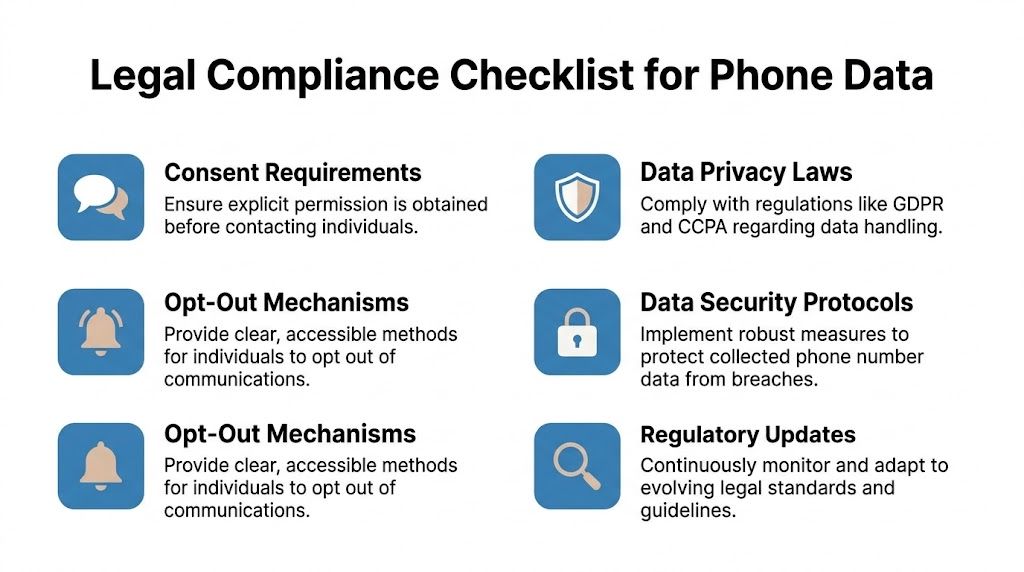
The most direct warning in this area is financial. One source covering enterprise use of public phone data notes that TCPA fines average $1,500 per violation for unverified outreach, while also highlighting post-2025 CCPA/CPRA concerns around sharing phone numbers linked to property ownership (compliance overview covering TCPA and privacy issues).
TCPA is not optional
If your team calls or texts consumers, TCPA should be part of your operating model, not an afterthought.
The practical issue isn't whether the number was sourced from a public record trail. The issue is whether your intended contact method, consent posture, and internal process align with the law. Teams get in trouble when they treat a public-source phone number like an invitation to launch automated outreach.
A few hard rules help:
Match channel to permission
Calling, texting, and automated outreach don't carry the same risk profile. Review each separately.Keep consent records
If consent matters for your use case, document it. Don't rely on assumptions or vendor marketing copy.Apply suppression controls
Internal do-not-contact lists and broader suppression workflows matter before launch, not after complaints arrive.
Privacy law changed the operating environment
State privacy laws matter more now because they shape what counts as proper collection, sharing, and use of personal data. If your workflow touches property-linked phone numbers, you need counsel and process discipline around what your team stores, enriches, exports, and activates.
This is especially important for multi-state operators. The same workflow can look normal in one jurisdiction and risky in another. Public records law, privacy law, and outreach law don't line up neatly.
FCRA limits some uses
The Fair Credit Reporting Act matters whenever your team edges into decisions that look like eligibility, underwriting, tenant screening, employment screening, or other regulated determinations. A phone number sourced from public-record-linked data may still sit inside a regulated context.
That means the same data may be acceptable for one business purpose and restricted for another.
| Intended use | Risk posture |
|---|---|
| Marketing research | Still requires careful suppression and privacy review |
| Property owner outreach | Requires channel-level compliance and internal controls |
| Underwriting or screening-related use | Requires heightened review under FCRA and related rules |
| General sales prospecting | Requires documented lawful basis and outreach governance |
The National Do Not Call issue
Teams are generally aware that the National Do Not Call Registry exists. Fewer teams build it properly into their data activation layer.
That shows up in two common failures:
- A team buys or enriches numbers, then assumes the vendor already handled every suppression issue.
- A team scrubs once, then keeps reusing old exports without rechecking before outreach.
Neither is strong enough. A compliant workflow needs list hygiene, documented process, and ownership inside the business.
Compliance rule: The question isn't "Can we find the number?" It's "Can we prove our use of this number fits the law and our policy?"
Public agency records don't solve the consent problem
Some operators assume that if a phone number appears in an agency file or public record request, legal use is settled. It isn't.
The source of the data and the legality of the outreach are separate questions. Even when a number is lawfully obtainable, your use still has to satisfy the rules governing contact, privacy, and purpose.
What smart teams do differently
The teams that stay out of trouble usually do five things well:
- They document source provenance
- They classify use case before activation
- They route contact data through suppression and review
- They separate research from outreach permissions
- They avoid using consumer-grade lookup tools for enterprise action
That's not bureaucracy. That's basic operational protection. Without it, public record phone numbers can turn into legal liabilities faster than they turn into pipeline.
How Do Professionals Get Accurate and Compliant Phone Data
Professionals don't rely on a single public source. They build or buy a verification workflow that turns fragmented records into scored, usable contact intelligence.
At the market level, this work depends on large aggregation and refresh pipelines. For example, commercial providers maintain very large phone databases tied to consumer and business identities, including over 600 million U.S. phone records updated monthly in one cited example (Alesco phone ID database overview). That matters because usable phone data isn't found in one place. It's assembled, matched, refreshed, and scored over time.
The professional process is layered
A reliable workflow usually combines several steps, not one magic lookup.
Entity resolution
The team matches a person, owner, LLC, trust, or business to the correct parcel, filing, or identity cluster.Multi-source enrichment
Public-record-linked signals get combined with commercial and telecommunications-related data sources.Verification and scrubbing
Numbers are checked for reachability, type, and likely association quality.Confidence scoring
Each candidate number gets ranked so operators know what to use first and what to suppress or review manually.Compliance activation
The number enters outreach only after policy checks, channel rules, and suppressions are applied.
Raw data versus verified data
This is the split often underestimated. Raw public record data is useful as source material. It is rarely enough as the final answer.
| Attribute | Raw Public Record Data (Free Lookups) | Professionally Verified Data (e.g., BatchData) |
|---|---|---|
| Source quality | Fragmented and uneven | Aggregated across multiple vetted sources |
| Freshness | Often unclear | Regularly refreshed and maintained |
| Match logic | Basic or opaque | Entity-resolved and confidence-scored |
| Operational use | Manual research | Built for batch workflows and APIs |
| Compliance readiness | Weak | Better suited for governed outreach workflows |
| Reachability | Uncertain | More actionable after verification and scrubbing |
What verification actually changes
Verification does three practical things.
First, it reduces wasted motion. Reps and acquisition teams spend less time chasing disconnected numbers.
Second, it improves prioritization. If you have multiple candidate contacts for one owner or business, confidence scoring helps your team sequence outreach intelligently.
Third, it creates a cleaner data contract between departments. Marketing, acquisitions, underwriting, and engineering can work from the same contact assumptions instead of each team inventing its own list logic.
Better phone data doesn't just improve contact attempts. It improves the system around the contact attempt.
Why real estate teams need property-aware contact data
A generic reverse lookup may tell you something about a number. A property-aware data workflow ties contact information to ownership structure, parcel context, mailing address, and event triggers.
That's why professional real estate workflows often pair contact enrichment with:
- ownership history
- tax and assessment data
- lien or distress indicators
- listing and permit signals
- valuation and equity context
When teams combine those layers, phone data becomes part of a decision system rather than a standalone guess. Related data workflows are often stronger when paired with property analytics like geospatial analysis for valuation models.
The business lookup exception
For pure business outreach, some teams don't need owner-level residential data. They need a faster path to a current company contact. In those cases, targeted resources focused on how to find business phone number quickly can be useful, especially when the workflow is company-first rather than parcel-first.
That still doesn't remove the need for verification. It just changes the entity you're matching.
What professionals look for in a provider
If you're evaluating a data vendor or internal process, ask direct questions:
- How is the phone tied to the entity
- How often is the data refreshed
- Is there confidence scoring
- Can the data be batch-delivered or queried by API
- What suppression and compliance controls exist
- Can your team audit source logic and update cadence
If the answer to most of those questions is vague, the data is probably research-grade, not production-grade.
How Should Real Estate and Marketing Teams Use This Data
Use public-record-derived phone data as a prioritized, verified outreach layer inside a broader property and marketing workflow.
That means you don't start with the phone number. You start with the business objective. Are you trying to reach pre-foreclosure owners, enrich brokerage records, support servicing outreach, or identify local business contacts tied to properties or neighborhoods? The phone number should serve that use case, not define it.

A practical workflow for real estate teams
Most high-performing teams follow a sequence closer to this:
Start with the property or portfolio
Build the target universe first. That might be absentee owners, distressed assets, recent transfers, or specific zip-code clusters.Append contact data after targeting
Once the asset list is right, enrich for owner or business contact details.Score before outreach
Prioritize who gets called first based on ownership context, timing signals, and contact confidence.Route by channel
Not every record should go to phone outreach. Some belong in direct mail, email, internal review, or a mixed sequence.
How marketing teams should think about activation
Marketing teams often over-focus on contact volume. Operationally, list shape matters more than list size.
A better activation model usually includes:
| Step | Purpose | Result |
|---|---|---|
| Audience build | Define the right owner or business segment | Fewer irrelevant contacts |
| Enrichment | Add verified phone and related identity signals | Better contactability |
| Compliance review | Apply suppression and channel rules | Lower legal exposure |
| Sequencing | Decide call, text, mail, or mixed outreach | More controlled execution |
Where call infrastructure fits
Once a team has verified, policy-reviewed phone data, infrastructure matters. Dialing from ad hoc tools creates reporting gaps and weak controls. If your operation depends on phone-heavy outreach, purpose-built VoIP call center solutions can help standardize routing, logging, and rep workflows.
That matters because phone data quality and calling operations are connected. Even a good record set underperforms if reps can't track outcomes cleanly.
Outreach quality is part data problem, part process problem.
A sample operating pattern
A real estate acquisitions team might:
- pull a geography-based property segment
- enrich owner contacts
- score records by relevance and timing
- suppress records that don't fit policy
- route high-priority contacts to phone outreach
- push lower-confidence records into mail or manual review
A brokerage or portal team may do something similar but with a different objective, such as agent prospecting, local market coverage, or business development. The key is that verified phone data should sit inside a repeatable playbook, not a one-off spreadsheet.
For broader market context, teams often benchmark list strategy and contact priorities against recurring resources like the Investor Pulse reports.
Why mixed-channel execution usually wins
Phone is powerful, but it shouldn't carry the whole campaign. In practice, teams get better results when phone data supports a coordinated sequence with direct mail, CRM tasks, and property intelligence.
Here’s a helpful primer on how contact data fits into a modern property workflow:
That approach does two things. It improves operator efficiency, and it lowers the pressure on any single data point to do all the work. That's how professionals use public record phone numbers: as one verified layer in a disciplined execution system.
Frequently Asked Questions About Public Record Phones
Most confusion about public record phone numbers comes down to three issues: what’s public, what’s accurate, and what’s legal to use.
Are phone numbers themselves public records
Not usually in a standalone sense. A phone number is more often found within a public or commercially aggregated record connected to a person, property, business, or agency activity. That's an important distinction because it affects how the number was collected, how fresh it is, and what use restrictions may apply.
Can I use a free reverse lookup for owner outreach
You can use it for lightweight research, but it's usually a weak choice for operational outreach. Free lookups don't typically give you the verification, confidence scoring, source transparency, or compliance controls needed for serious real estate or marketing use.
Is a public number automatically safe to call or text
No. Public discoverability and legal outreach permission are different questions. Before outreach, your team should review consent requirements, suppression obligations, channel rules, and internal policy.
What's the difference between research use and production use
Research use means investigating a lead, validating a filing, or understanding who may be associated with a property or business. Production use means activating the number in a CRM, dialer, campaign, servicing workflow, or automated sequence.
That distinction matters because production use requires stronger governance.
| Use type | Typical characteristics |
|---|---|
| Research | Manual review, analyst investigation, one-off validation |
| Sales activation | CRM import, list building, rep outreach, tracking outcomes |
| Marketing activation | Sequenced campaigns, suppression needs, channel governance |
| Risk or servicing use | Tighter policy review, stronger audit expectations |
Why isn't manual verification enough
Manual verification helps on small lists. It breaks at scale.
An analyst can spot-check records, compare ownership names, and review context. That works for a handful of targets. It doesn't work well when your team is enriching large audiences, refreshing records regularly, or syncing data into multiple systems.
What should I ask before buying phone data
Ask practical questions, not marketing questions.
- How is the phone associated to the person or business
- How often is the file refreshed
- Is there confidence scoring or ranking
- What suppressions are available
- Can the provider explain intended-use limitations
- Can my systems ingest the data cleanly
If the provider answers with vague claims like “billions of records” but can't explain verification and policy controls, keep looking.
Are public agency phone logs useful for commercial teams
Sometimes, but narrowly. Agency logs can help with research or official contact discovery. They are not a substitute for a compliant owner-contact strategy, and they don't solve consent or intended-use questions for commercial outreach.
Should phone data be the first step in list building
No. Start with the target entity, property set, or business segment. Then enrich with contact data. Teams that reverse that process often end up with broad, noisy contact lists that don't map well to the actual objective.
Public record phone numbers work best when they follow targeting, not when they define it.
What's the best way to operationalize this internally
Set a policy that separates:
- source discovery
- entity matching
- verification
- compliance review
- channel activation
That gives marketing, sales, operations, and legal a shared framework. It also prevents a common failure mode where one team buys data and another team uses it without understanding what it is.
If your team needs property-linked contact data that’s usable in real workflows, BatchData is built for that gap between raw records and production use. It combines large-scale U.S. property coverage, verified owner contact enrichment, skip tracing, daily updates, and developer-friendly delivery so marketing, servicing, underwriting, and proptech teams can work from cleaner, more actionable data.