



Identity resolution APIs are no longer optional marketing utilities. They're operational infrastructure for turning disconnected property, owner, contact, and portfolio records into decisions your real estate systems can execute.
An identity resolution API ingests partial identifiers, standardizes them, matches them against an identity graph, and returns a canonical entity with enrichment and a confidence signal. The difficult production questions aren't limited to match logic. They include latency, false positives, consent, deletion handling, endpoint design, and whether a standalone resolver adds more value than the complexity it introduces.
The practical takeaways:
- Real estate records need entity continuity: Tax, assessment, MLS, CRM, contact, and property data often describe the same owner or asset differently.
- Matching is a trade-off: Deterministic methods prioritize precision, while probabilistic methods extend coverage and require stronger controls.
- Endpoint behavior matters: Reverse lookup, profile retrieval, discovery, and organization lookup support different workflows.
- Infrastructure determines usability: Network placement, connection reuse, governance, and response shape affect real-time performance.
- Compliance is part of the data model: Consent, access control, audit logs, deletion, and selective disclosure belong in the architecture.
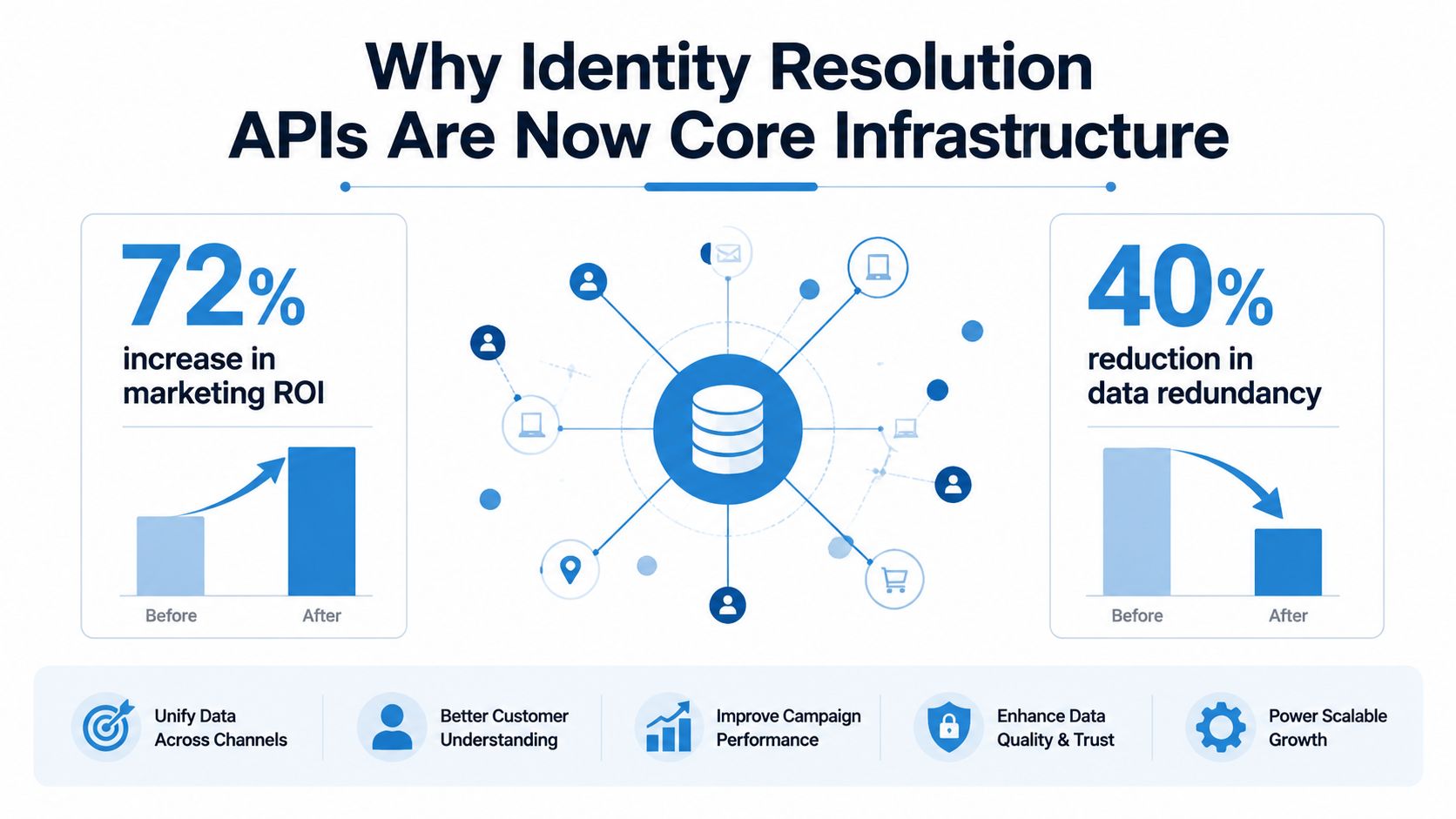
The market signals support that infrastructure view. One report estimates identity resolution software at USD 1.54 billion in 2025, with a projection of USD 4.48 billion by 2031, implying roughly 20% CAGR from 2026 to 2031. Another estimates USD 1.51 billion in 2024 and projects USD 2.56 billion by 2033, at an 11.16% CAGR, while North America held 38.2% of revenue share in that report's analysis (Mordor Intelligence's identity resolution software market analysis). The API layer sits inside this broader category because matching now supports customer data unification, consent-aware personalization, measurement, and live decisioning.
Why Identity Resolution APIs Are Now Core Infrastructure
An identity resolution API has become the connective layer between fragmented real estate data and real-time application behavior. A portal can't reliably personalize an owner experience, a lender can't consistently consolidate borrower-linked property records, and an investor platform can't monitor a portfolio cleanly when every source assigns a different identity to the same person or organization.
The historical shift is important. Older identity programs emphasized offline matching and deterministic record linkage. Cloud systems, the post-cookie environment, mergers among data and marketing technology providers, and data clean rooms have pushed the category toward always-on identity graphs and API services. One market analysis estimates that more than 1.5 billion digital identities are reconciled globally every month with automated identity resolution tools (Delivr's 2026 identity resolution vendor landscape).
For real estate, the underlying problem is especially visible:
- Ownership records vary: A tax record, CRM contact, deed record, and marketing lead may use different names, addresses, or phone formats.
- Property and person identities diverge: One owner can control multiple properties, while one property can have multiple owners or an owning entity.
- Contact data changes: Phone numbers, email addresses, mailing addresses, and business affiliations need ongoing validation.
- Applications need speed: A search result, underwriting screen, or portfolio alert can't always wait for a nightly merge.
A standalone resolver can help, but it also adds another integration boundary. The service must return enough context to be useful without creating unnecessary payload size, duplicated identity logic, or an ungoverned copy of sensitive data.
Production rule: Treat identity resolution as a decision service, not merely a data-cleaning job. The API should return an entity your application can act on, a confidence signal, and the governance context needed to explain the match.
Recent industry coverage frames the operational gap clearly. Teams increasingly use identity resolution inside AI workflows and live decisioning, which makes API-first access, millisecond profile updates, per-query governance, RBAC, and logging more important than a compelling diagram of the matching engine (Treasure Data's identity resolution analysis). The question isn't whether two records match. It's whether the system can resolve them quickly, safely, and audibly under production load.
How Identity Resolution APIs Process Fragmented Data
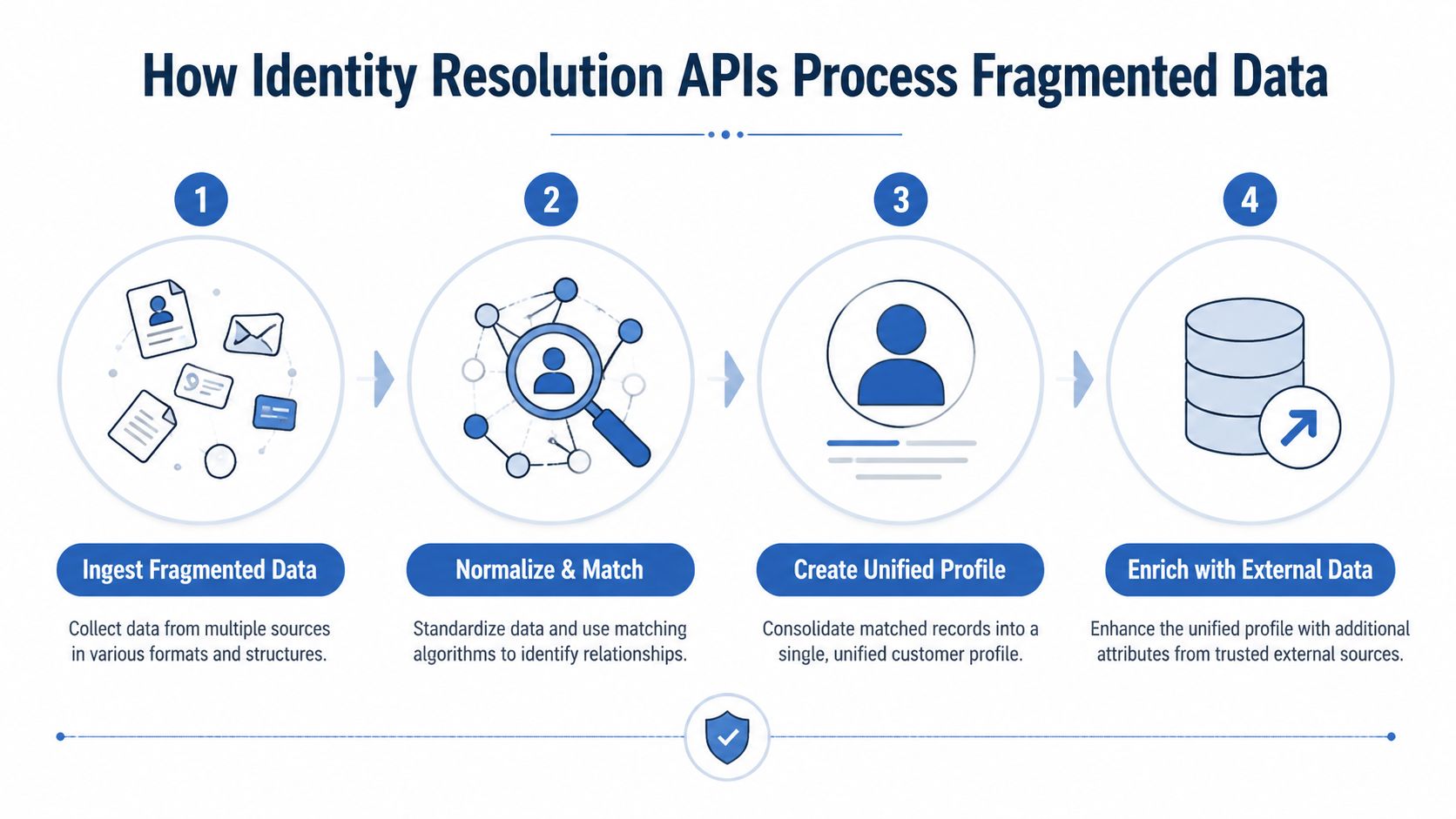
Most identity resolution APIs follow four core steps: ingest, normalize, match, and resolve. The result is a persistent identifier tied to a canonical record and, where supported, additional profile attributes.
1. Ingest fragmented inputs
The request may include an email address, phone number, name, company, property address, device ID, profile handle, or external identifier. Real estate applications often start with incomplete inputs, such as an owner name and ZIP code, a property address, or a phone number found in a lead record.
The API shouldn't assume that every field is present or trustworthy. It should record which attributes arrived, preserve source provenance, and distinguish user-supplied values from provider-enriched values.
2. Normalize before matching
Normalization converts inconsistent inputs into comparable values. That can include standardizing phone formats, casing names, parsing addresses, resolving abbreviations, and separating apartment or unit information from a street address.
Normalization isn't glamorous, but poor normalization creates avoidable misses. A resolver that compares raw strings will treat formatting differences as identity differences.
3. Match against an identity graph
The resolver compares normalized inputs with known entities using deterministic rules, probabilistic logic, or a combination of both. The identity graph stores relationships between identifiers, people, organizations, devices, properties, and source records.
The engine should preserve candidate matches rather than collapsing uncertainty. A useful response includes a canonical entity, linked records, the identifiers used, and a confidence signal.
4. Resolve and enrich
The API returns a persistent ID and the profile associated with it. Depending on the product and permissions, the response may include contact records, ownership history, property attributes, equity information, or other approved enrichment.
Consider a partial owner record containing only a name and ZIP code. A successful workflow may connect that input to a canonical person or entity, associate the person with a property, and return available phone, email, ownership, and equity attributes. Those fields still need validation and policy checks before an application uses them for outreach or eligibility decisions.
A golden-record strategy helps teams decide which source owns which field and how conflicts are handled. The same principle applies when combining property tax, ownership, contact, and market signals in a real estate platform, as described in this multi-source real estate data quality strategy.
The API response should make uncertainty operational:
- Canonical ID: The stable entity identifier used by downstream systems.
- Confidence signal: A score or category that tells the consumer how strongly the inputs support the match.
- Evidence fields: The identifiers and source records that contributed to the resolution.
- Enrichment fields: Additional attributes returned under the request's permissions.
- Provenance: The source and update context for each important value.
Without those elements, a match is difficult to debug, audit, or safely reverse.
Deterministic vs Probabilistic Matching Explained
Deterministic matching favors precision when exact identifiers are available. Probabilistic matching favors coverage when records are incomplete, inconsistent, or ambiguous. Real estate systems usually need both, but they shouldn't treat their outputs as equally trustworthy.
Deterministic matching uses exact or strongly normalized identifiers such as an email address, phone number, stable external ID, or known account key. The method is easier to explain and often produces higher-confidence links, but it can't resolve records when the identifier is missing, stale, shared, or incorrectly entered.
Probabilistic matching evaluates combinations of weaker signals. Those can include name similarity, address relationships, location, organization affiliation, and other permitted attributes. The method can find more candidates, but it can also connect two different people who share a name, household, address, or phone relationship.
A neutral engineering paper reports deterministic matching at about 20–40% match rates and probabilistic matching at roughly 40–70%, with probabilistic resolution requiring confidence scoring to control false positives (IRJET's identity resolution engineering paper). A separate 2026 comparison describes deterministic-first vendors around 30–60% real-world match rates, while noting that deterministic-plus-probabilistic systems generally offer higher reach with less transparent published performance (Leadpipe's identity resolution API comparison).
| Criteria | Deterministic | Probabilistic |
|---|---|---|
| Primary logic | Exact or normalized identifier agreement | Weighted similarity across multiple signals |
| Reported match range | About 20–40% in the IRJET paper | Roughly 40–70% in the IRJET paper |
| Confidence | Usually high when the identifier is valid and unique | Variable, requiring calibrated confidence thresholds |
| Real estate use | Known owner contact, stable property or account ID | Skip tracing, incomplete owner records, ambiguous names |
| Main trade-off | Lower coverage when identifiers are missing | Higher false-positive risk and harder explanations |
The practical pattern is deterministic-first, probabilistic-second. Resolve exact phone, email, or stable IDs first. Use probabilistic logic only when the application can tolerate uncertainty and has a clear threshold for accepting, reviewing, or rejecting the candidate.
False-positive control matters more than a headline match rate. A missed owner record creates a coverage problem. A wrong owner match can contaminate outreach, underwriting, reporting, and portfolio decisions.
This trade-off appears beyond real estate. For a separate example of an API built around matching structured records, teams can compare wine prices via API. The domain differs, but the engineering question is similar: define the input keys, matching behavior, response confidence, and error handling before production integration.
API Endpoints and Data Models for Property Resolution
Endpoint design determines how developers turn a resolution engine into a usable property workflow. The most useful APIs expose predictable patterns for reverse lookup, profile retrieval, discovery, and organization or portfolio resolution.
A technical B2B identity resolution primer describes a response containing a canonical record plus a confidence signal, along with endpoint patterns that map cleanly to property applications (B2B identity resolution endpoint patterns).
Reverse lookup
A reverse lookup starts with a known contact identifier and finds the associated person, organization, or property. Typical inputs include an email address or phone number. The output can contain the matched person, linked property, ownership relationship, contact records, and confidence information.
This pattern is valuable when a lead form captures a phone number but the platform needs to identify the person and property behind it. The API contract should clearly state whether it accepts plaintext PII, hashed values, or both, and whether one input can return multiple candidate IDs.
Stable profile lookup
A stable ID lookup retrieves the canonical profile after an earlier resolution. This is the lowest-ambiguity pattern because the application already holds the provider's persistent identifier.
Use it for profile refreshes, portfolio screens, servicing workflows, and downstream enrichment. The response should support field selection so a quick contact check doesn't always return the complete linked-record graph.
Discovery from partial identifiers
Discovery starts with incomplete information such as a name, company domain, profile handle, location, or property address. It should return candidate entities rather than pretending that every result is definitive.
This endpoint needs explicit candidate ordering, confidence values, pagination behavior, and ambiguity handling. A real estate analyst searching for an owner by name and ZIP code needs a reviewable candidate list, not an opaque merge.
Organization and portfolio lookup
Organization lookup resolves a company slug, stable organization ID, or other business identifier. In property systems, the result may connect an LLC or corporation to related ownership records and properties.
The data model should distinguish person, organization, property, relationship, and source record. Flattening everything into one customer object makes ownership structures difficult to represent and encourages incorrect assumptions about control or beneficial ownership.
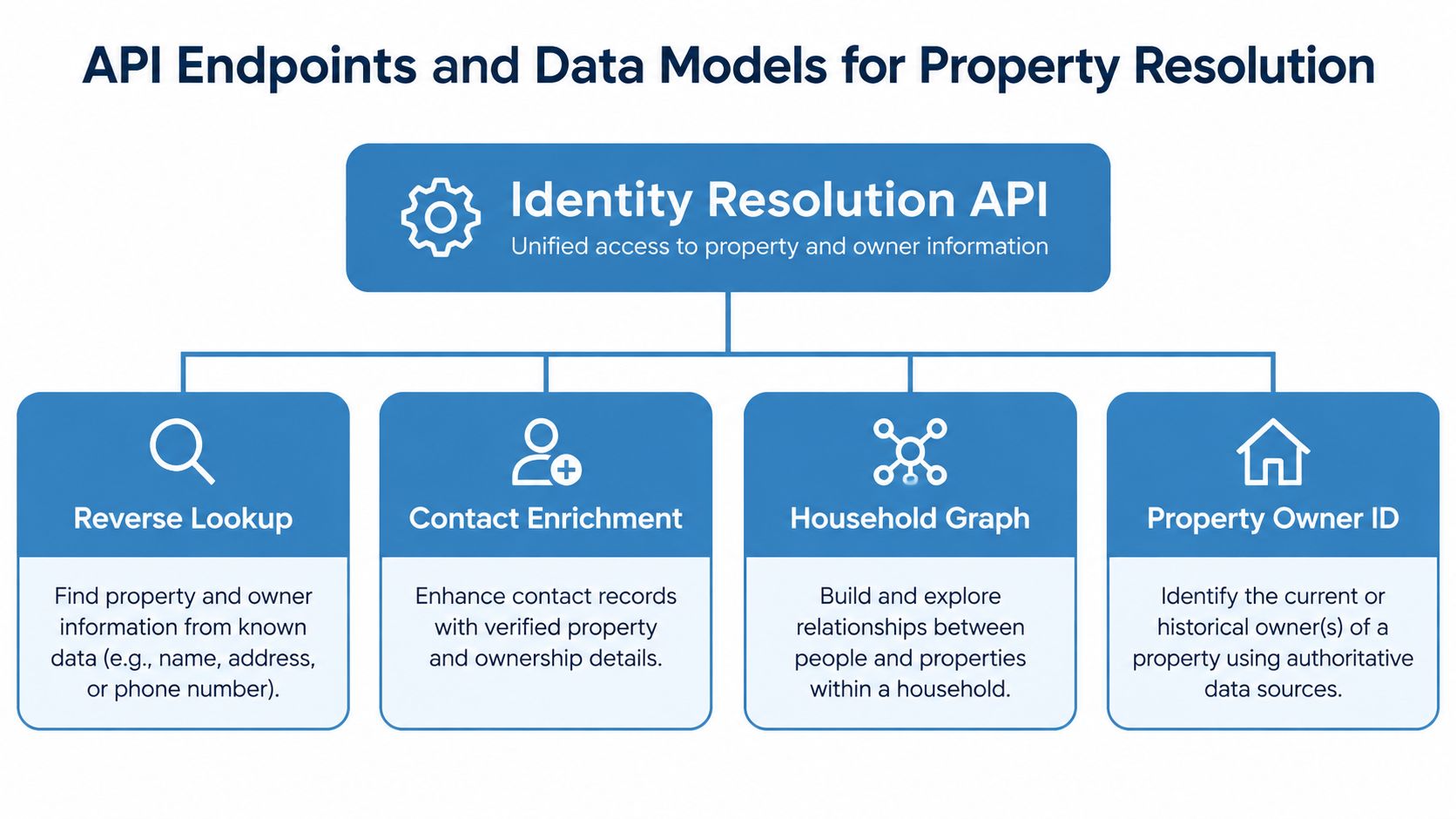
Endpoint behavior can differ materially across vendors. LiveRamp's AbiliTec documentation distinguishes a Match endpoint that can accept plaintext PII and may return multiple IDs from a Lookup endpoint that uses a single input string and returns one ID per request (LiveRamp AbiliTec documentation). Twilio Segment documents real-time identity resolution across web, mobile, server, and partner touchpoints using cookie IDs, device IDs, emails, and custom external IDs (Twilio Segment identity resolution documentation).
For a property platform, test these details before selecting a provider:
- Input privacy: Plaintext, hashed, tokenized, or provider-specific identifiers.
- Multiplicity: Whether one request can return multiple IDs or candidates.
- Response shape: Fixed REST payload, field selection, or a flexible query model.
- Relationship depth: Person to property, household, organization, and portfolio links.
- Error behavior: No match, ambiguous match, invalid input, permission denial, and rate limiting.
A reverse phone workflow can be a useful reference point when designing this layer. See the reverse phone lookup API for the type of property-linked person resolution real estate applications often require.
Real Estate Workflows Powered by Identity Resolution
Identity resolution creates value when it removes a specific operational bottleneck. The API isn't the workflow. It supplies the stable identity and evidence that let a workflow proceed without duplicate, stale, or disconnected records.

Owner contact enrichment
A property platform starts with an address, parcel ID, or owner record and requests contact enrichment. The resolver links the property to a canonical person or organization, then returns available verified contact records under the application's permissions.
The downstream system can use the result for an approved marketing, servicing, or research workflow. It shouldn't overwrite the original source blindly. Store the resolved value, provenance, confidence, and refresh context separately from the source record.
Deduplication across systems
Tax, assessment, MLS, CRM, servicing, and marketing systems rarely use identical keys. A platform can submit records for resolution, receive persistent IDs, and group records by person, organization, or property relationship.
The important design decision is survivorship. If two systems disagree about an address or owner name, the application needs field-level rules and source priority. A resolver can identify that records are related, but the data product still needs a policy for which value becomes canonical.
Skip tracing
Skip tracing begins with limited owner information and uses broader matching to locate reachable contacts. Probabilistic matching can help when exact identifiers are absent, but the system should route low-confidence results to review instead of automatically triggering outreach.
Inputs may include a name, last known address, property address, or partial contact record. Outputs can include candidate people, phone numbers, email addresses, linked properties, and confidence signals. The workflow must also apply suppression, consent, and contact-law rules before activation.
Portfolio monitoring
Portfolio monitoring uses persistent property and ownership identities to track changes over time. A platform can associate ownership records, equity attributes, mortgage or lien information, listings, permits, and pre-foreclosure signals with the relevant property or owner entity.
The value comes from continuity. Without stable IDs, a change in ownership name or mailing address can look like a new record instead of an update to an existing portfolio position.
Underwriting and due diligence
Underwriting systems need entity relationships that are explainable. A property may connect to a borrower, guarantor, organization, prior owner, and related assets, but those relationships shouldn't be flattened into one undifferentiated profile.
Use the API to create a reviewable graph, then pass only the approved attributes into the decisioning system. That separation limits data exposure and makes it easier to explain why a record was included.
Operational pattern: Resolve once, persist the provider ID and evidence, and reuse that identity across workflows. Re-running fuzzy matching independently in every application creates inconsistent results and makes corrections harder.
Privacy and Compliance Requirements You Cannot Ignore
Match rate isn't the primary compliance metric. A highly accurate resolver can still create unacceptable risk if it uses data without the right purpose, exposes more fields than necessary, or can't honor deletion and access controls.
NIST's digital identity guidance emphasizes data minimization, privacy controls, and separation of identity proofing, authentication, and federation risks (NIST digital identity guidance). Those principles apply directly to identity resolution architecture. A system that matches a property owner isn't automatically authorized to expose every associated phone number, email address, household relationship, or historical record.
Define purpose and permission
Before sending data to an API, document the business purpose, permitted fields, retention period, and downstream actions. Separate internal research from marketing activation, servicing, underwriting, and eligibility decisions because each may have different legal and contractual requirements.
Consent isn't a universal switch. Its relevance depends on the data, purpose, jurisdiction, channel, and provider terms. Real estate teams using phone data should assess TCPA requirements, while commercial email workflows should assess CAN-SPAM obligations and applicable state privacy laws such as CCPA.
Build deletion into the identity layer
Deletion requests create a systems problem. Removing a record from the CRM isn't enough if the same identifier remains in a warehouse, cache, feature store, event stream, suppression table, or vendor-managed identity graph.
Your integration should support:
- Deletion propagation: Track where resolved identifiers and enriched fields are copied.
- Selective disclosure: Return only fields needed for the request.
- Access controls: Apply RBAC to endpoints and sensitive attributes.
- Auditability: Log the requester, purpose, fields returned, and decision path.
- Retention controls: Expire temporary resolution inputs and cached responses.
Organizations also need a process for disputed matches. A person or business should have a route to correct an incorrect association, especially when a property relationship or contact record could affect outreach or a financial decision.
Privacy documentation should be concrete enough for implementation teams to inspect data handling, retention, and user rights. For an example of the level of detail buyers may review, see Maya's privacy details for manufactured home quotes.
The competitive advantage is moving toward governed resolution, not just broader matching. A resolver that returns fewer fields with clear permissioning can be more useful than one that returns a larger profile your compliance team can't approve.
Real estate platforms should also document cross-border processing, vendor subprocessors, encryption practices, incident procedures, and data deletion behavior. The identity graph is a high-value concentration of personal and property information. Treat it as a controlled system of record, not an invisible utility hidden inside an enrichment call.
For a practical overview of the controls involved, review what data compliance means before finalizing the integration.
How to Evaluate and Scale an Identity Resolution API
Evaluate an identity resolution API with production-shaped tests, not a vendor demo. Submit the identifiers your application receives, measure the fields it needs, and inspect every ambiguous result.
Latency depends on more than matching logic. In one published benchmark, pre-mapped requests recorded a median latency of 22 ms inside the same AWS region and 79 ms outside Amazon, with connection reuse helping avoid SSL setup overhead (FullContact's identity resolution engine benchmark). Network placement and session reuse can therefore change user-facing response times even when the resolver itself is fast.
Score vendors across these dimensions:
- Match behavior: Deterministic coverage, probabilistic coverage, candidate ordering, and false-positive handling.
- Confidence calibration: Whether scores correspond to acceptance, review, and rejection policies.
- Latency: Median and tail latency under realistic concurrency and network placement.
- Reliability: Rate limits, retries, timeouts, idempotency, and incident communication.
- Data model: Person, organization, property, household, relationship, provenance, and update timestamps.
- Bulk support: File, warehouse, object-storage, or streaming delivery for records that don't need synchronous calls.
- Governance: Consent flags, RBAC, field-level controls, audit logs, deletion support, and regional restrictions.
- Integration economics: Whether a standalone resolver removes complexity or adds another costly handoff.
A bundled CDP may be sufficient when your team mainly needs customer profile unification and activation within that platform. A standalone identity layer makes more sense when you have complex cross-source matching, multiple downstream applications, property-specific relationships, or large-scale data operations that a CDP doesn't model well.
BatchData is one practical reference for real estate teams evaluating this category. Its platform provides 169M+ U.S. property records, 1,000+ attributes, low-latency APIs, and bulk delivery through S3, Snowflake, or flat files, with coverage spanning ownership, valuations, equity, mortgages, liens, listings, permits, and pre-foreclosure activity. Use those capabilities as an evaluation baseline, then validate the exact fields, match behavior, permissions, and service terms against your own workflow.
BatchData offers property-linked identity resolution, contact enrichment, reverse skip tracing, phone verification, and portfolio data through low-latency APIs and bulk delivery options. If your real estate platform needs persistent owner and property identities with usable confidence signals, visit BatchData and evaluate the integration against production records.