


SEO Title: What Is Data Compliance for Real Estate Businesses
Meta Description: Learn what data compliance means, which rules affect real estate data, and how to build auditable workflows.
Meta Keywords: what is data compliance, real estate data compliance, GDPR CCPA GLBA, property data privacy, vendor compliance, data governance, DSAR workflow
Data compliance is now an operating requirement, not a legal side task. By the end of 2024, privacy laws covered about 6.3 billion people, or 79% of the global population, and by the start of 2025 144 countries had data and consumer privacy laws in force, according to Usercentrics privacy law statistics.
For real estate businesses, that changes the conversation. If you collect owner records, enrich lead files, sync contact data into a CRM, push records through APIs, or share property intelligence with lenders, insurers, or marketing teams, compliance now sits inside everyday operations. It affects intake, permissions, retention, deletion, vendor controls, and executive oversight.
Here's the short version:
- Data compliance is a provable operating system. It requires records, controls, and audit evidence.
- Real estate data creates edge cases fast. Public records, owner contacts, enrichment workflows, and third-party processors complicate obligations.
- The hard part is execution. Access, deletion, portability, and objection rights have to work across systems, not just inside a privacy policy.
- Vendor architecture matters. Compliance risk usually expands when data moves across APIs, files, warehouses, and external processors.
What Exactly Is Data Compliance?
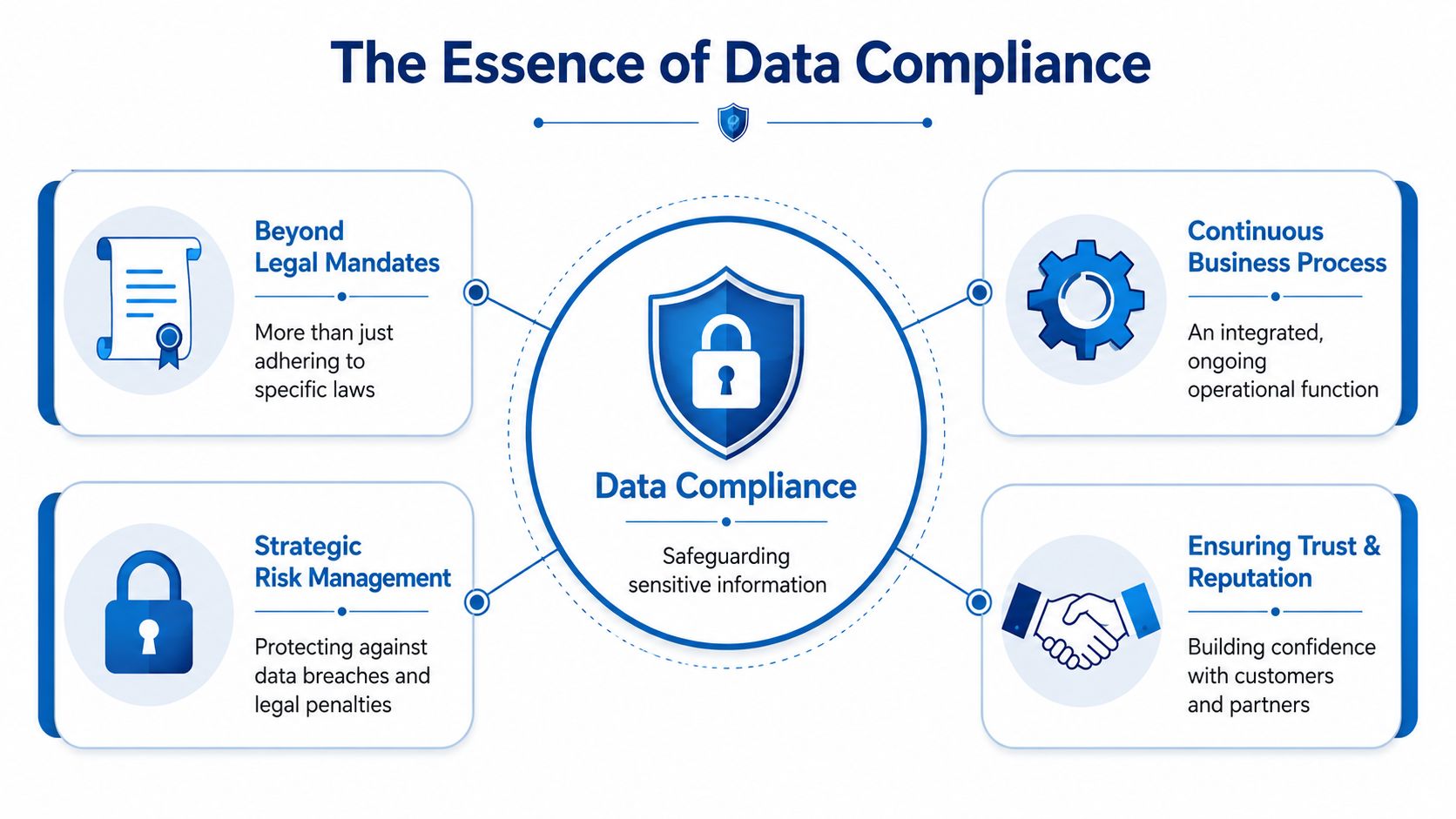
Data compliance is the ongoing process of handling data in ways that meet the legal requirements of the places where your business operates. In practice, that means governance over the full data lifecycle, with evidence that your controls work.
A lot of executives hear “what is data compliance” and think of legal language, policy binders, and annual reviews. That's too narrow. The practical model is closer to financial controls. Finance teams don't prove integrity by publishing an accounting policy. They prove it with reconciliations, approvals, records, and audit support. Data compliance works the same way.
In a real estate company, this reaches far beyond a privacy notice. If your team ingests assessor data, appends owner contact information, stores lead activity, exports data to servicing platforms, and sends records to outside vendors, every one of those steps creates a control question. Who had access? Why was the data collected? How long is it retained? What happens when a person asks for deletion or access? Can your team prove the answer?
Why definitions alone fail
The operational standard is stricter than most summaries admit. Data compliance requires a provable control environment with audit trails, access logs, encryption records, data-flow maps, and incident-response documentation that regulators can inspect, as outlined in this data compliance guide from Expanso.
That matters because compliance spans collection, storage, processing, sharing, retention, and deletion. For a real estate platform, “we secure our data” isn't enough. You need to show where owner records live, which systems process them, which vendors receive them, and which jurisdictional rules apply.
Practical rule: If your team can't show the path a record took from collection to deletion, your compliance posture is weaker than your policy suggests.
What this looks like in real estate operations
Real estate data has a misleading reputation. Teams often assume property-related information is automatically low risk because parts of it originate in public records. That assumption breaks down once records are linked to contact details, customer accounts, borrower files, lead scores, or behavioral data.
A workable operating model usually includes:
- Collection controls: Define why each field is collected and whether the use is permitted for the product or workflow.
- Access controls: Restrict who can see owner, borrower, tenant, or prospect data by role.
- Retention rules: Set deletion and archival rules instead of keeping every record forever.
- Evidence trails: Preserve logs that show access, changes, exports, and downstream transfers.
- Disposal controls: Retire devices, files, and backups in a defensible way. A practical business data protection guide is useful here because disposal is often where policy and reality separate.
For teams working through vendor exposure in property data workflows, this real estate data privacy and vendor compliance guide is a useful operational companion.
Why Has Data Compliance Become So Critical for Businesses?
Privacy and consumer data laws now reach most of the markets where companies sell, source, and process data. For executives, that changes compliance from a legal side task into an operating requirement. A company can trigger obligations by expanding into a new state, adding a data vendor, launching a new product line, or combining datasets that were previously kept separate.
That shift is especially sharp in real estate.
High-volume real estate businesses move data through more systems than many teams realize. Parcel feeds, deed records, ownership data, skip-trace enrichment, lead forms, ad platforms, CRMs, underwriting tools, servicing platforms, and outside processors all create handoffs. Each handoff creates exposure. The issue is not just whether a record started in a public source. The issue is what the business did with it after collection, who could access it, how long it was kept, and whether the company can prove those decisions were controlled.
A few pressure points show up repeatedly in real estate operations:
- Growth across jurisdictions: A brokerage platform, lender, insurer, or proptech company may collect data under one set of state rules and process it under another.
- Data mixing: Property records become more sensitive once they are linked to phone numbers, email addresses, borrower status, lead scores, household details, or online behavior.
- Vendor chains: A company can maintain strong internal controls and still inherit risk from enrichment providers, marketing platforms, analytics vendors, or offshore processors.
- Executive exposure: Regulators and enterprise buyers expect documented ownership, access rules, retention controls, and response procedures. System complexity is not a defense.
Compliance reaches the board level when the company cannot explain who accessed sensitive real estate data, why access was allowed, and where that data moved next.
The older model of compliance fails here. Publishing a privacy notice and asking legal to review contracts does not control exports from a CRM, stop improper audience syncing, or fulfill a deletion request across backups and downstream vendors. In practice, the gap shows up during audits, customer due diligence, breach response, and procurement reviews.
The companies that handle this well treat compliance as an operating system, not a policy archive.
| Business posture | What it looks like | Likely result |
|---|---|---|
| Paper compliance | Policies exist, but system controls and data ownership are unclear | Slow audits, weak evidence, avoidable findings |
| Security-only compliance | Strong security controls, but poor consent, rights handling, and retention execution | Missed requests, inconsistent records, regulator scrutiny |
| Operational compliance | Data inventory, access rules, retention schedules, vendor oversight, and logs match actual workflows | Faster reviews, lower friction with partners, stronger defensibility |
There is also a commercial reason this matters. Real estate data businesses sell into lenders, carriers, brokers, investors, and large enterprise operators that now ask detailed questions before signing. They want to know where data originated, how it is classified, which vendors touch it, and whether deletion and access requests can be executed reliably. If your team cannot answer those questions with evidence, deals slow down. In some cases, they stop.
Which Key Data Regulations Impact Real Estate Data?
The main frameworks to understand are GDPR, CCPA or CPRA, and GLBA. They approach the problem differently, but they all force companies to define what data they hold, why they hold it, and how people can exercise rights over it.
Most generic explainers stop at broad summaries. The harder issue is execution. Teams need to know how access, deletion, portability, and objection rights work across real systems and vendor chains. That operational gap is exactly what this Immuta guide on data compliance regulations calls out. It also notes that major frameworks increasingly require organizations to support rights such as access, deletion, portability, and objection, and under GDPR these include rights to be informed, access, rectify, erase, restrict processing, portability, object, and not be subject to certain automated decisions.
Comparison of Key Data Compliance Regulations
| Feature | GDPR (General Data Protection Regulation) | CCPA/CPRA (California Consumer Privacy Act) | GLBA (Gramm-Leach-Bliley Act) |
|---|---|---|---|
| Who it generally affects | Organizations processing personal data tied to people in the EU | Businesses handling covered California consumer personal information | Financial institutions and related entities handling customer financial information |
| Core focus | Lawful processing, transparency, individual rights, accountability | Consumer notice, rights, data use transparency, and related controls | Privacy disclosures and safeguards for customer information |
| Rights emphasis | Broad rights framework, including access, erase, rectify, portability, object | Strong consumer rights framework centered on knowing, deleting, correcting, and limiting certain uses | More focused on safeguarding and privacy obligations than broad consumer self-service rights |
| Real estate implication | Matters when a proptech or portal touches EU-linked personal data | Matters for California consumer and household data in marketing, portal, and servicing workflows | Matters for lenders, servicers, and firms operating in financial services contexts |
| Operational pressure point | Proving lawful basis and handling rights requests across systems | Managing notice, request handling, and downstream vendor behavior | Maintaining documented safeguards around customer data |
What this means for property and owner data
Real estate teams often work with a blend of data types:
- Public-record property data
- Owner identity and contact information
- Customer application or account data
- Behavioral and transactional signals
- Third-party enrichment fields
Those categories don't all carry the same obligations, but they do interact. A parcel record on its own may be one thing. The same record, linked to owner contacts, CRM status, outreach history, and servicing notes, becomes a different compliance problem.
Where executives should focus
A regulation summary won't protect the business. Execution will.
Ask these questions:
- Can we identify which records fall under which framework?
- Can we process access or deletion requests across all connected systems?
- Can we explain how a record was shared with a vendor or partner?
- Can we separate product use cases from marketing use cases?
- Can we prove controls, not just describe them?
If the legal team understands the law but operations can't execute the workflow, the company isn't compliant in any practical sense.
What Are the Core Components of a Compliance Program?
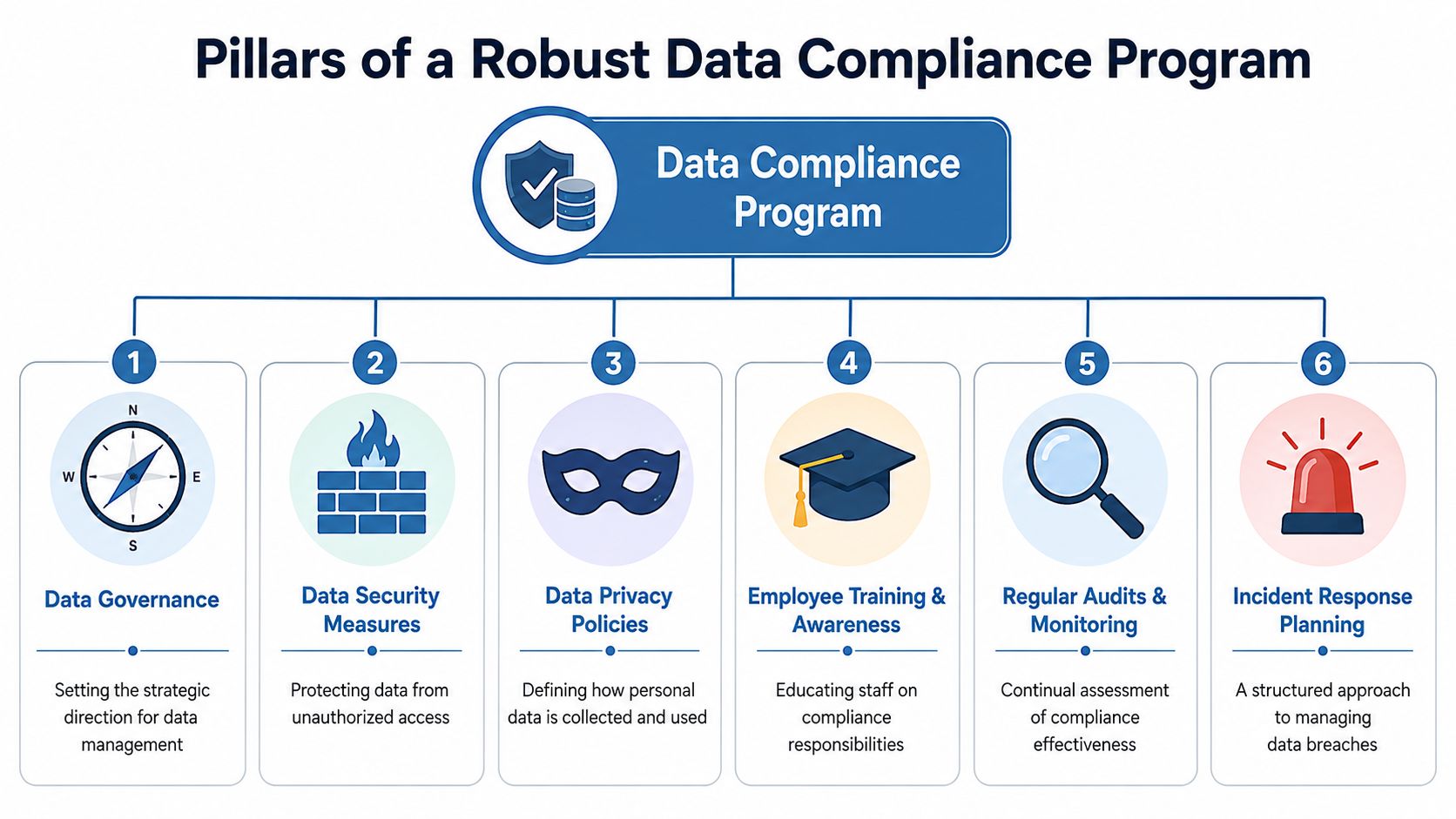
A real compliance program starts with data inventory and classification, then expands into controls, monitoring, and audit readiness. Without that foundation, everything else turns into guesswork.
A technical model converges on five steps: identify and categorize sensitive data, map data flows, implement required controls, monitor and document activity, then review and audit continuously, according to Fivetran's data compliance overview. That sequence matters because inventory becomes the basis for access control, risk assessment, retention rules, and breach-response workflows.
The components that matter
A mature program usually includes these parts.
Data inventory and classification
This is the master list of what you hold. In real estate, that means parcel data, owner records, borrower files, contact enrichment, lead intelligence, and derived analytics. If a field exists in production and no one owns it, that's a governance problem.Data-flow mapping
This shows how data moves between intake forms, APIs, warehouses, CRMs, servicing systems, and outside processors. The risk in exports, scheduled syncs, and flat-file transfers is often underestimated.Access control
Least-privilege access should be real, not aspirational. Marketing shouldn't see everything underwriting sees. Contractors shouldn't inherit broad production access because it's convenient.Retention and deletion rules
Many real estate operators frequently encounter challenges in this area. They can collect and enrich data quickly, but they don't have a disciplined process for retiring stale records, suppressing restricted records, or propagating deletion decisions downstream.
Program ownership and monitoring
A compliance program also needs operating ownership.
| Component | What good looks like | What usually goes wrong |
|---|---|---|
| Governance | Clear owners for policy, systems, and decisions | Shared responsibility with no accountability |
| Monitoring | Logs, reviews, alerts, and documented exceptions | Teams rely on memory and informal approvals |
| Incident response | Defined escalation path and records of action | Ad hoc handling during pressure |
| Vendor oversight | Contract review, data-use review, transfer awareness | Procurement checks only security questionnaires |
The technical controls need a business owner. Otherwise the company ends up with tooling but no enforcement.
For teams evaluating API-specific safeguards in property data environments, this checklist for securing property data APIs covers the controls that usually deserve executive review.
A short explainer can help align stakeholders before implementation:
The difference between a checklist and a program
A checklist says, “we have encryption.” A program answers harder questions:
- Which datasets are encrypted and where?
- Who can export them?
- What logs prove access?
- How are rights requests executed?
- What happens when a vendor receives the same record?
That's the difference between surface compliance and evidence-backed compliance.
How Do You Implement Data Compliance Best Practices?
Start with workflow reality, not policy language. Map the systems people use, then design controls around those paths.
Real estate data environments are messy by default. Teams inherit legacy imports, broker files, skip-trace outputs, CRM fields with unclear provenance, and vendor feeds that keep syncing after no one remembers why. The practical response is a controlled rollout, not a theoretical framework.
Use a staged implementation checklist
A useful sequence looks like this:
Inventory the data estate
List systems, feeds, file stores, warehouses, and endpoints. Include the ugly parts. Shared drives and old exports count.Tag sensitive and regulated records
Separate public property data from contact details, customer records, financial information, and derived insights. Mixed datasets need special handling.Map every transfer path
Follow records through APIs, CSV exports, CRM syncs, enrichment jobs, backup systems, and external processors. Silent transfers create blind spots.Define request workflows
Access, correction, deletion, objection, and portability requests need owners, SLAs, decision rules, and evidence capture. If requests depend on manual heroics, the process won't scale.Apply privacy by design to products
New proptech features should inherit restrictions by default. Don't launch first and retrofit controls later.Review vendor posture before integration
Ask how vendors log access, support suppression, manage retention, and handle downstream sharing. Security review alone isn't enough.Document exceptions
There will be edge cases. Document them, approve them, and revisit them. Hidden exceptions become permanent risk.Train operators, not just managers
Compliance failures often happen in customer support, ops, marketing, and data engineering. Those teams need role-specific guidance.
The fastest way to fail a rights request is to discover during the request that no one knows which system is authoritative.
Focus on resilience, not just retention
A lot of compliance work overlaps with recovery discipline. If you can't restore systems cleanly, separate environments, or verify records during an incident, your compliance posture weakens under pressure. For infrastructure leaders thinking through backup and recovery dependency, this guide for Saskatchewan IT leaders is a practical reference on operational resilience.
What works and what doesn't
| Approach | Works | Fails |
|---|---|---|
| System-by-system cleanup | Good for high-risk datasets first | Slow if there's no central ownership |
| Policy-first rollout | Useful for defining standards | Weak if workflows stay unchanged |
| Vendor-led implementation | Helpful when architecture is clear | Risky if the company outsources judgment |
| Operational playbooks | Strong for repeatable requests and incidents | Weak only when logs and evidence are missing |
The best programs accept that perfect centralization is rare. What matters is documented ownership, visible flows, restricted access, and repeatable execution.
How Can BatchData Streamline Your Compliance Workflow?
A compliance-aware data provider reduces friction when your workflows depend on external property data, API delivery, and downstream enrichment. It doesn't remove your obligations, but it can make them easier to execute.
Many teams struggle with this. Guidance often says to keep a data inventory, classify sensitive data, use restrictive access controls, run regular audits, and maintain documentation and breach plans. The missing piece is how compliance changes when data is synced across APIs, warehouses, files, and external processors. That gap is exactly what this IBM overview of data compliance highlights. Modern compliance depends on proving governance and accountability, not just having controls.
For real estate companies, vendor choice affects four things immediately:
- Data provenance
- Delivery method
- Freshness management
- Downstream governance
A provider that delivers public-record property data, owner information, and updates through structured channels is easier to govern than one that leaves teams stitching together undocumented feeds. BatchData fits into that category. It provides U.S. property records, owner contacts, and delivery options through APIs, bulk files, and warehouse-friendly formats. That makes it easier to map intake paths, define system ownership, and document where third-party data enters the environment.
Where this helps operationally
The practical value isn't marketing language. It's workflow control.
- Structured ingestion: Cleaner intake makes classification and data mapping simpler.
- Defined delivery channels: API and bulk workflows are easier to monitor than ad hoc file exchanges.
- Record management: Data freshness processes reduce the temptation to keep stale copies in too many systems.
- Integration discipline: This real-time CRM enrichment guide is relevant if your main compliance risk sits inside sync logic and downstream activation.
No vendor can make a company compliant on its own. Your legal basis, product design, retention rules, request handling, and internal controls still belong to you. But a provider with documented workflows and predictable delivery can lower the operational burden, especially in a distributed real estate data stack.
If your team is working through property data governance, vendor intake, CRM enrichment, or API-based compliance controls, BatchData is worth evaluating as part of the workflow design. The platform gives real estate operators a structured way to bring property and owner data into production systems, which can make inventory, mapping, and downstream control easier to manage.