




































Managing real estate data from multiple sources – like tax assessors, MLS feeds, and CRMs – is a challenge. Inaccurate or outdated information leads to wasted marketing dollars, flawed pricing models, and legal risks, like TCPA violations costing $500–$1,500 per call. The solution? Golden Records: a single, reliable profile for properties and owners, updated in near real-time.
Key Takeaways:
- Golden Records resolve conflicting data by merging multiple sources with clear rules for accuracy and recency.
- Five critical data dimensions: completeness, accuracy, consistency, uniqueness, and timeliness.
- Homeowner contact data is the hardest to manage due to frequent changes, name variations, and outdated information.
- BatchData offers live data pipelines, eliminating stale records and ensuring compliance with tools like DNC and litigator checks.
Why It Works:
Golden Records streamline operations, reduce compliance risks, and improve ROI by ensuring marketing and underwriting decisions rely on accurate, up-to-date data. Ready to transform your data processes? Start by testing a Golden Record feed in one workflow and measure results.
Data and Marketing for Real Estate Investors
sbb-itb-8058745
Golden Record Fundamentals for Real Estate Data
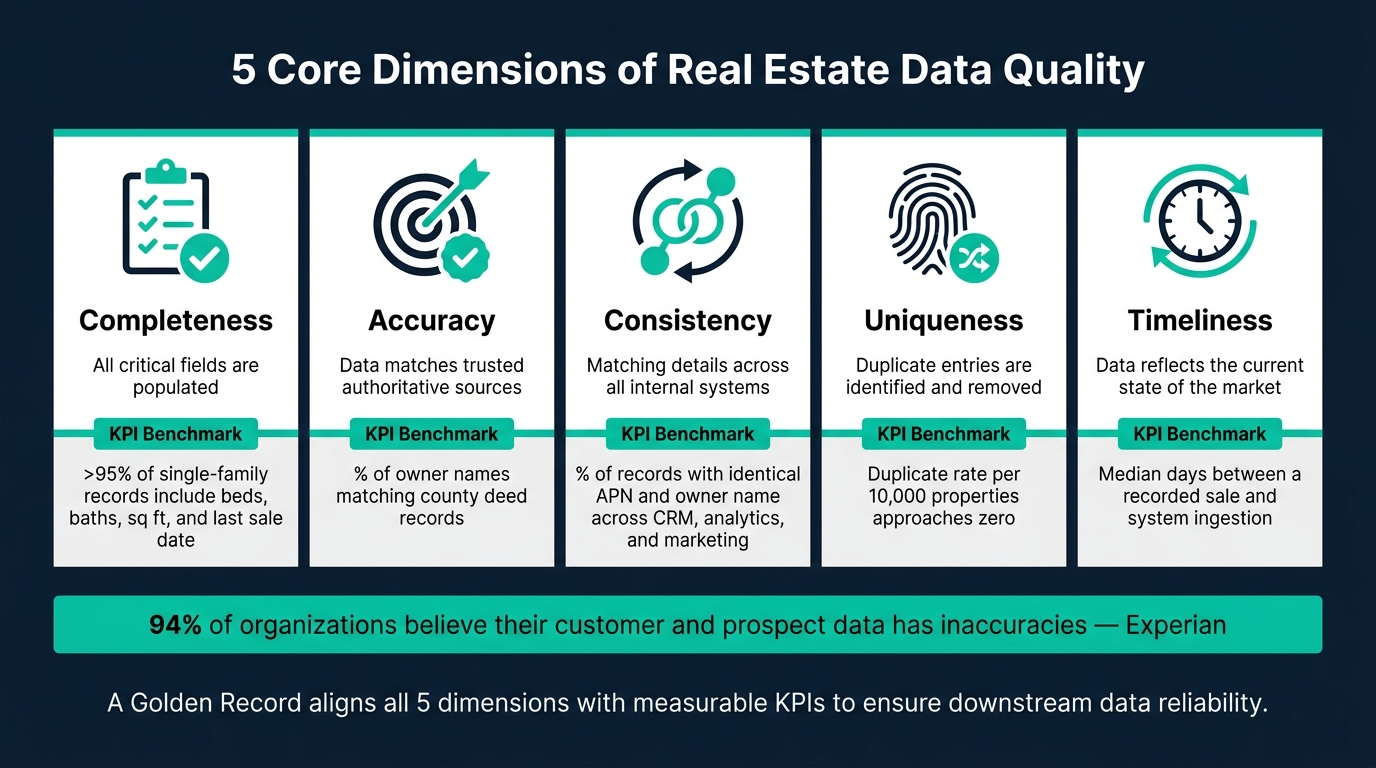
5 Core Data Quality Dimensions for Real Estate Golden Records
To create a dependable Golden Record, you need to organize existing data properly. For PropTech platforms, this means nailing down five key data quality dimensions before you can trust any downstream processes.
The 5 Core Dimensions of Data Quality
A Golden Record should align with five essential dimensions: completeness, accuracy, consistency, uniqueness, and timeliness. In the real estate world, each of these directly impacts operational effectiveness.
| Dimension | What It Means in Practice | Example KPI |
|---|---|---|
| Completeness | Ensuring all critical fields are filled, not left blank | More than 95% of single-family records include beds, baths, square footage, and last sale date |
| Accuracy | Data matches trusted sources | Percentage of owner names that align with county deed records in a sample set |
| Consistency | Properties have matching details across internal systems | Percentage of records with identical APN and owner name across CRM, analytics, and marketing |
| Uniqueness | Duplicate entries are removed | Average duplicate rate per 10,000 properties approaches zero |
| Timeliness | Data reflects the current state of the market | Median time (in days) between a recorded sale and its ingestion into your system |
A study by Experian revealed that 94% of organizations believe their customer and prospect data has inaccuracies. This highlights the difficulty of maintaining high-quality data, especially when pulling from thousands of county offices with inconsistent formats. The key to success lies in defining these dimensions with measurable KPIs – moving beyond vague aspirations to actionable benchmarks. By doing so, platforms can avoid accumulating technical debt and ensure scalability.
Once these KPIs are in place, you can start leveraging specific data sources to address quality gaps.
How Each Data Source Contributes to Data Quality
Breaking down the five dimensions helps clarify how different data sources enhance overall quality. No single source excels in all areas, but each plays a unique role:
- Tax assessors provide reliable completeness and accuracy for structural details like parcel IDs (APNs), assessed values, land use classifications, and legal descriptions.
- MLS feeds are excellent for timeliness, offering up-to-date information on sale prices, property statuses, and agent activity. However, their scope is limited to listed properties, leaving out off-market data.
- Court and recorder data ensure uniqueness and consistency in the legal domain, with authoritative records for deeds, mortgage liens, foreclosures, and ownership transfers. However, updates can lag behind real-world events by 48–72 hours.
- CRM systems contribute behavioral insights but often struggle with duplicate entries and lower accuracy, particularly for ownership data.
A well-built Golden Record engine doesn’t rely on a single source for everything. Instead, it assigns authority at the field level. For instance, ownership details might default to assessor and recorder data, while bed/bath counts could come from the latest MLS listing. Contact information often requires its own specialized verification process. This field-specific attribution is what gives the Golden Record its reliability.
While structural data can be cross-verified across multiple sources, homeowner contact data remains a particularly tricky challenge.
Why Homeowner Identity and Contact Data Is the Hardest to Get Right
Homeowner identity and contact data introduce unique challenges. Unlike property characteristics, which are tied to physical assets that change slowly, contact information is tied to people – who move, change phone numbers, restructure ownership into LLCs or trusts, and abandon email addresses. Depending on the type of data, consumer contact details can decay at rates of 30%–70% annually.
Resolving ownership is further complicated by name variations and entity splits. For example, "John A. Smith", "John Smith and Mary Smith", and "J.A. Smith Revocable Trust" might all refer to the same owner. Unlike parcel IDs, there’s no universal identifier for individuals, so resolving ownership requires probabilistic matching of messy inputs like name variations, mailing addresses, and shared loan documents.
Adding to the complexity, third-party skip-trace vendors often introduce “ghost data” – contact details that were once valid but are now outdated or reassigned. For high-stakes operations like foreclosure outreach, mortgage origination, or acquisition campaigns, ensuring the accuracy of homeowner identity and how to skip trace property owners for contact data is crucial to maintaining efficiency and avoiding costly errors.
Entity Resolution and Conflict Handling Across Real Estate Sources
Entity resolution (ER) is all about identifying when records from different sources refer to the same property or person—a process often involving skip tracing and how it works – and combining them into a single, reliable record. In real estate, ER operates on two levels: property-level and owner-level. Getting both levels right is what transforms messy data into a dependable Golden Record. Let’s break down how these two layers work and why they’re essential for accurate real estate records.
Property-Level Entity Resolution
At the property level, ER relies on a strong composite matching key. The most effective combination includes three identifiers: the Assessor Parcel Number (APN), a USPS-standardized address, and geospatial coordinates (like latitude/longitude or parcel centroids).
APNs are a stable property identifier within a county, but here’s the catch – they’re not standardized nationwide. Counties use different formats, with variations in dash placement and leading zeros. To work around this, you need to store both the raw APN (as issued) and a normalized version to enable cross-jurisdiction matching. Addresses also need to be standardized to USPS format before running any matching logic.
A three-tiered matching strategy ensures accuracy:
- Tier 1: Perform an exact match on APN and normalized address. This is your most reliable match.
- Tier 2: Use high-confidence geospatial proximity combined with a near-exact address when APNs are missing or formatted inconsistently.
- Tier 3: Rely on fuzzy matching to flag uncertain records for manual review.
This layered approach minimizes false matches while still accounting for the messy, inconsistent data that often exists in the real world.
Owner-Level Entity Resolution
Resolving ownership records is more complex, as it involves probabilistic matching of normalized names, mailing addresses, deed histories, and co-owner relationships. For example, the same person might appear as "John A. Smith", "J. A. Smith", or "Smith, John A." – and sometimes under a trust name like "John A. Smith Revocable Trust."
It gets even trickier with corporate and trust ownership. Many investment properties in the U.S. are held by LLCs or trusts, which can obscure the true owner’s identity. To handle this, ownership names should be parsed into structured fields. Legal suffixes like "LLC", "Inc.", "Revocable", and "Trust" can be stripped to create a normalized root name, while the full legal name is stored separately. For instance, "John A. Smith and Jane B. Smith, Trustees of the Smith Family Trust" could be broken down into:
OWNER_1 = SMITH, JOHN AOWNER_2 = SMITH, JANE BENTITY = SMITH FAMILY TRUST
Linking individuals back to their entities through deed signers or registered agent records ensures that ownership data stays accurate and current.
How to Resolve Data Conflicts Between Sources
Once entities are matched, resolving conflicts between data sources becomes critical. For example, what do you do when the assessor lists 3 bedrooms, the MLS lists 4, and a user submission says 2? The solution lies in applying a source hierarchy for each attribute rather than relying on a single global rule.
- For ownership details, county recorder and tax roll data are the most reliable, outranking MLS and CRM inputs.
- For property features like bedroom or bathroom counts, a recent MLS listing is often more accurate than outdated assessor records.
- For sale price and date, recorded deeds are the authoritative source.
When top-tier sources conflict, recency rules come into play – the most recent record takes precedence. To ensure transparency, store all conflicting values along with their source, timestamp, and confidence score. This makes it easier to review discrepancies and meet regulatory requirements.
As BatchData highlights: "The most significant technical challenge is unification: the process of resolving conflicts and standardizing records." This systematic conflict resolution process is what ensures the integrity of the Golden Record system.
Contact Data Quality for High-Stakes Real Estate Workflows
Once property and owner entities are sorted out, the next hurdle is ensuring communication reaches the right person. In high-stakes real estate workflows like foreclosure and mortgage origination, the quality of contact data plays a critical role in determining deal success and staying compliant with regulations.
Common Problems with Homeowner Contact Data
Challenges with homeowner contact information usually fall into three categories:
- Identity Ambiguity: Public records might list entities like "Smith Family Trust", but they often fail to indicate who has the actual authority to sign.
- Outdated Contact Information: Many skip tracing methods rely on old credit header files and utility records, leading to issues like phone numbers tied to former tenants or deceased owners. This is especially problematic in foreclosure investing, where quick action is required within strict legal timelines. According to a 2021 phone verification study cited by Twilio, 20–30% of phone numbers in typical customer lists were invalid, disconnected, or unreachable.
- Misidentification of Decision-Makers: Often, the listed contact is someone without the authority to make critical decisions – like an adult child or a property manager – rather than the actual homeowner.
These issues lead to low right-party contact (RPC) rates and an increase in wrong-party responses, meaning calling teams waste time chasing leads that seem promising on paper but fail to deliver results.
Multi-Tier Verification Methods
Addressing these challenges requires more than a simple database check. A layered verification process ensures better accuracy. A modern verification stack typically includes:
- Basic format and syntax validation.
- Line-type checks to identify whether a number is mobile, VoIP, or a landline.
- Real-time telecom data to confirm if the number is active and able to receive calls.
Beyond verifying if a number is functional, it’s crucial to confirm that it belongs to the homeowner. This involves cross-referencing the number against multiple datasets, including public records, telecom data, and identity graphs. BatchData takes this a step further by using historical stability scoring to assess how long a number has been tied to a specific identity. They also implement feedback loops to flag and downgrade numbers associated with wrong-party contacts or complaints. This thorough process not only improves accuracy but also boosts financial outcomes.
How Better Contact Data Improves Marketing ROI
In real estate, having verified contact data can significantly cut down operational costs and compliance risks. Outdated skip tracing methods can drag RPC rates from a healthy 25–40% range into single digits, driving up telephony and labor expenses while increasing the chance of being flagged as spam by carriers. Gartner estimates that poor data quality costs businesses an average of $12.9 million annually.
For foreclosure investors, higher RPC rates mean fewer calls are needed to reach the right person, leading to faster initial contact. This speed is vital when competing for distressed properties within strict legal deadlines. For mortgage originators, verified contact data ensures smooth communication during critical stages like document collection and disclosure, reducing the risk of losing applicants between submission and closing. Additionally, minimizing wrong-party contacts lowers exposure to TCPA-related penalties, which have resulted in settlements exceeding $10 million in some cases. Treating verified contact data as a key operational metric can set high-performing teams apart, helping them avoid wasted marketing dollars and maintain a competitive edge.
Building a Live Golden Record Pipeline with BatchData
Moving from File Transfers to Live Data Pipelines
One of the biggest challenges in real estate data operations isn’t just dealing with bad data – it’s managing stale data. BatchData tackles this issue head-on with zero-copy sharing via Snowflake, allowing teams to access BatchData’s mastered tables directly without needing to import copies. This means that whenever BatchData updates a record – whether it’s an ownership transfer, lien, or disconnected number – the change is reflected instantly. No more file ingestion jobs, ETL scripts, or manual refreshes. This live pipeline approach directly addresses the problem of data decay. With daily database updates, newly recorded deeds and mortgages are typically accessible within 24–48 hours of county recording. Compare that to legacy providers, which often update on a monthly or quarterly basis.
"The modern standard is daily refreshes. Relying on stale data for liens, ownership changes, or pre-foreclosure status creates unacceptable business risk." – BatchData
For teams not on Snowflake, BatchData offers bulk updates through AWS S3 and a low-latency RESTful JSON API with a 99.99% uptime SLA. This ensures that no matter your tech stack, you can maintain a live data pipeline.
Compliance and Recency as Built-In Data Quality Standards
Unlike many platforms that treat compliance as an afterthought, BatchData integrates it directly into the data stream. Every contact record comes with structured compliance flags such as IS_DNC, IS_STATE_DNC, and IS_LITIGATOR, along with timestamps showing when each compliance check was last performed. These checks are continuously updated against the National DNC Registry, which had 246 million active registrations as of FY 2023, as well as curated TCPA litigator lists.
This approach eliminates the need to rebuild compliance logic across multiple tools like dialers, CRMs, or marketing platforms. Instead, BatchData provides a pre-filtered, compliance-annotated view, reducing the risk of a stale suppression list slipping through one system while another catches it. Under the TCPA, running a non-compliant campaign that makes 10,000 illegal calls could result in $5 million–$15 million in statutory penalties.
Recency is handled with the same level of care. BatchData includes timestamps like LAST_CONTACT_VERIFIED_TS, enabling teams to enforce rules – such as targeting only contacts verified within the last 90 days – directly within their campaign logic.
Together, these compliance and recency measures make it easier to implement the Golden Record strategy effectively.
How to Put the Golden Record Strategy into Practice
Bringing the Golden Record concept into production doesn’t have to involve a lengthy overhaul. Here’s a practical path to get started:
- Map your use cases. Determine whether you’re focusing on foreclosure leads, mortgage origination, or portfolio analytics. Your use case will dictate which BatchData datasets you need – like
PROPERTY_MASTER,OWNER_MASTER, orCONTACT_MASTER– and the level of latency your workflows can tolerate. - Create a thin consumption layer. Keep BatchData’s mastered tables in a read-only schema. Use link tables to connect your internal CRM or deal IDs to BatchData’s
OWNER_IDandPROPERTY_ID. From there, build use-case–specific views, such as aMARKETING_READY_OWNER_CONTACTS_VIEWthat filters for active phone numbers, excludes litigators, and includes only recently verified contacts. - Run a pilot before scaling. Start with a single market and integrate Golden Records into an existing workflow, such as dialing or underwriting. Measure the results. Teams that adopt this approach often see a 20–50% boost in correct-party contact rates and a 15–30% drop in mail bounce rates, thanks to better verification and faster updates on ownership changes.
Once the pilot proves its value, you can confidently retire redundant ETL pipelines and establish BatchData’s Golden Records as your default source of truth.
Conclusion: Getting Multi-Source Data Quality Right
Ensuring high-quality, multi-source data in real estate isn’t just about a one-time fix – it’s an ongoing commitment to maintaining accuracy and consistency. The biggest hurdle? Resolving conflicts between different data sources. Relying on in-house ETL scripts or custom Python solutions to tackle this issue can be a costly and fragile approach, pulling engineers away from more strategic, revenue-generating projects.
The Golden Record strategy provides a direct solution to this problem. By leveraging pre-mastered Golden Records, teams can avoid the time-intensive and expensive process of reconciling data manually. Research shows that data teams often spend 40–80% of their time cleaning and reconciling external data during analytics projects. Adopting this strategy frees up valuable resources, allowing teams to focus on more impactful tasks.
Homeowner identity and contact data are particularly challenging to manage. Issues like name variations, recycled phone numbers, and outdated contact details lead to inefficiencies and increased costs – think wasted call time, undeliverable mail, and heightened compliance risks under TCPA regulations. To address these risks, carrier-grade phone verification and real-time Do Not Call (DNC) list scrubbing are essential. These measures separate efficient, compliant operations from those vulnerable to costly penalties.
Transitioning from periodic file updates to a zero-copy, live data pipeline is another game-changer. With this approach, updates like ownership changes, lien filings, and disconnected numbers are reflected in real time. This eliminates version drift, where multiple, conflicting versions of data coexist across teams and tools. The result? Resolved data conflicts and a stronger foundation of trust in your operations. Gartner underscores the importance of this shift, predicting that by 2026, 80% of organizations that fail to modernize their data governance will struggle to scale their digital operations.
To get started, evaluate your data sources, test a Golden Record feed in critical workflows, and track measurable improvements – whether in contact rates, reduced discrepancies, or lower engineering overhead. These steps bring together everything discussed in this guide, helping you move from fragmented data chaos to reliable, up-to-date, and compliant information that supports your business goals.
FAQs
What is a “Golden Record” in real estate data?
A “Golden Record” in real estate data refers to a unified property profile that pulls together information from various sources, like county records, MLS feeds, and user submissions. By addressing inconsistencies, removing duplicates, and consolidating data, it creates a single, dependable source of truth for each property. This ensures that information remains accurate and consistent across all platforms.
How do you decide which source is right when data conflicts?
When faced with conflicting data, a structured, multi-step process ensures accuracy and consistency by verifying and standardizing information from over a dozen top-tier sources. Advanced algorithms step in to resolve discrepancies, focusing on factors like source credibility, how recent the data is, and its verification status. For sensitive fields, such as owner contact details, techniques like carrier-grade signaling are used to ensure precision. This method creates a single, dependable dataset, minimizing errors and improving processes like mortgage origination and foreclosure investing.
How can I pilot a Golden Record feed without rebuilding my stack?
To test a Golden Record feed without completely revamping your existing setup, you can rely on modern data delivery methods such as real-time APIs or direct cloud access through platforms like Snowflake or S3. Begin by using an API key to evaluate the integration process and verify the quality of the data.
For a balanced approach, combine bulk data delivery – like Parquet files – for initial data loads and periodic updates with real-time API calls to handle high-frequency data needs. This method ensures smooth integration while maintaining reliable, high-quality data flow.


