



Home equity is the current market value of your property minus all debts secured by it. This single figure represents your true financial ownership stake, a critical metric for homeowners and investors to leverage for loans, sales, or wealth-building strategies.
Understanding this calculation is the first step to unlocking the financial power of your property. This guide provides the exact formulas, valuation methods, and debt identification processes you need.
| Key Takeaway | Description |
|---|---|
| Core Formula | Current Market Value - Total Debt = Home Equity |
| Valuation is Key | An accurate market value from an appraisal, AVM, or CMA is non-negotiable. |
| Debt is Holistic | Include the primary mortgage, HELOC balances, and any hidden liens for a true figure. |
| LTV Matters | The Loan-to-Value ratio (Total Debt / Value) dictates your borrowing power. Lenders require it to be below 80%. |
This guide will now walk you through the precise steps required to calculate and leverage your home equity.
What is the formula for calculating home equity?
The direct formula for home equity is Current Market Value - Total Debt = Home Equity. This calculation reveals the portion of the property you own outright. A related and equally critical formula is the Loan-to-Value (LTV) ratio, which lenders use to assess risk.
The math is simple, but its accuracy depends entirely on the quality of your inputs. An precise market value and a comprehensive total of all associated debts are mandatory for a meaningful result. For a slightly different perspective, this Australian take on what is equity in property breaks down the same universal concepts.
Core Equity Formulas
Two formulas define your financial position: one calculates your equity in dollars, and the other—the Loan-to-Value (LTV) ratio—is the primary metric lenders scrutinize.
- Home Equity Formula:
Current Market Value - Total Debt = Home Equity - LTV Ratio Formula:
(Total Debt / Current Market Value) * 100 = LTV (%)
A lower LTV is always better. Lenders typically require an LTV of 80% or less before approving a new loan like a HELOC or cash-out refinance. That 20% equity is their required safety buffer. In Q3 2025, U.S. homeowners held approximately 71.6% equity in their real estate, demonstrating a long-term trend of strong ownership positions. You can analyze these trends via the latest statistics from the FHFA.
Core Components of Your Home Equity Calculation
This table details the essential inputs and the resulting outputs for calculating home equity and its related metrics.
| Component | Definition | Example Value |
|---|---|---|
| Current Market Value (CMV) | The estimated price the property would sell for on the open market today. | $500,000 |
| Primary Mortgage Balance | The remaining principal owed on your main home loan. | $280,000 |
| Other Liens/Loans | The total balance of any second mortgages, HELOCs, or other liens. | $20,000 |
| Home Equity | The calculated ownership stake in the property (CMV – Total Debt). | $200,000 |
| Loan-to-Value (LTV) | The ratio of total debt to the property's value, expressed as a percentage. | 60% |
Mastering these components is the first step to leveraging your property's value. To explore the definitions and implications further, review our guide on what is equity in real estate.
How do you determine a property's current market value?
A property's current market value is determined through a formal appraisal, an Automated Valuation Model (AVM), or a Comparative Market Analysis (CMA). This figure is not the original purchase price; it is a dynamic number reflecting current market conditions, comparable sales, and the property's condition.
An accurate market value is the foundational element of any home equity calculation.
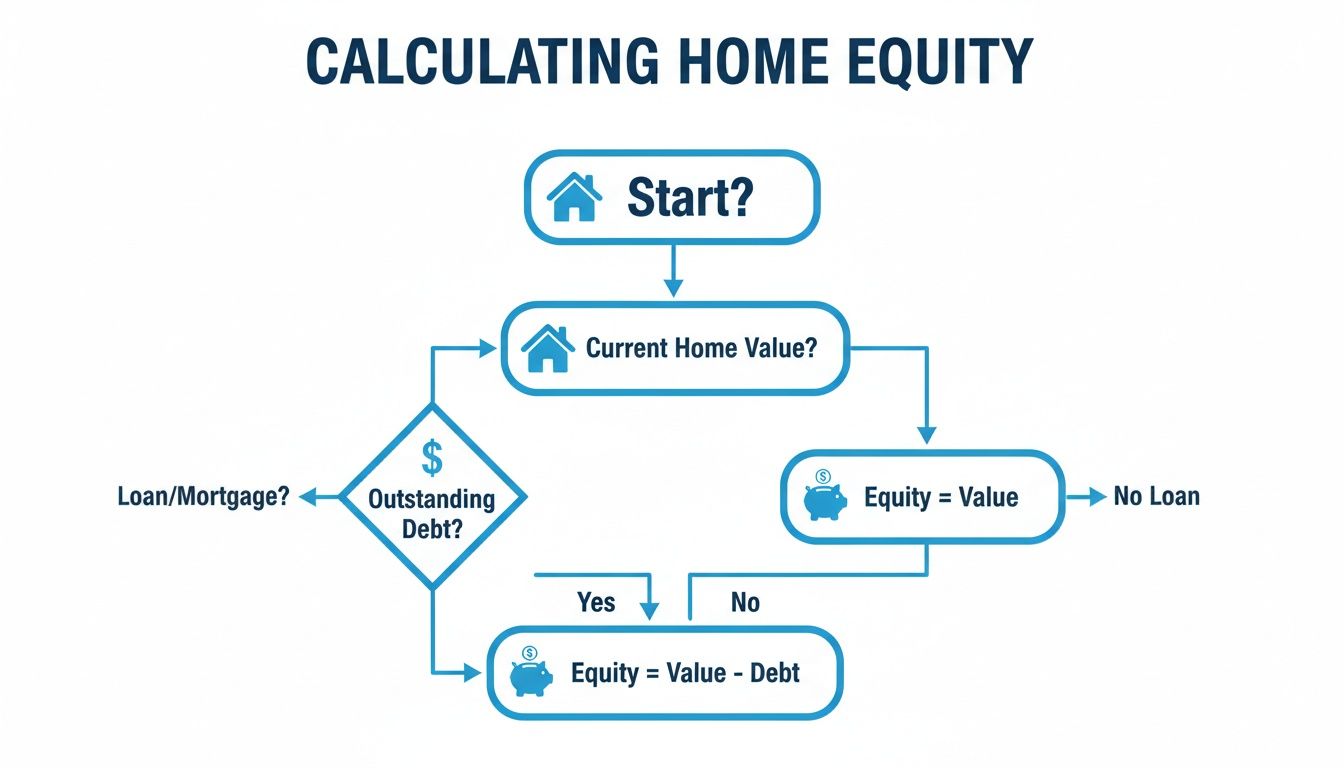
As the flowchart illustrates, a credible property value is the mandatory starting point.
Formal Appraisals
A formal appraisal is the gold standard for property valuation and a requirement for most lending decisions. A state-licensed appraiser conducts a physical inspection, measures the property, and analyzes recent comparable sales (comps) to produce a legally defensible market value. This method combines quantitative data with a professional's qualitative assessment of the property's condition and features. For more detail, read about professional House Valuations.
Automated Valuation Models
Automated Valuation Models (AVMs) are algorithms that analyze public records, tax assessments, and MLS data to generate a property value estimate instantly. AVMs are essential tools for investors analyzing hundreds of properties at scale, prioritizing speed and efficiency. The primary drawback is that an AVM cannot account for a property's physical condition, recent renovations, or specific defects, which can lead to valuation discrepancies of 10-20%. Use AVMs as a preliminary filter, not a final assessment. Investors needing to integrate this data should explore real estate valuation software.
Comparative Market Analysis
A Comparative Market Analysis (CMA) is a valuation prepared by a real estate agent that balances the speed of an AVM with the detail of an appraisal. The agent analyzes recent sales, active listings, and expired listings of similar properties, then uses their market expertise to adjust for differences in condition, size, and amenities. A CMA is the ideal tool for homeowners planning to sell or seeking a reliable equity check without the cost of a formal appraisal.
Comparing Property Valuation Methods
The optimal valuation method depends on your objective. Use an AVM for quick checks, a CMA for sales preparation, and an appraisal for lending purposes.
This table breaks down the key differences.
| Valuation Method | Typical Cost | Speed | Best For |
|---|---|---|---|
| Formal Appraisal | $400 – $700+ | 1-2 Weeks | Securing a mortgage, HELOC, or cash-out refinance; legal matters like divorce or estate settlement. |
| AVM | Free – $50 | Instant | Quick portfolio analysis, initial research, tracking broad market trends at scale. |
| CMA | Usually Free | 1-3 Days | Setting a listing price, making a competitive offer, periodic equity checks without formal cost. |
How do you identify all outstanding property debt?
To calculate total property debt, you must sum the principal balance of the primary mortgage, the drawn balance of any HELOCs, and the value of all other recorded liens, such as tax or mechanic's liens. Omitting any debt instrument will result in an inflated and inaccurate equity figure.
A precise accounting of every financial claim against the asset is non-negotiable.

This process begins with the primary mortgage but must extend to every junior lien attached to the property title.
Locating Your Primary Mortgage Principal
The primary mortgage balance is the largest debt component. The required figure is the current principal balance, not the original loan amount.
Find this number via one of these sources:
- Online Lender Portal: The dashboard will display the "Principal Balance" or "Payoff Amount." This is the most current source.
- Monthly Mortgage Statement: The statement lists the principal balance after the application of your most recent payment.
- Annual Mortgage Statement: This document provides a year-end summary of the principal.
For a formal transaction like a refinance, you must request an official payoff statement from the lender, which specifies the exact principal and accrued interest as of a set date.
Accounting for Second Mortgages and HELOCs
Junior liens, such as second mortgages and Home Equity Lines of Credit (HELOCs), must be included in your total debt calculation. A second mortgage is a lump-sum loan with a fixed repayment schedule; its principal balance is found on its dedicated statement.
A HELOC is a revolving line of credit. The debt is not the total credit limit but the outstanding balance you have actually drawn. This figure fluctuates and must be verified on your latest HELOC statement.
Total debt is the sum of the first mortgage principal, the second mortgage principal, and the drawn balance of any HELOCs. A HELOC with a $100,000 limit but a $0 balance adds zero to your debt. As of mid-2025, U.S. mortgage holders possessed $11.5 trillion in "tappable" equity—the amount available while maintaining a 20% equity cushion. You can read more about these record-breaking home equity levels and what they mean.
Uncovering Hidden Liens and Judgments
Liens are legal claims against a property that silently destroy equity and must be settled before a sale.
Common liens include:
- Tax Liens: Filed by government bodies for unpaid taxes.
- Mechanic's Liens: Placed by unpaid contractors.
- Judgment Liens: Result from court rulings that attach a monetary debt to the property.
Manually searching for liens across a portfolio is inefficient. Property data platforms automate this by aggregating all recorded mortgages and liens from public records into a single report. This provides the complete debt picture required to accurately calculate the loan to value ratio and assess a deal's true viability.
How is home equity calculated in different scenarios?
Real-world equity calculations vary based on the number and type of liens on a property. The core formula, Market Value - Total Debt, remains constant, but the "Total Debt" component changes with each scenario, directly impacting the final equity and LTV figures.
We will now analyze three distinct financial situations.

Each example will calculate total debt, home equity, and the loan-to-value (LTV) ratio—the primary metric lenders use to evaluate risk.
Scenario 1: The Straightforward Single Mortgage
This is the most common scenario: a homeowner with a single mortgage and no other liens.
- Current Market Value (CMV): $450,000 (from a recent CMA)
- Primary Mortgage Balance: $250,000
- Other Debt: $0
The calculation is direct.
- Calculate Total Debt:
$250,000 (Mortgage) + $0 (Other Liens) = **$250,000** - Calculate Home Equity:
$450,000 (CMV) - $250,000 (Total Debt) = **$200,000 in Home Equity** - Calculate Loan-to-Value (LTV):
($250,000 / $450,000) * 100 = **55.6% LTV**
With an LTV well below the 80% lending threshold, this owner is in a strong financial position to secure new financing.
Scenario 2: The Primary Mortgage Plus a HELOC
This scenario includes a primary mortgage and a Home Equity Line of Credit (HELOC). Only the drawn balance of the HELOC is included in the debt calculation.
- Current Market Value (CMV): $600,000 (from an AVM)
- Primary Mortgage Balance: $310,000
- HELOC Details: $80,000 credit limit, with $35,000 drawn.
Here is the calculation.
- Calculate Total Debt:
$310,000 (Mortgage) + $35,000 (HELOC Balance) = **$345,000** - Calculate Home Equity:
$600,000 (CMV) - $345,000 (Total Debt) = **$255,000 in Home Equity** - Calculate Loan-to-Value (LTV):
($345,000 / $600,000) * 100 = **57.5% LTV**
Despite a second lien, the LTV remains low, indicating a financially sound position with available borrowing capacity. An investor analyzing this property would note that the combined debt is low relative to its value, signaling a responsible owner.
Scenario 3: A Property with a Tax Lien
This example demonstrates how a non-mortgage lien impacts equity, a common situation in distressed property analysis.
- Current Market Value (CMV): $320,000
- Primary Mortgage Balance: $220,000
- Other Debt: A $25,000 federal tax lien recorded against the property.
The tax lien must be included in the total debt.
- Calculate Total Debt:
$220,000 (Mortgage) + $25,000 (Tax Lien) = **$245,000** - Calculate Home Equity:
$320,000 (CMV) - $245,000 (Total Debt) = **$75,000 in Home Equity** - Calculate Loan-to-Value (LTV):
($245,000 / $320,000) * 100 = **76.6% LTV**
The tax lien increases the LTV to 76.6%, creating significant risk for a lender and limiting the owner's financing options. For an investor, this high-LTV scenario signals a potentially motivated seller seeking to resolve the lien.
Why does an accurate home equity calculation matter?
An accurate home equity calculation is the foundation of strategic financial decisions for homeowners, lenders, and investors. For homeowners, this figure represents tappable capital for investments, renovations, or debt consolidation. For lenders, the inverse of equity—the loan-to-value (LTV) ratio—is the primary metric for assessing risk and approving loans.
A precise calculation transforms a residential property into a versatile financial instrument.
A Key to Unlocking Capital
Knowing your equity allows you to leverage it. Homeowners primarily access this value through two products, each designed for a different financial objective.
- Home Equity Loan: A lump-sum disbursement at a fixed interest rate. This is ideal for large, one-time expenses with a known cost, such as a major renovation or debt consolidation.
- Home Equity Line of Credit (HELOC): A revolving credit line with a variable interest rate, secured by the home. This is suited for ongoing projects with variable costs or as a flexible emergency fund.
The choice between them depends on the need: a single, immediate capital injection (loan) versus flexible, long-term access to funds (line of credit).
The Investor's Strategic Advantage
For real estate investors, accurate equity calculation is a core competitive advantage for sourcing off-market deals. High-equity properties often indicate owners with financial flexibility who may be motivated to sell quickly, potentially below full market value. An owner with 80% equity is not constrained by a large mortgage and has more room to negotiate.
Modern data platforms enable investors to filter entire markets by estimated equity percentages. This transforms lead generation from a broad, inefficient search into a targeted, data-driven process, dramatically increasing the probability of connecting with motivated sellers.
Common Questions About Home Equity
The following are answers to the most frequently asked questions regarding home equity calculations and their practical application.
How often should I calculate my home equity?
Homeowners should calculate their equity annually for a general financial check-up. However, a fresh, up-to-the-minute calculation is mandatory before any major financial transaction, such as applying for a refinance or HELOC, or preparing to sell the property.
Real estate investors tracking portfolios or searching for opportunities should perform equity checks quarterly to identify market trends and emerging high-equity targets.
Can my home equity be negative?
Yes. Negative equity occurs when the total debt secured by the property exceeds its current market value, a situation also known as being "underwater" or having an "upside-down mortgage." This is typically caused by a rapid decline in property values following a purchase with a low down payment. If a home purchased for $400,000 with a $380,000 mortgage drops in value to $350,000, the owner has -$30,000 in equity, making it impossible to sell or refinance without bringing cash to closing.
What is the difference between equity and tappable equity?
Total equity is the full difference between a home's value and its debt. Tappable equity is the portion of that equity a lender will allow you to borrow against.
Lenders typically require a homeowner to maintain at least 20% equity as a security buffer. Tappable equity is the amount above this 20% threshold.
Example:
- Home Value: $500,000
- Mortgage Balance: $200,000
- Total Equity: $300,000 (60% of home's value)
- Lender's Required Equity (20%): $100,000
- Tappable Equity:
$300,000 (Total) - $100,000 (Lender's Buffer) = **$200,000**
The table below contrasts the two concepts.
| Feature | Total Home Equity | Tappable Equity |
|---|---|---|
| Definition | The full ownership stake in a property (Value – Debt). | The portion of equity available for borrowing. |
| Primary Use | A measure of personal net worth and financial health. | A practical measure of borrowing capacity for loans. |
| Calculation | Market Value - Total Debt |
Total Equity - (Market Value * 20%) |
| Who Cares Most | The homeowner, for personal financial planning. | The lender, for risk assessment and loan approval. |
Does home improvement always increase home equity?
No. Home improvements increase market value, but the return on investment (ROI) is not dollar-for-dollar. The equity increase is determined by the perceived value added in the marketplace, not the project's cost.
High-ROI projects typically include kitchen and bathroom remodels or curb appeal enhancements (e.g., new siding, garage door), which can sometimes return over 100% of their cost at resale. Low-ROI projects are often highly personalized or luxury additions like swimming pools or home theaters, which appeal to a limited number of buyers. Before undertaking a renovation to boost equity, consult local cost-vs-value reports to identify projects with the highest ROI in your specific market.
At BatchData, we provide the comprehensive property data that powers smart real estate decisions. Whether you're an investor hunting for high-equity deals or a lender assessing risk, our platform delivers the accurate valuation, mortgage, and lien data you need. Stop relying on incomplete information and start making moves with confidence. Explore our industry-leading data solutions at https://batchdata.io.