



A HUD-1 doesn't look like a simple bill, it looks like a settlement map. If you're opening your closing packet for the first time, the page can feel crowded and the labels can blur together. The good news is that the form follows a rigid structure, so once you know where the totals live and how the line numbers work, the whole document becomes much easier to read.
A HUD-1 Settlement Statement is a standardized real-estate closing form that itemizes all charges and credits to the buyer and seller, and the CFPB says it's also used to list all charges in a mortgage refinance CFPB HUD-1 definition. In practice, that means it is a transaction-level accounting document, not a loose summary. The layout matters because the numbers on the detailed pages flow into the final cash-to-close figures on page 1, so if one line is off, the headline amount can be off too.
- Page 1 gives you the transaction snapshot.
- Page 2 carries the itemized settlement costs.
- Page 3 compares charges against the earlier estimate and shows loan terms.
- Left side and right side matter, because buyer and seller charges are separated visually HUD-1 structure overview.
If you know where to look, you can review a closing packet with a lot more confidence and a lot less guessing.
Why the HUD-1 Layout Matters at Closing
The HUD-1 matters because it tells you, line by line, where every closing dollar is going. On closing day, most buyers are staring at a thick packet, a stack of signatures, and a deadline. The HUD-1 is the document that turns that pile of paper into a readable accounting trail.

A HUD-1 is a standardized settlement statement used in U.S. mortgage closings to itemize all charges and credits to the buyer and seller; structurally, it is organized so page 1 summarizes the transaction while the reverse side breaks out the line-item economics, with the buyer's charges in the left column and the seller's charges in the right column Investopedia HUD-1 explanation. That layout is the reason the form looks dense at first glance. It isn't random clutter, it's a controlled breakdown of the deal.
Practical rule: If you can track the flow from itemized charges to the final cash-to-close number, you're reading the form the right way.
The structure also helps you separate what belongs to you from what belongs to the other side. That matters when you're checking seller credits, lender fees, prepaid items, and recording charges. The page itself is built to reduce ambiguity, but only if you read it in order.
The easiest mistake first-time buyers make is treating the HUD-1 like a final summary page. It isn't. It's the closing ledger, and the totals only make sense when you trace the detail behind them.
The Three-Page Anatomy of a HUD-1 Form
The HUD-1 is usually read as a three-page form, and each page has a different job. Page 1 is the snapshot, pages 2 and 3 carry the supporting math and comparisons. Once you know that, the form stops feeling like a wall of numbers.
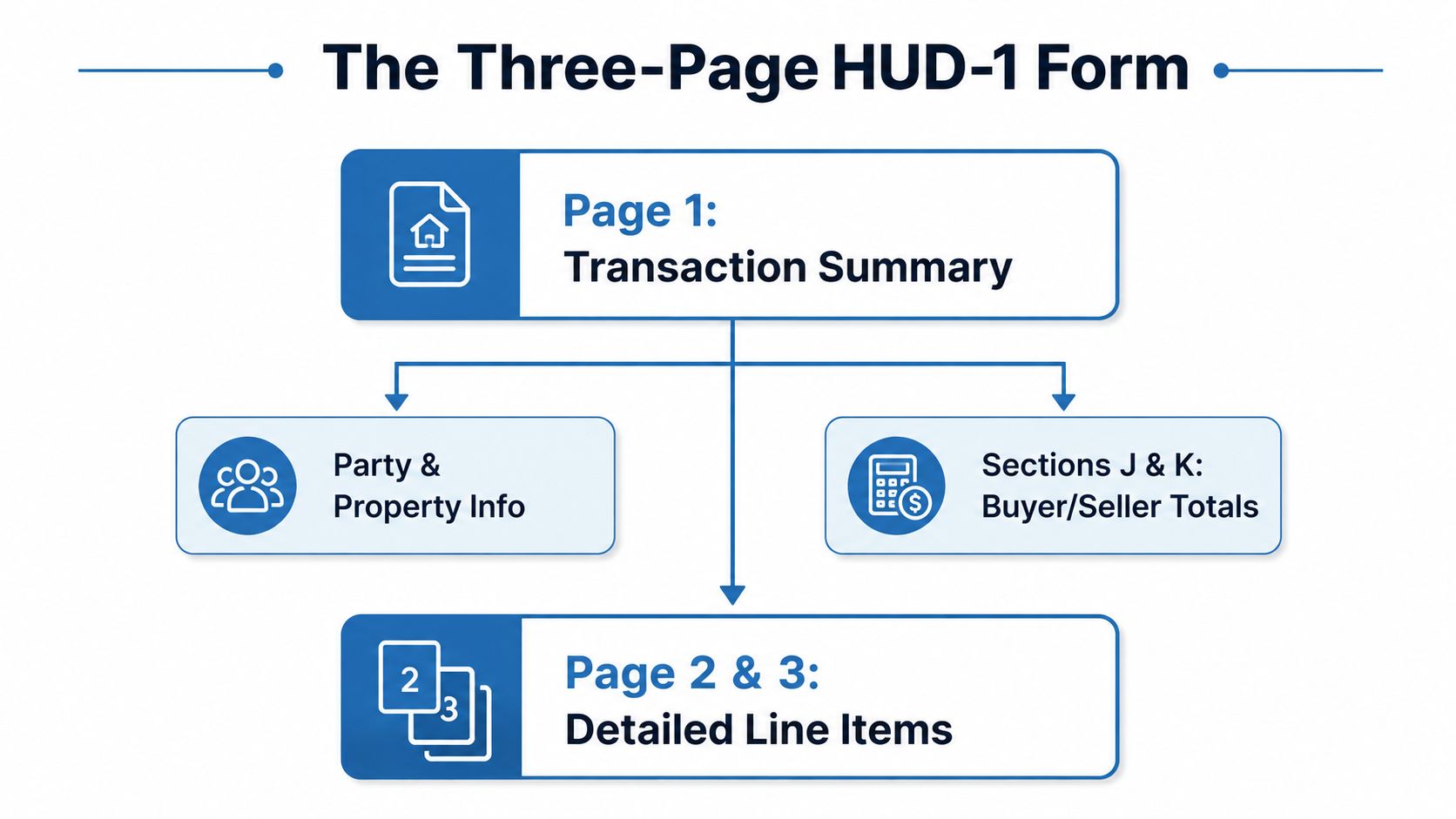
Page 1 holds the transaction identity
The top of page 1 captures the party and property identifiers, then the form rolls into the buyer and seller summaries. The CFPB's layout guidance shows that sections J and K summarize the buyer and seller transactions, and the totals from the detailed pages flow into the final cash-to-close amount on page 1 CFPB regulation layout. That is the page that gets looked at first, because it shows who's involved, what property is changing hands, and what the closing ends up costing each side.
Page 2 holds the cost detail
Page 2 is where the line-item economics live. You'll see categories such as title insurance, recording and transfer charges, prepaid items, and lender-required fees in the categorized line series described by the CFPB CFPB section-and-line structure. If a buyer says, “I don't see where this fee came from,” page 2 is usually where the answer starts.
Page 3 shows the comparison layer
A common HUD-1 layout also includes a third page that compares charges against the lender's earlier estimate and lists loan terms like amount, rate, and payment information HUD-1 three-page form description. That comparison is what helps you spot whether a charge moved, changed category, or showed up in a place you didn't expect.
A clean way to think about the form is this, page 1 tells you the result, page 2 explains the charges, and page 3 gives you the comparison context. Once you see that flow, the document reads like a chain instead of a maze.
Key Line Items and Section L Categories Explained
Section L is where the HUD-1 gets specific. This is the part that turns broad settlement language into numbered charge categories, and it's the section most buyers need to slow down for. The form is laid out by section and line-number series, not freeform text, so each cost has a place and a code range CFPB form structure.
The category system is the real roadmap
The CFPB describes settlement costs in categorized line items, including title insurance, recording and transfer charges, prepaid items, and lender-required fees CFPB section-and-line structure. That means you're not just checking a total, you're checking which bucket each fee landed in. If a charge seems vague, the first question is simple, what section and line number is it sitting in?
Here's the useful part. A fee that belongs in one bucket but appears in another can change how you understand the settlement. That doesn't automatically mean it's wrong, but it does mean you should ask for an explanation before you sign.
| Line-item category | What it generally represents | What to double-check |
|---|---|---|
| Title insurance | Coverage tied to the title policy process | That the policy type matches the deal |
| Recording and transfer charges | Government or county-related filing costs | That the charge is tied to the correct property and deed |
| Prepaid items | Amounts collected ahead of closing for future obligations | That the timing and number of months match the loan setup |
| Lender-required fees | Charges tied to lender conditions | That the fee is actually required by the lender |
Where errors usually hide
The biggest review mistake is reading only the total and skipping the category names. A number can be correct and still be sitting in the wrong line. If that happens, the form becomes harder to reconcile with your loan estimate, your title commitment, or your escrow setup.
The line-number series helps you trace the logic back to the top of page 1. When you find a number you don't recognize, move backward through the section code, then forward again to the cash-to-close summary. That's the cleanest way to see whether the math is consistent.
For a deeper look at how title-related charges show up in the packet, review this practical guide to a title insurance commitment.
Buyer's shortcut: If the fee name is unfamiliar, don't ask only “How much is it?” Ask “What line series placed it here, and what document supports it?”
HUD-1 vs Closing Disclosure and When Each Is Used
The HUD-1 and the Closing Disclosure are not the same form, and people get burned when they assume they are. The HUD-1 is still used for certain transactions, while the Closing Disclosure replaced it for most residential purchases under TRID. The deciding factor is the type of loan and the transaction setting, not just the fact that you're buying property.
The CFPB says the HUD-1 Settlement Statement is used to itemize all charges and credits in a settlement, and that it is also used to list all charges in a mortgage refinance CFPB HUD-1 definition. That is why both forms can still show up in a real estate career. One is more common in purchase closings under current rules, but the older form is still alive in specific transaction types.
| Feature | HUD-1 | Closing Disclosure |
|---|---|---|
| Primary use | Settlement statement for certain closings and refinances | Main disclosure form for most residential purchases |
| Charge presentation | Itemizes charges and credits for buyer and seller | Presents loan and closing terms in a consumer-friendly format |
| Common context | Refinance and select non-TRID transactions | Most purchase-money mortgage closings |
| Layout style | Sectioned settlement form with line-item categories | Standardized disclosure designed for loan comparison |
That comparison matters because the document you expect is tied to the transaction you're doing. If you're reviewing a refinance packet, the HUD-1 may still be the right document. If you're buying a home under the modern disclosure regime, you're more likely to see the Closing Disclosure instead.
For a practical breakdown of how title-related charges move through closing paperwork, this guide to title company fees is a useful companion. The point is simple, know which form belongs to your transaction before you start hunting for the wrong page.
How to Read and Verify Your HUD-1 Figures
The fastest way to review a HUD-1 is to treat it like an audit, not a signature page. Start with the identity fields, move to the totals, then drill into the line items that support those totals. If the top-level number looks fine but the support doesn't, the form still needs correction.
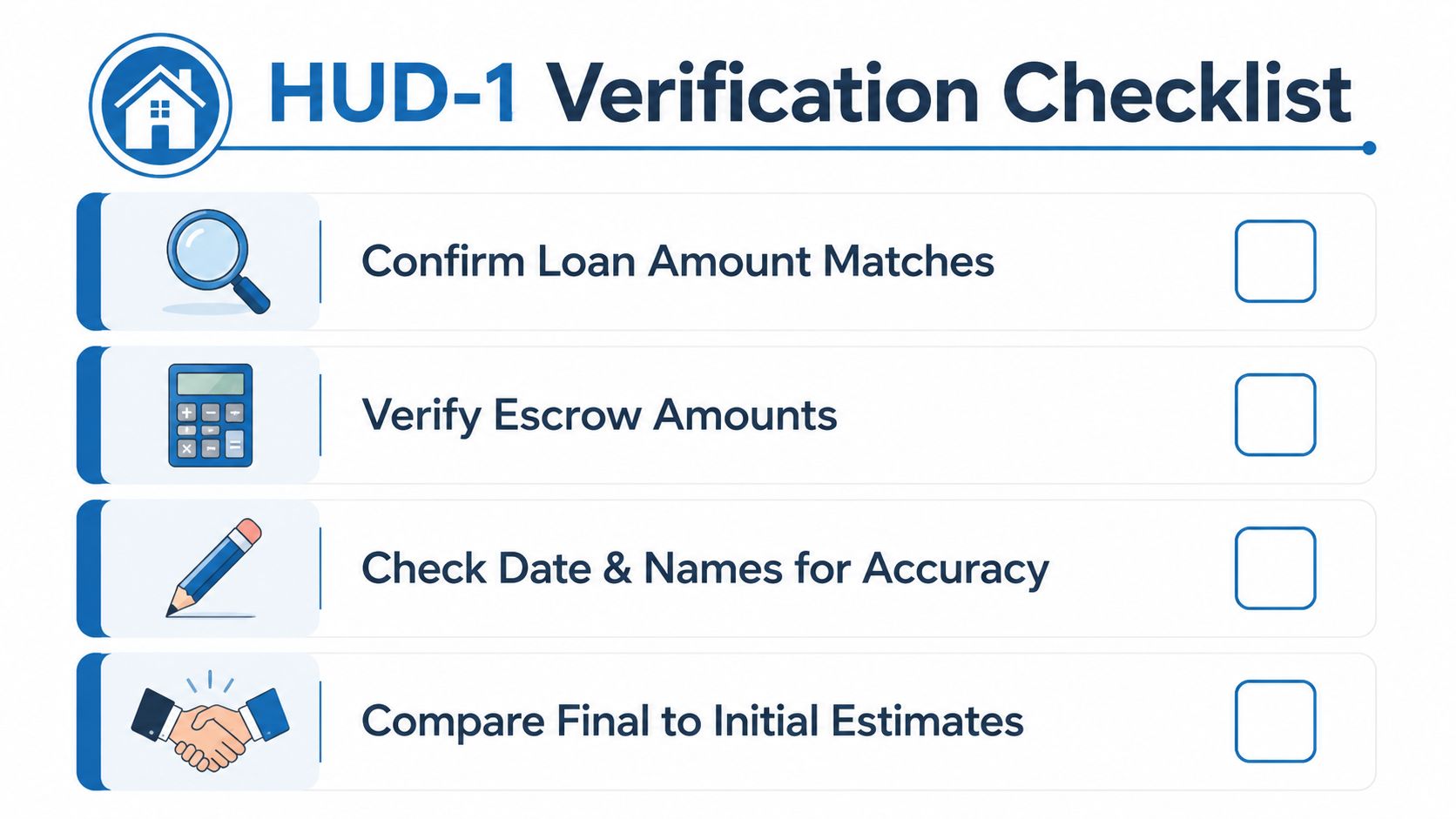
Start with the basic identifiers
Check the names, property address, and loan details at the top of page 1. Those fields should match the rest of your closing packet and the loan file. A wrong name or property line can create downstream confusion in the transaction, even if the dollar amounts look clean.
Then trace the money
Look for the buyer and seller summary sections, then follow the itemized charges that feed into them. The CFPB's layout shows how the totals from the detailed pages flow into the final cash-to-close amounts on page 1 CFPB form structure. That means you should verify the path, not just the endpoint.
Practical rule: A clean closing statement is one where every total can be traced back to a named charge, a numbered section, and a supporting document.
Use this checklist before you sign
- Confirm the loan amount. Make sure the loan figure matches the commitment and the rest of your lender packet.
- Verify escrow and prepaid items. Check that the amounts line up with how your account is being set up.
- Review seller credits. Make sure any agreed credits appear where they should in the buyer and seller summaries.
- Compare the estimate and the final form. Page 3 is where the earlier estimate comparison should highlight changes, so you can spot surprises before closing.
- Flag duplicates and odd labels. If the same-looking fee appears twice, or a charge has a vague name, ask for a written explanation.
If you want a closer look at how fee categories are organized, this title company fees reference can help you pressure-test what you're seeing. The goal is not to memorize every line. The goal is to make sure the final numbers are supported, consistent, and explainable.
Connecting Closing Data to Broader Property Intelligence
A HUD-1 is a single transaction record, but it sits inside a much larger property data picture. The loan amount, lien position, and title charges on the form connect to the ownership, mortgage, and historical records that lenders and investors use for underwriting and monitoring. When those records are organized well, one closing document becomes part of a broader decision system.
That broader system matters because property teams rarely care about a closing form in isolation. They care about what it signals about the asset, the borrower, and the trail of related records. If the settlement packet and the property file don't align, someone has to reconcile the difference, and that's where operational discipline starts to matter.
For teams managing sensitive financial records, digna's take on data observability is a useful reminder that accuracy depends on more than just storage, it depends on watching data quality as it moves. That principle shows up clearly in real estate workflows, where a closing document, a title record, and a loan record all need to tell the same story.
Batch-level property data platforms extend that logic across portfolios. A platform like BatchData organizes property records, ownership history, mortgage and lien details, and pre-foreclosure activity so operators can move from a single HUD-1 to portfolio-level intelligence. That's why tools that unify tax, assessment, and market signals are so useful, they let teams connect one closing to the rest of the asset lifecycle. For a practical example of closing-cost modeling, the taxes, title, and fees calculator shows how transaction inputs can be translated into usable decision support.
If you need to review closing documents, compare settlement details, or connect a HUD-1 to the larger property record, BatchData can help you work from the document level to the portfolio level without losing the thread. Visit BatchData to see how modern property data can support underwriting, due diligence, and transaction review with cleaner, faster access to the records behind the numbers.